Showing posts with label favorites - television. Show all posts

Sunday, December 28, 2025

Favorites of 2025: Movies and television

Television

For us this was an especially rich year for television series, beginning in May with PBS's Miss Austen, which also rounded out the Austen 250th anniversary year with its rebroadcast in November. In between we caught up on three series we'd missed the first go-round.

Miss Austen. Written by Andrea Gibb, based on the novel by Gill Hornby; directed by Aisling Walsh. Produced by BBC Studios and PBS Masterpiece, 4 episodes, 2025.

Keeley Hawes as Cassandra Austen in Miss Austen

Keeley Hawes (Cassandra Austen) in Miss Austen. Image credit: BBC. Image source: RadioTimes.com

Miss Austen is a wonderful, complex, historically-informed series that rewards repeated viewings. E&I favorite Keeley Hawes (featured in previous favorites Wives & Daughters (1999) and Tipping the Velvet (2002)) is the Miss Austen of the title, Jane Austen's older sister Cassandra. It's 1840, 23 years after Jane's premature death, and Cassandra's co-sister-in-law Eliza Lloyd Fowle (Madeline Walker) has died in possession of dozens of letters from Jane. Both Cassandra and her overbearing sister-in-law Mary Lloyd Austen (a wonderfully awful Jessica Hynes), Eliza's sister and the widow of Cassandra's brother James, arrive at the Fowle home to support Eliza's bereaved daughter Isabella (Rose Leslie)—but also in desperate competition to find the letters. Mary wants them as part of her research for a biography she's planning to write about James, while Cassandra dreads the prospect of Jane's witty and indiscreet private letters being published. [1]

Cast of Miss Austen

Rose Leslie (Isabella Fowle), Keeley Hawes (Cassandra Austen), Mirren Mack (the servant Dinah), and Jessica Hynes (Mary Lloyd Austen) in Miss Austen. Image credit: Robert Viglasky/BBC. Image source: RadioTimes.com

Spoiler alert, but not really: it's Cassandra who finds the letters and manages (despite several close calls) to conceal their discovery from the insistently inquisitive Mary. Re-reading them inspires in Cassandra memories of her engagement to Eliza's brother-in-law Tom Fowle (Calam Lynch), and his untimely death on a voyage to the West Indies (a real-life occurrence). It also brings back memories of Cassandra's life with Jane. A word has to be said about Patsy Ferran's vibrant embodiment of Jane: both the actress and the writing in these scenes are absolutely brilliant. Hers is by far the best portrayal of Jane we've seen, far surpassing those of Olivia Williams in the sour Miss Austen Regrets (BBC, 2007) and Anne Hathaway in the glamorized and falsified Becoming Jane (2007).

Cast of Miss Austen

Patsy Ferran (Jane Austen), Madeleine Walker (Eliza Fowle), Synnøve Karlsen (young Cassandra Austen), and Liv Hill (young Mary Lloyd) in Miss Austen. Image credit: Robert Viglasky/Bonnie Productions and PBS Masterpiece. Image source: TVinsider.com

Together, Hawes and the well-cast Synnøve Karlsen as her younger self give an immensely sympathetic portrayal of Cassandra, whose emotional wounds from the death of her fiancé and of Jane, and her sorrow at feeling unable to accept the love of the (fictional) suitor Henry Hobday (Max Irons), are freshly reopened by Jane's letters. The depiction of Cassandra is so touching, in fact, that we are lured into hoping that the wrong character will find the letters—because Cassandra's purpose in seeking them is to ensure that they can never be brought to light. Miss Austen enables us to see that act as one of love, as well as of destruction.

A sequel, Miss Austen Returns, based on Gill Hornby's novel The Elopement, has been announced from the same creative team, with Keeley Hawes reprising her role as Cassandra. We're very much looking forward to it—especially if Patsy Ferran also returns as Jane.

Fingersmith. Written by Peter Ransley, based on the novel by Sarah Waters; directed by Aisling Walsh. Produced by BBC Television, 3 episodes, 2005.

Still from Fingersmith

Elaine Cassidy (Maude Lily) and Sally Hawkins (Sue Trinker) in Fingersmith. Image credit: Aisling Walsh.

A con man nicknamed "Gentleman" (Rupert Evans) plots to cheat the sheltered heiress Maud Lily (Elaine Cassidy) out of her inheritance by marrying her, getting control of her money, and then committing her to an insane asylum. To further his scheme he recruits Sue Trinker (Sally Hawkins), an orphan raised as a thief in the slums of London, to go to work under a false identity as the heiress's maid. Sue is tasked with becoming Maud's confidante and advisor, and urging her to elope with Gentleman. Contrary to plan, she falls in love with the intended victim. But in Sarah Waters' twist-filled story, who will wind up betraying whom?

Everyone is perfectly suited to their roles. The locations evoke almost too viscerally the crowded slums of Victorian London and the decaying grandeur of the country estate of Maud's creepy guardian Uncle Christopher (Charles Dance). And Aisling Walsh's direction brings out many fleeting subtleties and nuances in the interactions among the characters. (A word of caution: the series, like the book, features some disturbing and violent scenes.) Brilliant work all around—but I recommend seeing it after you've read the book. For more on Waters' novel, please see the full-length review of Fingersmith, which was also one of my favorite books of 2025.

Hornblower. Written by Russell Lewis ("The Even Chance"), Mike Cullen ("The Examination for Lieutenant"), Patrick Harbinson ("The Duchess and the Devil"), Chris Ould ("The Frogs and the Lobsters"), T.R. Bowen ("Mutiny"), Ben Rostul ("Retribution"), Niall Leonard ("Loyalty"), and Stephen Churchett ("Duty"), based on the novels Mr. Midshipman Hornblower, Lieutenant Hornblower, and Hornblower and the Hotspur by C.S. Forester; directed by Andrew Grieve. Produced by ITV, 8 episodes, 1998–2003.

Ioan Gruffudd as Horatio Hornblower

Ioan Gruffudd as Horatio Hornblower. Image source: Into the Woods

While I gravitate to period literary dramas full of rustling muslin and subtle social and emotional nuance, my loving partner loves manly swashbuckling tales from the era of tall ships. (I'll leave it to the amateur psychologists among my readership to speculate about the reasons for our complementary tastes.) Hornblower stars Ioan Gruffudd (William Wilberforce in Amazing Grace) as Horatio Hornblower, who at the start of the first episode is a raw midshipman and by the end of the series has been promoted to post-captain. [2]

Gruffudd is surprisingly convincing as young midshipman (at 17 Hornblower is getting a late start—some of his peers would have already served onboard for five years), whom we gradually see mature and gain confidence as battle succeeds battle. He manages the action scenes with panache, although Hornblower is not your typical action hero: when ordered the climb the rigging on the heaving ship Hornblower's fear of heights and tendency to seasickness come to the fore. A regular presence is Hornblower's sometime commanding officer and mentor Captain Edward Pellew (Robert Lindsay), an all-too-rare example of both competence and decency in the hierarchy of the Royal Navy.

Still from Hornblower Loyalty

Still from Hornblower: Loyalty (2003), showing the realism of the series' sailing ships and armaments. Image source: Internet Movie Firearms Database.

The episodes feature Hornblower in action against the French during the Napoleonic wars. But the films don't only show us broadsides and boardings, the brutality of naval close combat in the early 19th century. They also portray the daily indignities of life on board crowded ships with no privacy, the constant jockeying for position and testing of authority among the men, and the sheer difficulties of navigating and maneuvering ships entirely dependent on the power of the wind. The sailing and battle scenes are generally well-filmed, detailed and vividly realistic.

Still from Hornblower Loyalty

Still from Hornblower: Loyalty (2003): Greg Wise as loyalist Major Andre Côtard in the foreground. Image source: Internet Movie Firearms Database.

If you liked the movie Master and Commander: The Far Side of the World (2003, based on two Patrick O'Brien novels), the Hornblower series is 13+ hours of similarly perilous situations, hair-breadth escapes, and pitched ship-to-ship battles whose outcomes depend as much on wit and skill as on sheer firepower.

Agatha Christie's Poirot. Written by Clive Exton ("The Mysterious Affair at Styles," S3.E1, "The Murder of Roger Ackroyd," S7.E1, and "Murder in Mesopotamia," S8.E2), Anthony Horowitz ("Hickory Dickory Dock," S6.E2, "Lord Edgeware Dies," S7.E2, and "Evil Under the Sun," S8.E1), Kevin Elyot ("Death on the Nile," S9.E1), and others, based on the novels of Agatha Christie. Directed by Edward Bennett (10 episodes), Renny Rye (9 episodes), Andrew Grieve (9 episodes), Brian Farnham (6 episodes), and others. Produced by ITV, 1989–2013.

David Suchet as Hercule Poirot

David Suchet as Hercule Poirot. Image source: Virtual-History.com

There are 70 (!) episodes of Agatha Christie's Poirot, starring David Suchet as the eponymous Belgian detective hero of Christie's first novel, the locked-room country house mystery The Mysterious Affair at Styles, and many subsequent novels and stories. My loving partner and I must have been among the last people on the planet who hadn't yet seen an episode. And so far we've only managed to see seven episodes scattered over five seasons; clearly we have some catching up to do. But we've been struck by the attention to period detail in the costumes and settings—every episode we've seen has been gorgeous to look at—and by how skillfully David Suchet renders Poirot as a multidimensional character, not just a collection of impeccable suits, behavioral quirks and catchphrases.

Honorable mention, Jane Austen division

Death Comes to Pemberley. Written by Juliette Towhidi, based on the novel by P.D. James after characters from Jane Austen's Pride and Prejudice; directed by Daniel Percival. Produced by BBC Drama Productions and PBS Masterpiece, 3 episodes, 2013.

Anna Maxwell Martin as Elizabeth Bennet

Anna Maxwell Martin as Elizabeth Darcy in Death Comes to Pemberley. Image credit: Daniel Percival.

Jane Austen famously has little to say about what happens to her heroines and heroes after they marry in the final pages of her novels. In Pride and Prejudice we hear about many other characters' reactions, but of Elizabeth and Darcy very little. Elizabeth does write to her aunt Mrs. Gardiner after her engagement and before her marriage, "I am the happiest creature in the world. Perhaps other people have said so before, but no one with such justice" (Ch. LX).

Faced with only vague accounts of the couple's post-wedding felicity, multiple authors have been unable to resist the temptation to carry the story forward. In her 2011 novel which is the basis of this three-episode 2013 BBC series, P.D. James concocts a murder mystery that takes place roughly six years after the events of Pride and Prejudice. The scoundrel George Wickham is the prime suspect (of course!), but as we might guess from time-honored mystery conventions, the character found kneeling next to the still-warm corpse crying out "I killed him, I killed him!" is rarely the true culprit.

Jenna Coleman as Lydia Wickham

Jenna Coleman as Lydia Bennet Wickham.

On the plus side, Jenna Coleman, who plays the young Queen Victoria in the excellent ITV series Victoria (2016-19), is delightful in the role of the pleasure-loving flirt Lydia Wickham. Matthew Goode nicely suggests Wickham's highly mixed character, nine parts blackguard to one part brave soldier with his own peculiar sense of honor (which evidently does not extend to women). And of course the costumes, sets and locations provide copious eye-candy, along with visual allusions to the brilliant 1995 BBC adaptation of Pride and Prejudice starring Jennifer Ehle as Elizabeth and Colin Firth as Darcy. As Darcy in Death Comes to Pemberley, Matthew Rhys is directed to assume the taciturn, glowering, haughty character of Darcy's first appearance in Pride and Prejudice, rather than the kinder, gentler Darcy that six years of marital bliss with Elizabeth would surely have produced.

Juliette Towhidi's script is filled with un-Austenesque language, and the story involves multiple implausibilities and incongruities. So the series satisfies neither as a continuation of Pride and Prejudice nor as a mystery. The main reason to watch is E&I favorite Anna Maxwell Martin's excellent performance as Elizabeth Bennet Darcy; whether her performance will outweigh the series' many annoyances will depend on the viewer. For more, please see the full-length review of Death Comes to Pemberley.

Mansfield Park. Written by Ken Taylor, based on the novel by Jane Austen; directed by David Giles. Produced by BBC Television, 6 episodes, 1983.

Sylvestra Le Touzel as Fanny Price

Sylvestra Le Touzel as Fanny Price in Mansfield Park. Image source: Jane Austen Reviews

From the update to Six months with Jane Austen: Favorite adaptations and final thoughts:

This adaptation is far from perfect. The annoying music by composer Derek Bourgeois that plays during the opening and closing titles is far out of period—it sounds like it dates from eight or nine decades after the time in which the novel is set. As with other BBC series of the era it was shot on video, and so the image is soft-grained and flattened. And despite the five-hour running time, the conclusion feels rushed: we cut too quickly from Edmund Bertram's revelation of Mary Crawford's worldly principles to his wondering "whether a very different type of woman might not do just as well—or a great deal better." The delicious comedy of Austen's final chapter—"I purposely abstain from dates on this occasion, that every one may be at liberty to fix their own, aware that the cure of unconquerable passions, and the transfer of unchanging attachments, must vary much as to time in different people"—is, alas, missing.

But otherwise the dramatization by Ken Taylor is very faithful to the novel, with large chunks of the dialogue coming straight from Austen. Sylvestra Le Touzel, familiar from many later roles (including Amazing Grace and my favorite adaptation of Northanger Abbey), plausibly looks Fanny Price's age (18 at the end of the novel), and credibly expresses her mix of social timidity and moral strength—although perhaps she is directed to convey wide-eyed panic once or twice too often. Nicholas Farrell is an ideal Edmund; we can believe him principled, and yet subject to temptation against his better judgment. The other actors' performances are good across the board. Special honors from this viewer go to Anna Massey as a wonderfully horrible Mrs. Norris, and to Jackie Smith-Wood as the flirtatious and harp-playing Mary Crawford.

Movies

This was a year when we spent most of our viewing time with television series or streamed operas and concerts. Of the few movies we saw for the first time (as opposed to rewatching), none quite rose to the status of a favorite, and only one merited an honorable mention (see below). But there was one memorable film rewatch event that surprised and delighted in equal measure:

Clueless. Written and directed by Amy Heckerling, based on Emma by Jane Austen, 1995.

Still from Clueless

Brittany Murphy as Tai (Harriet Smith), Alicia Silverstone as Cher (Emma), and Stacy Dash as Dionne in Clueless. Image source: TVinsider.com

This July marked the 30th anniversary of the release of Amy Heckerling's high school comedy Clueless, an occasion that inspired a Jane Austen Society of North America watch party at which Heckerling was an honored guest.

In the film Cher (Alicia Silverstone) is the glamorous queen bee of Bronson Alcott High School. She spends her time organizing the social lives of her friends, and her special project is the new girl Tai (Brittany Murphy). Although Cher generally keeps boys at a distance, when a handsome and stylish new guy appears, Christian (Justin Walker), she finds herself unexpectedly becoming attracted to him. Meanwhile, Cher's sardonic stepbrother Josh (Paul Rudd) finds fault with everything she does. Any resemblance to Emma Woodhouse, Harriet Smith, Frank Churchill, and Mr. Knightley in Austen's Emma is purely intentional.

I confess that the first time I saw Clueless, about two decades after its release and more than three decades after I'd graduated from high school, I felt I'd waited too long to see it; I later wrote that "I liked this movie less than I was expecting to." I found some of the humor crude or slapsticky (it is, of course, a high school comedy), and felt like I'd long ago aged out of its target audience.

But the watch party, with running chat commentary by hundreds of JASNA members attuned to every Emma allusion, was thoroughly (or "Totally!", as Cher might say) enjoyable and enabled me to see the film with renewed appreciation. I updated Six months with Jane Austen: Favorite adaptations and final thoughts, "After a Jane Austen Society of North America Clueless watch party today, I find I have to upgrade my estimation of this movie. Cher is a wonderful comic creation, delightfully portrayed by Alicia Silverstone. She's not exactly Emma, but there are many clever parallels to scenes from the book. (And some equally clever divergences: Christian is concealing a different sort of romantic secret than Frank Churchill.) Heckerling's script includes some priceless, laugh-out-loud lines, and the film just glows thanks to her direction and Bill Pope's cinematography. I'm glad I gave it a second chance."

Honorable mention

Amazing Grace. Written by Steven Knight; directed by Michael Apted, 2006.

Ioan Gruffudd as William Wilberforce in Amazing Grace

Ioan Gruffudd as William Wilberforce in Amazing Grace. Image credit: Michael Apted.

This film is a well-intentioned portrayal of the role of William Wilberforce (Ioan Gruffudd of Hornblower) in the struggle to end the British slave trade in the late 18th and early 19th centuries. It has an amazing cast, with costume designs and hair or wig styles often directly modelled on paintings of the historical figures they are portraying.

But as I wrote in my full-length review of Amazing Grace, "despite the excellence signalled by the director [Michael Apted of the Up documentary series] and cast, as well as the evident care taken with many of the costumes and settings, the screenplay by Steven Knight (Dirty Pretty Things (2002)) undermines the entire enterprise. It simplifies, and at times falsifies, the complex history of abolition in Britain. . .[The] social background to Wilberforce's actions is largely absent, and several important figures, such as the advocate Granville Sharp, the poet William Cowper, and the former slave Ignatius Sancho, are missing entirely. Other major abolitionists such as Thomas Clarkson [Rufus Sewell] and Olaudah Equiano [Youssou N'Dour] are given merely supporting roles. . .Perhaps only someone such as Ken Loach or Mike Leigh (writer and director of Peterloo (2018)) could do greater justice to the complexity of the movement for abolition and the failings, inconsistencies, and conflicts, as well as the courage and rectitude, of those who ultimately brought an end to British slavery."

Other favorites of 2025:


  1. The family trees in Deirdre Le Faye's Jane Austen: A Family Record, Second Edition (Cambridge, 2004, "Family pedigrees," [pp. 345–355]), were of immense help in figuring out all the characters and their relation(s) to one another. "Family pedigrees," though, makes the Austens and their relatives sound like dogs or horses.
  2. C.S. Forester wrote a dozen or so Hornblower titles, which follow Hornblower up the command chain to admiral. Hornblower's career is modelled loosely on that of Lord Horatio Nelson, hero of Trafalgar. 

Friday, November 29, 2024

Favorites of 2024: Movies and television

Print of The sleep of reason produces monsters by Francisco Goya

"The sleep of reason produces monsters," Plate 43 of Los Caprichos by Francisco Goya, 1799. Image source: History of Medicine Division, US National Library of Medicine.

Favorite movies seen in 2024

In a year full of horrors with no end in sight, we gravitated towards disturbing, unsettling movies that seemed to capture the foreboding spirit of the times.

Vampyr (1932), screenplay by Christen Jul and Carl Theodor Dreyer; directed by Dreyer.

Image source: carlthdreyer.dk

A traveler, Allan Gray (Julian West), arrives at a remote chateau-turned-hotel in what seems to be an almost deserted village. He is surrounded by an atmosphere of uncertainty and fear, and becomes convinced that the innkeeper's youngest daughter (Sybille Schmitz) is the victim of a vampire. Events unfold with the logic of a nightmare; in the film's most horrifying sequence, Gray is sealed in a glass-fronted coffin and witnesses his own burial. Director Carl-Theodor Dreyer wrote, "With Vampyr I wanted to create a waking dream on the screen and show that horror is not to be found in the things around us but in our own subconscious."

Thanks to some dear friends, we saw this film in a restored print with the live orchestral accompaniment of Wolfgang Zeller's original score performed by the SF Conservatory of Music Orchestra conducted by Timothy Brock. For my full-length review, please see "A waking dream": Carl Theodor Dreyer's Vampyr.

Poor Things (2023), screenplay by Tony McNamara, based on the novel by Alasdair Gray; directed by Yorgos Lanthimos.

Poor Things film poster

Poster for Poor Things. Image source: CelebMafia.com

A kind of postmodern Bride of Frankenstein, Poor Things is the story of a young suicide victim reanimated when she receives a transplant of her own unborn child's brain. Naïve and (literally) childlike, Bella (Emma Stone) soon attains the "bitter knowledge of deceit, injustice, and cruelty: the immense suffering that humans, and the social and economic systems we've created, cause other humans." For my full-length review, please see Poor Things.

The Prime of Miss Jean Brodie (1969), screenplay by Jay Presson Allen, adapted from her play based on Muriel Spark's 1961 novel; directed by Ronald Neame.

Film still of Maggie Smith as Miss Jean Brodie

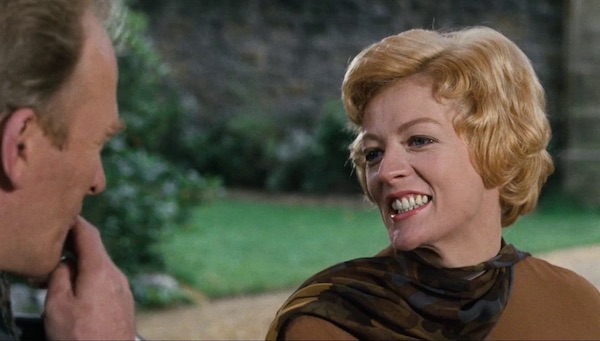
Maggie Smith as Miss Jean Brodie.

Jean Brodie (Maggie Smith) is a charismatic teacher in a girls' school in Edinburgh in the early 1930s. She tries to instill in her charges her own admiration for all things Italian: its Renaissance art, its food—and its dictator, Benito Mussolini. She herself is a kind of classroom dictator, anointing favorites from among her students and playing manipulative emotional games. She fights furiously against anything that threatens her self-image or her position at the school, even if it's her own happiness. The film shows how fascism and cruelty are perpetuated not only in our political but our personal lives. When teeth are bared is it a smile, or a snarl?

Gordon Jackson as Gordon Lowther and Maggie Smith as Miss Jean Brodie.

Maggie Smith died on 27 September of this year. The Prime of Miss Jean Brodie was her 11th film, and it made her an international star. And rightly so—her performance of the imperious, magnetic, troubled teacher is indelible. But there are other compelling performances in the film as well. The first is by Celia Johnson (of the great Brief Encounter (1945)) as the school's headmistress, Miss Mackay, who has increasing misgivings about Miss Brodie's sway over her "girls" and her power in the school. And the second is by Pamela Franklin as the watchful Sandy, one of Miss Brodie's favorites, who like the others not only wants to be like her, but wants to be her. She becomes aware too late of the moral compromises that will entail.

Pamela Franklin as Sandy and Maggie Smith as Miss Jean Brodie.

Franklin, 18 at the time of filming, gives a performance that is assured, daring, and deeply disconcerting. Young as Franklin was, The Prime of Miss Jean Brodie was not her first major film role. Eight years earlier she had starred in another milestone of British cinema:

The Innocents (1961), screenplay by Truman Capote with William Archibald and John Mortimer after the novella The Turn of the Screw by Henry James; directed by Jack Clayton.

Deborah Kerr as Miss Giddens and Peter Wyngarde as Peter Quint. Image source: Silver Sirens

Perhaps the best Hitchcock film not directed by Hitchcock, The Innocents creates an atmosphere of mounting suspense and dread. An inexperienced young governess, Miss Giddens (Deborah Kerr), accepts a position caring for two orphaned children at a remote country estate. She is welcomed by the sympathetic housekeeper Mrs. Grose (Megs Jenkins), and finds 10-year-old Flora (Pamela Franklin) to be sweet and charming.

They are soon joined by 11-year-old Miles, who has been expelled from boarding school for bad behavior (we don't learn the specifics; the headmaster simply writes that "he is an injury to the others"). After Miles' arrival, the governess begins to see ghostly apparitions of a man and a woman. She learns that they must be Peter Quint (Peter Wyngarde), a valet, and Miss Jessel (Clytie Jessop), the former governess, both of whom died within the past year. In life, the two were secretly lovers; are the spirits of the dead trying to possess and corrupt the children? Or are the strange visions and sounds all in the governess's mind? The film never allows us to decide what is real and what is her dark fantasy; whatever the case, horrifying consequences result.

https://youtu.be/muz-0gY5RtM [song ends at 1:03]

The eerie "O Willow Waly," from the opening credits of The Innocents. Although it sounds like a old English folksong, it was composed for the film by Georges Auric with lyrics by Paul Dehn. This performance is generally credited to Isla Cameron, the Scottish folk singer and actress who plays Anna in the film. However, Cameron was 34 years old at the time and often sang with a distinct Scots accent; could this voice belong to an uncredited Pamela Franklin?

Favorite television series seen in 2024

Mr Bates vs the Post Office (4 episodes, 2024), screenplay by Gwyneth Hughes; directed by James Strong.

The cast of Mr Bates vs the Post Office (Toby Jones, center). Photo credit: ITV Plc. Image source: New Stateman

In 1998 Alan Bates (played by Toby Jones) and his partner Suzanne Sercombe (Julie Hesmondhalgh) invested £65,000 of their life savings in a post office in a town on the Welsh coast. Two years later the Post Office implemented a new automated sales and accounting system, Horizon. Almost immediately huge financial discrepancies appeared: in the first couple of months Horizon reported an erroneous £6,000 deficit in their accounts. Like other subpostmasters Alan and Suzanne were contractually liable for making up any shortfalls. Although they submitted nearly a hundred complaints about the reliability of the system, no investigation of Horizon took place; instead, Bates was told that no other post office had reported any problems. Alan and Suzanne's contract with the Post Office was terminated in 2003, and they lost their investment.

Bates started a campaign, seeking other subpostmasters who had experienced problems with Horizon. After setting up a website and receiving some publicity about his case, in 2009 he called a meeting of subpostmasters affected by Horizon discrepancies. More than twenty people showed up; all had been told that no one else had reported any problems. Many of those attending had been subject to unjust prosecution for theft and fraud by the Post Office. Ultimately it turned out that there were hundreds of subpostmaster victims. Huge judgments had been assessed, people bankrupted, prison terms served and lives ruined. Meanwhile the Post Office stonewalled or tried to coopt all complaints and investigations. Screenwriter Gwyneth Hughes brings her skills as a former journalist and documentary filmmaker to the dramatic retelling of this multifaceted story, and the ensemble cast led by Jones does a superb job of embodying the disbelief, anguish, and growing anger experienced by these ordinary people.

When this series was broadcast earlier this year on Britain's ITV network it finally brought broad public attention to the flaws in the Horizon system and the persecution of the subpostmasters. Thanks to the public outcry cases are being revisited, some compensation paid, and the former head of the Post Office was shamed into returning her CBE. But that does not make up for the devastation of hundreds of lives and the decades the subpostmasters have had to spend pursuing justice. And as our financial transactions, power grids, 911 call centers, oil pipelines, elections, and other essential services become ever more dependent on electronic systems, we should all be very concerned about their vulnerabilities. Mr Bates vs the Post Office is not a feel-good story, but an urgent warning.

Your Lie in April (22 episodes, 2014–15), screenplay by Takao Yoshioka, adapted from the manga series by Naoshi Arakawa; directed by Kyōhei Ishiguro.

Kaori and Kōsei in Your Lie in April. Image source: justfocus.fr

Teenaged pianist Kōsei Arima has been drilled from childhood into becoming a technically flawless competition-winning machine. But when his demanding mother dies, he loses his ability to hear his own playing. Then Kōsei meets free-spirited violinist Kaori Miyazono, who chooses him to be her musical partner despite his struggles. For Kaori, playing from the heart is more important than winning competitions. Her approach inspires Kōsei to free himself from the crushing burden of his mother's expectations and find his own authentic musical voice. He finds himself falling in love with Kaori—but heartbreak awaits.

Your Lie in April incorporates many time-honored elements of teen stories: the manic pixie dream girl who sweeps the socially awkward hero off his feet, the tomboy secretly in love with her oblivious best friend, tragic events that threaten newfound friendships. But the series avoids formula through the quality of Takao Yoshioka's writing, the striking animation and Kyōhei Ishiguro's fluid direction. I found it to be engaging and unexpectedly moving; many thanks to the relative who thought (correctly) that we would greatly enjoy it.

My Favorites of 2024:

Saturday, December 17, 2022

Favorites of 2022: Movies and television

Rosaleen (Sarah Patterson) and Granny (Angela Lansbury) in The Company of Wolves. Image source: CBS News

Given the flow and ebb and flow of COVID cases and the couldn't-care-less approach to mask-wearing that has become widespread (and, no doubt, is spreading widely), we're not going back to movie theaters for the foreseeable future. The only other way to see current movies (as well as most television series) is to subscribe to streaming platforms, which we also don't do. DVD releases are delayed (often, it seems, permanently), and so it's becoming harder and harder for us to see films released in the past twelve months. 

Public libraries have come to the rescue (as they so often do) by providing some current offerings through services such as Kanopy and Hoopla. But for those of us still wedded to physical media these are rich days for hunting, as people dump their (or their parents') collections. So, as I've been picking up DVDs for a song at various sales, the past year for us has been one largely of rediscovery. In previous Favorites lists I have focussed almost exclusively on movies and television shows viewed for the first time in the past 12 months, but for 2022 that would leave me with a list only a few items long. So this year I am listing my favorite viewing over the past twelve months, whether it was a watch or a rewatch, ordered chronologically. Two of the films that made my list, The Company of Wolves and Goodfellas, were rewatched in tribute to actors who sadly passed away in 2022, Angela Lansbury and Ray Liotta.

MOVIES

City Lights (1931). Starring Charlie Chaplin, Virginia Cherrill, and Harry Myers; written, directed, and score composed by Charlie Chaplin. (First seen in the early 1980s.)

Perhaps this is a film that needs no recommendation. It is #36 on the just-announced 2022 Sight and Sound poll of the greatest films of all time, and #11 on the 2007 version of the American Film Institute's "100 Years. . .100 movies" list (up from #76 on the 1998 poll, just behind (egad) Dances with Wolves). In case you somehow haven't seen it yet, the plot is simple, but describing it doesn't capture what makes the film so affecting.

Chaplin's Tramp saves a rich drunkard (Harry Myers) from suicide, and is befriended by him—at least, whenever he's drunk. When he sobers up, he no longer recognizes the Tramp and kicks him out of his house. One day on the street the Tramp encounters a blind flower girl (Virginia Cherrill), who mistakes him for a rich man; the Tramp falls in love. From these two threads Chaplin weaves an emotionally rich tapestry full of ironic contrasts: the selfish rich and the generous poor; the sighted who avoid seeing the suffering all about them, and the sightless who perceive it all too clearly. The film ends with one of the most pathos-filled scenes in cinema; if you can watch it with dry eyes, you are made of stronger stuff than I am.

https://www.youtube.com/watch?v=9cZxD-ihzmk

The Company of Wolves (1984). Starring Sarah Patterson and Angela Lansbury; written by Angela Carter and Neil Jordan, based on Carter's short story "The Company of Wolves" from The Bloody Chamber and other adult tales (1979); directed by Jordan. (First seen in 1984.)

The Company of Wolves, like the Arabian Nights, nests stories within stories. Rosaleen (Sarah Patterson), a girl on the brink of adulthood, falls asleep and dreams a series of fearful fairy tales recounted by her superstitious grandmother (Angela Lansbury). Her grandmother warns Rosaleen of the beasts that lurk within men, and the danger of straying from the path. But Rosaleen's mother (Tusse Silberg) assures her, "If there's a beast in men, it meets its match in women too." And what if Red Riding Hood encounters a devilishly handsome wolf. . .?

https://www.youtube.com/watch?v=lwXImpudjvU

GoodFellas (1990). Starring Ray Liotta, Joe Pesci, and Robert De Niro; written by Nicholas Pileggi and Martin Scorsese, based on Pileggi's book Wiseguy; directed by Scorsese. (First seen in 1990.)

Speaking of devilishly handsome wolves, Ray Liotta gives one of the best performances of his career as Henry Hill, a mobster who can never become a "made man" because of his Irish, rather than Sicilian, origins. Liotta somehow makes Hill—a brutal, mercenary opportunist—an appealing figure. We watch him slowly rise through the ranks, a career made perilous not only because he could be arrested at any moment, but also because his own compatriots in the mob might turn against him at any time. The "Do you think I'm funny?" scene, where Hill laughs at a story being told by Joe Pesci's psychotic gangster Tommy DeVito, only for the mood to change in an instant to one of deadly seriousness, is chilling.

Would it be heresy to say that Goodfellas is Scorsese's best film? The 2022 Sight and Sound poll thinks that honor belongs to Taxi Driver (1976, #29), which is certainly memorable, and the 2007 version of AFI's "100 Years. . .100 movies" list thinks it's Raging Bull (1980, #4). But when contemplating another rewatch I think I would reach for Goodfellas instead of either of those more critically acclaimed films. 

https://www.youtube.com/watch?v=2ilzidi_J8Q

Honorable Mention:

Bad Education (2004). Starring Gael García Bernal, Fele Martínez, and Daniel Giménez Cacho; written and directed by Pedro Almodóvar. (First seen in 2022.)

Drawing on elements of film noir, Almodóvar's Bad Education is filled with twists, turns, assumed identities, and obsession. Enrique (Fele Martínez), a film director looking for a new project, receives a visit from Ignacio (Gael García Bernal), an actor looking for work. Ignacio claims to be Enrique's first lover. The two met in boarding school and began a clandestine relationship, but were separated when Ignacio was expelled; they haven't seen each other since. Ignacio, now a transgender woman, has written a story entitled "The Visit," which he wants Enrique to make into a movie with himself as the star. "The Visit" details Ignacio's molestation at boarding school by a priest, Father Manolo (Daniel Giménez Cacho), and his attempt as an adult to blackmail the priest for the money for gender-reassignment surgery. But despite Ignacio's intimate knowledge of Enrique's past, is he really who he claims to be? 

Bad Education echoes aspects of classic films noir such as Out of the Past (1947) and Vertigo (1958). But for me the film it most closely resembles is the neo-noir Mulholland Drive (2001). As in David Lynch's film, in Bad Education there are so many layers of fictionality that it can become unclear in which narrative a scene is taking place, whether in the frame story, "The Visit," or in the film that Enrique ultimately makes (and that we, evidently, are watching). Immediately after seeing the film my partner and I discovered that we had very different interpretations of certain scenes. A movie that probably needs to be rewatched several times to untangle.

https://www.youtube.com/watch?v=vLZuzDSYS74

Documentary:

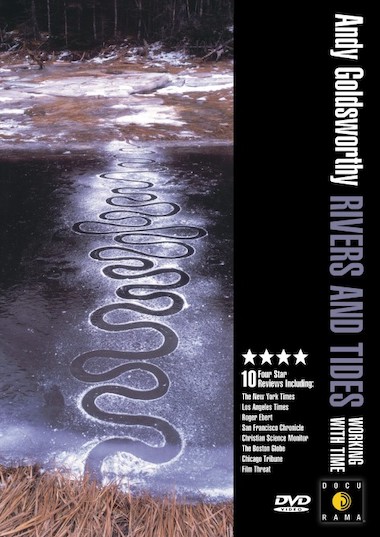
Andy Goldsworthy: Rivers and Tides: Working with Time (2004). Directed by Thomas Riedelsheimer. (First seen in 2004.)

A fascinating look at the artist Andy Goldsworthy, who makes site-specific works entirely of found natural materials. We see Goldsworthy painstakingly creating both small-scale, ephemeral works, such as his icicle sculptures, as well as large-scale permanent installations such as his mortarless serpentine rock walls. Rivers and Tides, by allowing us to follow Goldsworthy's intricate process and by capturing both the creation and (often) disintegration of his environmental pieces, is a truer representation of his art than still photographs. Essential viewing if you are interested in art, or nature.

https://www.youtube.com/watch?v=2pET5lN4vZc

Poly Styrene: I Am a Cliché (2021). Written by Celeste Bell, Paul Sng, and Zoe Howe; directed by Bell and Sng. (First seen in 2022.)

In my 2011 memorial post on Poly Styrene I wrote that "as a teenager she was the lead singer and songwriter for one of the best punk bands ever, X-Ray Spex. She was a nonconformist even among the rebels and misfits of punk rock: she was short, wore braces, wasn't rail-thin, designed her own clothes (often in bright colors, an anomaly in punk), and was multi-racial. She was smart, wickedly funny (her lyrics are great), and absolutely electrifying onstage. Her voice was and will remain unforgettable."

I Am a Cliché (named after the title of the B-side of X-Ray Spex's first single, "Oh Bondage, Up Yours!") is a biographical documentary made by Poly Styrene's daughter Celeste Bell and collaborators. It's an attempt to come to terms with her mother's legacy: her brief period of notoriety with her band X-Ray Spex, followed by decades during which she was a Hare Krishna devotée and struggled with bipolar disorder. A compelling film on multiple levels, it adds another dimension to the excellent Dayglo: The Poly Styrene Story, one of my Favorites of 2022: Books.

https://www.youtube.com/watch?v=stXSFuUOdeU

TELEVISION

Gentleman Jack (2019-22). Starring Suranne Jones, Sophie Rundle, and Gemma Jones; created by Sally Wainwright, based on the books Gentleman Jack: The Real Anne Lister by Anne Choma, and Female Fortune: Land, Gender and Authority: The Anne Lister Diaries and Other Writings, 1833–1836 by Jill Liddington. (First seen in 2022.)

Gentleman Jack dramatizes four key years in the life of Anne Lister (Suranne Jones), a Yorkshire estate owner whose coded diaries, once deciphered, revealed her sexual relationships with many of the single and married women of her acquaintance. Over the period covered by the series, Anne returns to her estate, Shibden Hall; meets, seduces, and makes a symbolic marriage with a local heiress, Ann Walker (Sophie Rundle); and struggles against the suspicions of Ann's relatives and the hostility of their neighbors.

The series follows fairly closely what we know of Anne's life (and thanks to her diaries, that's a great deal), although it does add a number of unnecessary subplots in an attempt to heighten "dramatic interest," especially in Season 1; as the producers ultimately realized, Anne's story is fascinating enough by itself. I wrote in "No historical interest whatever: Anne Lister, part 6" that "a key reason to watch the show is the performance of Suranne Jones as Anne, who, naturally enough, is in virtually every scene of every episode. Unafraid to be unsympathetic (although the character softens a bit as the series progresses), Jones is an arresting presence onscreen. It's unfortunate that it looks as though Season 2 will be the last opportunity to see her dynamic portrayal of Anne Lister; in June it was announced that HBO would not renew Gentleman Jack."

https://www.youtube.com/watch?v=-uBYRcP44M4

Honorable mention:

The Best of Thunderbirds (1965-66). Created by Gerry and Sylvia Anderson. (First seen a long time ago.)

"Thunderbirds are Go!" A product of the techno-optimism of the 1960s, the puppet series Thunderbirds ("Filmed in Videcolor and Supermarionation") mesmerized me as a young boy. Now that I'm a few years older, I am still amazed by the lavish detail of the sets, props, and special effects.

The immensely wealthy former astronaut Jeff Tracy has created the International Rescue team with his five sons Scott, Virgil, Alan, Gordon, and John (any resemblance to the Mercury 7 astronauts Scott Carpenter, Virgil Grissom, Alan Shepherd, Gordon Cooper, and John Glenn is purely intentional). From their private Tracy Island in the South Pacific (um, isn't the South Pacific the farthest point on average from everyone on Earth?), International Rescue launches its fleet of Thunderbird machines—a swing-wing rocket plane (Thunderbird 1), a huge cargo plane (Thunderbird 2), a rocket (Thunderbird 3), and a submersible (Thunderbird 4)—whenever danger threatens. Their actions are coordinated by Thunderbird 5, a space station usually manned by John.

Of course, we're in a future world where, for example, Jeff thinks nothing of launching Thunderbird 3 to send Alan's girlfriend Tin-Tin to meet him Paris for the weekend (in the James-Bond-like episode "The Perils of Penelope"), and passenger airliners are powered by nuclear reactors ("Trapped in the Sky"). (My partner and I couldn't help wincing at the huge environmental impact of International Rescue.) Some of the episodes seem, in retrospect, eerily prescient: in "Sun Probe" a crew of solarnauts loses control of their ship and plummets helplessly into the sun, anticipating the Apollo 13 accident; and in "Terror in New York City" the Empire State Building collapses, a pre-echo of the destruction of the World Trade Center. If you can overlook the Orientalist tropes—one of the main villains in the series is Hood, a criminal mastermind with a Malaysian lair—the series can be enjoyed for its sophisticated, film-like mise-en-scène, pre-CGI props and special effects, and technologically preposterous storylines.

Should you be interested in seeing the original of Trey Parker and Matt Stone's parody Team America: World Police (2004), the entire Thunderbirds series is available on YouTube, "free with ads."

Other Favorites of 2022:

Saturday, December 21, 2019

Favorites of 2010-2019: Movies and TV

The pop culture critic's existential crisis: who writes the roundup of the end-of-the-year rounduos

Cartoon by E. Black (caption slightly modified). Image source: New Yorker

It's been ten years since I began posting my year-end lists of the favorite movies, TV, music, live performances and books I experienced in the previous 12 months. Over the past decade I listed 35 narrative films from countries other than India, 27 films from India, 15 documentaries, 18 TV series, 49 recordings, 57 live performances, 39 works of fiction, and 32 works of non-fiction.

While I tend to be more interested in planning my next adventure than in reviewing past pleasures, I've gone back through all of the favorites lists of the past decade to nominate my favorites of the favorites, 2010-19.

One friend calls my lists "idiosyncratic." I'm sure it was meant kindly, but in fact it's the entire point. These are not intended to be "best-of" lists, nor are they driven by the commercial considerations that motivate most year-end listmaking. The movies, music, books, etc., that make my favorites lists are simply those I found most personally engaging in the previous year, whenever the works themselves were produced. They can be a universally acclaimed masterpiece, a hidden gem, or just something that perfectly matched my mood at the time. Your tastes may (and probably will, and probably should) vary.

NARRATIVE FILMS

Fully half of my ten favorite narrative films seen in the past decade are in languages other than English (and as usual Indian films are in their own category), and eight were produced more than half a century ago. Just missing the list: Her (2013), Mysteries of Lisbon (2010), and Today's Special (2009). Apologies to Jean Arthur, René Clair and Ernst Lubitsch, who were limited to one film apiece: otherwise Too Many Husbands (1940), Sous les toits de Paris (1930), and One Hour With You (1932) would also have been included.

À nous la liberté (Give us freedom! 1931): René Clair's great comic masterpiece, in which two free spirits try to escape the conformist, coercive worlds of prison, work and school.

Still from Trouble in Paradise

Trouble in Paradise (1932): "The Lubitsch touch"—witty, sophisticated comedy—is brought to a peak of perfection in this classic pre-Code romantic triangle.

Libeled Lady

Libeled Lady (1936): Speaking of witty and sophisticated comedy, it's delivered here with sparkling timing by a quartet of glamorous stars: Jean Harlow, Spencer Tracy, William Powell and a luminous Myrna Loy.

Still from Remember the Night

Remember the Night (1940): Four years before they appeared as the fatally attracted couple in Billy Wilder's classic Double Indemnity, Fred MacMurray and Barbara Stanwyck co-starred in this compelling Preston Sturges-penned Christmas noir.

The Devil and Miss Jones

The Devil and Miss Jones (1941): One of the best of Jean Arthur's comedies (which is saying a great deal), The Devil and Miss Jones offers heartfelt emotion and a pointed social message.

Tokyo Story

Tokyo Story (Tōkyō Monogatari, 1953): Yasujiro Ozu's masterpiece of restraint in which details of the characters' lives and emotions are slowly unveiled, as in a great novel.

Still from the Report on the Party and the Guests

A Report on the Party and Guests (O slavnosti a hostech, 1966): A party that everyone is forced to attend becomes a barbed analogy for political life under Communism in this brilliant parable by Czech New Wave filmmaker Ester Krumbachová.

Still from War and Peace

War and Peace (Voyna i mir, 1967): Epic in every sense, Sergei Bondarchuk's four-film adaptation of Tolstoy's great novel sets the characters' private dramas of sacrifice, betrayal, and reconciliation against the public catastrophe of Napoleon's invasion of Russia.

Frantz

Frantz (2016): Based on Ernst Lubitsch's Broken Lullaby (1932), François Ozon's Frantz follows the deepening emotional connection between a German war widow and the French soldier wracked with guilt over his role in her husband's death.

Julieta

Julieta (2016): In deciding the final entry for this list, I thought about which film I'd be most eager to rewatch. It was no contest. As with most Pedro Almodóvar movies, Julieta (based on Alice Munro short stories) is less about the twists and turns of the plot than about a series of emotion-packed moments rendered with the hyper-real acuity of a dream.

DOCUMENTARIES

Out of my 15 favorite documentaries first seen in 2010 or after I've selected five. Just missing inclusion were three performing arts documentaries, Every Little Step (2008), First Position (2011), and Pina (2011).

Cover of the Joni Mitchell album Blue

Joni Mitchell: A Woman of Heart and Mind (2003): Susan Lacy's documentary traces Joni Mitchell's life and work from her mid-1960s beginnings singing as Joni Anderson in Calgary coffeehouses, through her 1970s heyday and her subsequent fall from pop music favor. Even if you think you aren't interested in Mitchell or her music, her determination to explore her own path in the face of what seem at times to be insurmountable difficulties is compelling.

Viven Maier photograph

Finding Vivian Maier (2013) tells the fascinating and wildly improbable story of John Maloof's discovery of Maier's photographic archive at a storage space auction, his attempts to trace her identity and history, and his bringing her work to well-deservedfame. And it is filled with Maier's striking and sometimes unsettling photographs.

I Am Not Your Negro

I Am Not Your Negro (2016): Drawn primarily from James Baldwin's writings on the 1960s civil rights movement, Raoul Peck's documentary speaks just as urgently to the present moment. Essential viewing.

The Beatles

The Beatles: Eight Days a Week—The Touring Years (2016): In a matter of months in 1963 and 1964, to their own disbelief, the Beatles went from playing basement bars to sold-out stadiums filled with tens of thousands of screaming fans. It's an amazing story that never gets old, and Ron Howard lets us watch events unfold through footage shot at the time. Pure pleasure.

Joan Jett in concert

Joan Jett: Bad Reputation (2018): This documentary captures Joan Jett's onstage energy, her fierce integrity (which has survived four and a half decades in the music industry), and her delightfully raspy speaking and singing voice. A must for fans; if you aren't one, watch this movie and you will be.

TV SERIES

Unsurprisingly all of my favorites-of-favorites TV series are related to literary works. Just missing inclusion on the list were The Barchester Chronicles (1982), Daniel Deronda (2002), and Victoria (2016).

Middlemarch

Middlemarch (1994): Adapted by Andrew Davies, this BBC series features virtually every major incident in George Eliot's great novel of marital disillusion, a wonderful cast (including E & I favorite Rufus Sewell), and of course fabulous costumes and locations.

Still from Wives and Daughters

Wives and Daughters (1999): Another Andrew Davies adaptation, this time of Elizabeth Gaskell's best novel. Molly Gibson (the ethereal Justine Waddell) is a young woman who must deal with her unpleasant new stepmother (Francesca Annis) and her beautiful but emotionally manipulative new stepsister (Keeley Hawes). The cast also includes Michael Gambon, Barbara Flynn, Barbara Leigh-Hunt, and Rosamund Pike.

Still from Slings and Arrows

Slings & Arrows (2003-2006) follows the fortunes of a theater company that bears a striking (but surely coincidental!) resemblance to the Stratford Festival in Ontario. Each season centers on the production of a different Shakespeare play: Hamlet, Macbeth, and King Lear. But the other productions of the festival and the barely controlled backstage chaos provide an authentic backdrop for the mainstage drama.

Still from Cranford

Cranford and Return to Cranford (2007-2009): These Heidi Thomas-scripted Elizabeth Gaskell adaptations focus on the inhabitants of the fictional town of Cranford, and the challenges to their traditions posed by new social, political and economic changes. Dame Judi Dench heads an ensemble cast of excellent British actors such as Imelda Staunton, Barbara Flynn, Claudie Blakely, Lesley Manville, Jim Carter, Michael Gambon, and the serenely radiant Julia Sawalha.

Still from Lark Rise to Candleford

Lark Rise To Candleford (2008-2011) is the story of a young rural woman (Olivia Hallinan) learning to make her way in the wider world; the contrast between hamlet and town offers a microcosm of the social, political, economic and technological changes occurring in England in the late 19th century.

Other Favorites of 2010-2019: