Showing posts with label personal. Show all posts

Sunday, July 14, 2024

The problem is me, part 3: Ramones

Cover of the Ramones' first album. Photo credit: Roberta Bayley. Image source: Discogs.com

As described in the first post in this series, The problem is me: The Sex Pistols, Steve Jones, and Lonely Boy, hearing The Sex Pistols on my college radio station in 1978 was a life-altering experience. One of the many changes it inspired was that I began to seek out the music of other punk bands. The New York publications I started to explore, including the Village Voice and the New York Rocker, extolled a group of four leather-jacketed guys from Queens who called themselves the Ramones.

It was an era when rock album covers often displayed fantasy art featuring spaceships, surrealist landscapes, knights or wizards. In stark contrast, the Ramones' first album offered a grainy black and white photo of the band standing against a grafittied brick wall. Each Ramone wore the bands' uniform of black leather jacket, well-worn blue jeans, and sneakers. And on the back cover Joey (born Jeffrey Hyman, vocals), Johnny (born John Cummings, guitar), Dee Dee (born Douglas Colvin, bass), and Tommy (born Thomas Erdelyi, drums) each took the last name Ramone, as though they were a band of brothers. By punk standards their hair was shockingly long (for the origins of the spiky punk haircut, see Betrayal takes one: Richard Hell).

The songs on that first album were incredibly simple and short, usually constructed around three chords and rarely lasting more than two minutes. They were also incredibly catchy, with melodies hearkening back to the early 60s. On that first album "I Wanna Be Your Boyfriend" and "Listen To My Heart" sounded like lost classics, and they covered "Let's Dance" by Chris Montez. They'd go on to cover "California Sun" (The Rivieras) on Leave Home, "Do You Wanna Dance?" (Bobby Freeman) and "Surfin' Bird" (The Trashmen) on Rocket to Russia, "Needles and Pins" (The Searchers) on Road to Ruin, "Baby I Love You" (The Ronettes) on the Phil-Spector-produced End of the Century, and many others.

They quickly became one of my favorite groups, but I was suspicious of my own enjoyment. While they were one of the first CBGB bands and some of their songs portrayed gritty New York street life (hustling in "53rd & Third," hitching a ride to an urban beach in "Rockaway Beach," scoring heroin in "Chinese Rock"), other songs evoked the worlds of comic books and horror movies. Were the Ramones an elaborate joke, or did they mean it, man? (That the answer to that question could be "both"—that they were completely sincere, and at the same time had a sense of humor about their obsessions—was hard for me to grasp.)

Ramones, Ritchie Coliseum, University of Maryland College Park, Tuesday 14 July 1981

Mark Sullivan, "The cretins bop," The Diamondback, 16 July 1981, p. 6. Photo credit: Debbie Gertler.
Image source: University of Maryland Libraries

I had seen the Ramones for the first time in May 1980 at Ida Noyes Gym at the University of Chicago. I had stayed out overnight in line to buy tickets, needlessly afraid that they'd sell out, but when I awoke cold and sore on the flagstones there were perhaps only twenty people in line with me. Sensible people waited until the box office opened that day, walked up and bought their tickets; the show didn't sell out. (An amazingly loyal friend stuck it out with me all night. When I opened my eyes and realized that it had been pointless, I felt worse for him than for myself.) Perhaps it was my lack of sleep, the bright gym lighting on the Ramones' pasty skin—the gym definitely lacked a rock 'n' roll ambience—or the relatively sparse and largely uninvolved crowd, but after the concert that night I left feeling underwhelmed, even chagrined. If the Ramones were a joke, it was on me.

But despite that first experience, while home the next summer in Baltimore I decided to drive 45 minutes to the University of Maryland on a Tuesday night (a work night!) to see them again. It was a summer in Baltimore; to paraphrase Bruce Springsteen, what else was I going to do? When I walked into the venue, my heart sank: it was another gym, this time the arena where the Terrapin volleyball teams played. It was cavernous, seating perhaps 1500 people on bleachers, with standing room for another 750 or so on the floor. Only about two or three hundred people had shown up to the Ramones gig at the University of Chicago, and although the University of Maryland was substantially larger, it was summer. I feared that there would be a relative handful of us rattling around in this huge space. A less congenial place to see a band like the Ramones was hard to imagine.

But to my amazement, the arena kept filling; ultimately it was packed. And when the Ramones took the stage they seem to have been inspired by the size and enthusiasm of the crowd. They played one of the fiercest, tightest, most intense sets I've ever witnessed. No sooner would one song end in ringing feedback from Johnny's guitar than Dee Dee would count off "onetwothreefo" and they'd launch into another song. I was right in front of the stage in the mosh pit, and it was in a constant frenzy. I later read that the band blazed through 34 songs in an hour, which is completely believable. For a taste of how fast and tight they could be, here is a clip of "Cretin Hop" from their 1977 New Year's Eve show at the Rainbow Theatre in London:

https://www.youtube.com/watch?v=tkucRqyySdA

At the end of the concert I staggered out into the humid Maryland night completely soaked in sweat, bruised, battered, and happily exhausted. This still ranks among the best concert experiences I've ever had. Some bands didn't need to experiment much; they just needed to perfect what they were.

Coda: Although they played hundreds of concerts a year to tens of thousands of fans, the Ramones never achieved the radio play they wanted or the recognition they deserved. Unfortunately, none of the members of the original band is still alive: Joey died in 2001 (of lymphoma), Dee Dee in 2002 (heroin overdose), Johnny in 2004 (cancer), and Tommy in 2014 (cancer).

After the death of Joey Ramone in April 2001 it emerged that in his final moments of consciousness in the hospital he had asked to hear U2's "In A Little While." During U2's summer tour that year Bono would introduce the song by paying tribute to Joey and the Ramones. At a concert in Boston in June he introduced the song by saying "This is a song that Joey Ramone loved. . .it was the last song that Joey Ramone heard in his life here. And that's an amazing thing for someone who grew up as a fan of Joey Ramone."

https://www.youtube.com/watch?v=FbJXwG-1Oy4 (song ends at 4:20)

At a concert in Berlin in July he asked a woman in a Ramones t-shirt to come on stage, and then said, "The Ramones are the reason why we started this band, and we owe so very much to the Ramones." U2 then performed the song with the utterly dazzled woman clinging to Bono throughout. The moment was captured by an audience member on video. 

But U2 hadn't always played arenas.

Next time: U2 at the International House Assembly Hall, University of Chicago, 11 (or 12?) April 1981.

Last time: The Psychedelic Furs at the Marble Bar

Sunday, June 30, 2024

The problem is me, continued: The Psychedelic Furs at the Marble Bar

Psychedelic Furs, Marble Bar, Baltimore, Sunday 5 July 1981

A George Herriman-inspired flyer for the Marble Bar announcing the upcoming Psychedelic Furs show. [1]
Poster by George R. Wilcox/Musigrafix. Image source: Accelerated Decrepitude

After the end of the academic year in Chicago I would return to the family home in Baltimore to work for the summer. There were three advantages to being at home: I didn't have to pay for meals, I had the use of a car, and the drinking age in Baltimore was only 18, which meant I could see shows at venues where alcohol was served. The chief disadvantage, of course, was that I was living at home.

Fortunately for my sanity Baltimore had become home to the City Paper, an alternative weekly similar to Chicago's Reader and New York's Village Voice. As part of my exploration of punk rock (see The problem is me) I began to notice ads for interesting-sounding shows at a place called the Marble Bar. It was located on West Franklin Street in the basement of the Congress Hotel, a former luxury hotel that was now an SRO in a run-down neighborhood just north of downtown. The Marble Bar had live local bands almost every night and once or twice a month hosted a group on tour.

To enter the Marble Bar you had to walk down narrow, dimly-lit stairs into a vast basement room. On the far side was a bar of solid marble. I've seen multiple online claims that the bar was 72 feet long; whatever its dimensions, it was huge.

The Marble Bar's marble bar. Image source: Baltimore Business Journal

The owners, Roger and LesLee Anderson, tended bar except when they'd take the stage with the house band (otherwise known as The Alcoholics) to do vintage rock 'n' roll covers. As I recall, a can of Budweiser cost $1. I would generally buy one when I arrived and then nurse it for the rest of the night. In my defense, I was an impoverished student and was supposed to be saving money for my return to college in the fall. And hey, it probably made for a safer drive home after closing.

LesLee and Roger Anderson at the Marble Bar. Photo courtesy LesLee Anderson. Image source: Baltimore Magazine

I don't remember the first night I went there in the summer of 1979 or 1980, but I soon went there regularly on Friday or Saturday nights. (Yes, I was one of the derided "weekend punks.") I would also go on a worknight (ah, youth) if a band I'd heard of was appearing there.

For a Baltimore basement dive the Marble Bar hosted some surprising shows, including Black Flag with the Minutemen (circa What Makes A Man Start Fires?), the Bush Tetras (circa Rituals), The Cramps (circa Smell of Female), the Dead Boys (circa Night of the Living Dead Boys), the Dead Kennedys (circa In God We Trust, Inc.), Iggy Pop (circa New Values), Sonic Youth (circa Confusion is Sex), The Teardrop Explodes (circa Kilimanjaro), Johnny Thunders and Jerry Nolan, the Undertones (circa Positive Touch), and X (circa Wild Gift—a great show, and unfortunately one of only two of those listed that I was able to see, the other being the Bush Tetras). Baltimore's location between New York City and Washington DC meant that it was a logical place for bands to stop over on their East Coast tours, and musicians probably spread the word about Roger and LesLee's stalwart support of the local scene.

Poison Ivy of The Cramps at the Marble Bar, 2 March 1983. Image source: Jim M (Flickr)

The bar wasn't air-conditioned and the only ventilation was its open door, so on nights when it was packed it could get pretty muggy and airless. It was, of course, also the era when people smoked in bars, and so before the night had advanced very far there was always a thick pall of (mostly) cigarette smoke hanging in the air. When you arrived home after a night at the Marble Bar your hair and clothes smelled like an ashtray.

The most crowded I ever saw the place was when the Psychedelic Furs played there. Like so many English punk and new wave bands they were formed after a Sex Pistols concert, but their sound also hearkened back to the early 70s glam rock era. [2] Like Roxy Music, the Furs included a saxophonist (Duncan Kilburn) in their lineup; like Lou Reed and David Bowie, vocalist Richard Butler sounded world-weary and his lyrics were often elliptical. But although their sound drew on many influences, Butler's gravelly, whiskey-and-cigarettes vocals and John Ashton's flanged guitar also made it distinctive.

The Marble Bar had a sign near the door announcing that the maximum occupancy was 449 people, but I'm guessing there were many more jammed into the club that night. We were so tightly wedged together in front of the stage that you couldn't move; had there been a fire none of us would have made it out alive. I have no idea how the Furs made their way through the densely packed crowd massed between the dressing rooms and the low platform that served as the stage, but somehow the band suddenly materialized a few feet in front of me. In addition to Richard Butler, Ashton and Kilburn, the band included Roger Morris on second guitar, Butler's brother Tim on bass, and Vince Ely on drums. When they launched into the first song, "Into You Like A Train," we all started jumping up and down in unison, because that was the only way you could move. And if the people jammed up against you were jumping up and down, you did too. I understood instantly why English punks had invented the pogo.

The Furs had just released their second album, Talk Talk Talk, and played most of its songs, including "Mr. Jones," "All of This and Nothing," and "Pretty in Pink," plus many favorites from their first album (here is the setlist). Although they would go on later to have some hit synth-pop and dance singles, and "Pretty in Pink" would even become the title song of a John Hughes movie [3], for me the band was at its peak this July night in a sweaty Baltimore basement.

Astonishingly, the Marble Bar show was recorded and has been posted. I'm amazed that 43 years later I can, at least aurally, relive that night, sound system issues and all (you can hear the high end drop out towards the end of "Pretty in Pink" at about 27:24 in the video, and it stays out for the rest of the show). At the end of the show (around 55:12 in the video) Roger Anderson says "this is one of the best shows we've ever had here," while apologizing for the sound and proactively refusing the refunds that no one was asking for—we just wanted an encore. A very Marble Bar moment. I don't recall being disappointed by the sound, but I was very close to the stage—so close that I remember watching the ever-lengthening ash on Richard Butler's cigarette, waiting for it to fall. The song "Fall" from their first album was not, alas, on their set list; probably it was planned for an encore that didn't happen due to the sound system issues. Whatever the problems with the sound system, it was a great concert and a peak Marble Bar experience.

https://youtu.be/KjQn895U4n0

Coda: On 26 April 1984 Roger Anderson had a fatal heart attack in the Marble Bar. [4] LesLee tried to keep the club going for another year or so, but in May 1985 she gave up the lease. Apart from some sporadic shows over the next few years the Marble Bar has been empty ever since, and the neighborhood is even more desolate now than it was then.

I'm clearly far from the only person with fond memories of the Marble Bar. Tom Warner's blog Accelerated Decrepitude offers some excellent posts about the place and the people who made it special:

Baltimore Magazine published a good retrospective on the 35th anniversary of the Marble Bar's third "closing forever" party in 1987:

The Psychedelic Furs show at the Marble Bar was not the only memorable event of that summer. Just nine days later I went to see another exhilarating show by a favorite band in a very different venue: a volleyball gym.

Next time: Ramones

Last time: The problem is me: The Sex Pistols, Steve Jones, and Lonely Boy


  1. The flyer suggests that the show took place in June; however, a June calendar for the club doesn't list a Furs show, and multiple sources (including Setlist.fm and YouTube) confirm the 5 July date. Note the $5 ticket price (in advance).
  2. Alex Ogg, "All Of This And Nothing: The Psychedelic Furs On Talk Talk Talk." The Quietus, 2010, https://thequietus.com/articles/05128-the-psychedelic-furs-interview-talk-talk-talk/
  3. In Alex Ogg's interview linked above, Richard Butler says "The idea of the song was, 'Pretty In Pink' as a metaphor for being naked. The song, to me, was actually about a girl who sleeps around a lot and thinks that she’s wanted and in demand and clever and beautiful, but people are talking about her behind her back. That was the idea of the song. And John Hughes, bless his late heart, took it completely literally and completely overrode the metaphor altogether!"
  4. In the image of the article on Baltimore Or Less, the first character of every line in the first column is cut off, and so I think the transcription misstates the date of Roger Anderson's death. According to the retrospective article in Baltimore Magazine linked above, he died on 26 April 1984, not 6 April. [Since this was written, almosthipguy (Tom Warner) has corrected the date—many thanks!]

Sunday, December 31, 2023

Packing my library

From Austen to Casanova on my "Authors before 1900" shelves. Storing books on top of other books can cause damage—please don't try this at home.

Every year around this time I confront an inviolable law of physics: my books take up more room than the space available on my shelves. This becomes inescapably apparent when the tottering stacks of books on practically every horizontal surface above floor level reach the point of critical instability, and I am compelled to find more permanent places for the new books I've acquired during the past twelve months through gifts from others and (far more numerous) myself.

Painful decisions are forced on me: which of my treasured volumes will have to be boxed up (and how will I remember that I have them, and where to find them)? Which will be sold back to my favorite used book shops? (This is hardly a solution, as I inevitably ask for trade credit, which I then use to bring home more books.) And which will be donated to my local library sales? (Again, not a solution, as when I drop off the donations I browse the new arrivals and find additional treasures.) Inevitably, sooner or later I regret the loss of the books I've sent away; I have even been known, after the agonizing process of deciding to give them up, to turn around and buy them back.

The German cultural critic Walter Benjamin wrote a famous essay entitled "Unpacking My Library," which is included in Illuminations, Hannah Arendt's selection of his essays. In it Benjamin describes opening the crates of his books after rescuing them from storage, taking time to renew his acquaintance with each and relive the memory of its acquisition:

I am unpacking my library. Yes, I am. The books are not yet on the shelves, not yet touched by the mild boredom of order. . .Instead, I must ask you to join me in the disorder of crates that have been wrenched open. . .to join me among piles of volumes that are seeing daylight again after two years of darkness. (p. 59)

I must invite you to join me among piles of books and open boxes, but for a process that reverses Benjamin's. Some of these books must enter the darkness, for who knows how long; others will be placed in sturdy bags for transportation to new homes (but will their new owners be deserving?).

Benjamin wrote that "for a collector—I mean a real collector, a collector as he ought to be—ownership is the most intimate relation one can have to objects. Not that they come alive in him; it is he who lives in them" (p. 67). I am hardly a book collector in Benjamin's sense, certainly not one as I "ought to be." I do see books as objects that are intrinsically beautiful, but also useful and pleasurable, and they can be desirable for any or all of those reasons.

From The Viking/New Penguin Opera Guide (Amanda Holden, editor) to Mozart's Operas (Daniel Heartz) on my music books shelves.

I remember the circumstances of acquisition of some of my books: the volumes received as gifts from my partner, relatives, or good friends, or the electric discovery of a radically underpriced rarity on a bookshop's shelves. And books picked up while traveling recall memories not only of the books, but of the journey. As Benjamin notes, "I have made my most memorable purchases on trips, as a transient. . .How many cities have revealed themselves to me in the marches I undertook in the pursuit of books!" (p. 63). Some of the London neighborhoods most familiar to me are those in which Oxfam book shops happen to be located.

Also memorable, in a more painful way, are the books I didn't buy on trips because the prospect of lugging them home along with all my other acquisitions was too daunting. Jenny Uglow's 700-page biography in letters Elizabeth Gaskell: A Habit of Stories will just have to await another opportunity.

But mainly for each book I remember the excitement of the first time I read them. Most of the books that have found places on my shelves have done so because they have been especially important to me, and trace a process of exploration and discovery of new writers and new subjects of interest. And yes, unlike some book addicts collectors I've read about, I've actually read the vast majority of the books on my shelves.

The books in piles everywhere tend to fall into three categories: books that await their turn in my reading queue; books that I'm currently reading (and yes, at any time there are usually multiple titles in this category); and books that I've read and want to keep. But which of the books already on my shelves should they displace, if any?

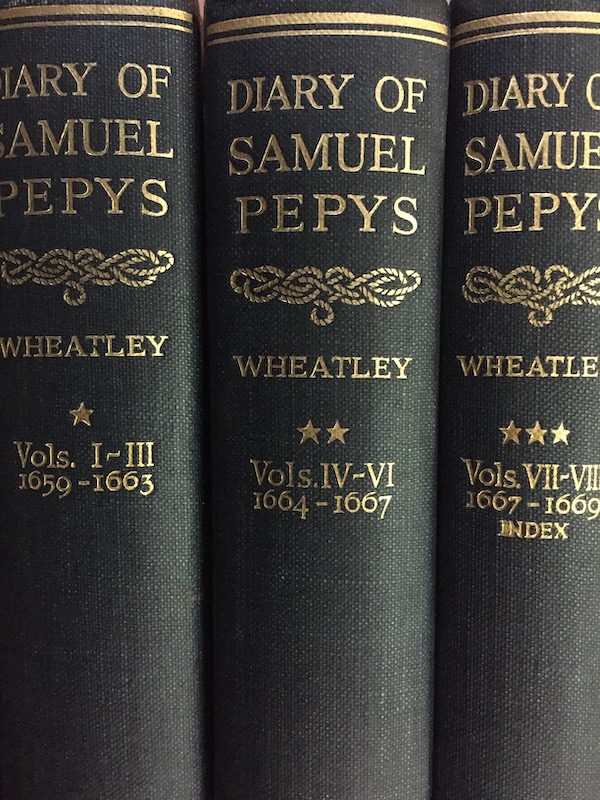
As a troublesome case in point, one of the books I have to make a decision on today is a three-volume edition of Samuel Pepys' complete diary, edited with notes by Henry B. Wheatley. The diary is a key document of that tumultuous time in British history from just before the restoration of King Charles II in 1660 until a few years after the Great Fire of London in 1666; these years also saw the Great Plague of 1665-66, and the Dutch raids on the English coast and up the Thames during the Second Anglo-Dutch War.

This edition is in handsome navy blue cloth (how appropriate, since Pepys was a naval administrator—no doubt that's the explanation of the decorative knotwork on the spines as well), letterpress-printed on bright, crisp India paper in a small but readable font, and with dimensions that fit nicely in the hand (about 7.5 inches tall by about 4.75 inches wide).

Since acquiring this edition over a decade ago I have regularly made a resolution to read it. I have considered several general plans for tackling the diary's several thousand entries:

  • Beginning with Pepys' first entry for 1 January 1659 (Old Style; 1660 New Style), read the entry corresponding to the day of the year. So I'd read the entries for 1660 a day at a time in 2024, those for 1661 in 2025, and so on. This is the method adopted by Phil Guyford's site The Diary of Samuel Pepys (which is a year ahead of me). The advantage of this plan is that reading one entry per day (even with dense footnoting) seems pretty doable. The obvious disadvantage of this plan is that I wouldn't finish until 31 May 2033.
  • Trying to complete the entire diary in a year. Pepys was a regular diarist, and so this would require reading roughly ten entries per day, every day. This also presents the question of whether the diary should be read chronologically, or whether every entry for a particular day (1 January, say) should be read on the corresponding day. The entries are not generally lengthy, and some are only a paragraph or two. Still, the daily task is daunting. When I've tried this in the past, inevitably I've had to skip a day or two, and then catching up became too difficult.
  • Giving up the idea of reading the complete diary and picking up a one-volume selection instead, such as The Shorter Pepys (Robert Latham, editor). For someone who has read Samuel Richardson's Clarissa and Sir Charles Grandison, this seems an ignominious admission of defeat.

Or, does this set go into a box to present a future quandary? Or should it find another, more dedicated home? These are the judgments—read immediately, or later (and if so, when?); shelve, or box; keep, or recirculate—that have to be made dozens of times as I try to bring some order to the chaotic jumble of my unshelved books. Librarian, organize thyself.

Monday, December 25, 2023

A Christmas wish

On Christmas, the mournful Coventry Carol for a mournful year:

Voces8 performing Philip Stopford's setting of "Lully, Lulla, Lullay" in St Stephen's Walbrook Church, London:
https://youtu.be/-7qYeZcOioI

In the coming year, may we have fewer reasons to mourn and more opportunities to celebrate peace and joy.

Sunday, June 6, 2021

The problem is me: The Sex Pistols, Steve Jones, and Lonely Boy

Sid Vicious and Johnny Rotten of the Sex Pistols, 1977.
Photo: Dennis Morris. Image source: mirror.co.uk

My college had a 10-watt radio station whose signal only reached about five blocks. Fortunately my dorm room was close enough to get the signal, and when my roommate was out I would tune it in softly in the background as I struggled to work problem sets. It was an eclectic station: the DJs played a lot of jazz, some classical, some folk, some blues. And even, occasionally, rock music.

One night during DJ Don Hedeker's show a song came on that made me put down my pencil and listen, dumbfounded.  I couldn't make out all the words (I still can't), but I was stunned by the sheer rage and contempt blasting out of my tiny radio speaker. This was the song, though I think it's impossible to hear it today the way I heard it then:

https://www.youtube.com/watch?v=eW9l8FNJaMg

Barely discernable words and phrases emerged from the wall of sound, but I had no trouble making out the line "Bet you thought you solved all your problems, but YOU are the problem!" (at around 2:50 in the clip above). Followed, of course, by the devastating and all-too-clear chorus: "The problem is YOU! Whatcha gonna do?" The song closes with the singer chanting the word "problem" over and over like an alarm signalling impending disaster, until it abruptly cuts off. 

The singer, of course, was Johnny Rotten of the Sex Pistols. I had never heard a song which sounded so pissed off and which seemed to speak to me so directly. Every time Rotten snarled "The problem is YOU!" his scorn hit home: the problem was me. And that problem—of alienation, loneliness, unhappiness with myself and the world I found myself in—seemed insoluble.

This wasn't my very first encounter with punk. That had been through the segment "The New Elizabethans," broadcast on 25 June 1977 on NBC's Weekend, the news magazine show hosted by Lloyd Dobyns that replaced Saturday Night Live one weekend each month. My main impressions from Weekend's report on punk: the music was almost undifferentiated noise, punks poked safety pins through their cheeks and wore razor blades as jewelry, and during shows they jumped up and down in unison and spit on the bands as a sign of approval. I was appalled, as I was intended to be. But "The New Elizabethans" also planted a deep seed of curiosity. [1]

After seeing the Weekend piece I tried to find out more about punk. It wasn't easy to do. In Baltimore the music wasn't mentioned in the local newspaper of record or played on the radio (though a few "new wave" bands like Talking Heads or Elvis Costello & The Attractions occasionally got a spin on WKTK FM). The following year I'd discover the free weekly City Paper and its coverage of the local scene, including the now-legendary punk dive the Marble Bar. But in 1977 punk was largely ignored, or dismissed; a repeated claim was that punks couldn't play their instruments. While this is patently untrue of the original Sex Pistols or The Clash or any number of other punk bands, it is true that punks disdained virtuosity for its own sake. That attitude was a reaction against an era when rock groups wrote "suites" that took up whole album sides, and played guitar solos that by themselves were longer than entire punk rock songs. [2]

Again, this anti-virtuosity stance made me curious. When I was younger I'd taken lessons in piano, guitar, and trumpet, and found them painful going. The idea that you didn't have to play perfectly before you could start, that you could just get a band together and learn as you go, had never before occurred to me. This was an especially liberating punk attitude: everyone was encouraged to do it themselves.

"Now form a band": Graphic from Sideburns, No. 1, p. 2, January 1977, by Tony Moon.
Image source: The Guardian UK

But not everyone thought DIY was a great idea—including, it turns out, the Sex Pistols' guitarist Steve Jones. As he writes in his funny and frank autobiography Lonely Boy (Da Capo Press, 2017),

. . .I like big record companies—I don't want to be around some Mickey Mouse indie label where everyone's having committee meetings about who's going to go out to buy the falafels. That was another real misconception about punk—'Oh, write your own magazine, start your own label.' I couldn't give a shit about that stuff. If you're any good, you'll be able to get a proper paying gig at one of the places that's already there. It's not meant to be a fucking hobby. (p. 173)

This brings up a key tension within punk. If punk was only an arresting musical and sartorial style then it could be adopted, or co-opted, by anyone. If it was an ethos—a rejection of the social, economic and political systems that were attempting to mold your thoughts, keep you in your place and destroy the world for profit—then it meant changing your life, not just your clothes.

Of course, punk rock was not only liberatory: as with many subcultural movements its meanings were not monolithic and were fiercely and sometimes violently contested. Some punk fashion (the razors and safety pins) seemed to aestheticize self-harm. Punk music and style was often meant—and often taken—as an affront, and punks faced physical attack on the streets (Johnny Rotten was stabbed). Some punks flaunted Nazi symbols; while probably most who wore them did it to provoke outrage rather than from any understanding of or identification with Nazism, there were some who advocated the nativist and fascist ideology of the National Front. You'll note that Johnny Rotten's Vivienne Westwood T-shirt in the photo at the head of this post features a swastika with the word "Destroy" written above it. The intended meaning seems to be "Destroy Nazism"—the song "God Save the Queen" describes Britain's monarch as the figurehead of "the fascist regime/They made you a moron/Potential H-bomb." 

But it wasn't only people who hated punk who misunderstood the theatrical aspect of its violent imagery. When in "Anarchy in the UK" Rotten sings "I wanna destroy/Passers-by," some may have taken it as an invitation to violent action, unaware of the allusion to André Breton's Second Surrealist Manifesto: "The simplest Surrealist act consists of dashing down the street, pistol in hand, and firing blindly, as fast as you can pull the trigger, into the crowd. Anyone who, at least once in his life, has not dreamed of thus putting an end to the petty system of debasement and cretinization in effect has a well-defined place in that crowd, with his belly at barrel level." [3]

Sid Vicious is a case in point. In Lonely Boy Jones speculates that Vicious (born John Simon Ritchie) felt he had to live up to his stage name. After Vicious's 1979 death from a heroin overdose, Johnny Rotten (who by then had reverted to his birth name, John Lydon) commented, "Poor Sid. The only way he could live up to what he wanted everyone to believe about him was to die. . .He really bought his public image." [4] 

Vicious's violence was not only self-directed. In June 1976 he hit journalist Nick Kent in the head with a bicycle chain at the 100 Club during a Sex Pistols show, and in September of that year during the second night of the 100 Club Punk Festival he threw a glass at the stage during The Damned's set that shattered against a pillar; shards struck a young woman in the eye, blinding her.

But in February 1977 Rotten pushed for Vicious to be brought into the Sex Pistols to replace original bass player Glen Matlock, even though Vicious didn't know how to play. If it wasn't already obvious what that would mean, it quickly became so the following month when Vicious attacked a colleague of the BBC presenter Bob Harris (the insufferable host of the music program Old Grey Whistle Test) with a broken bottle and opened a gash in his head requiring stitches. [5]

For Jones, in retrospect the shift in the band's focus away from the music and towards sparking media outrage was the beginning of the end. It started with "The Filth and the Fury" Bill Grundy television interview in December 1976, and escalated when Vicious joined the group in early 1977.

From the minute Sid joined the band, nothing was ever normal again. I get that it was great the way him and John looked together, and the media frenzy certainly sold a lot of newspapers, but as far as I was concerned, that wasn't what the Sex Pistols were meant to be. . .[At an early Sex Pistols gig] I'd told the guy from the NME [New Musical Express], 'We're not into music, we're into chaos'. . .but I found out afterwards that it wasn't really true. Be careful what you fucking wish for! I was into music. We all were. . .but now we'd got chaos instead, and it was shit. (p. 185)

Of the twelve tracks on Never Mind the Bollocks, Here's the Sex Pistols (released October 1977), all but two were written before Vicious joined the band. Jones played most of the bass parts on the album, with Matlock returning for "Anarchy in the UK."

During the Sex Pistols' January 1978 American tour band conflicts came to a head. Manager Malcolm McLaren had booked them into venues across the South (such as Randy's Rodeo in San Antonio, the Kingfish Club in Baton Rouge, and the Longhorn Ballroom in Dallas) in a bid to provoke confrontations between the band and the crowds. If that was the goal, it certainly worked; see Lech Kowalski's film D.O.A. (1980) for footage of Jones in mid-song heading away full beer cans thrown at the band, and Vicious hitting an audience member with his bass guitar.

The Sex Pistols at Winterland Ballroom, San Francisco, 14 January 1978.
Photo: Michael Zampelli. Image source: Flickr.com

After the last show of the tour at San Francisco's Winterland Ballroom on 14 January 1978, Rotten left the band; his final words to the audience that night were "Ah-ha-ha. Ever get the feeling you've been cheated?" Jones and drummer Paul Cook continued to flog the dead horse of the Sex Pistols for another few months, but after Vicious left for good in September 1978 it was clear the band was finished. As Jones writes in Lonely Boy,

. . .there was no fixing the problems that ultimately destroyed us, because they were the same things that made the band work in the first place. . .The Sex Pistols were born to crash and burn, and that's exactly what we did. (p. 207)

But that's not the end of the story. Instead of foreclosing action, the Sex Pistols' ruthless criticism of everything existing kicked open a door; it was up to you to seize the possibilities. While the band was only really together for 29 months, mid-August 1975 to mid-January 1978, the groups formed or reshaped in the wake of their gigs were legion: among them, Buzzcocks, The Clash, The Fall, Generation X, Joy Division, Psychedelic Furs, Siouxsie & the Banshees, Television Personalities, and X-Ray Spex. And lives were changed, for better and worse. 

Mine was one of them. After hearing "Problems" that night in my dorm room I began to seek out other music that made me feel as though my secret thoughts had somehow found expression. It was scary, yes, but also exhilarating and strangely affirming: there were other people who felt and thought the way I did. But they had something I didn't: loud guitars. Eventually I became one of them; I picked up a (bass) guitar and two weeks later joined a band—a story for another time, perhaps.


By the time I first heard "Problems" the Sex Pistols had broken up, so I never had a chance to see them live. But I'll end this post with the story of seeing Steve Jones and Paul Cook in their post-Sex Pistols band The Professionals. It was not a particularly happy experience, for them or me. [6]

The Professionals were the opening band for The Jam's final American tour, which I saw in May 1982 at Chicago's Aragon Ballroom. At the time I was only familiar with the songs Jones and Cook had written after Rotten's departure and released on The Great Rock 'n' Roll Swindle album. But in the meantime Jones had produced the Avengers' EP and both he and Cook had played on Joan Jett's cover of "You Don't Own Me," so I was excited to see their new band live.

Paul Cook, Steve Jones and Paul Myers of The Professionals onstage in 1981.
Photo: Grudnick. Image source: Flickr.com

That excitement quickly turned to disappointment. The sound of the guitar and drums was unmistakable, and Jones could clearly write a memorable hook. But the band's lyrics were generic, and each song seemed to aspire to be a stadium-rock sing-along. The chorus of "Kick Down the Doors" includes the line "Don't you ever stop," which isn't all that distant from "Don't stop believin'." Worse, the musicians made no attempt to connect with the audience and fatally lacked energy, which made a ludicrous contrast with the rock-star poses they were striking. They were not well received (I even recall scattered booing) and did not bother to give the unimpressed crowd an encore. Researching this post I discovered that Jones and bass player Paul Myers were junk-sick during this tour, which may partly explain their leaden performance. [7]

When The Jam took the stage, guitarist Paul Weller (who had evidently heard the booing) took a moment to remind us who "Steve and Paul" were and to acknowledge how great an inspiration the Sex Pistols had been to his own band. (Although apparently the inspiration went both ways: The Jam's first single "In the City" is widely credited with providing the Sex Pistols with the chord progression for "Holidays in the Sun.")

The Jam then proceeded to play a powerful, heartfelt concert that showed exactly what had been missing from The Professionals' rote set. At one point Weller accidentally stepped on the mic stand base and the microphone swung forward like a hammer and smashed him in the mouth. Although he was obviously in pain he threw himself into the music with redoubled intensity.

Paul Weller of The Jam at the Aragon Ballroom, Chicago, 26 May 1982.
Photo: rhanke. Image source: Flickr.com

The crowd was incredibly enthusiastic, calling the band back to the stage three times for encores. Then the house lights came up and canned music started to play over the PA—the universal "go home, the concert's over" signal. But the crowd, cheering, stomping and clapping, refused to leave. After what seemed like an eternity but was probably five minutes, Weller suddenly vaulted over the drum risers onto the stage and a huge cheer erupted; the rest of the band took their places, the lights were dimmed once again, and they played a fourth encore. I had never before, and have never since, seen a band come out again after the house lights have come up.

Alas, neither band would make it to the end of the year intact. The Professionals fell apart at the end of the summer tour when Jones stayed behind in New York while the rest of the group returned to the UK. And although 1982 was the year of The Jam's greatest commercial success—The Gift, the album they were touring to support, had reached #1 in the UK—in the fall Weller announced their breakup; they played their final shows in December. (I think they had actually reached their peak on the 1980 album Sound Affects; it's apparently Weller's favorite of their albums too.) But at least before their demise The Jam gave one of the most impassioned performances it's been my privilege to see.

Postcript: This post was occasioned by my learning that Danny Boyle (director of Trainspotting and Slumdog Millionaire) is filming Pistol, a six-episode FX TV series about the Sex Pistols based on Jones' memoir. No fault of Steve Jones, but can Pistol be anything but fake and awful?


  1. I would link to "The New Elizabethans" in this post, but amazingly it does not seem to be available on YouTube or elsewhere.
  2. Comparisons are to the studio versions in each case: the guitar solos in Led Zeppelin's "Stairway to Heaven" (totalling 1:10) are longer than Stiff Little Fingers' "Here We Are Nowhere" (58 seconds); the guitar solo in the Allman Brothers' "Ramblin' Man" (2:05) is longer than The Clash's "Career Opportunities" (1:52); the guitar/talkbox solo in Joe Walsh's "Rocky Mountain Way" (2:33) is longer than X-Ray Spex's "Identity" (2:25); and the guitar solo in Lynyrd Skynyrd's "Free Bird" (3:55) is longer than the Buzzcocks' "Boredom" (2:51). And if we compare live versions, the guitar/talkbox solos in Peter Frampton's "Do You Feel Like We Do" from Frampton Comes Alive (totalling 8:38) are longer than the Ramones' "Rockaway Beach," "Teenage Lobotomy," "Blitzkrieg Bop" and "Sheena is a Punk Rocker" from It's Alive put together (totalling 8:22).
  3. André Breton, "Excerpts from The Second Surrealist Manifesto," translated by Richard Seaver and Helen R. Lane, in Lucy R. Lippard, editor, Surrealists On Art, Prentice-Hall, 1970, p. 29.
  4. Mikal Gilmore, "John Lydon Improves His Public Image," Rolling Stone, 1 May 1980. Accessed 6 June 2021 from the Fodderstompf PiL Fansite Archive: http://www.fodderstompf.com/ARCHIVES/INTERVIEWS/JL_RS5.80.html
  5. On 12 October 1978 Vicious would be arrested and charged in the killing of his girlfriend Nancy Spungen, who had been found stabbed to death in their room at the Chelsea Hotel in New York. While out on bail on this charge on 8 December 1978, Vicious smashed a beer bottle across the face of Todd Smith (Patti Smith's brother and road manager) at a concert by the Chicago band Skafish at the Hurrah club. For the full story see Jim Skafish, "Sid Vicious' last Hurrah. . .again," Official Skafish Blog, 25 January 2011 (http://skafishblog.skafish.com/2011/01/25/sid-vicious%E2%80%99-last-hurrah-again/). Vicious was arrested again on an assault charge. On the night of his release on bail, 1 February 1979, he died from an overdose of heroin; his body was discovered the next morning.
  6. I also saw John Lydon's band Public Image Ltd. in concert in 1982—also a story for another time. 
  7. Jones eventually managed to kick his heroin habit and later became the host of Jonesy's Jukebox, a long-running LA radio show.

Saturday, May 16, 2020

See you on the dark side: Tolkien, Pink Floyd, and the Claremont Diner

The coronavirus shutdown has resulted in our literal confinement to interior spaces. But for me it has also meant that, without the welcome distractions of friends, libraries, concerts, bookstores, museums, parks, and my usual wanderings around the city, I've been increasingly confined to my own head. Like many of us, perhaps, as each day settles into a predictable repetition of an endless present, I've found myself thinking more about the past. And the internet is an amazing aid to memory: details that have long been fuzzy can be almost immediately clarified (although the collective memory, like my personal memory, can sometimes be unreliable, as you'll see below).

Mass market paperbacks of The Lord of the Rings trilogy; covers designed by Barbara Remington (1965). Image source: New York Times

Tolkien. One summer when I was approaching or in my early teens I discovered J.R.R. Tolkien's The Hobbit and The Lord of the Rings. I had been an avid (but pretty much indiscriminate) reader before this: I read everything from Wilfred McCormick's Bronc Burnett series to Sherlock Holmes to James Bond to science fiction. But Tolkien's books took me into a very different imaginative realm, one in which ordinary, comfort-loving protagonists found themselves unwillingly caught up in a titanic struggle between good and evil. [1]

The story had everything to appeal to an adolescent boy: adventure, terror, chases, magic, deep caverns, dark forests, impassable mountains, and (not enough) beautiful elf-maidens. That summer I immersed myself in Tolkien's world and was so captivated by it that when in mid-summer I reached the end of LoTR, I started over again from the beginning and re-read the whole thing. [2]

Pink Floyd. This was also the summer I immersed myself in Pink Floyd's Dark Side of the Moon. Its atmospheric music was the perfect soundtrack to my reading. Every day I would put the album on our cheap portable stereo, curl up on the comfy old couch in the family room, and rejoin Frodo and Sam on their quest; when the record reached the end of a side I would get up and flip it over. I would do this for hours, probably to the dismay of any family member within earshot.

https://www.youtube.com/watch?v=pgXozIma-Oc

I owed the discovery of both Tolkien and Pink Floyd to a friend of my older sister whom I'll call Dale. He was a flamboyant character: his black hair was shoulder-length and frizzy, held in place by a headband, and he favored vests worn over tie-dyed t-shirts. He started coming over to our house regularly to visit my sister, but she would usually refuse to leave her room when he stopped by. That left Dale and me to entertain one another.

Perhaps Dale thought that the way to my sister's heart was to be kind to her younger brother; if so, I could have disabused him of that notion. But despite Dale's continued lack of success with my sister, a pattern developed: he would stop by once or twice a week in the afternoon, bringing two or three albums with him. We'd sit around that portable stereo while he played what he had brought: prog-rock bands like Yes, Jethro Tull, Traffic, ELP, and King Crimson. [3] Given that my listening until then had been largely AM-radio-driven—I had a small cube alarm-clock radio that I tuned into New York stations at very low volume late at night when I was supposed to be sleeping—Dale's music was ear-opening. [4]

His favorite band was Pink Floyd. Dale would play "Careful With That Axe, Eugene" (from Ummagumma), and wait for the moment when he could whisper the title phrase followed by a bloodcurdling scream. Or he'd play the 23-minute "Echoes" (from Meddle) and narrate the scenes from Lord of the Rings that the sounds evoked for him (which is probably what established the connection for me between Pink Floyd and Tolkien). But once he brought over Dark Side of the Moon, it was the one we played most often. Later I managed to acquire my own copy (perhaps at my next birthday).

The concert. Memory is fallible, and I don't remember how the possibility of seeing Pink Floyd live came about; Dale must have arranged the whole thing. The band was appearing at Roosevelt Stadium in Jersey City, which was a good 45 minutes away by car. I have no idea how Dale talked my parents into allowing me to go. They must have paid him for the ticket, as well, because I couldn't have. This stub shows that the price of a ticket was $7.50—pretty steep in those days [5]:

Image of ticket stub from the Pink Floyd concert

Image source: https://digilander.libero.it/careful53/PFlisting/THPF02.htm

However it happened, the afternoon of the concert I found myself in a car filled with Dale and a group of his friends, most of whom were, like Dale, several years older than I was, heading down the highway towards the gritty industrial cities that lined the Jersey shore opposite Manhattan. Dale had assured my father that I'd be back around midnight.

We got to the venue fairly early, while it was still light, and in our inexperience parked as close to the stadium as we could get. (Better, we realized afterwards, to park near the exit.) We entered and took our seats, which were in the stands almost directly opposite the stage. A huge white pyramid/prism floated over the stage, and there was a large circular screen looming over the band, on which films would be projected during the second-half performance of the entirety of Dark Side of the Moon. There were wires stretching from the stage over the audience to the roof of the stadium behind us; during "On the Run," a large model plane with sparks shooting from its engines would slide down the wire (according to one story, it got stuck before crashing into the stage and fizzled out over the audience; I do remember being puzzled by the effect). [6]

Here is the opening song of the very concert I saw: "Raving and Drooling (I Fell On His Neck With A Scream)," an early version of "Sheep" (later issued on Animals, released in 1977)):

https://www.youtube.com/watch?v=dBdSJk6eFcQ

The lyrics are hard to make out, but this is what I hear:

Raving and drooling
I fell on his neck with a scream
He had a whole lot of
Terminal shock in his eyes
That's what you get
For pretending the rest are not real
Babbling and snapping at faraway flies
He will zig-zag his way back
Through memories of boredom and pain
Raving and drooling
I fell on his neck with a scream
He was caught in the middle
Between the illusion
Of safety in numbers
And being brought down to his knees

The whole first half of the concert was unfamiliar (here's the complete set list, and if you like you can actually listen to the entire concert). I learned later that the music they performed during that first hour was not only new, but unreleased material, a brave choice by the band: after "Raving and Drooling" came "You've Got To Be Crazy" (an early version of "Dogs," later issued on Animals), "Shine On You Crazy Diamond Parts I-V," "Have A Cigar," and "Shine On You Crazy Diamond Parts VI-IX" (all later issued on Wish You Were Here, released three months after the concert). I now know that the entire first half of the concert featured songs about Syd Barrett, the band's co-founder and original lead guitarist and singer, the "mad genius" who had been forced to leave the band and later was briefly institutionalized due to his erratic behavior. [7]

"Now there's a look in your eyes / like black holes in the sky": Syd Barrett in the late 1960s (left) and during the Wish You Were Here recording sessions in 1975 (right). Image sources: Mick Rock, YouTube (left); Nick Mason, Wikipedia (right)

During (I think) "Shine on You Crazy Diamond," spotlights were aimed at a mirrored circle that had risen over the stage; the reflected beams were quite spectacular in the twilight, shining through the haze of fog and pot smoke. A fair proportion of the latter was generated by the people sitting in the row directly in front of us, who seemed to be toking constantly from the time we arrived until the end of the concert. A stiff breeze was blowing straight into our faces, carrying their smoke into our eyes, noses, mouths, and lungs. I didn't get high—at least as far as I can tell judging by later experiences—but I can't vouch for the other members of our group, and we all got hungry. Perhaps our hunger wasn't chemically aided, as we had left for the concert in the late afternoon and by the time the concert ended, after the encore of "Echoes," it was nearly 11.

That encore infuriated Dale: "That wasn't 'Echoes'!" he insisted as we tried to find our way back out to the car. Listening to the recording of the concert I do hear an added saxophone solo by Dick Parry, which didn't fit with the gestalt of the song as we knew it, but then, couldn't the band change it as they saw fit? For Dale, a purist in these matters, the answer was no.

Once we found the car it took us more than an hour to make it out of the parking lot (that half the drivers in the place were stoned probably didn't help), and when we finally got on the road we immediately took the wrong freeway entrance. We'd been driving for at least 15 minutes when someone finally realized we were travelling in the wrong direction. It took more time to find an exit and get ourselves turned around. By the time we made it back into familiar territory it was well after 1 am. We were all starving, and someone had the brilliant idea of going to the Claremont Diner.

The Claremont Diner

Image source: Cooky Cat

The Claremont Diner. At the intersection of Bloomfield Road and Route 23 in Verona stood the Claremont Diner, one of those stainless-steel-clad 1940s diners that stayed open around the clock. The Claremont served a legendary cheesecake, baked daily on the premises, and we all ordered a slice. We were long-haired, tired but giddy teenagers, must have been reeking of secondhand pot smoke, and as rambunctious teenaged boys were probably not the quietest or most well-behaved group; we were treated with wary skepticism by the weary night-shift waitresses. The cheesecake and coffee that we were finally served revived us, and as we were about to leave I took a slice of the cheesecake to go, thinking that I would enjoy it for dessert the next day. [8]

Claremont Diner cheesecakes awaiting customers.
Photo by Jeffrey J. Jensen, son of the Claremont's pastry chef. Image source: MyVeronaNJ

When I was dropped off at home it was about 3 in the morning. I tried to be as quiet as possible as I crept up the walk and inserted my key in the lock of the front door. Before I could turn it, though, the door suddenly opened and I was face to face with my father, dressed in his bathrobe. As he lost no time in informing me, he had been waiting up all night for my return, and was not happy about the hour.

I could sense that he was about to pronounce my doom and that I would be grounded for weeks (or the rest of the summer!), when I had a brainstorm. "I'm late because we stopped at the Claremont Diner," I said, "and—I brought you a slice of cheesecake." I held out the cardboard container containing the precious offering. My father grumbled that this didn't make up for my lateness, but he sat down at the kitchen table and ate my cheesecake while I watched, concealing my disappointment as best I could.

The cheesecake worked its magic, though, and the dreaded punishment never materialized. In fact, a few weeks later I was permitted to go with Dale and his friends to a local movie theater to see Monty Python and the Holy Grail. I'd learned what sacrifice I would need to make to appease the angry god on my return: a slice of Claremont Diner cheesecake.

Coda: About two months after the concert I attended, a nineteen-year-old named John Lydon was walking down King's Road in London wearing a Pink Floyd t-shirt. Only, he had slashed holes in the silk-screened band photo and written "I HATE" above it in red marker. The manager of a new band approached him and asked him if he wanted to audition as the singer. Later that night Lydon mimed to Alice Cooper's single "I'm Eighteen (and I don't know what I want)." As the band's guitarist remembered it a couple of years later, "we thought he was really funny, I thought he was hysterical. And like he probably did—he thought we was a bunch of idiots. So we went on from there." [9]

Johnny Rotten wearing his I Hate Pink Floyd T-shirt onstage

Image source: Vintage Everyday

With John Lydon renaming himself Johnny Rotten the band went on to be the Sex Pistols, whose visceral three-minute blasts of confrontational anger were the musical antithesis of Pink Floyd's melancholy space music (although the musical differences disguise a shared lyrical theme of alienation). I would discover the Sex Pistols and other punk bands a few years later, and perhaps that discovery will be the subject of another post.

Next time: The problem is me: The Sex Pistols, Steve Jones, and Lonely Boy

Last time: What is happy?: The Cowsills in concert


  1. If somehow you haven't read the books or seen the Peter Jackson films: the sorcerer Sauron, the Dark Lord who rules the blasted land of Mordor, suspects that the Ring of Power that will enable him to conquer Middle Earth has fallen into the possession of a hobbit living in the bucolic Shire. Sauron sends his armies of evil to find the ring; meanwhile, the hobbits and their small band of allies, the Fellowship of the Ring, learn that the Ring can't be used for good. The only way to defeat Sauron is to destroy the ring by hurling it into the fires where it was forged: Mount Doom, deep within Mordor.
  2. Books were precious and expensive commodities. When I started LoTR, probably at Dale's recommendation, I cautiously bought only the first volume. When I finished it I rode my bicycle down to the local bookstore with my carefully saved allowance and counted out the coins to order the next. I should have rationed my reading so that I didn't finish a volume before I had saved enough money to order the next one, but I'm not sure I was so self-disciplined. In 1965 Barbara Remington had designed a set of covers for the mass-market paperbacks that, when placed together, formed a continuous image. But by the time I started reading the set the paperback cover art (and the cover price) were changing, so I wound up with a mismatched set. I recently found a boxed set of the paperbacks with the Remington covers at a book sale for 50 cents. I bought the set, even though I don't plan to re-read the novels—although if the coronavirus shutdown continues I may reconsider.
  3. Dale also brought records by more obscure groups. Evidence that the internet is astounding, Exhibit 111,279,637,948: I remembered one album with a nautical/pirate theme and a gatefold cover, but that's all I could remember. In a couple of minutes of surfing I found it: Discogs.com allows you to filter by cover type (gatefold), year and genre. It was Dinosaur Swamps by The Flock.
  4. Number 1 singles on the Billboard Hot 100 chart in 1974 included 34-year-old Ringo Starr singing "You're sixteen, you're beautiful, and you're mine," Terry Jacks' version of Rod McKuen's "Seasons in the Sun," Ray Stevens' "The Streak," Bo Donaldson and the Heywoods' "Billy Don't Be A Hero," Paper Lace's "The Night Chicago Died," and Paul Anka's "Having My Baby." The competition is stiff, but it may qualify as the single worst year in pop music.
  5. The ticket seems to read "Sat Jun 14 1975; Rain date June 15." The concert was not postponed by rain (the New York Times for 14 June predicts the weather to be "sunny and warm") but several internet sites and YouTube videos claim Sunday June 15 as the date of the concert. Unlikely: it's inconceivable that my parents would have allowed me to attend a concert on what would probably have been a school night (school wouldn't have ended until at least a week later).
  6. The animations for the Dark Side of the Moon songs were by Ian Emes, and can be found on YouTube.
  7. The words are attributed to Roger Waters, the band's bass player and lead singer after Barrett was forced to leave the band in 1968, in Nicholas Schaffner's Saucerful of Secrets: The Pink Floyd Odyssey (New edition). Helter Skelter, 2005, p. 14.
  8. Alas, a little more than a year later the Claremont Diner burned to the ground. More about its history (and the famous cheesecake) is available on the MyVeronaNJ blog.
  9. Quoted in The Sex Pistols: The Inside Story, compiled and edited by Fred and Judy Vermorel, Universal, 1978, p. 15.

Sunday, April 26, 2020

What is happy?: The Cowsills in concert

I listen to classical music almost exclusively now, but there was a time (as regular readers of this blog may have gathered) when I went to a lot of rock shows. A recent e-mail from a friend got me reminiscing about some of the memorable shows I've seen, and I started compiling a list. I'll spare you the full version, since reading about a great show you didn't attend is like hearing about a great party that you missed. But I thought that—aided by the collective memory of the internet—I would share my experience of the very first rock concert I attended:

The Cowsills, Music Circus, Lambertville, New Jersey, 5 September 1970

My age wasn't yet in double digits when, for a birthday present, my father took me to St. John Terrell's Music Circus outside of Lambertville, New Jersey, to see The Cowsills.

They were a major part of my musical universe at the time, along with The Beatles, The Monkees, The Archies, and The Fifth Dimension (my mother's favorite group). In 1970 I think I only owned perhaps three albums in total—$3.98 was a lot of money on a $0.10 weekly allowance, so my mother must have helped me out—and two of them were by The Cowsills: Captain Sad and His Ship of Fools and Best of. (The third? The Monkees' Headquarters.)


Captain Sad and his Ship of Fools, 1968. Image sources: discogs.com


The Best of The Cowsills, 1968. Cover art by Jack Davis. Image source: discogs.com

If you've never heard of The Cowsills, they were the toothy, clean-cut, real-life models for TV's The Partridge Family (which didn't start airing until a few weeks after the concert I attended). The real Cowsills were more talented than most of their TV avatars; for evidence, a truncated version of their hit "The Rain, The Park, and Other Things" from their first appearance on the Ed Sullivan Show on 29 October 1967:


Dig 11-year-old drummer John's stick-twirling (at 0:20), the perfectly syncopated tambourine of 7-year-old Susan, who looks like she's having the time of her life, the cool violin bass of 13-year-old Barry, and the five-part backup vocals led by their mother Barbara. Eldest brother Bill is on lead guitar, and second-oldest brother Bob on keyboards; none of the children were yet out of their teens.

I know that as we grow older we can often be embarrassed by our first musical enthusiasms, and sure, the lyrics about the alluring but elusive Flower Girl are very much of their time. (The song was written by Artie Kornfeld and Steve Duboff; Kornfeld would go on to co-organize the 1969 Woodstock Music Festival.) But this song still sounds pretty great to me more than 50 years on, and their performance is charming. This configuration of the group isn't quite the one I saw; middle brother Paul would join the group in 1968, and in 1969 Bill would be kicked out by his father Bud, the group's manager.

The Music Circus concert was a surprise birthday present, so during the long drive across New Jersey with my father I was given no clue to where we were going. When we arrived and I saw the band's name on the roadside sign I was overwhelmed. This was my first concert, and it wasn't until we were pulling into the parking lot that I understood that attending a performance by a famous group was even possible. You could watch pop stars performing on TV and listen to their records, but didn't they inhabit their own realm apart from ordinary mortals? That for the price of a ticket anyone could share the same physical space with them and hear them play their music live was a brand-new idea for me.

My father being my father, we had left three hours early to make a one-hour drive, so we had time to kill. (Alas, I've inherited his neurotic anxiety about being late.) The Music Circus was a big-top tent (and a carousel!) set amid the pastureland of west Jersey; summer concerts began in the early evening, while it was still light, but we had arrived so early that the tent wasn't yet open. So we walked around to the back, where we encountered a crowd of girls, three or four years older than me, packed together at the dressing room door. Every time it would open a crack they would scream and make a rush for the door, which would hastily be shoved closed. I was completely baffled and dismayed by this behavior—why were they besieging the poor group?


The Music Circus in September 1968. Image source: St. John Terrell's Music Circus

My father, perhaps sensing my growing unease, suggested that we take a walk. We headed off across the fields surrounding the Music Circus, and soon the screaming girls were left behind. Ahead of us in the distance was an apparently deserted 19th-century farmhouse, and for lack of any other destination we walked towards it. But as we got closer I could hear the muffled sound of amplified instruments, growing louder. The band wasn't backstage after all—they were here, in the living room of this house now a few yards away, rehearsing for the concert.

If you're thinking that this is the story of how I met The Cowsills, I'm sorry to disappoint you. As soon as I realized where they were, I stopped dead in my tracks. My father urged me to climb the porch stairs and knock on the door, but that thought totally mortified me. The last thing I wanted to do was intrude on them. Unable to convince me to take a step further, my father finally gave up, took my hand and led me back to the big top, which was beginning to fill. It wouldn't be the last time I declined the chance to meet idols in the flesh.

I spent the time waiting for the band to come on stage looking through the concert program, which was 30 pages long and about the size of a record album, and which I kept as a treasured memento for many years afterward.


The Cowsills 1970 souvenir program cover. Image source: B.A. Presley's Cowsills site

As the tent slowly filled I found myself pretty much the only boy among about 2000 teenaged girls, who, when the lights went down and the band took the stage, began screaming nonstop: it was a terrifying, overwhelming wall of sound. The poor musicians pleaded with them to stop screaming and listen, to no avail. I was frightened and bewildered: why was the audience here if they didn't want to hear the band play? It was my introduction to the idea that pop concerts fulfill a variety of functions, many of them non-musical. In retrospect, I can see that for most of the audience, the concert was more of an occasion to scream en masse than to listen to the band. That auditory manifestation of power must have been exhilarating.

The concert itself was pretty much a blur. I was disoriented not only by the unremitting screaming but by the unfamiliar songs the band was playing, some of them covers and some drawn from their new album, II x II. The set list from a show one month later, which must be very similar to the show I saw, has been preserved by B.A. Presley. The concert apparently ended with "Hair," which had been their biggest hit the year before, but it to me it would just have been another song I didn't know (it was released after The Best of The Cowsills, but has since been included on CD versions of that album). That the most clean-cut pop group in America was singing a song extolling hair so long that it would "fly in the breeze / And get caught in the trees / Give a home for the fleas" was a joke that The Cowsills themselves embraced, but that I only appreciated somewhat later.


When the concert was over, night had fallen and I was completely wide-eyed. I wasn't sure whether I had even enjoyed it—I was definitely suffering from sensory overload. But something about the experience must have been captivating, because the very next rock concert my parents allowed me to attend, almost five years later, promised even more sensory overload: Pink Floyd performing Dark Side of the Moon, perhaps the subject of a future post.

Coda: In researching this post I came across information about the emotional and physical abuse (as well as financial mismanagement) visited on his family by the dictatorial, alcoholic patriarch Bud Cowsill; in the documentary Family Band Bob Cowsill says that he "created a house of fear." The band's sunny pop sound and cheerful public personae concealed that painful backstage reality. The group broke up in 1971 after recording one final album, but in the past three decades surviving members have periodically reunited, played live, and recorded; they maintain the official Cowsills website.

I also came across a website for the Lambertville Music Circus. Among the other performers appearing there during the summer of 1970 were Ike and Tina Turner, B.B. King, Little Richard, and Fleetwood Mac. Many thanks to the fans and fellow obsessives who have documented so much of this history, and prompted my very fallible memory to recall the things I couldn't think of yesterday.

Next time: See you on the dark side: Tolkien, Pink Floyd, and the Claremont Diner