Showing posts with label opera - Lorraine Hunt. Show all posts

Friday, March 1, 2024

Remembering Lorraine Hunt Lieberson

Lorraine Hunt Lieberson, American mezzo-soprano, October 1, 2003. Photo credit: Richard Avedon. Image source: Operachic

Lorraine Hunt Lieberson, born 1 March 1954, would have turned 70 today. It is a shock to realize that it has been almost 18 years since her tragic death from breast cancer on 3 July 2006, at the age of only 52.

We were incredibly fortunate to have been able to see her in performance four times: twice as the repudiated Empress Ottavia in Monteverdi's L'incoronazione di Poppea (The coronation of Poppea) at San Francisco Opera in the summer of 1998—her "Addio Roma, addio patria" was magnificent—and twice in recitals sponsored by UC Berkeley's Cal Performances: the first on 29 April 2001 in the cavernous Zellerbach Hall, and the second on 29 September 2002 in the more intimate wood-lined Hertz Hall. Although all of her appearances were memorable, the second recital was one of the most moving performances I've ever experienced.

In late January 1999 Lorraine Hunt was scheduled to perform a program of Bach's cantatas directed by Peter Sellars as part of the Cal Performances season; a second show was even added in early February. However, just two weeks before those performances were to take place they were cancelled "because of an illness in Hunt's family," according to the announcements that appeared. We later learned that her sister Alexis had been diagnosed with breast cancer, and Hunt cancelled the engagements to be with her. Alexis died in May 2000.

Two months before her sister's death, Hunt herself was diagnosed with the disease. The program of the 2002 recital was clearly a response to her diagnosis and her sister's death. Every song was about mortality and the imperative to grasp fleeting moments of joy, from the opening "Scherza infida" ("Mock me, faithless one," from Handel's Ariodante), in which the suicidal Ariodante seeks "the embrace of death," to the closing "Ich bin der Welt abhanden gekommen," ("I am lost to the world," from Mahler's Rückert-Lieder), in which she sings "truly I am dead to the world./I am dead to the world’s clamor/And rest in a quiet place,/I live alone in my heaven,/In my love, in my song!"

Fortunately for us, her performances of some of the songs from this recital program were recorded. Here is Claude Debussy's "Beau soir," recorded at Alice Tully Hall in New York City on 20 October 2002. As in the Berkeley recital we attended three weeks earlier, Robert Tweten is her accompanist:

https://youtu.be/1QgEAsJul18 ["Beau soir" ends at 3:10]

Beau soir
(Paul Bourget)

Lorsque au soleil couchant les rivières sont roses,
Et qu'un tiède frisson court sur les champs de blé,
Un conseil d'être heureux semble sortir des choses
Et monter vers le cœur troublé;

Un conseil de goûter le charme d'être au monde
Cependant qu'on est jeune et que le soir est beau,
Car nous nous en allons, comme s'en va cette onde:
Elle à la mer — nous au tombeau!
Beautiful evening
(My translation)

When at sunset the rivers turn pink
And a mild breeze brushes the fields of wheat,
Everything seems to urge contentment
And ascend to a troubled heart;

To urge us to savor the delight of being in the world,
While we are young and the evening so beautiful,
For our life flows by, as do the waves:
They to the sea — we to the tomb.

As in the recital we attended, on this recording "Beau soir" is followed after a pause by Ernest Chausson's "Le Colibri" (The hummingbird); if you want to keep listening you can find the words by Charles-Marie-René Leconte de Lisle together with a translation by Richard Stokes on the Oxford International Song Festival website.

The final song (and third encore) of the recital was her signature encore, the spiritual "Deep River," in which she sings "Deep river/My home is over Jordan/Lord, I want to cross over into camp ground." This recording was made live at the 2004 Ravinia Festival with Peter Serkin as her accompanist:

https://youtu.be/iSkskC68eEQ ["Deep River" ends at 2:40]

Although no recording can do justice to the experience of hearing this remarkable artist in person, many of her performances are available on audio or video. Among our favorites are the collections of Handel arias she recorded with the Philharmonia Baroque Orchestra under musical director Nicholas McGegan, Arias for Durastanti and Handel Arias (there are four tracks in common). Supreme for me, of course, reigns her performance with the PBO of the Carthaginian queen Dido in Purcell's Dido and Aeneas. I've written elsewhere on this blog about how Dido and Aeneas and Hunt's other Baroque opera and oratorio performances with PBO and McGegan played a major role in igniting our passion for Baroque opera—a gift for which we will always be profoundly grateful.

Dido's lament from the final scene of the opera:

https://youtu.be/IKRjtUCbTmw

For more about what is was like to hear Lorraine Hunt Lieberson in performance, it would be difficult to find a warmer tribute than Alex Ross's "Fervor" (The New Yorker, 25 September 2006). Details in this post were also taken from the following articles:


  1. I believe that in this article Kosman mis-states the date of Lorraine Hunt's diagnosis; the date he gives of spring 1999 is contradicted by both Charles Michener's and Charlotte Higgins' accounts.

    Perhaps this is also the place to mention that while Kosman can be an insightful critic, he seemed utterly oblivious to the wrenching theme of Hunt's 2002 recital. In his review in the San Francisco Chronicle (1 October 2002) Kosman wrote that the recital was "an odd patchwork affair" that "lacked something of the unnerving sublimity of Hunt Lieberson's previous performances" and, to him, felt like "[one] song after another." Sublimity is, of course, in the ear of the auditor, but Kosman seemed not to grasp the story Hunt was telling through her musical choices. Not only was the recital a thematically coherent meditation on death, it was also carefully structured (the songs were grouped by language), and deeply affecting. So, hardly a patchwork, and it's no closer to the mark to call it "an appealing sampler," as Kosman does in his first sentence.

Saturday, February 11, 2023

Dido & Aeneas: A brief survey

La Morte di Didone (The Death of Dido) by Guercino, 1631. Image source: Classical Inquiries

Henry Purcell's Dido and Aeneas (1688?), the greatest opera in English, was written for parents' night at a girls' school. Possibly as a result, the original performances—there is evidence suggesting that there were at least two, one in 1688 or earlier and another in 1689—were only about 75 minutes long, including a prologue and the recital of a poem after the end of the opera (for details, please see The Mysteries of Dido and Aeneas). The music to the prologue has been lost, and we no longer recite poems after the curtain has come down; the surviving music can be performed in about 50 minutes.

The opera's tunefulness and brevity (it can fit on a single LP, and easily on a CD) has made it an irresistible recording project for several decades, and the role of Queen Dido of Carthage has been sung by a long list of renowned singers, including:

  • Kirsten Flagstad (conducted by Geraint Jones, 1951),
  • Teresa Berganza (Pierre Dervaux, 1960),
  • Janet Baker (Anthony Lewis, 1962),
  • Victoria de los Angeles (John Barbirolli, 1965),
  • Tatiana Troyanos (Charles Mackerras, 1967, and Raymond Leppard, 1977),
  • Emma Kirkby (Andrew Parrott, 1981),
  • Lynne Dawson (René Jacobs, 1998),
  • Susan Graham (Emmanuelle Haïm, 2003),
  • Julianne Baird (Valentin Radu, 2007),
  • Sarah Connolly (Steven Devine & Elizabeth Kenny, 2008).

On MusicWeb International you can read Ralph Moore's survey of 30 Dido recordings (his tastes aren't quite mine); the Dido discography on Wikipedia lists nearly 50 versions.

I'm going to do nothing so ambitious as Moore or Wikipedia. Instead, I'm going to offer notes on six recordings involving period-instrument ensembles and their HIP conductors (that's "historically-informed performance," although not everything HIP conductors do is historically justified, as we will see).

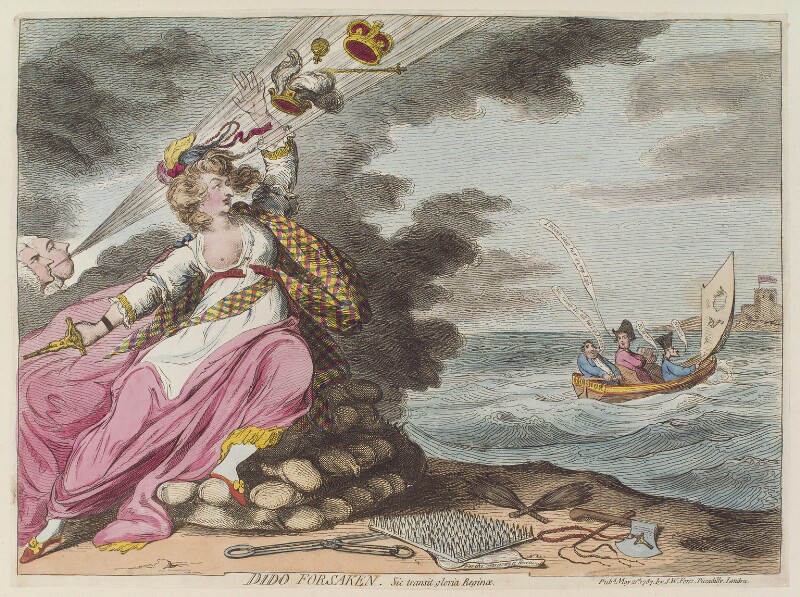
My mini-survey was inspired by my previous post on Venetia Murray's An Elegant Madness: High Society in Regency England. That post included a caricature by James Gillray in which the Prince of Wales is cast as Aeneas and his mistress Mrs. Fitzherbert as Dido:

"DIDO FORSAKEN. Sic transit gloria Regina [Thus passes the glory of the Queen]." George, Prince of Wales: "I never saw her in my Life." Steersman Charles Fox: "No, never in all his Life, Damme." Frederick North: "No, never." Edmund Burke: "Never." Caricature by James Gillray, published by Samuel William Fores, 21 May 1787. Image source: National Portrait Gallery NPG D12994

(For a fuller explanation of the historical circumstances of the caricature, please see An Elegant Madness; for a discussion of its imagery, please see that post's footnote #4.)

The story being referenced in the caricature is from Virgil's Aeneid. The Trojan hero Aeneas, escaping from the destruction of Troy with a few ships and a few dozen men, finds shelter at Carthage, ruled by the widowed Queen Dido. At a court banquet Aeneas tells the harrowing story of the fall of Troy and his escape from the burning city. Dido, to her dismay, finds herself falling in love with the hero. Aeneas' fate, though, is to sail to Italy and found Rome, and when the gods send Mercury to remind him, he abandons Dido. She kills herself with a sword Aeneas gave her as a gift; as his ships sail away, Aeneas sees the smoke from Dido's funeral pyre rising behind them.

Nahum Tate's libretto for Purcell's opera alters Virgil's epic by removing the gods as agents of Dido's destruction and substituting a sorceress whose hate for Dido inspires her to send a spirit ("in the form of Mercury") to command Aeneas to leave Carthage. Dido does not commit suicide but dies of heartbreak. Schoolgirls could hardly depict self-murder, although the implication that Dido and Aeneas consummate their love at some point between the Palace and the post-coital Grove scenes (Aeneas sings "one night enjoy'd/the next forsook") is certainly eyebrow-raising—perhaps it was acceptable for unmarried young women to enact Dido's story as a cautionary tale. For more on the opera, please see Opera Guide 1: Dido and Aeneas.

In Gillray's caricature, the dialogue of the men in the boat and its repetition of "never" is likely a reference to the First Sailor's song from Dido and Aeneas:

Come away, fellow sailors, your anchors be weighing,
Time and tide will admit no delaying.
Take a boozy short leave of your nymphs on the shore,
And silence their mourning with vows of returning,
But never intending to visit them more,
No never intending to visit them more,
No never, no never intending to visit them more.

Discovering the caricature and its apparent quote from Dido and Aeneas sent me to listen to opera once again, and in choosing the link to the First Sailor's song I began to make comparisons among several performances. I limited myself to period-instrument versions of the opera, and ultimately chose six to survey, given in the table below:

Role Arkiv Produktion, 1988 L'Oiseau-Lyre, 1992 Harmonia Mundi, 1993 Erato, 1994 Chandos, 1995 Rhombus Media, 1995
Dido Anne Sofie von Otter Catherine Bott Lorraine Hunt Véronique Gens Maria Ewing Jennifer Lane
Aeneas Stephen Varcoe John Mark Ainsley Michael Dean Nathan Berg Karl Daymond Russell Braun
Sorceress Nigel Rogers David Thomas Ellen Rabiner Claire Brua Sally Burgess Jennifer Lane
Belinda Lynne Dawson Emma Kirkby Lisa Saffer Sophie Marin-Degor Rebecca Evans Ann Monoyios
Second Woman Sarah Leonard Julianne Baird Donna Deam Sophie Daneman Patricia Rozario Shari Saunders
Witches Elizabeth Priday
Carol Hall
Elizabeth Priday
Sara Stowe
Christine Brandes
Ruth Rainero
Sophie Daneman
Gaëlle Mechaly
Mary Plazas
Pamela Helen Stephen
Shari Saunders
Meredith Hall
Spirit Kym Amps Michael Chance Christine Brandes Jean-Paul Fouchécourt James Bowman Meredith Hall
First Sailor Nigel Rogers Daniel Lochmann Paul Elliott Jean-Paul Fouchécourt Jamie McDougall Benjamin Butterfield
Conductor Trevor Pinnock Christopher Hogwood Nicholas McGegan William Christie Richard Hickox Jeanne Lamon
Orchestra The English Concert The Academy of Ancient Music Philharmonia Baroque Orchestra Les Arts Florissants Collegium Musicum 90 Tafelmusik Orchestra
Chorus Choir of The English Concert Chorus of The Academy of Ancient Music Choir of Clare College, Cambridge Soloists, plus Steve Dugardin (alto) and Jonathan Arnold (bass) Collegium Musicum 90 Choir Tafelmusik Chamber Choir

This is not an exhaustive list of period-instrument versions by any means. But just as I prefer the sound of historical instruments in this music, I favor a particular voice type in the role of Dido, which eliminated several possibilities.

Dido is a sorrowful figure from the first moments of the opera: the words of her first aria, addressed to her sister Belinda, relate her torment and grief at the love for Aeneas that as queen she must conceal. A young woman might be joyful at newfound love; Dido, older and wiser, understands that falling in love could be disastrous (as, indeed, it turns out to be).  Singers performing this role must combine both depth of emotion and nobility of expression. The role also spans a wide range, and requires a strong lower register.

So I prefer a mezzo-soprano Dido; high sopranos Emma Kirby for Andrew Parrott, Lynne Dawson for René Jacobs, and Julianne Baird for Valentin Radu have the wrong sound, to my ears, and so those recordings were not included in the survey. (I made an exception for Véronique Gens, one of my favorite singers, with William Christie.) I also prefer a baritone Aeneas and a mezzo-soprano or alto Sorceress, although having another voice type in those roles did not automatically eliminate a recording. (After all, we have evidence that at the original performances at Josias Priest's school Aeneas was sung by a young woman.)

Finally, the surviving music is scored for strings and continuo. Adding winds (as do both Jacobs and Emmanuelle Haïm) has no specific justification. Nor does repeating the first section of the overture (as do both Jacobs and Haïm), which has no repeat sign in the early scores. I far prefer versions that rely on the existing musical evidence over interventionist approaches that attempt to "improve" Purcell.

Taking my selections in chronological order:

The English Concert & Choir conducted by Trevor Pinnock. Image source: Presto Music

For Trevor Pinnock's version on Archiv, Anne Sofie von Otter has the requisite regal gravity. But at the words "Remember me" in her final aria von Otter sings "Remombah mah!," calling attention not to the despair of the character, but to the difficulty of singing the highest notes of the role. In his survey linked above, Ralph Moore says that "Von Otter’s final scene is up with the best." This pronunciation flaw is so obtrusive I can't agree; your judgment may differ.

Stephen Varcoe in the bass-baritone role of Aeneas sounds quite similar to tenor Nigel Rogers' Sorceress. While it could be a dramatic choice to depict both Aeneas and the Sorceress as linked agents of Dido's destruction, this feels more like Pinnock was simply following the tradition established in the 18th and 19th centuries for a male Sorceress. As for Rogers, according to Ellen Harris' Henry Purcell's Dido and Aeneas, 2nd edition (Oxford, 2018), the earliest surviving manuscript of the score, from 1700, sets the Sorceress's part in the mezzo-soprano range; in later 18th-century sources the part is written for bass. I prefer a woman in this role; in any case, here I agree with Moore about Rogers that "there is little of menace or the macabre in his threats—he just sounds like a bloke singing the Sorceress' words."

Pinnock's tempos are stately, and as a result this version feels sluggish and lacks dramatic drive at key points. (Characteristically, Pinnock's overture takes 2:20, versus 2:04 for Hogwood, 1:54 for Christie and Hickox, and 1:51 for McGegan.) Taken together these issues are sufficiently bothersome for me to recommend against this version. However, Matthew Boyden in The Rough Guide to Opera, 3rd edition (2002), selects it as one of his top choices.

Chorus and Orchestra of The Academy of Ancient Music conducted by Christopher Hogwood. Image source: Presto Music

Speaking of blokes singing the Sorceress' words, bass David Thomas on Christopher Hogwood's L'Oiseau-Lyre version is even worse than Rogers. Singing in an exaggerated, affected way, Thomas sounds like a pantomime dame. Here is the Sorceress's first appearance, "Wayward sisters":

https://www.youtube.com/watch?v=m81q1Lp9Xog

The witches have also been directed by Hogwood, unsuccessfully, to camp it up (Stowe in particular just sounds excessively nasal). Hogwood makes another odd choice: the First Sailor, Daniel Lochmann, is a boy treble, making incongruous his admonition to his fellow sailors to "take a boozy short leave of your nymphs on the shore." If David Thomas evokes a panto dame, the First Sailor sounds like he's wandered in from a production of Oliver. John Mark Ainsley is a tenor Aeneas, and although he has a good voice, I prefer a bass-baritone in the role.

Finally, Catherine Bott's mezzo-soprano is not particularly rich or resonant, particularly in the role's lower range, and her manner is strangely detached: when she sings "I am press'd with torment," she hardly sounds it, nor does her final scene sound like a woman facing the end of her hopes, and her life. (Bott does sing a beautifully floated and correctly pronounced "Remember me!"). With these substantial problems, I can't recommend this version either, although it is given an "Outstanding" rating in the Gramophone Classical Good CD Guide 2004.

The Choir of Clare College, Cambridge and the Philharmonia Baroque Orchestra conducted by Nicholas McGegan. Image source: Presto Music

I confess that I can't be fully objective about Nicholas McGegan's version on Harmonia Mundi: McGegan and his Philharmonia Baroque Orchestra were in the pit for our first performances of the opera by the Mark Morris Dance Group, our Baroque opera conversion experience, and his was the first recording of this work we heard.

McGegan does make two missteps, in my view, which I'll address straight away. The first is casting contralto Ellen Rabiner as the Sorceress. Her pronounced vibrato and Wagnerian vocal style set her apart from the rest of the cast. Rabiner is a significant improvement over either Thomas or Rogers, and casting a low female voice in the role of the cave-dwelling Sorceress is a choice that could have worked extremely well. However, I regret that McGegan didn't opt for Jennifer Lane (who sings the dual roles of Dido and the Sorceress for Jeanne Lamon on the DVD of the Mark Morris production) or Judith Malafronte (who sang Dido and the Sorceress for McGegan when we saw the Mark Morris production live).

McGegan's second misstep is to immediately follow the final scene of the opera with Purcell's music for The Gordian Knot Unty'd. This is clearly done to fill out the CD, which would otherwise be only 50 minutes long. The contrast, though, between the moving final chords of Dido's death scene and the dance-filled incidental music to The Gordian Knot Unty'd is jarring. Fortunately this is a fault easily remedied by CD programming, playlist editing, or just hitting the stop button. Dido does not need any fillers.

The performances of the witches and sailors (soloists and chorus) are quite characterful. The witches have a kind of wild, sinister hilarity, and Paul Elliott's First Sailor is sung as an authentic-sounding Jack Tar. This theatrical approach may bother some listeners, but I find that (unlike Hogwood's) McGegan's direction doesn't go over the top, but rather enhances the flavor of the proceedings—this is, after all, a stage work.

But the glory of this set is Lorraine Hunt's Dido, a role perfect for her plangent mezzo-soprano. Hunt is regal and conveys deep feeling; a better embodiment of the tragic queen is impossible to imagine. Helped by McGegan's urgent pacing, Hunt also summons fierce anger in Dido's final confrontation with Aeneas, when she rejects his last-minute change of heart and promise to stay. And her sorrowful closing lament simply stops time. We are fortunate indeed to have this record of Hunt's performance.

Dido's first aria, expressing her foreboding about her developing feelings for Aeneas, "Ah! Belinda, I am press'd with torment":

https://www.youtube.com/watch?v=Tz9aXLHIjzA

Hunt's performance makes this version my first choice. Hunt would go on to powerfully portray other tragic women, including Medea (Charpentier's Médée, recorded with William Christie in 1994), Irene (Handel's Theodora, recorded with William Christie in 1996), Phédre (Rameau's Hippolyte et Aricie, recorded with William Christie in 1997), Empress Octavia (Ottavia in Monteverdi's L'Incoronazione di Poppea, at SF Opera in 1998), and Berlioz's Dido (Didon in Les Troyens, at the Metropolitan Opera in 2003). Her death from breast cancer at age 52 in 2006 was a profound loss.

Les Arts Florissants conducted by William Christie. Image source: Presto Music

Given the French influences on Stuart society in the 1680s—the mother of James II, Henrietta Maria, was French, and as a young man James served in the army of Louis XIV—it is certainly defensible to perform Dido and Aeneas in French style. And William Christie's version on Erato has many virtues. As with McGegan's recording, Christie's benefits from extensive experience in staged opera, and offers dynamism and drama (at 45 minutes it's the shortest version in this survey). It also has the suitably heroic Aeneas of Nathan Berg, and the excellent Sophie Daneman as Second Woman and First Witch. The Second Woman's recounting of the tale of Diana and Actaeon, "Oft she visits this lone mountain":

https://www.youtube.com/watch?v=B4yP26skIZg

However, there are also some noteworthy issues. Most of the cast (the British Daneman and the Canadian Berg aside) sing their English lines with light but detectable French accents. (Of course, French, Italian, and German audiences must frequently listen to non-native opera singers outright massacre their languages, so being bothered by this seems unfair; still.) Claire Brua's Sorceress "is a splendidly insinuating conception, with a slithering melodic style," according to the Gramophone guide; you may feel, as I do, that her sliding around the notes is overdone, as are the witches' sneering voices. As Dido, Véronique Gens has a lovely voice and beautifully expresses the tragic nature of character, but the role lies a bit low for her pure soprano. She isn't quite able to offer the vocal richness of Lorraine Hunt (see above) or Jennifer Lane (see below), particularly in the role's lowest range. 

Finally, Christie's chorus seems to be largely made up of the soloists. While this was a common practice in Italian opera seria, which typically only had one short final ensemble, it would probably not have been the case for this opera, where the chorus has such a prominent role and is onstage simultaneously with the principals. Not only does Christie's small chorus lack the impact of a larger group, but as Ralph Moore points out in his survey, their voices don't blend particularly well. 

I find these drawbacks to be significant; however, my reservations are not shared by the Gramophone guide, which gives it a "Recommended" rating.

Collegium Musicum 90 conducted by Richard Hickox. Image source: Presto Music

Richard Hickox's recording on Chandos served as the soundtrack for a BBC film of the opera directed by Peter Maniura, broadcast on PBS in 1996. In the film the setting was shifted from ancient Carthage to the Renaissance, with Hampton Court picturesquely serving as Dido's palace. Apart from giving the filmmakers the opportunity to raid the BBC's vast store of sumptuous costumes, the film's main virtue is to give Maria Ewing's Dido a visual dimension. She was one of the great singing actresses of her generation, and seeing her performance (despite the occasional lip-synching problems) adds to its impact. 

The visual dimension doesn't hurt the handsome Karl Daymond's portrayal of Aeneas, either. And having an Aeneas that is visibly younger than Dido works well dramatically: it implies that Dido sees in Aeneas her last chance of a great passion.

On CD, as a purely aural experience, Ewing's operatic vocal style, and particularly her prominent vibrato, is more bothersome. Here is "Your counsel all is urg'd in vain," Dido's final confrontation with Aeneas after she learns that he is leaving:

https://www.youtube.com/watch?v=SW1Y18-dzyE

Ewing's dramatic engagement is not in question, but her vibrato is a matter of taste, and I prefer other singers in this role. But what's also apparent from this excerpt is that, perhaps due to his relative inexperience with opera, Hickox takes this dramatic scene at far too slow a pace; McGegan's and Christie's versions are both well under four minutes long, while Hickox takes nearly four and a half minutes. Although I think the film version is worth seeing, the combination of the slack pacing and Ewing's vibrato rule out the CD version of this performance for me. In his survey Ralph Moore disagrees, calling it "a top contender" and "highly recommendable."

Tafelmusik Orchestra and Chamber Choir conducted by Jeanne Lamon. Image source: Mark Morris Dance Group

This video preserves Morris' performance in the double role of Dido and the Sorceress in what is perhaps his most moving work. Jeanne Lamon's conducting emphasizes the opera's tragedy with slow tempos, perhaps to enable the dancers to more easily execute the gestural choreography. But as a purely musical experience it lacks the headlong, inexorable rush towards the final tragedy that McGegan's or Christie's version provides. 

Vocally, Jennifer Lane and Russell Braun are an excellent central couple. And, paralleling Morris' double role, Lane sings both Dido and the Sorceress (she is easily the best Sorceress in this survey). The double roles suggest that, as Joan Acocella writes in her great book on Morris (FSG, 1993), the Sorceress is "an anti-Dido," just as her coven of witches is the evil mirror image of the courtiers who surround the queen. The double casting may also suggest that the Sorceress is a self-destructive aspect of Dido. As Roger Savage has written:

It can be argued that. . .all the [female] characters in the opera are really personified aspects of Dido: Belinda and the Second Woman projections of her yearning towards erotic fulfillment, the Sorceress a formidable anti-self embodying all her insecurities and apprehensions of disaster contingent on her involving herself in any deep personal relationship, and the two solo witches nightmarish shadows of Belinda and the Second Woman. [1]

Barbara Willis Sweete's direction is sometimes distracting—we don't really need to see the singers floating on and off the screen again after their first appearance—but this film is an invaluable record of one of Morris' greatest works.

Highly recommended: McGegan, Harmonia Mundi; Lamon, Rhombus Media


  1. Roger Savage, Producing Dido and Aeneas: An investigation into sixteen problems. In Michael Burden, ed. The Purcell Companion, Amadeus Press, 1995, pp. 445-468.

Sunday, January 13, 2013

Les Troyens


Who can describe the havoc of that night?
Who can tell its deeds of death? Who can with tears
Equal in sorrow its calamities?
Our ancient and imperial city falls.
All around, on streets, in homes, at temples
sacred to the gods, lifeless bodies lie.
Nor is it only Trojan blood that flows:
The vanquished too at times with courage burn,
And conquering Grecians fall. On every side
Are cruel wailings heard, and everywhere
Is fear, with countless scenes of death.
—Virgil, The Aeneid, Book II, lines 361-369
(translated by Benjamin Hall Kennedy and Pessimisissimo)

Hector Berlioz's Les Troyens (The Trojans, completed 1858) portrays episodes from Books II and IV of Virgil's Aeneid: the fall of Troy, Aeneas' escape with a handful of men to Carthage, the love of Aeneas and Queen Dido, Aeneas' departure for Italy and Dido's anguish and death. The opera is suitably epic in scope. The five acts, which include symphonic and ballet interludes and require huge choral forces, take more than five hours to perform.

The difficulties of staging Les Troyens are so daunting that Berlioz never saw a complete performance. The last three acts were presented in a heavily edited version in 1863 as Les Troyens à Carthage, but the full opera wasn't produced until decades after Berlioz's death. Since then, complete performances have remained rare, and only larger opera houses have the resources to contemplate a production.

The Metropolitan Opera in New York is one of those houses, and after the work's Met premiere in 1973 it has staged the opera every decade since. On January 5, 2013, we went to see the Met Live in HD broadcast of this season's remounting of Francesca Zambello's 2003 production. While I had mixed feelings about aspects of the production, I was grateful to have the opportunity to see the opera at all (it hasn't been staged by the San Francisco Opera since the late 1960s).

And in one respect the production was revelatory: young American tenor Bryan Hymel (pronounced EE-mel), who, we learned, had stepped in for Marcello Giordani on short notice in mid-run, proved to be an absolutely thrilling Énée. Here is an audience-shot video of Hymel singing the Act IV love duet with the Didon of Yvonne Nafe from the 2010 Amsterdam production. Even with not-great sound and image, it will give you at least an idea of what we heard:


The words, written by Berlioz himself, are: "Nuit d’ivresse et d’extase infinie! / Blonde Phoebé, grands astres de sa cour, / Versez sur nous votre lueur bénie; / Fleurs des cieux, souriez à l’immortel amour!" (Night of rapture and boundless ecstasy! / Golden Phoebe, and you, great stars of her court, / pour on us your enchanted light; / Flowers of heaven, smile on our immortal love!)*

As this excerpt suggests, Berlioz's music for Les Troyens, particularly in the more intimate or inward moments in the second part, is often exquisite (another example is Hylas' wistful lament for his Trojan homeland which opens Act 5, and which was sung beautifully by Paul Appleby).

Susan Graham was Hymel's Didon, and while her voice does not have the opulence of her 2003 predecessor, Lorraine Hunt Lieberson, she was admirable in this emotionally and physically exhausting role. Deborah Voigt reprised her role as the prophetess Cassandre from the 2003 production, and seemed somewhat taxed in the lower-lying reaches of the music (the part was written for a mezzo-soprano). The Met has resources other opera houses can only envy; the secondary roles were taken by singers of high caliber, including baritone Dwayne Croft (Chorèbe, Cassandre's betrothed), contralto Karen Cargill (Anna, Dido's sister), and bass Kwangchul Youn (Narbal, Dido's advisor). Fabio Luisi conducted with apparently inexhaustible energy, though I couldn't help but wish we could hear what James Levine would have brought to the score.

Lorraine Hunt was also a deeply affecting Dido in the recording with Nicholas McGegan and the Philharmonia Baroque Orchestra of Henry Purcell's 1689 chamber opera Dido and Aeneas. To give you a sense of the scale of Les Troyens, to perform the entirety of Purcell's opera takes less time than any one of the five acts of Berlioz's sprawling epic.

I'll close with Lorraine Hunt Lieberson performing Didon's lament after she learns of Énée's betrayal, "Je vais mourir" (I am going to die); note the return of "Nuit d'ivresse" as if in a memory:


This excerpt is from the 2003 Met production; could there be a more compelling case for an official release of the full-length performance?

Update 8 June 2015: Yesterday we attended the opening performance of Les Troyens at San Francisco Opera, the first fully staged production of this work here since 1968 (that's 47 years). This production featured Anna Caterina Antonacci as Cassandre, Brian Hymel as Enée, Susan Graham as Didon, and Sasha Cooke as Anna, Didon's sister. As you might expect from this partial cast list, the opera was superbly sung. The secondary characters were also strongly cast. Didon's advisor Narbal was sung by Christian Van Horn, excellent as the four villains in the SF Opera production of Offenbach's Tales of Hoffman two years ago; Brian Mulligan, whom we've seen at SF Opera as Marcello in Puccini's La Bohème and as Sharpless in Madama Butterfly, also impressed as Cassandre's lover Chorèbe.

While it's difficult to single out particular moments from such a beautifully realized performance, highlights included every moment the fierce Antonacci was onstage, Enée's anguished realization that he must betray Didon, "Intuile regrets" (Futile regrets), and Didon's final lament, "Je vais mourir" (I am going to die). The exquisite love duet between Enée and Didon, "Nuit d'ivresse," simply stopped time.

Less well-realized was the production by David McVicar, which was often incoherent. The first two acts, "The Capture of Troy," feature costumes and war materiel that suggest the Crimean conflict of the mid-1850s, but this suggestion seems to be largely abandoned in the last three acts, "The Trojans at Carthage." There are unfortunate directorial choices: at the end of the first act, Cassandre collapses onstage; when after a brief pause the scrim rises for Act II, there is a body lying in just about the same place. Cassandre? No—it turns out to be Enée. There is some unfortunate choreography (originally by Lynn Page, re-created by Gemma Payne): during the Act IV revels that precede "Nuit d'ivresse" I turned to my partner and whispered, "Someone has seen Mark Morris" (attempted borrowings from his Dido & Aeneas and L'Allegro were particularly apparent). She whispered back, "Yes—but not enough." And there are unfortunate design choices (Es Devlin did the sets): the onstage model of Carthage in the last three acts (an element that also appears in the Metropolitan Opera's Francesca Zambello production; perhaps it's called for in the libretto) should be cut immediately, the appearance of the Trojan Horse is initially effective but its rocking movement and unimpressive pyrotechnical effects soon replace awe with eye-rolling, and at the end of the opera the vision of Roman triumph over Carthage that arises from a continually smoking heap of metal is just...bad.

The ineffective moments in the production, though, can be ignored. The sublime singing of the cast and the inspired playing by the SF Opera Orchestra under conductor Donald Runnicles are memories we'll treasure.

--

* Berlioz's complete libretto for Les Troyens can be found can be found on The Hector Berlioz Website.

Wednesday, February 17, 2010

Agrippina

Handel's Agrippina (1709) is a wickedly entertaining opera filled with some of the most delightfully conniving and underhanded characters since Monteverdi's Coronation of Poppea (1642). And that's no coincidence: Agrippina is a kind of prequel to the earlier opera and features many of the same morally suspect characters: the soon-to-be-emperor Nerone (Nero, here a petulant adolescent), the seductive Poppea, the wronged Ottone (Otho). Added into the mix are Nero's ruthlessly scheming mother Agrippina, who'll stop at nothing to see her son crowned emperor, the aged current emperor Claudio (Claudius), and two buffoonish freedmen, Pallante (Pallas) and Narciso (Narcissus), who do Agrippina's bidding in the hope of being rewarded with her love. In another parallel to the earlier opera, Agrippina has a similarly amused, skeptical tone. What's surprising is that this cynical and ironic (rather than morally disapproving) take on these backstabbing and corrupt characters was created by a cardinal, Vincenzo Grimani, who wrote the opera's libretto and probably commissioned the music from Handel.

And of course Grimani could rely on his audience's knowledge of the characters and their tangled relationships. Historically, everyone who features in the opera came to a bad end: depending on which Roman historian you believe, Agrippina had Claudius and Narcissus murdered, while she herself was killed by Nero (as were Poppea and Pallas), and both Nero and Otho ultimately became emperors who were forced to abdicate by committing suicide. But ignoring the bloody reality, the opera's plot verges at times on bedroom farce, perhaps as Grimani's satire of the mores of the Papal Court.

The action takes place a few years after the marriage of Agrippina and Claudio, and conflates and compresses historical events. As it opens, Claudio is reported lost at sea as he returns from the conquest of Britain (which occurred a decade earlier, but never mind). Agrippina and her co-conspirators Pallante and Narciso waste no time in declaring the teenaged Nerone to be emperor. To everyone's consternation, though, Ottone arrives and announces that he has rescued Claudio from drowning, and as a reward for saving the emperor's life he himself been named as the next emperor. He then unwisely confides in Agrippina that he cares more for the love of Poppea than for power. Agrippina, knowing that Claudio is also besotted with Poppea, then tells her falsely that Ottone has given her up to Claudio in exchange for the throne, and convinces her to get back at him by telling Claudio that Ottone wants her for himself.

This leads to a brilliant scene halfway through the second act where Ottone, expecting to be crowned by Claudio, is instead denounced by him as a traitor. Ottone then appeals to Poppea, Agrippina and Nerone in turn for their intercession, only--to Ottone's shock and bewilderment--to be spurned by each of them.

Another great sequence occurs in the third act, when Ottone, Claudio, and Nerone arrive in Poppea's bedroom in succession, and she has each one conceal himself to eavesdrop. She uses the situation to turn the tables on Agrippina and Nerone; it's like something out of a Rossini farce.

Handel and Grimani even parody the conventional happy ending of opera seria. In a burst of magnanimity Claudio declares that he will crown Ottone emperor after all, and marry Nerone and Poppea. Waiting to be acclaimed for his wisdom and justice, instead he sees the stricken looks on everyone's faces, realizes his error and hastily switches the rewards of Ottone and Nerone. (Of course, in real life Poppea wouldn't wait long before dumping Otho for Nero, while Otho was not nearly as power-shy as he appears here--he was one of the successors to Nero in the Year of the Four Emperors.)

I don't want to make Agrippina sound too comic, because (as ever with Handel) it contains some ravishing music that lends emotional weight to the characters' dilemmas. Here is Ann Hallenberg singing Agrippina's thrilling Act II aria "Pensieri, voi mi tormentate":


Thanks to stolof for posting this live recording conducted by Fabio Biondi from the 300th anniversary production of the opera at Teatro La Fenice in Venice, the city where the opera had its 1709 premiere. The words are: "Pensieri, voi mi tormentate. / Ciel, soccorri a mie disegni, soccorri ciel! / Il mio figlio fa che regni / E voi Numi il secondate!" In English, "Thoughts, you torment me. / Heaven help me in my plan! / To bring my son to the throne. / Gods, help me!"

Another remarkable thing about this aria is its structure. A typical da capo aria ends after its first section is repeated. However, Handel plays with those expectations: after the aria is apparently over, Agrippina has several lines of recitative and arioso, and then the A section returns again for a final time (the recitative begins at about 5:00, and the second repeat of the A section at 5:45). It's as though she can't help herself: she's obsessively returning to her plans and her hopes for their success. Even though Handel was only 24 when he wrote Agrippina, he was already subverting the conventions of opera seria to make his characters more psychologically rich.

Performances and recordings of Agrippina are still comparatively rare, especially for such a musically brilliant, funny, and stylistically fresh work. I first heard excerpts from Agrippina on Arias for Durastanti, with Lorraine Hunt (later Lieberson) performing what became for me definitive versions of "Ogni vento" and "Pensieri" (Nicholas McGegan conducting; Harmonia Mundi HMU 907056). I then turned to the full-length John Eliot Gardiner recording from 1991-1992 (originally released in 1997, and recently reissued; Philips 4380092). Although it has many excellent qualities, for some reason I've always found it vaguely dissatisfying. It features Della Jones as Agrippina, Alastair Miles as Claudio, Michael Chance as Ottone, Derek Lee Ragin as Nerone, and Donna Brown as Poppea. Perhaps it's because Jones' voice isn't as rich as Hunt's (when the oboe enters in "Pensieri," it sounds eerily as though Hunt is suddenly dueting with herself), or perhaps the fault is Jones' characterization--she simply doesn't convey the same strength and fierceness as Hunt (and what's Agrippina without a strong Agrippina?). Speaking of characters who lack power, Michael Chance's soft countertenor lacks the fullness that a female contralto would have brought to the role of Ottone (it was originally written for a woman, Francesca Vanini-Boschi). A pleasant surprise, though, is Alastair Miles' commanding bass as Claudio. Perhaps too commanding--after all, Claudio is supposed to be an enfeebled and besotted old man.

A countertenor Ottone (Thierry Grégoire, not a huge improvement over Chance) is also employed in the stage version of Agrippina from Théâtre Municipal, Tourcoing, France, conducted by Jean-Claude Malgoire and released on DVD in 2004 (Dynamic DVD 33431). My main problem with this version, though, isn't so much with the generally good cast, which includes the vocally alluring Véronique Gens as Agrippina and a young Philippe Jaroussky as Nerone. It's with Frédéric Fisbach's staging, which places many of the characters in unnaturally-colored fright wigs, offers a starkly minimal, unatmospheric set, and forces Gens to sing "Ogni vento" under a projection of something that looks like a child's drawing of a alien spaceship (you can see it here; any guesses as to what it might mean are welcome, because I find it utterly mystifying). As with Gardiner's recording, a highlight of this version is the performance of the Claudio, Nigel Smith, though again he seems a bit too youthful and vigorous for the role. If you're tempted by this one you might want to skip the images and just listen to it on CD (Dynamic 43113), though there the limitations of live sound are probably more apparent.

Given the flaws of the Gardiner and Malgoire sets, I can only hope that conductors like Alan Curtis, Marc Minkowski, Christophe Rousset, or William Christie have this wonderful opera in their near-future recording plans.

Friday, January 4, 2008

Opera guide 1: Dido & Aeneas

This is the first installment in what is going to be an open-ended series on my favorite operas.

Henry Purcell's Dido & Aeneas (1689) is an oddity among 17th-century operas. Most Baroque operas are 3 hours long or more, and have a happy ending, however contrived; Dido takes less than an hour to sweep from the introduction of the characters to its tragic conclusion. The primary language of Baroque opera is Italian (although there's also a parallel French tradition); Dido is in English. As a result of its unusual qualities, Dido is an ideal starting point for anyone (or at least, any English speaker) interested in exploring opera, and particularly Baroque opera. Another reason it's ideal is that the music is very tuneful and, especially at key moments, ravishingly beautiful.

The outline of the story is taken from Book IV of Virgil's Aeneid. In Virgil's great poem, Aeneas, fleeing with a few followers the destruction of Troy by the Greeks, finds a safe haven in Carthage, ruled by Queen Dido. Against her better judgment Dido finds herself falling in love with the valiant warrior, a love that is fatefully consummated when, during a hunting party, the couple take shelter from a sudden storm in a secluded cave. Soon, however, Mercury--the messenger of Jupiter--appears to Aeneas and commands him to sail to Italy to found, in Rome, a new Troy. The abandoned Dido, angry, heartbroken and desperate, commits suicide out of "the grief / Of lovers bound unequally by love" (in Robert Fitzgerald's translation[1]); Aeneas, from the deck of his ship heading seaward, sees the smoke rising from her funeral pyre.

Purcell's librettist, the poet Nahum Tate, was famously called "a cold writer, of no invention" by Alexander Pope in The Dunciad. But Tate's changes to Virgil's story actually make it more dramatically complex and stageworthy. He introduces the character of a sorceress, who is Dido's sworn enemy and who plots to destroy her; the scenes in the witches' cave are delightfully dreadful. In the opera it is the sorceress who sends a spirit "in form of Mercury himself" to command Aeneas to leave Carthage; and in Tate's version it is not just Dido's pyre, but the entire city that burns (although Tate is discreetly inexplicit about the cause of Dido's death).

Any performance of Dido & Aeneas succeeds or fails on the basis of its Dido, and my favorite recording of the opera features Lorraine Hunt (later Lorraine Hunt Lieberson) in the role. She is a powerfully moving Dido, especially in her two great tragic arias: "Ah! Belinda, I am press'd" and "When I am laid in earth." Nicholas McGegan conducts the period-instrument Philharmonia Baroque Orchestra beautifully: he's sprightly in the dance sections, but brings out the full pathos of Dido's tragic arias. McGegan does go for a very characterful portrayal of the witches and sailors, which may bother some people. And while Michael Dean is a good Aeneas, Ellen Rabiner's Sorceress has a broad vibrato that makes her sound as though she's been airlifted in from some Wagner opera. But despite these minor stylistic issues and several other fine recordings, Lorraine Hunt's Dido makes this my first choice.

Here is Hunt's performance of Dido's first aria, "Ah! Belinda, I am press'd":


The words are, "Ah! Belinda, I am press'd / With torment not to be confess'd. / Peace and I are strangers grown; / I languish 'til my grief is known / Yet would not have it guess'd."

Many modern productions portray the sorceress as an aspect of Dido, and the roles are often performed by the same singer. Choreographer Mark Morris created a danced version of the opera in which he brilliantly enacted both Dido and the Sorceress; this is Dido's death scene (Dido is sung by Jennifer Lane):


The Mark Morris Dance Group, 1994

(Again, if the image doesn't load for some reason, here is a direct link.) Some of the commenters about this clip on YouTube are obviously nonplussed that Dido is being portrayed by a man. They are clearly unaware of how thoroughly gender was bent in Baroque opera. While a male Dido is unusual, a male sorceress is less so (perhaps it enhances her uncanniness). But even more surprising, in the first performance of Dido it's likely that the role of Aeneas was sung by a woman.

A single copy survives of the libretto from the first performance, "by Young Gentlewomen" at a boarding school for girls in 1689.[2] Recently a libretto for John Blow's Venus & Adonis was discovered which was printed for an April 1684 performance of that opera at the same girls' school.[3] The Venus libretto mentions that it was "Perform'd before the King. Afterwards at Mr. Josias Priest's Boarding School at Chelsey." Since Dido was modelled on Venus, some musicologists have speculated that Dido also must have been first performed at court. However, while both an early score and the libretto for Venus explicitly mention a court performance, the sole existing contemporary libretto for Dido does not. The 1684 libretto for Venus does have contemporary hand-written annotations indicating that the part of Adonis was sung by Priest's daughter; presumably the same practice--that is, having all the parts sung by women--was also followed in the 1689 Dido performance.

Alas, no score has yet been discovered that dates from Purcell's short lifetime (he died in 1695, in his mid-30s). The earliest surviving score is from around 1750, although it was apparently copied from a pre-1720 source.[4] There is a prologue in the libretto for which no music has been found, and other issues (such as the original range of the parts of Aeneas and the Sailor) that will remain a matter of speculation.

Nonetheless, what has survived is dramatically compelling and spectacularly beautiful. If you're unfamiliar with Dido & Aeneas, the Lorraine Hunt Lieberson recording is an excellent place to begin your acquaintance.

------------------------------------------------

1. Virgil. The Aeneid. Robert Fitzgerald, trans. New York: Vintage, 1983.

2. Ellen Harris. Henry Purcell's Dido and Aeneas. Oxford: Clarendon Press, 1987.

3. Richard Luckett. A new source for 'Venus and Adonis'. The Musical Times, v. 130 (no. 1752), Feb. 1989, 76-79.

4. A. Margaret Laurie. Allegory, sources, and performance history. In Curtis Price, ed., Henry Purcell: Dido and Aeneas: An authoritative score (pp. 42-59). New York: Norton, 1986.