Showing posts with label music - Beethoven string quartets. Show all posts

Monday, September 7, 2020

Black Beethoven and the Black Mozart


Portrait of Beethoven (detail), by Joseph Maehler, 1805

Was Beethoven Black?

It's no surprise that in a year of reckoning with systemic racism the speculation that Beethoven had African ancestry has resurfaced. (Of course, every human who has ever lived has African ancestry, but I don't think that's what's meant. Also, let's not forget that race is a social, rather than biological, category. But I digress.)

The evidence is circumstantial: Beethoven's complexion was described by acquaintances as dark, his nose was described as round, and he was nicknamed "The Spaniard." Beethoven's family history has been traced back several centuries, and was Flemish, but of course nothing can be ruled out.

In "Beethoven was black" (The Guardian, 7 September 2020) Philip Clark writes that the speculation may have originated in an interview with the composer Samuel Coleridge-Taylor, whose father was from Sierra Leone and whose mother was a white Englishwoman. Coleridge-Taylor noted the resemblance between his own features and Beethoven's, as described by contemporaries and represented in engravings and paintings. But Coleridge-Taylor was using the question of Beethoven's identity to highlight the racial prejudice he himself had just experienced during a recent visit to the United States: "If the greatest of all musicians were alive today, he would find it impossible to obtain hotel accommodation in certain American cities."

Following up on Coleridge-Taylor's insight, it's especially interesting to me that the question of Beethoven's race seems to recur during moments of widespread black political mobilization. Coleridge-Taylor's interview took place in 1907, just a few years after the publication of W.E.B. DuBois's The Souls of Black Folk (1903) and the founding of the Niagara Movement (1905), and a few years before the founding of the NAACP (1909). Beethoven's ancestry next receives prominent attention, according to musical scholar Dominique-René de Lerma, in J.A. Roger's Sex and Race, Vol. 3 (1944); during World War II, racism's contradiction of American ideals was made starkly apparent as African-Americans fought against fascism abroad but found themselves facing prejudice and violence at home. Rogers provocatively turns the question of Beethoven's race around: "there is not a single shred of evidence to support the belief that he was a white man."

During the Black Power movement of the 1960s, both Malcolm X and Stokely Carmichael asserted that Beethoven was black. In 1969 Rolling Stone carried an article entitled "Beethoven was Black and Proud!," and in his comic strip Peanuts Charles Schulz had Schroeder, on hearing that Beethoven may have been black, discover that all along he's been playing soul music.

This year the question of Beethoven's race has arisen again, in part because issues of racism have once more come to the fore, and partly because it is the 250th anniversary of Beethoven's birth. In a recent article, "Was Beethoven Black?," (Smithsonian Magazine, 23 June 2020) Nora McGreevy quotes University of Michigan history professor Kira Thurman:
There’s a way in which white people, historically, have constantly denied black people any kind of association with genius. And in a lot of ways, there is no figure that we associate more with genius than Beethoven himself. The implication of the idea that Beethoven might be black was so powerful, was so exciting and so tantalizing, because it threatens to overturn how people have understood or talked about race and racial hierarchy in the United States and around the world.
But of course the whole 19th- and early 20th century notion of musical history as a succession of geniuses is precisely what led to the exclusion and neglect of composers who did not fit prevailing (i.e., racist and sexist) models of genius. One of the most exciting developments in classical music during my lifetime has been the rediscovery of music outside of the established canon (see, for example, my post on Anna Beer's Sounds and Sweet Airs: The Forgotten Women of Classical Music).

As Thurman has written, "So instead of asking the question, 'Was Beethoven Black?' ask 'Why don’t I know anything about George Bridgetower?'"


Portrait of George Bridgetower by Henry Eldridge, before 1821. 
Image source: British Museum

Bridgetower was a virtuoso violinist and composer. His father was Afro-Caribbean and his mother was German-Polish. As a child he may have studied with Haydn; he gave concerts before Habsburg Emperor Joseph II and Britain's King George III and Queen Charlotte, and later became first violinist in the orchestra of the Prince of Wales (the future George IV).

In April 1803, at age 24, Bridgetower was invited to Vienna by Prince Joseph Franz Maximilian von Lobkowitz, a patron of Beethoven, to play the set of Beethoven's string quartets (Op. 18) dedicated to the Prince. The violinist charmed and delighted the bearish Beethoven, and he immediately began composing a piece for them to play together at a concert given for Bridgetower's benefit in late May.

The concert was postponed for two days to enable Beethoven to finish composing, and even so he just made it: it wasn't until 4:30 in the morning on 24 May, the day of the concert, that Beethoven asked a student to copy out the first two movements for the violin (the third movement had been composed some time before). In the event there was only time to copy the first movement before the concert began. Patricia Morrisroe in the New York Times, 4 September 2020, describes what happened next:
Beethoven and Bridgetower took the stage for the morning concert, having never rehearsed the piece. Bridgetower was sight-reading.

Beethoven had given Bridgetower an opening solo that began with an explosive declaration, moving into a fiery, sensual dialogue. At one point, Bridgetower surprised Beethoven by imitating and then expanding on a short piano cadenza in the first movement. Beethoven, jumping up, hugged him, crying, "My dear boy! Once more!"

After the performance, Beethoven presented Bridgetower his tuning fork and wrote a dedication on the score: "Sonata mulattica composta per il mulatto Brischdauer, gran pazzo e compositore mulattico" ("Mulatto sonata composed for the mulatto Bridgetower, great mulatto madman and composer").
However, Bridgetower and Beethoven later fell out (it was very easy to fall out with Beethoven). When the piece composed for Bridgetower was finally published in 1805 it was dedicated to another violinist, Rudolphe Kreutzer, and has been known ever since as the "Kreutzer Sonata." The designation is doubly invalid, first because the work was written for Bridgetower, but also because Kreutzer never played it (he found the piece that Bridgetower had sight-read at the first performance to be "unintelligible"). Kreutzer, though, has been immortalized by his tenuous association with this work, while Bridgetower has been largely erased from music history.

The first movement of the Kreutzer Sonata, performed by Itzhak Perlman and Vladimir Ashkenazy:


Was Mozart Black?


Joseph Boulogne, Chevalier de Saint-Georges. Image source: New York Times

Mozart wasn't black, but there was a "Black Mozart." As Marcos Balter, professor of music composition at UC San Diego, writes in "His Name Is Joseph Boulogne, Not 'Black Mozart'" (New York Times, 22 July 2020), "this erasure of Boulogne’s name not only subjugates him to an arbitrary white standard, but also diminishes his truly unique place in Western classical music history."

Joseph Boulogne's father was a Frenchman who owned a plantation on Guadeloupe, and his mother was an Afro-Caribbean slave. Meaningful consent is not possible, of course, when one partner holds life-or-death power over the other. Remarkably, though, when Boulogne was about 10 his father took him and his mother back to France and paid for his education, including fencing and music lessons.

Boulogne became a champion fencer and a highly regarded violinist. When in 1769 the composer François-Joseph Gossec was forming an orchestra for his Concerts des Amateurs series he invited Boulogne to join the violin section; within a few years he had become concertmaster and then musical director, and the orchestra established a reputation as one of the best in Europe.

Boulogne was also a pioneering composer. According to Balter he wrote some of the first string quartets by a French composer, and achieved his greatest success with the eight symphonies concertantes he wrote between 1775 and 1778. A symphonie concertante features two (or more) solo instruments with orchestra; Balter calls it "a virtuosic dialogue that emulate[s] a musical duel."

Interestingly, in 1778 Mozart travelled to France and stayed for a time in the same house as Boulogne. During and immediately after that visit in 1778 and 1779, perhaps inspired by the work of Boulogne, Mozart wrote six symphonies concertantes. Balther also reports that another musicologist, Gabriel Banat, has identified a musical passage in a Mozart symphonie concertante that seems to derive from a Boulogne violin concerto from 1777.

Here is a performance of the Allegro from Boulogne's Symphonie Concertante in G major by the Buskaid Soweto String Ensemble:


Boulogne would go on to negotiate the commission for Haydn's six "Paris" symphonies and conduct their premieres in 1786. He also composed operas, one (Ernestine, 1777) with a libretto by the author of the scandalous Les liaisons dangereuses, Pierre Choderlos de Laclos. Boulogne's vocal works were not as popular as his instrumental music, however, and most have been lost entirely or in large part. One opera, Le Droit de seigneur (1784), is known only by a single surviving aria, but the title suggests that Boulogne may have written an opera based on Beaumarchais' Le mariage de Figaro two years before Mozart and Da Ponte premiered Le nozze di Figaro in Vienna.

As Balter writes of this accomplished composer and musician, "Boulogne doesn't need to be anyone's second best—let alone anyone's Black echo."

Update 9 September 2020: Ars Minerva, the SF Bay Area group focusing on neglected composers of the Baroque and Classical eras, will present a "Cocktails & Chit-Chat" event on the life and music of Joseph Boulogne on Thursday 17 September, 6 pm Pacific Time; for details see the Ars Minerva website.

Sunday, December 17, 2017

Favorites of 2017: Live performances

Kindra Scharich and the Alexander String Quartet: produced by Lieder Alive! at the Noe Valley Ministry, San Francisco, September 10.

To open the 2017/18 Liederabend Series rich-voiced mezzo-soprano Kindra Scharich, accompanied by the Alexander String Quartet, presented a program of three song cycles by Gustav Mahler: Lieder eines fahrenden Gesellen (Songs of a Wayfarer), Rückert-Lieder (Rückert Songs), and Kindertotenlieder (Songs on the Death of Children).

Mahler published these song cycles in orchestral and piano versions; Zakarias Grafilo, first violin of the Alexander Quartet, has now arranged them for string quartet. The quartet versions offered both intimacy and lushness, and Scharich's voice floated beautifully over the strings. These performances were superbly realized on the part of everyone involved. "Ich atmet einen Linden duft" (I breathe the scent of lime) from the Rückert-Lieder:

https://youtu.be/EhYdBLVj7ds

The Mahler cycles are being recorded for release in 2018. I hope that Lieder Alive!'s recording project will also include Grafilo's arrangements for Scharich and the ASQ of Wagner's Wesendonck Lieder and Strauss's Vier Letzte Lieder.

Through the commissioning of these arrangements, the sponsoring of performances and the successful crowdfunding of support for the recordings, Lieder Alive!'s director Maxine Bernstein is showing what a small but visionary organization can accomplish. For more on the 2017/18 Liederabend Series, see Lieder Alive!'s website.

Four opera productions (in chronological order of performance):

Each of these productions showed what can be done despite limited means when you have a daring imagination and dedicated performers.

  • Atalanta (music by Handel): produced by the SFCM Baroque Ensemble at the Hume Concert Hall, SF Conservatory of Music, March 12.

    A talented young cast accompanied by the SFCM Baroque Ensemble conducted by Corey Jamason brought Handel's comedy of false identities and romantic confusion to vivid life. Especially impressive was soprano Morgan Balfour in the trouser role of the lovelorn Meleagro/"Tirsi." Another in a series of excellent Baroque opera performances by SFCM; for more on SFCM's free and low-cost concerts, see the SFCM Performance Calendar.
  • The Chastity Tree (music by Vicente Martin y Soler, libretto by Lorenzo da Ponte): produced by West Edge Opera at the Pacific Pipe Company, Oakland, August 12.

    Although the vast Pacific Pipe warehouse in industrial West Oakland might not seem like the most obvious venue for 18th-century opera, WEO's director Mark Streshinsky made a virtue of necessity in this bold and campy production. As I wrote earlier, "Streshinsky mounted a riotously colorful production that highlighted—at times, perhaps, too insistently—the salaciousness implicit in Da Ponte's libretto. What made it work was the fine cast who gamely embodied Streshinsky's concept and, no matter what they were enacting onstage, sang splendidly." For more of my review please see "The Chastity Tree: Martin y Soler's L'arbore di Diana"; for more on their upcoming productions, see the West Edge Opera website.
  • La Circe (music by Pietro Andrea Ziani, libretto by Cristoforo Ivanovich): produced by Ars Minerva at the ODC Theater, SF, September 8.

    La Circe is based on Ovid's Metamorphoses and takes place after Ulysses and his men have left Circe's island. Circe is a sorceress who at first welcomes shipwrecked travellers, and then transforms them into wild beasts, trees, brooks and rocks when she grows tired of them.

    As with the other productions mounted by Ars Minerva's intrepid artistic director Céline Ricci, Ziani's opera has not been performed since the time of its creation. Ricci not only unearthed the opera and directed the staging (aided by Patricia Nardi's beautiful scene-setting projections), she sang the title role compellingly. Other standouts in the excellent cast included Kindra Scharich as Andromaca and Aurélie Veruni as Scylla. In bringing unjustly forgotten operas to new life Ricci is performing an invaluable service for lovers of Baroque music.

    Ars Minerva has already announced its new project, Andromeda, a Cosmic Tale.
  • The Rape of Lucretia (music by Benjamin Britten, libretto by Robert Duncan): produced by the SFCM Opera Department at the Hume Concert Hall, SF Conservatory of Music, December 10.

    This production of Britten's dramatically compelling opera took place amid the ongoing eruption of sexual assault allegations made against powerful men. No allusions to the #MeToo movement were made in the program notes or in director Heather Mathew's staging, but they didn't have to be. A powerhouse performance by Chantal Grybas of the heroine's overwhelming feelings of guilt and shame was given an even greater resonance because of the cultural moment. Britten's score was incisively played by the Conservatory Orchestra under conductor Curt Pajer, and the real-life context made the entire experience especially memorable.

SF Music Day 2017: produced by Intermusic SF at the War Memorial Veterans Building, San Francisco, September 24.

During this annual day-long event Intermusic SF (formerly SF Friends of Chamber Music) presents a huge variety of performances and panel discussions, all for free. This year I counted more than 30 groups performing in four different venues around the vast Veterans Building. It's impossible to take in everything, but I saw wonderful performances by Musica Pacifica, the Minsky Duo, MUSA, Alam Khan and Arjun Verma, and the Telegraph Quartet.

But I think the highlight of the day for me was the period-instrument Sylvestris Quartet playing (as they announced from the stage) "250 years of French string music in 30 minutes." The music ranged from François Couperin to a meltingly beautiful rendition of the slow movement from Camille Saint-Saëns' String Quartet No. 1. (The performance in the video below is by the Quartetto d'Archi Venezia.)

https://www.youtube.com/watch?v=AiibsDQwpHo

I look forward to hearing more from these musicians in the coming year; a performance calendar is available on the Sylvestris Quartet website. For more on Intermusic SF's programs, see the Intermusic SF website.

(click on the image for a readable version; here is the full version)

Fun Home (Jeanine Tesori and Lisa Kron, based on the graphic novel by Alison Bechdel): produced by Fox Theatricals, Barbara Whitman and Carole Shorenstein Hays at the Curran Theater, SF, January 28.

Translating Bechdel's brilliant graphic memoir into a Broadway musical would seem to have been an impossible task, but somehow Jeanine Tesori and Lisa Kron managed it: the Broadway version won five Tonys, including best musical, best book, best original score, and best direction. From the evidence of the roadshow version it deserved them all. The book and music were amazingly well done, and Sam Gold's direction kept the ever-shifting time-frames perfectly clear. Special praise goes to the actors playing Bruce Bechdel (Robert Petkoff) and all the Alisons: Kate Shindle (as Alison), Abby Corrigan (as Middle Alison), and (I believe) Alessandra Baldacchino (as Young Alison; no announcement was made). Even for someone very familiar with Bechdel's memoir and entering the theater with a certain skepticism, it was an intensely moving experience.

Takács Quartet Beethoven cycle: produced by Cal Performances at Hertz Hall, UC Berkeley, October 2016 - April 2017

It was a privilege to be able to hear the world-renowned Takács Quartet perform all of Beethoven's string quartet music, and to participate in the many residency activities (open rehearsals, panel discussions, interviews and master classes) that surrounded the concerts. My thanks once again to the members of the Takacs Quartet, who were amazingly generous with their time, wonderfully open to interaction with the audience, and surprisingly funny throughout, and to producer Cal Performances. For my reflections on the experience please see:

Honorable mentions

Philharmonia Baroque Orchestra: La Temple de la Gloire (Rameau): produced by Cal Performances at Zellerbach Hall, UC Berkeley, April 30.

This production featured excellent singers, striking Baroque dances re-created by Catherine Turocy of the New York Baroque Dance Company, wonderful sets and costumes, and brilliant music performed by one of the world's premier period-instrument ensembles, the Philharmonia Baroque Orchestra and Chorale. What more could one ask for?

Well. . .how about an engaging narrative? In opéra-ballet each act tells a different story related to the overall theme, which in the case of La Temple de la Gloire is the Good King. The final act is one long celebration of the magnanimity and virtue of Trajan (read: Louis XV), which does not exactly make for compelling drama.

This was a huge undertaking for both PBO and Cal Performances, and deserves to be applauded—it is difficult to imagine a better production of this work. Fittingly it took place on the UC Berkeley campus, since the university's music library houses an original manuscript score and libretto. But according to the program notes the audiences of 1745 felt that this was a philosophical treatise disguised as an opera, and I have to say that the passage of 270 years has not provided reasons to alter that assessment.

Les Arts Florissants: Actaéon (Charpentier) and Dido & Aeneas (Purcell). Produced by Cal Performances at Zellerbach Hall, UC Berkeley, November 9.

These two Baroque chamber operas are linked not only by period and scale, but thematically: the tragic myth of Actaeon is referenced in Dido & Aeneas. They were given musically and vocally excellent modern-dress performances by Les Arts Florissants, with stage movement thoughtfully directed by Sophie Daneman.

However, the small instrumental ensemble (there were only seven players, including music director William Christie leading from the harpischord) and the relatively light voices of the singers, many of whom were recent graduates of LAF's young artist program Le Jardin des Voix, meant that the performers had difficulty filling the 2000-seat Zellerbach Hall with sound. As a result, some of the power and immediacy of these works was lost. A more intimate venue, such as the 700-seat Hertz Hall, would have better served both the artists and the works.

More favorites of 2017:

Saturday, December 16, 2017

Favorites of 2017: Nonfiction

B. G. MacCarthy: The Female Pen: Women Writers and Novelists 1621-1818 (NYU Press, 1994)

This book and the one that follows helped shape my 2017 fiction reading list, and informed my responses to the works I read.

MacCarthy's book, which first appeared in the 1940s, is like sitting down over a glass of good wine with an incredibly well-read and discerning friend. I had to keep stopping to jot down the authors and titles of books I had never heard of but that sounded intriguing, such as Elizabeth Griffith's The Delicate Distress (1769) and Susannah Gunning's Memoirs of Mary (1794). MacCarthy is also the reason I read Charlotte Smith's novels, Eliza Haywood's Miss Betsy Thoughtless and Charlotte Lennox's Henrietta, all of which made my list of favorites this year.

Instead of imposing an overarching ideological framework on the books she discusses, MacCarthy offers detailed description and sympathetic but not uncritical readings. If you are thinking of exploring writing by women from Aphra Behn to Jane Austen, MacCarthy is an excellent guide.

Sandra Gilbert and Susan Gubar: The Madwoman in the Attic (Yale, 1979)

Given my strong interest in 19th-century literature it's surprising that it took me so long to pick up Gilbert and Gubar's The Madwoman in the Attic, which has achieved classic status. (The title, of course, is a reference to Rochester's wife Bertha in Jane Eyre.) The authors don't lack for Big Ideas, but it is those very ideas—in particular, Freudian criticism and the sort of feminism that speaks sweepingly of monolithic male power—that can make The Madwoman in the Attic seem dated at times.

Here's a sample that verges on unintentional parody: in discussing the short story "The Lifted Veil," Gilbert and Gubar write, ". . .George Eliot apparently identified with the failed aspirations of a fallen Satan because of her own sexually engendered fears of flying and falling. . ." (p. 456) "Apparently," although they offer no evidence? "Fears of flying and falling" rather than, say, drowning, which is the fate of characters in Adam Bede, The Mill on the Floss and Daniel Deronda? "Sexually-engendered"? As they say on the previous page, "All of this would seem to lead us far afield from 'The Lifted Veil.'" Indeed.

But Madwoman is on my list of favorites because Gilbert and Gubar can also be very insightful about the dilemmas expressed in and through women's writing in the 19th century, and particularly in the work of Mary Shelley, Emily and Charlotte Brontë, and George Eliot. In another passage (p. 455) they write,

[Mirah's] angelic resignation [of her stage career] is contrasted directly with the demonic ambition of the Princess Halm-Eberstein, Daniel Deronda's mother.

Stricken with the same sort of 'double consciousness' (chap. 51) as Latimer [in 'The Lifted Veil'], the Princess knows that 'every woman is supposed to have the same set of motives, or else to be a monster' (chap. 51). . .the Princess explains to her son that he cannot understand her rebellion against forced renunciation: 'You are not a woman. You may try—but you can never imagine what it is to have a man's force of genius in you, and yet to suffer the slavery of being a girl' (chap. 51).

Passages like this in The Madwoman in the Attic inspired me to read Daniel Deronda, which is also included in my favorite fiction of 2017.

Elizabeth Barrett and Robert Browning: Letters

At half-past three on Saturday afternoon, September 19, 1846, Elizabeth Barrett left her family's house in Wimpole Street, London, to go to Hodgson's bookshop around the corner in Great Marylebone Street. Barrett, who suffered from chronically poor health, had spent most of the past six years in virtual seclusion in her bedroom, seeing only a few regular visitors and venturing out of her room infrequently. As usual on her rare expeditions outside the family home she was accompanied by her maid, Elizabeth Wilson, and her dog Flush.

She never returned.

Barrett was secretly meeting Robert Browning, who had been corresponding with and visiting her for the past two years, and who, a week earlier, had married her in a clandestine ceremony. After meeting in Hodgson's bookshop, the couple left together for Paris. While back in London Barrett's dictatorial father raged at the news of their elopement (he disinherited Elizabeth and never spoke to her again for the rest of his life), they travelled on to Italy, where they were separated only by her death 15 years later.

It's an astonishing story, told through the letters Browning and Barrett exchanged almost every day during their courtship. Their letters, together with incidents from their twice-weekly personal meetings, became the basis for one of the most beloved sonnet sequences in English literature, Sonnets from the Portuguese. For a fuller story of their courtship and links to the digitized letters and the Sonnets, please see the first of five posts about Elizabeth Barrett and Robert Browning.

Edward Dusinberre: Beethoven For A Later Age: Living With the String Quartets (University of Chicago Press, 2016)

When the musicians attempting to play Beethoven's Op. 59 quartets complained to him of the unprecedented difficulty of the pieces, the composer is said to have responded, "Oh, they are not for you, but for a later age." Perhaps that age has not quite yet arrived, because the Beethoven quartets can still shock and confound.

Dusinberre's book is a first-person history of the world-renowned Takács Quartet (he joined in 1993, replacing the founding first violinist Gabor Takács-Nagy). It's also a description of the compositional origins of selected Beethoven quartets, as well as a detailed account of the challenges of performing them. Both on the page and in person Dusinberre has a delightfully dry and self-deprecating sense of humor. Whether you are approaching the quartets for the first time or have spent a lifetime attempting to fathom their mysteries, you could not ask for a more informative and entertaining companion.*

I had the very great fortune in the past year of seeing the Takács Quartet perform all of Beethoven's music for string quartet in a series of concerts (and surrounding activities) sponsored by Cal Performances. For my thoughts on Beethoven and the experience of the concert series, please see "For a later age," "Not beautiful," and "The other Beethoven."

Michael Reynolds: Creating Der Rosenkavalier: From Chevalier to Cavalier (Boydell, 2016)

As I wrote in the post The Rosenkavalier trio,

. . .Reynolds' detective work has shown that the opera [Der Rosenkavalier] owes its existence to a creative trio: Richard Strauss, Hugo von Hofmannsthal, and the collaborator who has finally gained some recognition for the extent of his contributions, Count Harry Kessler. . .Reynolds has uncovered a treasure trove of production photos, programs, scores, and other materials, and has thoroughly investigated the myriad sources of both Der Rosenkavalier and the work that it was largely modelled on, L'ingénu libertin. . .If you love Der Rosenkavalier, Reynolds' book is essential—and fascinating—reading.

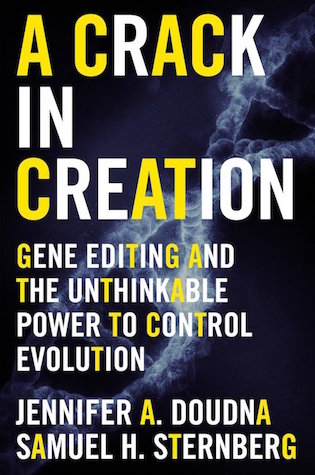
Jennifer Doudna and Samuel Sternberg: A Crack in Creation (Houghton Mifflin Harcourt, 2017)

Over a cup of coffee at a campus cafe a decade ago, UC Berkeley molecular biologist Jennifer Doudna learned about CRISPR from her colleague Jillian Banfield. CRISPR (clustered regularly interspaced short palindromic repeats) are highly regular sequences of DNA that had been found in many single-celled organisms such as bacteria, but at the time their function was unknown.

Doudna began work on the CRISPR system and after years of effort she and her colleagues discovered that it plays a key role in the bacterial immune system. CRISPRs matched sections of viral DNA. When a similar virus invaded the cell, CRISPR, together with proteins generated by CRISPR-associated system genes (Cas), targeted the same sequence in the virus and cut it.

Doudna realized that a system that targeted and cut specific sequences of DNA could be used to edit genes in any organism. She and members of her lab developed a simplified and highly precise gene editing technique using CRISPR and one of the Cas proteins, Cas9. Not only could specific genetic sequences be cut, but new sequences could be introduced that would be spliced into the gene by DNA's natural repair mechanisms.

The implications are mind-boggling. It is now possible (in theory, at least) to eliminate diseases that are caused by small genetic variations, such as sickle-cell anemia, or by viruses such as HIV. It is also possible to edit genes in the germ line, making any changes heritable. And it may also be possible to spread a particular gene through an entire species using gene drive. In gene drives, both specific genes and the CRISPR system to introduce the genes are passed from generation to generation. In fast-reproducing species the selected genes will quickly become dominant. In this way, for example, mosquito-borne diseases could be wiped out by releasing sterile mosquitoes engineered with gene drive, causing the population to crash (and also causing a possibly catastrophic cascade of effects across the ecosystem).

It seems as though we have entered a new era in which we can actively direct the evolution of our own species. Doudna has called for a global conversation on the ethics of CRISPR gene-editing, and has devoted much of her time to sparking that conversation. Her highly readable and thought-provoking book is an important part of that vital effort. Here's another: her TED talk from 2015:

More favorites of 2017:


* The first version of this post inexplicably omitted Beethoven For A Later Age from my list of favorites; my sincere apologies to the author.

Sunday, April 30, 2017

The other Beethoven: The Beethoven string quartets part 3


Portrait of Beethoven (detail), by Joseph Karl Stieler, 1820

In April the Takács Quartet returned to Berkeley's Cal Performances for the final concerts and residency activities in their Beethoven string quartet cycle. (For my posts on the other events in the cycle please see "For a later age" and "Not beautiful.")

The theme for the final weekend (extending from Thursday April 6 to Sunday April 9) was "Politics and Religion." Nic Mathew, our faculty host/raconteur for the cycle, pointed out that Beethoven was a wartime composer. From the time Beethoven was a young man until he was in his mid-40s, Austria faced a succession of conflicts with revolutionary and imperial France. Vienna was twice occupied by Napoleon's army, in 1805 and 1809 (dates which correspond roughly to the times of composition of the middle quartets).

Perhaps a wartime sense of the upending of certainties informed Beethoven's restless style. That such restlessness can still be disorienting to listeners became apparent in the jam-packed back room at University Press Books during Thursday's Page & Stage Book Club discussion of first violinist Ed Dusinberre's Beethoven for a Later Age (University of Chicago Press, 2016). Someone in the audience brought up the jarring contrasts in Beethoven's music, how the mood or tempo or character of one musical idea is often instantly negated by the radically different mood or tempo or character of the next. As Mathew memorably said, in Beethoven's music sometimes "you don't know where to put your ears."


The Takacs Quartet: Geraldine Walther (viola), Edward Dusinberre (first violin), András Fejér (cello), and Károly Schranz (second violin)

Such musical contrasts became a theme of the Takács Quartet's open rehearsal the next day. Dusinberre asked the audience to listen to the fourth movement from an early quartet, Op. 18 No. 6, called "La Malinconia" ("Melancholy"), and consider whether the alternation of the tragic slow and cheerful fast sections was a negation, or a dialogue:


After the Quartet finished the movement Dusinberre asked us for our responses. One woman in the audience mentioned that after the interjection of the bright fast music, she heard the slow music becoming less dark and more serene. What fascinated me was that I'd heard exactly the reverse: it sounded to me as though over the course of the movement the fast sections had taken on a more unsettled and searching quality. Listen, for example, to the way the reintroduction of the fast theme (around 6:32 in this recording) dies out after a bar or two before it is finally re-established (around 6:50), to my ears somewhat tentatively. In some ways, perhaps, the protean character of the music enables each of us to hear the Beethoven we want to hear.

Which Beethoven do we want to hear? As Mathew pointed out in his pre-concert talk on Saturday, there are many Beethovens. The music we think of as "Beethovenian" is only one aspect of a musical style that within a single work or even a single movement, as in the example above, can be exceptionally varied.

And when we think that Beethoven's dramatic qualities are instantly recognizable, our ears can deceive us. Mathew played three brief musical examples of larger-scale works with Beethovenian opening gestures:


This is exactly the kind of music we usually expect to hear when we think of Beethoven. Only, the first excerpt is the beginning of the overture to Mozart's Magic Flute (1791, performed by the Philharmonia Orchestra conducted by Otto Klemperer). The second is the opening of Joseph Haydn's Symphony No. 104 ("London," 1795, performed by the Philharmonia Baroque Orchestra conducted by Nicholas McGegan). And the third is the beginning of the overture to Luigi Cherubini's opera Anacréon (1803, performed by the Berlin Philharmonic conducted by Herbert von Karajan). So the musical rhetoric we think of as typical of Beethoven was actually already a part of the sound-world that shaped him as a composer: "Beethovenian" music existed independently of Beethoven.

And perhaps the "quite slow, singing and tranquil" third movement of Op. 135 (performed by the Takács on Saturday) doesn't strike us as being particularly Beethovenian. But it is this "other Beethoven" (in Mathew's phrase) that I find most compelling;


The other Beethoven is found primarily in the slow movements of the quartets: the second-movement Adagio from Op. 18 No. 1 (inspired by the tomb scene from Romeo and Juliet), the second movement from Op. 59 No. 2 (with the heartbeat motif), the third movement from Op. 132 (the "Hymn of Thanks" to be played "with inward feeling"), and the fifth-movement Cavatina from Op. 130 (to be played "slowly and very expressively"). And it is this Beethoven that I think I will return to again and again.

The final work performed by the Takács to complete the cycle was a reprise of Op. 130, which they had performed in the first concert in the series—but this time with the original ending, the Grosse Fuge (later published separately as Op. 133). It was easy to hear why—given the Grosse Fuge's sheer length and often agitated character—Beethoven's publisher requested a different ending. Parts of the Grosse Fuge sound as though they could have been written today. Such a concluding movement must have astonished Beethoven's contemporary audiences, because it is still astonishing in a later age:


During the open rehearsal Dusinberre mentioned in response to a question that knowing that this long, knotty movement was looming at the end of the Cavatina was likely to shade the Quartet's approach to the preceding music. And indeed when the Cavatina was performed on Sunday afternoon for the second time in the cycle, it seemed marginally less moving than it did in my memory of its first performance in the fall. Perhaps that was due to the power of Dusinberre's suggestion, to the enhancements and embellishments of memory, or to my greater familiarity with the music. But some of the other people with whom I've been attending the concerts mentioned a similar feeling, and it would be remarkable if even world-class musicians such as the Takács were utterly unaffected during the Cavatina by the prospect of Op. 133.

If so, the only reason I could ever be grateful for the boisterous replacement ending that was played in the fall would be if it enabled a maximally profound Cavatina. In fact, I felt that both endings marred the Cavatina's hushed mood: I think Beethoven, a radical in so many things, should have taken the unprecedented step of ending Op. 130 with the slow movement.

Final thoughts on the cycle: Remaking Beethoven

Summing up such a richly rewarding experience in a few words isn't really possible, for two reasons. The first is that every concert, as well as every pre-concert talk, open rehearsal, panel discussion, master class, symposium, and post-concert conversation presented multiple moments of intellectual and emotional engagement as well as points for reflection and reconsideration.

The second is that this is music that resists any final conclusions, because it is so multifarious and encompasses such a broad range of feeling and expression. To seek some final coherence or unity is to look for a quality that Beethoven himself seems to have delighted in confounding. The quartets have to be accepted for their difficulties and incongruities as well as their profound beauties. And each new encounter with this music will be a different experience; as the the opening theme of the residency had it, performers and audiences together actively participate in its remaking each time.

Very special thanks to Cal Performances' Director of Artistic Literacy Sabrina Klein and to Executive and Artistic Director Matias Tarnolpolsky for designing, organizing and implementing such a meaning-filled series of residency activities surrounding the concerts, and to Professor Nicholas Mathew of the UC Berkeley Department of Music for being such a brilliant and engaging host throughout. And my deep gratitude to the musicians of the Takács Quartet, who were unfailingly generous with their time and energy, and extraordinarily insightful on and off the stage.

Other posts in this series:

Thursday, March 16, 2017

Not beautiful: The Beethoven string quartets part 2


Portrait of Beethoven by Willibrod Josef Maehler (detail), 1815

The Takács Quartet returned to Berkeley in early March for the middle two concerts of their Beethoven quartet series. (For my previous post on the first two concerts in the series, see "For a later age.")


The Takacs Quartet: Károly Schranz (second violin), András Fejér (cello), Geraldine Walther (viola), and Edward Dusinberre (first violin). Photo: Keith Saunders, http://www.takacsquartet.com

Once again the concerts were introduced by a series of residency events. This time they included an open rehearsal; a panel discussion led by UC Berkeley faculty member Nic Mathew and featuring first violinist Edward Dusinberre and visiting scholars Mary Hunter and Mark Ferraguto; and pre-performance conversations between Mathew and each of the visiting scholars. The theme for the weekend's concerts was "When Old Media Were New Media," or as the Cal Performances residency events program had it, "the role of audiences, institutions and technologies in shaping our experience of this music."

One of the key new modes of experiencing the Beethoven string quartets was the public string quartet concert itself. Before Beethoven, string quartets were often played at home by groups featuring skilled aristocratic amateurs, with an audience of an invited group of friends. (A recent book about the Mozart string quartets was entitled Mozart's Music of Friends.) After Beethoven, string quartets were increasingly performed in concert halls by professional musicians with an audience of paying ticketholders.

The shift from amateur to professional performance is epitomized by the Op. 59 "Razumovsky" quartets. They were commissioned by Count Andreas Razumovsky, the Russian ambassador to the Habsberg court in Vienna, who was an avid and talented violinist. Beethoven delivered three quartets based on Russian musical themes, but they were too difficult for their patron to play. [1]


Portrait of Count Andreas Razumovsky, by Johann Baptist Lampi (detail), ca. 1806
Source: https://muse.jhu.edu/article/642687#pl07

Razumovsky had to hire the professional Schuppanzigh Quartet (named for its first violinist Ignaz Schuppanzigh) for the first performance in 1807. That performance was received with bewilderment.
Three new, very long and difficult Beethoven violin quartets dedicated to the Russian ambassador, Count Razumovsky, are attracting the attention of all connoisseurs.  They are profound in conception and admirably written, but not generally comprehensible. . . [2]
"Not generally comprehensible." Even fifteen years later this same journal would state that Op. 59 No. 2 involved "bizarre sounds."

Among the "bizarre sounds" may have been the first violin part in the second, slow movement, which is marked "Molto adagio. Si tratta questo pezzo con molto di sentimento" (Very slow, with a great deal of feeling). At around the 1:37 mark in the 2002 recording by the Takács Quartet the first violin starts playing a two-note figure that sounds like a heartbeat, as Mary Hunter pointed out:


It's unusual for the first violin to play a part that is so clearly intended as an accompaniment to what the other musicians are playing. It must have made those first listeners wonder whether the players had inadvertently switched parts.

The Op. 59 No. 2 quartet was performed by the Takács during the Sunday afternoon concert. In the panel discussion on Friday night, a page of the first violinist Edward Dusinberre's part for this quartet was projected onscreen. Over one of the measures (around 6:05 in the recording), he had written the words "not beautiful."


I had an opportunity to ask Dusinberre what he was warning himself against in that passage; he replied that as a student his training had emphasized producing a beautiful sound. As a professional musician, he had to learn to use beauty when it's appropriate, "and not just ladle it on." Beethoven's direction to play "with a great deal of feeling," in Dusinberre's view, meant that in these measures he should maintain a certain rigor and precision.

That precision is especially needed in the slow movement of Beethoven's Op. 132. This nearly 20-minute-long adagio was described by Beethoven on the score as "Heiliger Dankgesang eines Genesenden an die Gottheit" (Holy Song of Thanks from a Convalescent to the Deity). Beethoven had become seriously ill while working on Op. 132, and had miraculously recovered. The Holy Song of Thanks consists of five parts, alternating Molto adagio (very slow) with Andante (moderately slow). In inexpert hands this lengthy slow movement could easily bog down or become static; the Takács were able to maintain forward momentum while remaining emotionally expressive and playing in perfect unison.


In concert, this movement simply stopped time.

In the pre-performance conversation on Saturday night with Mary Hunter, Nic Mathew quoted someone as saying that "If you don't like the early quartets, that's Beethoven's fault; if you don't like the later quartets, that's your fault." Of course, it's never your "fault" if you don't like a work of art. As modern and postmodern (and whatever comes after postmodern) art have shown, the history of art is not a slow but steady march of progress from the worthy but primitive forms of the past to the increasing perfection of today.

But it is your mistake if you dismiss a work without trying to understand its historical context and the artist's aims and methods. We live in a world that has been musically shaped by the middle and late Beethoven quartets; when they were first performed, of course, they were unprecedented. In his day Beethoven was seen as revolutionary, and the residency events that Cal Performances has sponsored around the Takács Quartet's Beethoven cycle are designed in part to try to help us recapture that sense of radical innovation. For me they have immeasurably enriched the experience of these difficult works. I'm very much looking forward to the next (and, alas, final) concerts in the series.

Other posts in this series:


  1. Mark Ferraguto, a panelist in the Friday night discussion and a participant in the Sunday pre-performance conversation, believes that he has identified the "missing" Russian theme in Op. 59 No. 3; see "Beethoven à la moujik: Russianness and Learned Style in the 'Razumovsky' String Quartets." Journal of the American Musicological Society, Vol. 67 No. 1, Spring 2014, pp. 77-124. DOI: 10.1525/jams.2014.67.1.77
  2. Allgemeine musikalische Zeitung, 27 February 1807. 

Saturday, October 22, 2016

For a later age: The Beethoven string quartets part 1

Beethoven in 1805

Portrait of Beethoven (detail), by Joseph Maehler, 1805
"Oh, they are not for you, but for a later age."

—Beethoven to the first musicians attempting to play his Op. 59 string quartets
Last weekend I attended the first two of a series of six concerts by the Takács Quartet in which they will be surveying all of Beethoven's music for string quartet. What follows, to be continued in the spring, are my reflections on the experience of the concerts and the surrounding activities sponsored by UC Berkeley's performing arts organization Cal Performances.

The Takács residency began at noon on Friday October 14 with what was billed as an open rehearsal. I wouldn't actually describe what took place as a rehearsal—it was more an open conversation about the problems posed for the performers by the specific quartets that would be played that weekend. Each musician took turns leading a discussion of a particular moment they found especially problematic or striking in one of the quartets, and (together with the other musicians) demonstrating different ways that the passage could be approached.

What quickly became clear was the quartet's good humor and ease with one another. The Takács (pronounced, roughly, "Tah-katch") has existed for 42 years, and the newest member, violist Geraldine Walther, has been with them for more than a decade. What was also immediately apparent was the sheer number of decisions that have to be made in translating notes on a page into a vibrant and coherent performance. Here are just a few:
  • bowing: whether a note is played on an upstroke or downstroke; close to the frog (where the player holds the bow), the middle, or the tip of the bow; closer to the bridge or to the fingerboard. Each choice creates a different quality of sound.
  • articulation: whether a note is played staccato (crisply), legato (flowingly), or sforzando (a sharp attack to create emphasis).
  • volume: should the note be played loudly, softly, somewhere in between? And should each instrument try to play at the same volume, or should one or another instrument try to make their line more prominent? Should the note be a part of a gradual or sudden crescendo (increase) or diminuendo (decrease) in sound level?
  • tempo: Beethoven's indications of tempo for the quartets played this first weekend include adagio cantabile (slow, with a singing quality), larghetto espressivo (rather slow and with feeling), allegretto ma non troppo (moderately fast, but not too much so), allegro vivace (quick and lively), and allegro assai (very fast). The members of the quartet must agree on exactly what each of these phrases means, and how the tempo should contrast with those that come immediately before and after it.
Together, these choices (and I'm sure I've left many out) make up the musical character that is expressed by the passage in question. And perhaps it's an obvious point, but the players in a small ensemble are more exposed than those in an orchestra or even than a soloist. What any individual member of an orchestra is playing tends to blend into the combined sound of the full group, while a soloist only has to agree with him- or herself about these issues. The members of a quartet each play single parts that unite to make a whole, and so they must try to match one another closely. Any divergence in approach or slip in intonation is immediately apparent.

Takacs Quartet

The Takács Quartet: András Fejér (cello), Edward Dusinberre (first violin), Geraldine Walther (viola), and Károly Schranz (second violin)

The way that each of these musical elements affects how a work can sound became even more apparent during master classes held at the Department of Music later that afternoon. I attended sessions led by Walther and by Károly Schranz, the second violinist. (The members of the Quartet call Schranz "Kársci," pronounced, roughly, "Garshy"; Walther is "Geri.") Walther was extremely gentle with her students, generally posing her suggestions as questions ("Do you think we might slur this a bit more?"), and playing along with them to demonstrate her points and provide support. Schranz was also reassuring ("It's good, it's good," he would say), but then would borrow a student's instrument to suggest a new approach. In both cases, the improvement after even a few minutes was audible even to a listener as naïve as myself.

The afternoon's events also introduced us to Nicholas Mathew, Associate Professor of Music History at Berkeley, who was invited to make some introductory comments at the open rehearsal, and who would give the pre-concert talks throughout the cycle. Mathew is a rock star. Charismatic, articulate, overflowing with ideas, but also genuinely interested in drawing others into the conversation, he made us all want to go back to school and become music majors.

In the evening Mathew interviewed first violinist Edward Dusinberre about his new book, Beethoven for a Later Age: Living with the String Quartets (University of Chicago Press, 2016). The book is a first-person history of the Takács Quartet (Dusinberre joined in 1993, replacing the founding first violinist Gabor Takács-Nagy), a description of the compositional origins of selected Beethoven quartets and a detailed account of the challenges of performing them.

Both on the page and in person Dusinberre has a delightfully dry and self-deprecating sense of humor. A key point he makes both in the book and the interview was that the answers to the problems posed by the quartets can never be final, but necessarily differ with every performance. Thus the theme of the weekend, "Making and Remaking the Beethoven Quartets"; the quartets are made and remade every time they are played.

That sense of contingency, risk, and excitement was palpable during the weekend's concerts. The Takács programmed the series brilliantly. Instead of playing the entire quartet cycle in chronological order, in each concert they performed an early, middle, and late quartet (and will continue this pattern in the spring). It allowed us to hear over the course of a single concert both the radical changes in Beethoven's style over time, and also the continuities.

On Saturday evening the Takács opened the first concert in the series with the String Quartet in G Major, Op. 18, No. 2 (1800). The first movement of this quartet sounds almost as though it could have been written by Mozart or Haydn; in its lightness and elegance it is an audible homage to Beethoven's predecessors and (in the case of Haydn) teacher. The contrast with the middle-period String Quartet in F minor, Op. 95, Serioso (1810), was stark. Here was the dark, stormy music that I think of when I hear the name Beethoven; it's perhaps the quartet equivalent of the Fifth Symphony (first performed in 1808). This is the quartet of which the composer famously said that it was "written for a small circle of connoisseurs and is never to be performed in public." It must indeed have sounded radical during its first performance in 1814, because it still does today.

The concert concluded with the late String Quartet in B-flat Major, Op. 130 (1825). The Quartet chose to play it with the second ending, which Beethoven composed after his publisher complained about the length and difficulty of the first one. (The original final movement was later published as a separate piece entirely, the Grosse Fuge, "Great Fugue," Op. 133.) With its six movements, this quartet breaks with the then-standard four-movement structure. The first "extra" movement, the fifth, is marked "Cavatina. Adagio molto espressivo" (slowly, and with great feeling):


After this outpouring of lyricism (even more powerful when heard live), I was stunned. All I wanted was a few moments of silence to try to take in what I'd just heard. But—without a break—Beethoven has the performers move into the finale, a rollicking, boisterous "country dance," as Nic Mathew described it. It utterly tramples on the mood created by the Cavatina, as if Beethoven could not bear the feelings his own music evoked. The finale seems to me to be an act of self-vandalism; I wish that he had simply cut it off and let the quartet end with the Cavatina. Even better would be if he had placed 10 measures of rest at the end of the piece, so that the audience wouldn't prematurely break the spell by bursting into applause.

When I expressed this thought to the group I'm attending the concerts with, I got some funny looks. I felt like I was revealing a shameful lapse in taste, as though I were expressing a preference for art that is pretty and unchallenging. But the Cavatina is anything but unchallenging—it is profound and deeply moving. And, really: is Beethoven beyond criticism? Although I might indeed be displaying my own intellectual shortcomings, I can't help but feel that even Beethoven sometimes needed an editor.

But it's not only members of my concertgoing group who aren't disconcerted, as I am, by the second finale. In Beethoven for a Later Age Dusinberre, who has played Op. 130 with the Takács for almost 25 years, writes that in place of the Grosse Fugue he has come to prefer the alternative ending, which is
less taxing to muscles and psyche. When I first learned Opus 130 I had more zest for the fugue's violent energy, but now I am drawn to the music of...Opus 130's alternative finale, which dare[s] to brush off past conflicts and anguish. (p. 230)
We'll see if the Grosse Fugue's "violent energy" is preferable to what seems to me the incongruous cheerfulness of the second finale: the Takács will perform Op. 130 with its original ending to close the final concert of the series in April.

The Sunday afternoon concert began with the Quartet in F Major, Op. 18, No. 1 (1800), which is notable for its second movement. Marked Adagio affettuoso ed appassionato (slowly, tenderly and passionately), it was said by a close friend of Beethoven's to represent the tomb scene from Shakespeare's Romeo and Juliet. Beethoven wrote on the sketches for the movement "il prend le tombeau" (he descends into the tomb), "désespoir" (despair), "il se tue" (he kills himself),  "les derniers soupirs" (the last breaths). At the time he was composing this quartet Beethoven had fallen hopelessly in love with one of his piano students, Josephine von Brunsvik. She, though, was engaged to another man and apparently did not return Beethoven's affection.

It's usually simplistic to try to read biographical details into musical composition. Apparently the last piece of music an ill and suffering Beethoven completed before his death in 1827 was that jaunty finale to Op. 130. But the anguished slow movement of Op. 18 No. 1 does indeed sound like the musical expression of Beethoven's crushed romantic hopes:


The next piece on the program was the Quartet in E-flat Major, Op. 74, Harp, so called (not by Beethoven) because it calls for extensive pizzicato (plucking) in the first movement. But again, it was the slow second movement that I found most engaging. As the members of the quartet made clear in the open rehearsal, slow movements as well as fast ones are technically difficult; they must be deliberate enough to fully express the character of the music, but not so slow that they become static. It's a fine balance that the Takács has found unerringly so far.

The final quartet was Op. 131, often lauded as the pinnacle of Beethoven's achievement in the string quartet. (This is the quartet that is central to Yaron Zilberman's 2012 film A Late Quartet.) It has seven movements that are played continuously, rather than with standard pauses in between. As a result it is a bit of a marathon for performers and listeners alike.

Over its first 25 minutes or so, the mood shifts from serene to sprightly to reflective. Then in the fifth movement a manically insistent melody is played by the first violin. Over the next five minutes it undergoes variations but keeps returning over and over. The Takács played this section at an almost inhuman speed. While their virtuosity was breathtaking, I'm not a fan of technical difficulty for difficulty's sake. In his middle and late quartets Beethoven seems to be pushing musicians to the limits of what is possible, but to my ears the technical challenges are not always justified by the musical ends:


In its frantic energy and relentless repetition this movement reminded me of nothing so much as one of Carl Stalling's cartoon soundtracks. This is followed by a brief, mournful adagio that leads into the broken rhythms of the finale, a powerful, "Beethovenian" conclusion:


But as Nic Mathew pointed out in his pre-concert talk, Beethoven possesses a "multiplicity of voices." To seek coherence in his late quartets—with their jarring shifts of mood, tone and tempo—is to look for a unity that Beethoven seems to delight in negating. As Dusinberre mentioned during his interview with Mathew, Beethoven repeatedly "confounds your expectations in an uncomfortable way." Perhaps the only way to approach these works is simply to accept what critic Edward Said has called their "bristling, difficult and unyielding—perhaps even inhuman—challenge" to performers and listeners alike.

The talks, interviews, master classes and other events surrounding these concerts immeasurably enriched the experience of this music for me. I'm very much looking forward to the Takács Quartet's return in the spring to continue their Cal Performances residency and complete the cycle of the Beethoven quartets. More posts will follow.

Other posts in this series:

Sunday, March 24, 2013

A Late Quartet


The accepted notion is that age confers a spirit of reconciliation and serenity on late works....But what of artistic lateness not as harmony and resolution, but as intransigence, difficulty and contradiction? What if age and ill health don’t produce serenity at all?
—Edward Said, "Thoughts on Late Style," London Review of Books, 5 August 2004

When we think about an artist's "late style," Edward Said writes, we may think of Bach creating the crowning masterpieces A Musical Offering (1747), Mass in B-Minor (1749), and Art of the Fugue (1751) in his final years.* Or of Shakespeare writing The Tempest (1611), his bittersweet farewell to the magic of the stage. Or of Henri Matisse, often wheelchair-bound or bedridden and unable to paint, making the playful, brilliantly colored cut-outs that were published as Jazz (1947).

But there are also artists whose late work is difficult, dark, and challenging, posing problems that can never be finally resolved. Goya's Black Paintings (1819-1823), which he painted on the walls of his house when he was in his 70s, feature horrifying scenes of violence and rapacity. Monteverdi's final opera, L'incoronazione di Poppea (The Coronation of Poppea, 1642), features some of the most ruthless, corrupt and cynical characters ever put on stage.

In his final years, Beethoven continued to push the accepted boundaries of his chosen forms, producing works that achieved new extremes of scale, complexity and technical difficulty. Said, following Theodor Adorno's essay "Late Style in Beethoven," devotes much of his essay to a consideration of Beethoven's last compositions. These include his final string quartets, works which I think are aptly described as presenting a "bristling, difficult and unyielding—perhaps even inhuman—challenge" to listener and performer alike.

A Late Quartet (2012, directed and co-written by Yaron Zilberman) focusses on the fictional Fugue Quartet as its members prepare for a performance of Beethoven's String Quartet No. 14 in C-sharp minor, Op. 131. This quartet was composed in the final year of Beethoven's life, after he had gone entirely deaf and while he was struggling with illness. Much about this quartet is unusual, if not unprecedented: it's in seven movements, instead of the then-standard four; it begins with a slow movement instead of the then-standard fast movement; the movements range in length from nearly 15 minutes to under a minute, and were intended to be played continuously, without a break; the movements modulate over six different keys, instead of the usual two or three, and can feature abrupt shifts of mood and tempo.

Here is the opening movement of the quartet, marked "Adagio, ma non troppo e molto espressivo" (Slowly, but not too much so, and very expressively):


In Zilberman's film the Fugue Quartet's cellist, Peter (Christopher Walken), is diagnosed with early-stage Parkinson's disease, a disorder that affects motor control and will soon make it impossible for him to play.

Peter's revelation of his diagnosis to the other members of the Quartet throws the group into crisis. And from my point of view, far too much screen time is spent on the melodrama surrounding the rocky marriage of second violinist Robert and violist Juliette (Philip Seymour Hoffman and Catherine Keener), and on the affair first violinist Daniel (Mark Ivanir) initiates with Robert and Juliette's daughter Alexandra (Imogen Poots).

Peter's story—that of a musician facing the loss of his ability to perform the music that has been his life's purpose, dealing with the many diminishments of old age, and mourning the recent death of his wife Miriam (a brief but poignant cameo by mezzo-soprano Anne Sofie von Otter)—is far more compelling, and I wish it had remained the central focus of the film. Instead, for long stretches Peter remains in the background as we follow the increasingly erratic behavior of the other characters. It is a huge relief to return to Peter, who is the only member of the quartet who seems to deal with the situation like an adult.

The film includes some thoughtful touches. To commune with his memory of Miriam, Peter puts on one of her recordings; the music he chooses is "Mariettas Lied" from Erich Korngold's opera Die Tote Stadt (The Dead City, 1920), about a man seeking consolation after the death of his beloved wife:


The words mean: "Joy, stay with me. Come to me, my true love. Night falls now; you are my light and day. Our hearts beat as one; our hopes rise heavenward...Though sorrow darkens all, come to me, my true love. Bring your pale face close to mine. Death cannot separate us. If you must leave me one day, know that there is a life after this."

Another thoughtful touch is the cellist that Peter suggests to the other members of the Quartet as his replacement: Nina Lee, who in real life is the cellist for the Brentano Quartet, the group that performs on the film's soundtrack.

These kinds of touches, and the fascinating discussions among the characters about the challenges of playing Op. 131, are hints of the more music-centered (and in my view, more interesting) film that A Late Quartet could have been. As it stands, with its focus on not-very-engaging interpersonal melodrama, Zilberman's film feels like a missed opportunity.

Beethoven's Op. 131 in its entirety, played by the Quatuor Mosaïques on period instruments:


--

* But I've also written about why Bach isn't (yet) carved on my musical Mount Rushmore.