Showing posts with label Bollywood and beyond. Show all posts

Sunday, April 19, 2026

In memoriam: Asha Bhosle

Photograph of Asha Bhosle

Asha Bhosle. Image source: MumbaiMirror

The great playback singer Asha Bhosle (née Mangeshkar) died last Sunday at age 92. Born into a musical family, she recorded 12,000 songs (according to the Guardian's obituary) for over 2200 movies (according to the Internet Movie Database), outpaced perhaps only by her older sister Lata. If Lata became famous mainly for songs of romantic yearning and sorrow, Asha often represented youth, flirtatiousness and pleasure. (Of course, this division of labor wasn't absolute by any means.)

Asha's career as a playback singer began in the 1943 film Maze Baal (My Child), when she was was 10, and continued into the 21st century. Below I've selected some of my favorite Asha performances spanning the decades, linking to the videos on YouTube when they can't be embedded.

Aaiye Meherbaan from Howrah Bridge (1958): Many of the films for which Asha Bhosle sang playback in the 1950s became classics, such as Raj Kapoor's Shree 420 (Mr. Trickster, 1955), Bimal Roy's Devdas (1955), and Guru Dutt's Kaagaz Ke Phool (Paper flowers, 1959). In Howrah Bridge she voiced the seductive "Aaiye Meherbaan" (Come, my dear one), in which cabaret-singer-with-a-heart-of-gold Edna (Madhubala) practices her allurements on handsome stranger Prem (Ashok Kumar). Ultimately she will help him bring his brother's killer to justice. The music is by O.P. Nayyar and the lyrics by Qammar Jallalabadi. (Song ends at 43:16.)

Incidentally, in the video of this song linked above the young dancer in the cap and checked shirt is Saroj Khan, the subject of another "In memoriam" post.

Koi Kehde from Baharen Phir Bhi Aayengi (Spring will come again, 1966): The final production of Guru Dutt Films, Baharen Phir Bhi Aayengi features a love triangle between newspaper publisher Amita (Mala Sinha), her younger sister Sunita (Tanuja), and crusading journalist Jitendra (Dharmendra). In a classic plotline borrowed later by many other films, each sister decides to sacrifice her love for her sibling's happiness. But we can hardly blame Jitendra for being unable to resist the combination of Tanuja and Asha in "Koi Kehde" (Go tell the world). The music is by O.P. Nayyar and the lyrics by Sheven Rizvi.

koi kehde kehde kehde
zamaane se jaa ke
ke hum ghabraa ke
mohabbat kar baithhe
haaye mohabbat kar baithhe
koi kehde kehde kehde

ab jalta hai jale zamaana
banaaye fasaana
nahin ghabraayenge hum
dil ka sauda kiya hai khushi se
daren kyun kisi se
ke hum to abhi se hain thaame jigar baithhe
haaye mohabbat kar baithhe
koi kehde kehde kehde

kyun na raahon mein kaliyaan bichha den
jahaan ko dikha den
mohabbat ki jaadugiri
aaj dil ko jabaan mil gayi hai
dil ki kali khil gayi hai
ye dunia nayi hai
jo karna thha kar baithe
haaye mohabbat kar baithe
koi kehde kehde kehde
Go, tell, oh tell,
tell the world,
That in fear
love we unfurled,
Oh, love we unfurled.
Go, tell, oh tell, tell.

Let the world burn,
let tales be spun,
We shall not tremble, not be undone.
We exchanged our hearts, a joyful trade,
Why fear anything? We're unafraid.
Joining our hearts in this embrace,
Oh, love we embrace.
Go, tell, oh tell, tell the world,

Why not scatter blossoms on the way,
And show the world
love's magic play?
The heart now speaks,
the bud has bloomed,
This world is new, our hearts consumed.
What had to be, we now have done,
Oh, love we have won.
Go, tell, oh tell, tell.

Phur ud chala from Tere Mere Sapne (Our dreams, 1971) is an example of the spectacular songs that Asha sang in films such as Teesri Manzil (Third Floor, 1966) and Anamika (1973), which take place in Busby-Berkeley-like fantasy spaces or in nightclubs as big as airplane hangers. Anand (Dev Anand) is an idealistic doctor who chooses to practice among poor villagers instead of treating the complaints of the rich in the big city. In the coal-mining town where he goes to treat black lung, he meets schoolteacher Nisha (Mumtaz), and the two fall in love. On their day off they go to the village fair, where Bombay Touring Talkies has set up a screen to show the latest movie of the biggest Bollywood star, Maltimala (gorgeous and glamorous Hema Malini, voiced by Asha). The music of "Phur ud chala" (Where does the heart take flight?) is by S.D. Burman, with lyrics by Neeraj:

https://youtu.be/UcdORTx6CBU

Piya Tu Ab To Aaja from Caravan (1971): Asha made something of a specialty of drunken songs, many picturized on dance legend Helen. "Piya Tu Ab To Aaja" (Oh my beloved, come to me) is a paradigmatic example from Caravan. Helen plays Monica, a cabaret performer in thrall to the villain Rajan (Krishen Mehta), who is trying to steal the inheritance of heroine Sunita (Asha Parekh). The music is by R.D. Burman, with lyrics by Majrooh Sultanpuri.

Dil Cheez Kya Hai from Umrao Jaan (Beloved Umrao, 1981): Amazingly, although she'd been singing in films for nearly forty years, Umrao Jaan is the first film for which Asha sang the entire soundtrack, and it was also the first film for which she won the National Film Award for best female playback singer. It is a classic, probably the finest work not only of Asha, but of its star Rekha, writer/director Muzaffar Ali, and composer Khayyam. Set at the time of the 1857 Uprising, Umrao Jaan is the story of the impossible love between the tawaif (courtesan) Umrao Jaan (Rekha) and the Nawab Sultan (Farooq Shaikh). "Dil Cheez Kya Hai" (What is my heart?) is the moment when the Nawab Sultan, hearing her singing from his passing carriage, becomes enraptured by her voice—as are we. The music is by Khayyam and the lyrics by Shahryar:

https://youtu.be/5sYHweBM4L4

This post was inspired by a memorial re-watch with my partner of Umrao Jaan, a film that gets richer with every viewing.

Zara Sa Jhoom Loon Main from Dilwale Dulhania Le Jayenge (The Brave Heart Will Win The Bride, 1995): DDLJ, one of the biggest blockbusters in Bollywood history, is the film that made Shah Rukh Khan a superstar. The brash Raj (SRK) and the demure Simran (Kajol, Tanuja's daughter) meet on a summer Eurail tour, and despite Raj's relentless teasing of Simran, opposites attract and the two fall in love. But soon Simran reveals her secret: she is betrothed to a man she's never met, the son of her father's friend back in his home village in India. "Zara Sa Jhoom Loon Main" (Let me dance a little) displays the special onscreen chemistry between SRK and Kajol, a jodi that would ultimately appear in a series of superhit films. It's another drunken song: Simran has her first taste of alcohol, and enjoys it a little too much. The music is by Jatin-Lalit, with lyrics by Anand Bakshi; Abhijeet Bhattacharya sings playback for SRK.

https://youtu.be/96YVQBjrtWE

Radha Kaise Na Jale from Lagaan (Land Tax, 2001): Asha Bhosle was ageless; her voice retained its purity and range for decade after decade. In "Radha Kaise Na Jale" (How can Radha not burn with jealousy?), Asha, approaching 70, sang the playback for Gracy Singh, who had just turned 20 and was appearing in her first starring film role. Singh plays Gauri, a young woman who has long been in love with her village's leader Bhuvan (Aamir Khan). Bhuvan has accepted the challenge of the captain in charge of the nearby British military outpost (Paul Blackthorne): if Bhuvan's villagers can beat his soldiers in a game of cricket (a game the villagers have never played), they will be spared the ruinous land tax for three years. The captain's sympathetic sister Elizabeth (Rachel Shelley) decides to help the villagers prepare for the match—and discovers her own growing love for Bhuvan. 

In "Radha Kaise Na Jale" Gauri's suspicions are enacted as she and Bhuvan adopt the ritual roles of Radha and her wayward lover Krishna. Will the ragtag villagers set aside their caste prejudices and romantic rivalries to overcome impossible odds and defeat the crack British military team in the Big Match? And will Bhuvan be tempted by the British beauty or stay true to his village sweetheart? The music is composed by A.R. Rahman, with lyrics by Javed Akhtar; Udit Narayan sings playback for Aamir Khan. 

https://youtu.be/qNnvL0ztJhA

Asha received the International Indian Film Academy Award for Best Female Playback Singer for this performance, and the Filmfare Lifetime Achievement Award in the year of Lagaan's release. With her passing, an era has ended.

Update 20 April 2026: Dustedoff, far more expert than I in the Indian films of 1950s and 1960s, has written a wonderful tribute to Asha, "Ten Composers, Ten Solos: The Magic of Asha Bhonsle." (Asha was sometimes credited under different romanized spellings of her name; in Umrao Jaan she is credited as Asha Bhonsale.) It's a complement to her earlier post "Asha in Ten Moods"; I now have a list of Asha films I'll need to track down.

Sunday, May 12, 2024

What's Love Got To Do With It?

Poster for What's Love Got To Do With It? (2022). Image source: IMDB.com

The marriage crisis

Marriage is in an ongoing state of crisis. People are choosing to wait longer before they marry—median age at first marriage is now in the 30s for both men and women in the UK—and more are choosing never to get married at all. Although in the U.S. the legal right to marry was extended in 2015 to gay and lesbian couples in all 50 states, the number of marriages per 1,000 people is entering its fifth decade of decline: in 1980, there were 10.6 marriages per 1,000 people, while in 2020 there were around 5 (a COVID low; the number has since rebounded to around 6, but the long-term trend is steady decline). The marriage rate has fallen even though the percentage of people of marriageable age has increased over the same span, from around two-thirds to almost three-quarters of the population.

U.S. marriages per 1,000 people, 1980-2022. Data source: Provisional number of marriages and marriage rate, United States 2000-2022, CDC/NCHS National Vital Statistics System; Sally C. Curtin and Paul D. Sutton, Marriage rates in the United States, 1900-2018, NCHS Health E-Stat, 2020.

One reason for more women choosing to remain unmarried may be that, as Clementina Ford writes,

Marriage is not now and never has been designed with women's happiness in mind — and yet we're told that without it, we will be miserable. As any sociologist can tell you, it's men who benefit from marriage: they live longer, they are generally healthier and happier, and their economic prospects improve [compared to single men]. On the other hand, studies have shown that married women die earlier. [1]

Ford is citing a study of 100,000 Europeans that found that marriage adds 1.7 years to the average husband's lifespan, and subtracts 1.4 years from the average wife's. [2]

As marriage rates have fallen, so have divorce rates, but they are still proportionately high: in the U.S., the divorce rate fell from 5.2 per 1,000 people in 1980 (49% of the 1980 marriage rate) to 2.3 in 2020 (45% of the 2020 marriage rate). In other words, roughly speaking, for every two marriages there's one divorce. Let me just say that I would not get on a plane if I had little better than a 50% chance of making it to my destination.

Share of marriages ending in divorce in the US, by year of marriage. Image source: Our World in Data

Given our spectacularly poor track record at picking people who will be good, fulfilling, and reliable partners in the long term, shouldn't we seek assistance in making that choice? Two recent phenomena reflect this idea:

  • Marriage Pact: Begun at Stanford in 2017 as an undergraduate project, Marriage Pact is an algorithmic matchmaking service. According to a recent story in the San Jose Mercury News, each participant fills out a 50-question survey about their "core values," such as "communication styles and conflict resolution. Smoking and drug habits. And things like: 'If you do nothing for an entire day, how do you feel?' On a 1 to 7 scale, 'like a lard' is 1 and 'like royalty' is 7."

    No pictures or swiping are involved. Each participant receives one name, an email address, and a percentage: their highest-rated match among fellow participants. The marriage pact is a pledge to marry your algorithmic best match if you don't find someone better by a mutually-agreed date—a kind of marital backup plan. It has now spread to nearly 90 campuses around the country.

    According to the San Jose Mercury News story, of the nearly half-million participants to date, "a tiny fraction land in long-term relationships, even marriage." But the creators claim that 30% of the matches meet in person, and one-ninth of those wind up dating for a year or more. If those numbers are true, that's a 3.3% relationship success rate, or 33 out of 1,000 participants. With a current U.S. marriage rate of 6 per 1,000 people, on your own you could do a lot worse.
  • Indian Matchmaking: A 2020–23 Netflix reality series created by the Indian-American documentary director Smriti Mundhra, Indian Matchmaking features Sima Taparia, a Mumbai-based "marriage consultant." Mundhra had featured Taparia in her 2017 documentary A Suitable Girl (co-directed with Sarita Khurana), which followed the efforts of three middle-class families to find husbands for their college-educated daughters.
    Poster for A Suitable Girl
    One of the families was Taparia's, and we watch her struggling to succeed as a matchmaker for her own daughter, Ritu (who would prefer to continue her career in financial services).

    The TV series follows Taparia's efforts to find acceptable matches for multiple clients each season. In a Guardian article a viewer criticized the first season as a "cesspool of casteism, colourism, sexism, classism." Women must come from a "good" (i.e., high-caste) family and be light-skinned, slim, and at least average in height; "the prospects for women who are dark-skinned, overweight, or under 1.6 metres (5ft 3ins) are presented as bleak, if not a lost cause entirely." Women are also subject to "moral policing": they must not have an extensive romantic history, or children from previous relationships. An NPR story reports that in Season 3 the series introduces "Priya, a pretty 35-year-old who is dating after a divorce and worries that men she encounters think she is 'broken.'"
    Mundhar has now created a spinoff, Jewish Matchmaking, which dropped on May 3 of this year. Can Poly Matchmaking be far behind?

What's Love Got To Do With It?

Many of us could clearly use some help in finding good romantic partners. Which brings us to What's Love Got To Do With It?, the 2022 feature film written by Jemima Khan and directed by Shekhar Kapur. [3]

The film starts promisingly. Zoe (Lily James), an "award-winning documentary filmmaker" (is there any other kind?) has grown up with her Anglo-Pakistani next-door neighbor Kazim (Shazad Latif). When Zoe finds Kaz at his brother's wedding, sneaking a cigarette in their childhood backyard treehouse, he confesses that he is ready to settle down and is willing to try to find a Pakistani bride through an arranged marriage: "Well, 'assisted marriage.' That's what we're calling it these days." Zoe is initially incredulous—"What, like assisted suicide?"—but then decides that Kaz's search for a wife will be the perfect subject for her next film.

Shazad Latif (Kazim Khan) and Zoe Stevenson (Lily James) in What's Love Got To Do With It?. Image source: Greg King's Film Reviews

Zoe herself is starting to feel that it would be nice to have a relationship that lasts longer than a weekend. But despite (or perhaps because) of these feelings, she continues bonking men she's just met in bars, waking up in strangers' beds, and shying away from a handsome, kind veterinarian (Oliver Chris) she meets through her mother's dog's misadventures. Her desire to be in a couple is more than cancelled out by her fear of commitment; while she's looking for Mr. Right, she seems only to be attracted to Mr. Wrongs.

Of course, unlike the characters we can see exactly where this story is heading, but there's a good deal of pleasure in getting there. In the initial part of the film the humor in Khan's script can be delightfully pointed, as in Zoe's clueless but well-meaning mother Cath (Emma Thompson) calling the wedding celebrations "exotic" ("'Exotic' meaning good foreign rather than threatening foreign?" asks Zoe. "Yeah, exactly," responds Cath).

Cath Stevenson (Emma Thompson) in What's Love Got To Do With It?. Image source: Cinema Clock

Or Zoe's white male producers (Ben Ashenden and Alexander Owen) gradually becoming more interested in Zoe's proposed film about Kaz as they run through possible working titles ("My Big Fat Arranged Wedding"; "Meet the Parents—First"; "I Hope She's A Pretty Woman") and check off the funding boxes: "Eth? Tick. Female director? Double tick." (The white producers later critique her film as being shot through a "white lens"—evidently not "eth" enough.)

And although Zoe defends the practice of arranged marriage to the producers, in conversation with Kaz she's still skeptical. When he says of arranged marriages that "over time, you grow to love the person you're with," she responds, "What, like Stockholm Syndrome?" When, on the way to an appointment with the Muslim matchmaker (Asim Chaudry) hired by his parents (Jeff Mirza and E&I favorite Shabana Azmi), Zoe asks Kaz the difference between using a matchmaker and using a dating app, Kaz says "I suppose you could call it a bespoke, 3D, halal Tinder. Operated by your parents."

Kaz's parents Aisha Khan (Shabana Azmi) and Zahid Khan (Jeff Mirza) in What's Love Got To Do With It?. Image source: Firstpost

When the matchmaker Mo asks asks what they are looking for, Kaz's mother Aisha brings out the stereotypical criteria: "A girl from the same. . .background, soft-spoken, long hair. Not too dark." Kaz's father wants the bridal prospects to have complexions no darker than "wheatish." The film's portrayal of reflexive color prejudice is all too real.

Kaz soon begins to meet over Skype with Maymouna (Sajal Aly), a lovely young Pakistani woman. Of course, both sets of parents are hovering in the background the whole time, and can't help themselves from interjecting regularly. But perhaps Maymouna is not quite so chaste and demure as she appears, and has her own agenda. . .

Maymouna (Sajal Aly) and family in What's Love Got To Do With It?. Image source: Variety

The most treacherous moment in any romantic comedy, though, is the ending, and there's no way to talk about where the movie goes wrong without spoilers. So if you want to avoid them, please skip the next two paragraphs:

  • Spoiler 1: There's a subplot featuring Kaz's sister Jamila (Mariam Haque), who has become estranged from her parents and the family matriarch Nani Jan (Pakiza Baig) because they have rejected her marriage a non-Muslim white man. Towards the end of the film Kaz invites Jamila to the family Eid celebration without telling his parents or Nani Jan. When Jamila arrives, she has her husband and new baby in tow. Of course, fulfilling her traditional role as mother instantly erases all discord, and Jamila, her husband and baby are welcomed back into the family. This feels like a reinforcement, rather than a critique, of motherhood as a woman's destiny.
  • Spoiler 2: When it comes time for the main characters to figure out the pairing that has been obvious to the audience from the first scenes, there are a couple of problems. Since Zoe and Kaz have grown up together like sister and brother (although we do learn that as kids they shared their first kiss), when they finally start thinking about each other romantically it seems queasily semi-incestuous. And the big kiss they exchange just before fadeout is anything but electric. Since movies are shot out of sequence, my guess is that Kapur unwisely shot the kiss early in the filming schedule, before the actors had gotten to know and feel comfortable with each other. Perhaps the lack of spark is a deliberate directorial choice, signalling the difficulties and awkwardnesses that lie ahead for the couple. But a sense of difficulty and awkwardness is not the final impression that most romantic comedies want to leave with their audience.

—End of spoilers—

What's Love Got To Do With It? is worth seeing for the witty first 90 minutes or so of Khan's script, the performances of Lily James and Shazad Latif as people who only slowly come to realize that their best match may be right next to them, and the pleasures of watching veteran actors Thompson and Azmi as their mothers. As with many romantic comedies the ending doesn't quite fulfill the film's early promise. On the other hand, you could do a lot worse.

https://youtu.be/0LqOp2MNwao


  1. Christina Ford, "Marriage is an inherently misogynistic institution—so why do women agree to it?" The Guardian, 30 October 2023.
  2. Roger Dobson, "The stress of marriage shortens your life by a year (if you're the wife)," The Independent, 26 February 2006. 
  3. Screenwriter Jemima Goldsmith Khan is the British former wife of Pakistani cricket star, later Prime Minister, and current prisoner Imran Khan. Director Shekhar Kapur began his career in India, directing Masoom (The Innocent, 1983), with Naseeruddin Shah and Shabana Azmi; the indelible Mr. India (1987), with Anil Kapoor and Sridevi; and Bandit Queen (1994), with Seema Biswas. He then moved on to the UK for Elizabeth (1998), with Cate Blanchett, and then to Hollywood for The Four Feathers (2002), with Heath Ledger and Kate Hudson. Since the sequel Elizabeth: The Golden Age (2008), however, he's only contributed segments to anthology films, directed short films and some TV series episodes, as well as the 2016 documentary Science of Compassion.

Sunday, March 19, 2023

“My sin was great, but my punishment was greater”: East Lynne

Mrs Ellen Wood

Mrs. Ellen Wood by Joseph Sydney Willis Hodges, 1875.
Photo credit: Worcester Guildhall, licensed under CC BY-NC-ND. Image source: Art UK

Ellen Wood's East Lynne (1861) is like half a dozen Victorian novels in one. It involves a murder mystery (as in Charles Dickens' Bleak House (1853)), a murder trial (as in Elizabeth Gaskell's Mary Barton (1848)), marital misapprehension (as in Emily Eden's The Semi-Attached Couple (1860)), a woman concealing her past (as in Maria Edgeworth's Helen (1834)), female self-sacrifice (as in Gaskell's Ruth (1853)), and not one but two death-bed scenes (as in Dickens' The Old Curiosity Shop (1841)).

There are two intertwined main narratives in East Lynne. The first is the story of the murder of Afy Hallijohn's father by one of the flirtatious girl's many suitors. ("Afy" is pronounced "Affy"; her full name, fittingly, is Aphrodite.) Suspicion falls on Richard Hare, whose gun was used in the killing and who fled the town of West Lynne the night of the murder and hasn't been seen since. (Or has he?) Richard's father, a local magistrate who is upright to a fault, condemns his own son and vows to send him to the scaffold if he reappears. Believing him innocent, Richard's younger sister Barbara enlists the help of a longtime family friend, conscientious solicitor Archibald Carlyle, to try to clear her brother's name. Complicating matters is that Barbara is deeply in love with Mr. Carlyle, but he doesn't recognize it.

The second narrative concerns Mr. Carlyle's marriage to Lady Isabel Vane (the homophony with "vain," in the senses of foolish and proud, is probably not accidental). Lady Isabel's father died heavily in debt, leaving her "completely destitute." Mr. Carlyle sees her distress, and swayed by her youth, beauty, and "bitter dependence" on unsympathetic relatives, offers her his hand, heart, and comfortable home of East Lynne. Complicating matters is that Lady Isabel loves another man, the handsome but caddish Francis Levison.

. . .her head was aching with perplexity. The stumbling block that she could not get over was Francis Levison. She saw Mr. Carlyle approach from her window, and went down to the drawing-room, not in the least knowing what her answer was to be; a shadowy idea was presenting itself, that she would ask him for longer time, and write her answer.

In the drawing-room was Francis Levison, and her heart beat wildly; which said beating might have convinced her that she ought not to marry another. . .

"Mr. Carlyle. . .seems an out-and-out good fellow, Isabel, and I congratulate you."

"What!" she uttered.

"Don’t start. We are all in the family, and my lady [Lady Isabel's guardian] told; I won’t betray it abroad. She says East Lynne is a place to be coveted; I wish you happiness, Isabel."

"Thank you," she returned in a sarcastic tone, though her throat beat and her lips quivered. "You are premature in your congratulations, Captain Levison."

"Am I? Keep my good wishes, then, till the right man comes. I am beyond the pale myself, and dare not think of entering the happy state," he added, in a pointed tone. "I have indulged dreams of it, like others, but I cannot afford to indulge them seriously; a poor man, with uncertain prospects, can only play the butterfly, perhaps to his life’s end."

He quitted the room as he spoke. It was impossible for Isabel to misunderstand him, but a feeling shot across her mind, for the first time, that he was false and heartless. One of the servants appeared, showing in Mr. Carlyle; nothing false or heartless about him. He closed the door, and approached her, but she did not speak, and her lips were white and trembling. Mr. Carlyle waited.

"Well," he said at length, in a gentle tone, "have you decided to grant my prayer?"

"Yes. But——" She could not go on. What with one agitation and another, she had difficulty in conquering her emotion. "But—I was going to tell you——"

"Presently," he whispered, leading her to a sofa, "we can both afford to wait now. Oh, Isabel, you have made me very happy!"

"I ought to tell you, I must tell you," she began again, in the midst of hysterical tears. "Though I have said 'yes' to your proposal, I do not—yet——It has come upon me by surprise," she stammered. "I like you very much; I esteem and respect you; but I do not love you."

"I should wonder if you did. But you will let me earn your love, Isabel?"

"Oh, yes," she earnestly answered. "I hope so."

He drew her closer to him, bent his face, and took from her lips his first kiss. Isabel was passive; she supposed he had gained the right to do so. "My dearest! It is all I ask." (Ch. XII)

From her tearful confession to her future husband that she does not love him, to her acceptance of his kiss with the thought that "she supposed he had gained the right to do so," this proposal scene is a devastating depiction of Lady Isabel's emotional state as she enters her marriage. But as Mrs. Wood also makes clear, like many women of her time Lady Isabel has few alternatives.

Apart from her lack of romantic feelings for her husband—a condition surely shared by many Victorian wives—the first few years of the marriage involve additional tribulations for Lady Isabel. Although motherhood provides some consolation, the household at East Lynne includes Mr. Carlyle's domineering sister Cornelia, who refuses to yield to her the place of mistress of the house, countermands her orders to the servants, and even interferes in the raising of her children. 

Then Lady Isabel begins to notice that her husband is meeting with the beautiful Barbara Hare in odd places at odd hours. Their semi-clandestine meetings are to discuss developments in her brother's murder case, but of course Lady Isabel leaps to another conclusion. Her jealousy is inflamed by the insinuations of a guest who, at Mr. Carlyle's invitation, happens to be making an extended visit at their home: none other than Francis Levison, for whom seducing vulnerable women is mere sport. Lady Isabel's jealousy of her husband and her still-powerful attraction to the man who is now Sir Francis are a volatile combination.

Mr. Carlyle may be sincere, but he is not very perceptive of the feelings of the women in his life. He does not realize how upset Lady Isabel is becoming at his rendezvous with Barbara. Nor is he aware of Barbara's feelings—until one night as he is walking her home, when she can no longer keep them in check:

Her throat was working, the muscles of her mouth began to twitch, and a convulsive sob, or what sounded like it, broke from her. Mr. Carlyle turned his head hastily.

"Barbara! are you ill? What is it?"

On it came, passion, temper, wrongs, and nervousness, all boiling over together. She shrieked, she sobbed, she was in strong hysterics. . .Barbara struggled with her emotion—struggled manfully—and the sobs and shrieks subsided; not the excitement or the passion. . .

"Are you better, Barbara? What can have caused it?"

"What can have caused it?" she burst forth, giving full swing to the reins, and forgetting everything. "You can ask me that?"

Mr. Carlyle was struck dumb; but by some inexplicable law of sympathy, a dim and very unpleasant consciousness of the truth began to steal over him.

"I don’t understand you, Barbara. If I have offended you in any way, I am truly sorry."

"Truly sorry, no doubt!" was the retort, the sobs and the shrieks alarmingly near. "What do you care for me? If I go under the sod to-morrow," stamping it with her foot, "you have your wife to care for; what am I?"

"Hush!" he interposed, glancing round, more mindful for her than she was for herself.

"Hush, yes! You would like me to hush; what is my misery to you? I would rather be in my grave, Archibald Carlyle, than endure the life I have led since you married her. My pain is greater than I well know how to bear."

"I cannot affect to misunderstand you," he said, feeling more at a nonplus than he had felt for many a day. . ."But my dear Barbara. I never gave you cause to think I—that I—cared for you more than I did."

"Never gave me cause!" she gasped. "When you have been coming to our house constantly, almost like my shadow; when you gave me this"—dashing open her mantle, and holding up the locket to his view; "when you have been more intimate with me than a brother."

"Stay, Barbara. There it is—a brother. I have been nothing else; it never occurred to me to be anything else," he added, in his straightforward truth.

"Ay, as a brother, nothing else!" and her voice rose once more with her excitement; it seemed that she would not long control it. "What cared you for my feelings? What recked you that you gained my love?"

"Barbara, hush!" he implored: "do be calm and reasonable. If I ever gave you cause to think I regarded you with deeper feelings, I can only express to you my deep regret, my repentance, and assure you it was done unconsciously."

She was growing calmer. The passion was fading, leaving her face still and white. She lifted it toward Mr. Carlyle.

". . .If she had not come between us, should you have loved me?"

"Do not pursue this unthankful topic," he besought. . .

"I ask you, should you have loved me?" persisted Barbara, passing her handkerchief over her ashy lips.

"I don’t know. How can I know? Do I not say to you, Barbara, that I only thought of you as a friend, a sister? I cannot tell what might have been."

. . .Arrived at the back gate of the grove, which gave entrance to the kitchen garden. . .Mr. Carlyle took both Barbara’s hands in his.

"Good-night, Barbara. God bless you."

She had had time for reflection, and the excitement gone, she saw her outbreak in all its shame and folly. Mr. Carlyle noticed how subdued and white she looked.

"I think I have been mad," she groaned. "I must have been mad to say what I did. Forget that it was uttered."

"I told you I would."

"You will not betray me to—to—your wife?" she panted.

"Barbara!"

"Thank you. Good-night."

But he still retained her hands. "In a short time, Barbara, I trust you will find one more worthy to receive your love than I have been."

"Never!" she impulsively answered. "I do not love and forget so lightly. In the years to come, in my old age, I shall still be nothing but Barbara Hare." (Ch. XVII)

Mr. Carlyle's emotional obliviousness will ultimately bring tragedy to his marriage.

Ellen Wood, 1814-1887

Ellen Wood (née Price) did not become a novelist until she was in her mid-40s. She was the daughter of a Worcester glovemaker, Thomas Price, and his devout wife Elizabeth. When Ellen entered her teens she was diagnosed with curvature of the spine and confined to bed for four years. This treatment, unsurprisingly, did not correct the curvature; as an adult she could not stand fully upright and was less than five feet tall. In 1836 at the age of 22 she married Henry Wood, a businessman four or five years her senior, and the couple moved to Dauphiné in southeastern France.

The family returned to England in 1856 after Henry's business failed. Ellen had begun anonymously publishing short stories a few years previously, and initially she didn't receive any payment. By the late 1850s, though, she could no longer afford to work for free. She wrote her first novel Danesbury House (1860) in response to a contest sponsored by the Scottish Temperance League, and won the £100 first prize. However, after the novel was published she received no further recompense.

Her next novel, East Lynne (1861), was rejected by the publishers Chapman and Hall due to a poor report by their reader, George Meredith, who may have found that the story of a wife tempted by the prospect of an adulterous affair hit too close to home; just a few years earlier Meredith's wife had left him for another man. Wood's novel was also rejected by Smith, Elder & Co., publishers of Charlotte Brontë and Elizabeth Gaskell.

When East Lynne was offered to Richard and George Bentley, though, they anticipated strong sales; its serial publication in The New Monthly Magazine beginning in January 1860 had significantly boosted that periodical's circulation.

First installment of East Lynne in The New Monthly Magazine, v. 118, 1860, p. 28. Image source: HathiTrust.org

For the right to publish the novel in book form Bentley and Son paid Mrs. Wood £600, about four times the usual fee for a novelist without proven popularity, and ordered a substantial first print run of 2750 copies. (By comparison, publisher Thomas Egerton paid £110 for the copyright of Jane Austen's second novel, Pride and Prejudice (1813), and it had a first print run of 1,000 copies.) Unusually, the Bentleys also agreed to give Mrs. Wood half of the profits realized from sales of the novel. In exchange they asked Mrs. Wood to revise or remove certain "objectionable" scenes, a request she politely but flatly refused. She knew the worth of her work, and despite her image of demure gentility, drove a hard bargain.

Title page of the first edition of East Lynne. Image source: HathiTrust.org

Bentley and Son had, if anything, underestimated East Lynne's sales potential. In the ten years after its initial publication it went through 24 editions, and by 1901 it had sold more than half a million copies. [1]

Over the next 7 years Mrs. Wood would produce another 15 novels, often having two serializations running at once. By 1867 her writing had generated enough income for her to purchase The Argosy magazine and take over as its chief editor. In the first years of her editorship she provided at least half of the content of each issue of the magazine, much of it anonymously, while continuing to publish an average of two books per year under her name.

Title page of The Argosy, Volume VII, 1869. Image source: HathiTrust.org

By the time of her death in 1887, Ellen Wood had published more than 40 books of fiction (several more would be published posthumously) and her writing generated an exceedingly comfortable income of £5–6,000 per year. Denis Goubert writes that "her books enjoyed a greater circulation than those of Trollope, and brought her a great deal more money." [2]

The influence of East Lynne was international. Leo Tolstoy had a copy in the library at his estate Yasnaya Polyana, and as Goubert has shown, likely drew from it in writing Anna Karenina (1878). Mrs. Wood was one of four English novelists that Tolstoy in an 1891 letter said had greatly influenced him; the others were Charles Dickens, George Eliot and Anthony Trollope. [3]

In the late 19th century Mrs. Wood's popularity exceeded that of at least two of the other three English writers on Tolstoy's list. She also received critical recognition: East Lynne appears on the Daily Telegraph's 1899 list of the "100 Best Novels in the World," along with five novels by Dickens, one by Eliot, and one by Trollope. [4]

East Lynne on stage and screen

Shortly after East Lynne was published, multiple dramatic adaptations appeared, and they continued to be staged for decades; although Mrs. Wood received no royalties from the play versions their success likely helped to sustain the sales of the novel. In the early decades of the 20th century, several silent film versions of East Lynne were produced, one starring Theda Bara as Lady Isabel. Note that the poster states that the film is based on "the internationally famous stage success"; Mrs. Wood's name does not appear.

Poster for the silent film version of East Lynne (1916) starring Theda Bara. Image source: Wikimedia Commons

In 1931 a Pre-Code sound film starring Ann Harding as Lady Isabel came out; it was nominated for Outstanding Production (the early version of Best Picture) at the 4th Academy Awards, losing to Cimarron. (The actual best picture of 1931 was Chaplin's City Lights, although it was not even nominated; it wouldn't be the last time the film that should have won was overlooked.)

Poster for the 1931 film version of East Lynne starring Ann Harding. Image source: Amazon.com

The film was sufficiently popular that a Photoplay edition of the novel was issued. But the cover of the Photoplay edition, like the film poster, omits Ellen Wood's name or any mention of the novel. Although Mrs. Wood does receive credit inside the Photoplay edition, it is "fictionized by Arline De Haas" from the screenplay by Bradley King and Tom Barry.

Cover of Photoplay edition of East Lynne (1931). Image source: Archive.org

The history of East Lynne on the big screen may also include the 1969 Indian film Aradhana (Adoration), starring Rajesh Khanna and Sharmila Tagore. Although ostensibly based on the Hollywood film To Each His Own (1946) starring Olivia De Havilland, Aradhana contains scenes of maternal self-sacrifice for which East Lynne seems the more direct inspiration.

Poster for Aradhana (1969). Image source: TMDB

A BBC-TV adaptation of East Lynne from 1982 dates from a period before rising budgets brought a glossier look to BBC productions. Philip Mackie's script takes chunks of dialogue from the novel but omits some key scenes (Lady Isabel never confesses to her husband-to-be that she doesn't love him) and truncates others (Barbara's revelation to Carlyle of her feelings for him ends before she tells him that she will love him forever). Director David Green's pacing is stiff and stagy, as are many of the actors' line readings (not to mention the rustic characters' fake beards). The actor playing Archibald Carlyle, Martin Shaw, has a flat affect throughout; whether this is the fault of his acting or of Green's direction isn't fully clear.

With such major flaws it almost doesn't matter that small details are also off; in the novel Lady Isabel Vane is described as having "dark shining curls," Francis Levison as having "black hair," and Barbara Hare as "very fair, with blue eyes" and "light hair"; in the BBC adaptation Lady Isabel (Lisa Eichhorn) is blonde, Levison (Tim Woodward) has light brown hair, and Barbara Hale (Gemma Craven) has dark brown hair. (One reason this is worth noting is that when Lady Isabel reappears at East Lynne late in the novel, she is unrecognized due to the disfiguring effects of an accident, the tinted glasses she wears, and because her hair has turned gray—a greater contrast with dark hair than blonde hair.) This is a rare BBC adaptation to be avoided.

Ellen Wood today

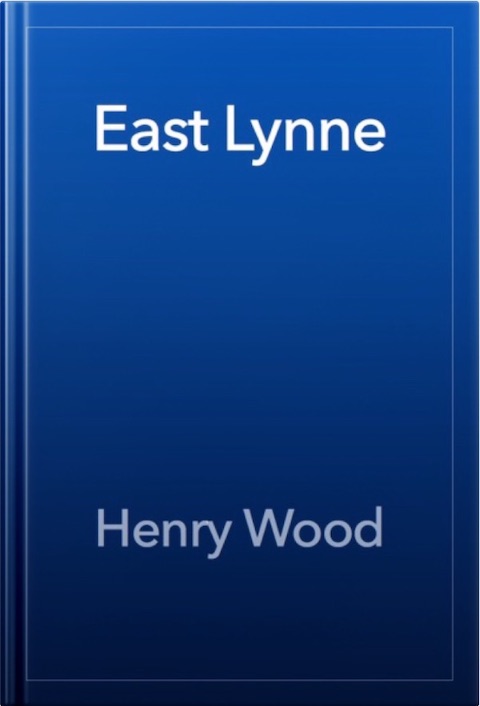
Tolstoy's influencers Dickens, Eliot, and Trollope continue to be widely read and taught, are the focus of a sizeable scholarly literature, and each has been the subject of more than one biography. As the omission of Mrs. Wood's name from the publicity materials of the films may signal, as the 20th century progressed Mrs. Wood's readership and literary reputation went into steep decline, particularly after the 1930s. In the 21st century she has fallen into such obscurity that e-book versions of her novels, including East Lynne, are sometimes attributed to "Henry Wood," dropping the honorific "Mrs." and so suggesting that it was Ellen's husband who wrote her books.

Cover of East Lynne by "Henry Wood" downloaded from Apple Books.

Perhaps, though, there are signs of a revival of interest in Mrs. Wood. A scholarly edition of East Lynne was issued by Broadview Press in 2000, and the first book-length biography of Mrs. Wood, by Mariaconcetta Costantini, was published in 2020.

Victorian critic Alexander Japp wrote that Mrs. Wood "combined in a remarkable degree these two powers or qualities—realistic portraitures of men and women, with invention, construction, and surprises. She successfully used sensational elements for moral ends." [5] As Japp points out, most of Mrs. Wood's characters (Francis Levison perhaps excepted) are "realistic portraitures" rather than cardboard heroes or villains. Mr. Carlyle is a respectable solicitor, and yet into his home and into close contact with his family he invites a wanted man, and later welcomes a notorious rake who is dodging his creditors. Barbara Hare, a candidate for the novel's heroine, expresses jealousy and resentment (as seen above). And Lady Isabel makes several poor choices, but her excessive suffering makes her the focus of the reader's sympathies.

Of course, the plot of East Lynne features some conspicuous implausibilities, and our moral judgments no longer closely align with those of Mrs. Wood's time. However, the narrator's comments that appear throughout the novel function, in my view, not to reinforce our moral judgments against Lady Isabel, but to call them into question. As Lady Isabel tells her husband, "My sin was great, but my punishment was greater." East Lynne deserves a contemporary readership for its compelling story (including a jaw-dropping plot twist two-thirds of the way through) and its multilayered characters. They, like ourselves, act out of a mixture of motives, and discover that actions taken in the heat of an impulsive moment can bring lasting regret.


  1. Jennifer Phegley, "Domesticating the sensation novelist: Ellen Price Wood as author and editor of the Argosy Magazine," Victorian Periodicals Review, Summer 2005, Vol. 38, No. 2, Interdisciplinary Work and Periodical Connections: An Issue in Honor of Sally H. Mitchell, pp. 180-198.
  2. Denis Goubert, "Did Tolstoy read East Lynne?" The Slavonic and East European Review, January 1980, Vol. 58, No. 1, pp. 22-39.
  3. The list of influential novels that Tolstoy shared in his letter was published in the New York Times, 2 April 1978: https://www.nytimes.com/1978/04/02/archives/selection-tolstoy-was-impressed.html. According to Denis Goubert (see note 3), the 1939 edition of Tolstoy's Works states that his library held eight novels by Mrs. Wood, including East Lynne. A manuscript catalogue dating from the half-decade or so after his death lists only six.
  4. The Dickens novels included on the list of the "100 Best Novels" are Martin Chuzzlewit, Nicholas Nickleby, The Old Curiosity Shop, Dombey and Son, and Oliver Twist; not included are David Copperfield, Bleak House, Great Expectations or A Christmas Carol. The Eliot novel is Scenes of Clerical Life; not included are Silas Marner, The Mill on the Floss, Daniel Deronda, or Middlemarch. The Trollope novel is Orley Farm, not included are any of the Chronicles of Barsetshire, the Palliser novels, or The Way We Live Now.
  5. Quoted in Phegley, p. 194.

Saturday, October 22, 2022

Bollywood and Hindu nationalism

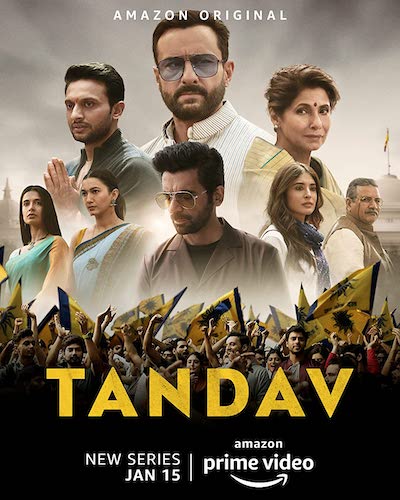
Poster for Ali Abbas Zafar's Tandav (2021). Image source: IMDB

Samanth Subramanian's recent New Yorker article "When the Hindu Right Came for Bollywood" (issue of 17 October 2022) uses the controversy over the Amazon Prime series Tandav (2021) as an illustration of the pressure the ruling Bharatiya Janata Party (BJP) and its Hindu nationalist satellite organizations are bringing to bear on the commercial Hindi film and television industry. That pressure includes calls for boycotts and outright bans; both veiled and explicit threats of violence (which sometimes have erupted into actual violence); and filing FIRs (First Information Reports requesting police investigation of alleged criminal wrongdoing) against actors, directors and producers for offending the religious sentiments of Hindus.

The BJP-led government has also moved to assert pre-release control over content: in 2020, the government ordered that streaming services such as Netflix and Amazon Prime fall under the censorship of the Ministry of Information and Broadcasting, which has long been involved in film censorship through its Central Board of Film Certification (CBFC). And in 2021, the government abolished the Film Certification Appellate Tribunal, where negative decisions by the CBFC could be appealed.

Tandav is about political betrayal, corruption, blackmail, and the cynical exploitation of social unrest to gain personal power. It includes a scene where a student leader named Shiva paints his skin blue and carries a trident (both elements of the iconography of the Hindu god). In response FIRs were registered in Bengalaru (Karnataka) against the actors Mohammed Zeeshan Ayyub (Shiva) and Saif Ali Khan, writer/director/producer Ali Abbas Zafar, producer Farhan Akhtar, and head of Indian Originals for Amazon Prime Aparna Purohit. Accusations against each were made under Indian Penal Code sections 153A ("Promoting enmity between different groups on grounds of religion, race, place of birth, residence, language, etc."), 295A ("Deliberate and malicious acts, intended to outrage religious feelings of any class by insulting its religion or religious beliefs"), 298 ("deliberate intent to wound religious feelings"), and 35 ("When a criminal act is done by several persons in furtherance of the common intention of all, each of such persons is liable for that act in the same manner as if it were done by him alone"). Similar cases were filed in Maharashtra (the state that includes Mumbai), Madhya Pradesh, and Uttar Pradesh; in all, at least 10 FIRs were registered.

Ram Kadam, a BJP Member of the Legislative Assembly for Maharashtra who filed an FIR against the creators and stars of the show in Ghatkopar, a suburb of Mumbai, tweeted that the Shiva scene in Tandav "demean[s] Hindu gods" and called for a boycott. Under the hashtag #BanTandavNow, Dehli BJP leader Kapil Mishra tweeted to his 1.3 million followers that Tandav was "spreading massive hate against our dharma and our Gods making hero out of terrorists [i.e., Muslims] and making fun of our forces." [1]

On January 18, only three days after the series' release, Zafar tweeted an "Official Statement from the Cast & Crew of Tandav." Under the heading "Our sincere apologies," he posted:

We have been closely monitoring viewer reactions to the web series Tandav and today during a discussion, the Ministry of Information and Broadcasting have informed us regarding a large number of grievances and petitions received on various facets of the web series with serious concerns and apprehensions regarding its content hurting the sentiments of the people.

The web series Tandav is a work of fiction and any resemblance to acts and persons and events is purely coincidental. The cast and crew did not have any intention to offend the sentiments of any individual, caste, community, race, religion or religious beliefs or insult or outrage any institution, political party or person, living or dead. The cast and crew of Tandav take cognizance of the concerns expressed by the people and unconditionally apologize if it has unintentionally hurt anybody’s sentiments.

Subramanian writes, "In Mumbai, people divide recent history into pre-'Tandav' and post-'Tandav' periods, reading the show’s fate—its bitter legal battles, its suspended second season—as a lesson in what can and cannot be said in Modi's India." While the manufactured outrage over Tandav is clearly intended to send a message to filmmakers, those who think it marks the beginning of an era have short memories. The tactics used against Tandav and its creators are well-established.

Poster for Deepa Mehta's Fire (1996). Image source: RogerEbert.com

  • In 1998, screenings of Indo-Canadian writer/director Deepa Mehta's film Fire in India were violently attacked by members of the interrelated Hindu nationalist organizations Shiv Sena, Bajrang Dal, and the BJP; Mehta herself received death threats and required armed protection. Fire depicts two sisters-in-law (Shabana Azmi and Nandita Das), each trapped in a loveless marriage, whose growing emotional closeness develops into passionate erotic desire. Shiv Sena's founder and leader Bal Thackeray claimed absurdly in an interview that sexual relations between women "are not part of Indian culture.'' [2]

    Vishvanath Temple in Khajuraho, Madhya Pradesh, India. Photo credit: Aotearoa, CC BY-SA 3.0. Image source: Wikimedia Commons

    After theaters and audiences in Mumbai, Dehli, Surat and Calcutta (now Kolkata) were attacked—the audience in Calcutta fought back against the attackers and the screening continued—the film was withdrawn from theaters for recertification by the CBFC. Advocates for freedom of expression and gay and lesbian rights mobilized and Fire was recertified without changes. Theater showings resumed, although some theater owners feared renewed violence and were reluctant to book the film.

Poster for Karan Johar's Ae Dil Hai Mushkil (2016). Image source: dnaindia.com

  • On 23 September 2016, as a response to an attack by Pakistan-based jihadists on an Indian army base in Uri, Kashmir, the Hindu nationalist group Maharashtra Navnirman Sena (MNS) ordered all Pakistani actors and film technicians to leave India within 48 hours or "we shall push them out." In a show of support for MNS, both the Indian Motion Picture Producers Association and the Film Producers Guild quickly followed this pronouncement with a call for a ban on the employment of Pakistani actors and technicians.

    Producer Karan Johar initially opposed the ban. However, after threats by the MNS to prevent screenings of his new film Ae Dil Hai Mushkil, which featured Pakistani actor Fawad Khan, Johar reluctantly joined the boycott, saying "For me, my country comes first. . .Going forward, I would like to say that of course I wouldn’t engage with talent from the neighbouring country given the circumstance."

Poster for Sanjay Leela Bhansali's Padmaavat (2018). Image source: Allociné

  • In his New Yorker article Subramanian mentions a January 2017 attack on the set of the film Padmaavat during a location shoot at the Jaigarh Fort in Jaipur, Rajasthan, by members of the organization Karni Sena. A crowd of men chanting slogans invaded the set, struck director Sanjay Leela Bhansali in the head and seized him by the hair, and vandalized the set and equipment; a video of the assault can be seen on YouTube. A few months later, after the production was moved to Maharashtra, the sets were burned in a late-night arson attack.

    Karni Sena falsely claimed that the film contained a dream-sequence love scene between the Hindu Queen Padmavati (Deepika Padukone) and the Muslim Sultan Alauddin Khalji (Ranveer Singh), as though this would justify its violence. Mahipal Singh Makrana, state president of Karni Sena, later threatened to facially disfigure Padukone. Surajpal Amu, media coordinator of the BJP in Haryana, offered a ₹ 10 crore reward for the beheading of Bhansali and Padukone (₹ 10 crore is 100 million rupees, or US$ 1.3 million). Haryana BJP leader Subhash Barala asked Amu to "show cause" for his comments (as if there could be any cause to call for beheadings), but later refused to accept Amu's resignation. In 2021 Amu was appointed the spokesperson of the Haryana BJP. [3]

    It's ironic that Padmaavat was the target of Hindu nationalist violence, because the film depicts the Muslim characters as stereotypical villains: lecherous, treacherous, and murderous. In the final scenes—spoiler alerts!—the black-clad, black-flag-waving Muslim horde stabs the upright Rajasthani hero Maharawal Ratan Singh (Shahid Kapoor) in the back, and yes, I do mean literally. Subramanian writes, "Padmavati and her handmaidens are besieged by Khilji’s army. Instead of submitting, they dress in red and stream through the palace, like blood through an artery, to leap into a pit of fire—a happy ending, in the moral universe of the Hindu right." Padmaavat quickly took its place among the all-time top ten highest-grossing Indian films worldwide, and went on to win a slew of awards; Karni Sena withdrew its condemnation and declared its support. Padmaavat was named Biggest Disappointment in my year-end survey Favorites of 2018: Movies and Television.

Film critic Fareeduddin Kazmi has written,

Conventional Hindi films. . .instead of challenging the ideological assumptions of their times, tend to reinforce and perpetuate them. In India, the mass media are primary technologies of ideology, with the Hindi conventional cinema standing in the forefront. [4]

Although no film industry is univocal, in the decades following independence the ideology expressed in mainstream Hindi films tended to be pluralistic. This followed the lead of the modernization policy of the Nehru-led government which criminalized caste and religious discrimination and attempted to give women legal parity with men.

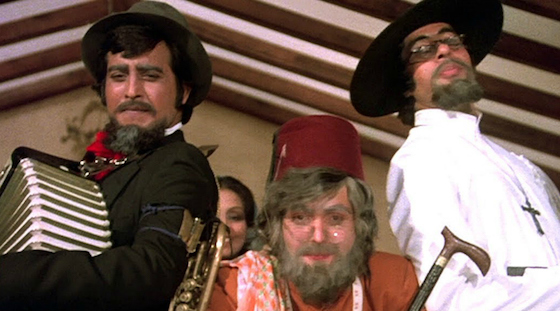
The quintessential example of a film reflecting pluralistic values is Manmohan Desai's Amar Akbar Anthony (1977).

Amar (Vinod Khanna), Akbar (Rishi Kapoor), and Anthony (Amitabh Bachchan) in Amar Akbar Anthony.

As I summarized the film in my Favorites of 2019: Movies and television, three little boys, inadvertently separated from their parents and apparently abandoned, are taken in by a Hindu police officer, a Muslim tailor, and a Catholic priest. Twenty-five years later, Amar (Vinod Khanna) has become a tough but honest cop, Akbar (Rishi Kapoor) has become a famous qawwali singer, and Anthony (Amitabh Bachchan) is a two-fisted, good-hearted bhai who rules his lane. When a blind old woman (guess who) is hit by a car and needs an emergency transfusion, the three men (who, of course, all share the woman's blood type) volunteer. As the blood of the three strangers who are her unsuspecting Hindu, Muslim and Christian sons mingles in Ma's veins to give her life—symbolism, anyone?—the credits begin to roll. The opening credits. This is just the pre-credit sequence.

Of course, the mid-1970s were also the period of the Emergency, during which Prime Minister Indira Gandhi ruled by decree. Political opponents were jailed and their organizations banned, civil liberties (such as political protests and trade union strikes) were restricted, and a program of forced sterilization was instituted that targeted the poor and marginalized, especially Muslims. The sentimental pluralism of films like Amar Akbar Anthony was belied by the actions of the Congress Party-dominated government.

One reason for the pluralism of many Bollywood films between independence and the early 1990s was not only the (stated) non-sectarianism of government policy, but the pluralism of Bollywood itself. As Maidul Islam writes,

. . .for many decades, Bollywood has remained one of the strongest bastions of secularism and 'perhaps the least religiously segregated place in India today where Hindus and Muslims work together as well as intermarry.' It is one of the few sites in India where Muslims are not marginal, but actually enjoy some prominence and success, and has many famous stars, successful directors, screenwriters, choreographers, lyricists, and composers. [5]

"Some prominence and success" indeed (links are to mentions in E&I):

As the BJP, aided by Congress Party corruption and incompetence, developed significant political power from the late 1980s onward, pluralistic films continued to be made. Films such as Lagaan (2001), Veer-Zaara (2004), Rang de Basanti (2006), Dor (2006), Chak De! India (2007), and My Name Is Khan (2010) were critical and box-office successes.

However, with the ascendency in the 2014 general elections of Modi and the BJP, and their consolidation of power in the 2019 general elections, Bollywood is bending with the prevailing political winds. We were dismayed to learn from Subramanian's article about recent films such as the Hindu-chauvinist Samrat Prithviraj (starring Akshay Kumar, 2022), and prominent actors who have embraced the BJP and its Hindutva ideology, including Anupam Kher and Kangana Ranaut.

Even many of those who aren't vocal BJP supporters are keeping their heads down, or up, as the case may be. A 2019 photo from Karan Johar's Instagram account:

Ranveer Singh, Sidharth Malhotra, Karan Johar, Varun Dhawan, Ranbir Kapoor, Vicky Kaushal (? identification uncertain), Rohit Shetty, Ekhta Kapoor, Ashwiny Iyer Tiwari, Rajkummar Rao, Bhumi Pednekar, Alia Bhatt, Ayushmann Khurrana, and others surrounding Narendra Modi. Image source: India Today

Actress Nafisa Ali posted in response, "Felt sad to see my Fraternity being part of PM’s planned PR. . .I will pray that the truth is exposed and the closed door planning of divide & rule is understood. I worry for the Constitutional rights of every Indian. I was in Gujarat soon after the riots and will never forget the reality of what I saw. I pray for the Unity of India."


  1. Mishra has been accused of fomenting the 2020 Dehli riots which started when a non-violent crowd blockading a road was attacked. The blockade was in protest of the discriminatory Citizenship Amendment Act, which provides a path to Indian citizenship only for non-Muslim immigrants from neighboring Muslim-majority countries. Over several days of violence and arson 53 people, more than two-thirds of them Muslims, were killed. ^ Return
  2. Quoted in Barry Bearak, "New Dehli Journal; A Lesbian Idyll, and the Movie Theaters Surrender." New York Times, 24 December 1998, p. A4. https://www.nytimes.com/1998/12/24/world/new-delhi-journal-a-lesbian-idyll-and-the-movie-theaters-surrender.html. Bearak's smirking, flippant article betrays his own profound limitations of perspective as a cultural observer.
  3. Throughout the anti-Padmaavat protests Hindu nationalists selectively conflated the characters depicted onscreen with the actors who portrayed them. Selectively, because while Padukone was threatened with death for what the perpetrators believed were the actions of her character in the dream of another (evil) character, apparently it didn't matter that offscreen Padukone and Singh were a real-life couple; they are now husband and wife.
  4. Quoted in Maidul Islam, "Imag(in)ing Indian Muslims in Post-liberalization Hindi Cinema," in Indian Muslim(s) After Liberalization, Oxford University Press, 2019, p. 111. 
  5. Maidul Islam, p. 93.