Showing posts with label movies - Barbara Stanwyck. Show all posts

Saturday, January 24, 2026

The Strange Love of Martha Ivers

The Strange Love of Martha Ivers. Starring Barbara Stanwyck (Martha Ivers), Van Heflin (Sam Masterson), Lizabeth Scott (Toni Marachek), and Kirk Douglas (Walter O'Neil). Screenplay by Robert Rossen, after the short story "Love Lies Bleeding" by John Patrick; directed by Lewis Milestone. Produced by Hal Wallis, distributed by Paramount Pictures, 1946.

Poster for The Strange Love of Martha Ivers

Poster for The Strange Love of Martha Ivers. Image source: imdb.com

Film noir is often portrayed as an urban genre: the noir classics The Maltese Falcon and The Lady from Shanghai are set in San Francisco; The Big Sleep and Double Indemnity are set in Los Angeles; Call Northside 777 and Undertow are set in Chicago; and Phantom Lady and Laura are set in New York, to mention just a few examples of many. There was even a post-WWII trend of noir films that announced their urban locations in the title, such as The Naked City, Cry of the City, Dark City, and Night and the City.

But in the world of noir, evil is not confined to cities—it saturates the whole of American society. In movies such as Shadow of a Doubt, The Postman Always Rings Twice, Out of the Past, and The Big Heat, suburbs and small towns are not havens of tranquility and safety, but sites of corruption, murder, blackmail, and betrayal.

Which brings us to The Strange Love of Martha Ivers. In 1928 in Iverstown, a Pennsylvania steel town, a teenaged Martha Ivers (Janis Wilson) is being raised as the ward of her strict aunt (Judith Anderson, the domineering housekeeper Mrs. Danvers in Hitchcock's Rebecca). The aunt owns the town's mill, which she runs with an iron fist with the aid of her fawning factotum O'Neil (Roman Bohnen). Martha hates her aunt and tries to run away with bad boy Sam Masterson (Darryl Hickman), but she is caught and brought back (for what we learn is the fourth time).

Janis Wilson, Judith Anderson and Roman Bohnen in <i>The Strange Love of Martha Ivers

Janis Wilson (young Martha), Judith Anderson (Mrs. Ivers) and Roman Bohnen (Mr. O'Neil) in The Strange Love of Martha Ivers. Image source: listal.com

When later that same night Martha tries running away with Sam again, her aunt hears a noise and comes to investigate. Their encounter ends with Martha wresting her aunt's walking stick from her hand and striking her in the head, causing a fatal fall down the stairs.

When O'Neil bursts in, Martha blames the assault on a nonexistent intruder. O'Neil's son Walter (Mickey Kuhn) has witnessed it all, but under the questioning of his father corroborates Martha's story. O'Neil immediately suspects the truth, and under the guise of solicitous concern for Martha's welfare seizes the opportunity for blackmail: "You poor child; you'll be all alone in the world now. . .But you needn't be afraid. We'll always be with you, Walter and I. We'll never leave you." Indeed. An alcoholic ex-millworker who'd been fired by Mrs. Ivers is picked up, and—thanks to the testimony of Martha, supported by Walter—is swiftly convicted of the murder and hanged.

Flash forward 18 years to 1946. On her aunt's death Martha inherited the mill, which over time she has hugely expanded, from 3,000 workers to 30,000. "I did it all by myself," the adult Martha (Barbara Stanwyck) says. (We don't doubt that Martha is a supremely competent corporate executive—she's Barbara Stanwyck, after all—but wartime demand for steel may have played a part.) Her money was used by Walter's father to send his son to Harvard; although Martha despises Walter, their shared guilt binds them together, and they are now married. The adult Walter (Kirk Douglas, in his first film role) tries to quiet his conscience and soothe the miseries of his unreciprocated love for Martha with drink.

Kirk Douglas and Barbara Stanwyck in a publicity still from The Strange Love of Martha Ivers

Kirk Douglas (Walter) and Barbara Stanwyck (Martha) in a publicity still from The Strange Love of Martha Ivers. Image source: Crooked Marquee

Sam left Iverstown the night of the murder and has grown up as a drifter and a gambler, but he's his own man and lives by his own moral code. Discharged from the army and driving west, the adult Sam (Van Heflin) has an accident on the road outside of Iverstown (paging Dr. Freud!) and is stuck in town until the car is repaired.

When he stops by his childhood home, now a women's rooming house, he meets Toni Marachek (Lizabeth Scott), who has "been away for awhile"—in jail for theft. She's out on parole and is supposed to catch a bus back to her hometown, but sees a chance for a fresh start out west with Sam.

Publicity still of Lizabeth Scott in The Strange Love of Martha Ivers

Lizabeth Scott (Toni Marachek) in The Strange Love of Martha Ivers. Image source: Wikipedia.com

She's not the only woman in Iverstown imagining a future with Sam; when he inevitably encounters Martha, her teenaged feelings for him are reawakened. The stage is set for a love quadrangle, with both women vying for Sam, and Walter justly perceiving Sam as a rival for Martha. He also recognizes Sam as a threat to reveal the truth about that fatal night almost two decades ago, a threat that must be dealt with. Revelations about the past, betrayal, and death will soon follow.

At times The Strange Love of Martha Ivers feels almost as claustrophic as Luis Bunuel's The Exterminating Angel. All the characters are trapped. Most obviously, Martha and Walter are inextricably tied to one another by their mutual guilt. But neither Sam nor Toni can escape Iverstown: the bus somehow always leaves without Toni, while Martha makes sure that the repairs on Sam's car make no progress. 

There's also no escape for Sam and Toni from the power of Martha and Walter. When Martha surprises Toni and Sam together in their connecting hotel rooms, Sam snaps, "Even a crummy hotel like this has a switchboard." "I have special privileges this hotel, Sam," Martha replies. "I own it." But Martha, rich and alluring as she is, represents the past for Sam; Toni is the future.

Sam, Toni and Martha in Sam's hotel room

Van Heflin (Sam Masterson), Lizabeth Scott (Toni Marachek), and Barbara Stanwyck (Martha Ivers) in The Strange Love of Martha Ivers. Image source: Feminéma

Even when Walter orders some goons to beat up Sam and dump him 25 miles out of town, Sam must return to settle the score. Only when the past has been confronted and everything is out in the open can any fresh starts be made. But Martha and Walter are trapped together in a web of lies from which there is no escape.

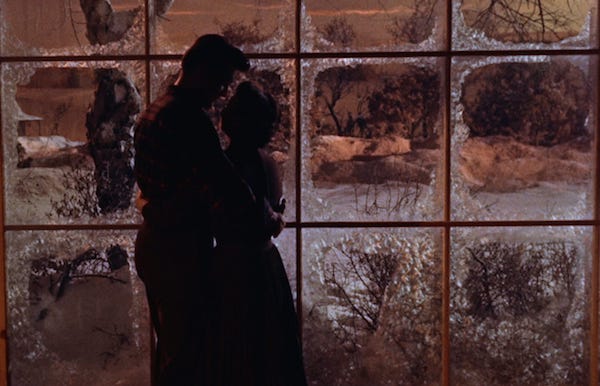
Director Lewis Milestone (All Quiet on the Western Front, Ocean's 11) heightens the sense of confinement through the tight framing of the characters in medium shots and close-ups or isolating them against dark backgrounds, while cinematographer Victor Milner (who worked extensively with both Ernst Lubitsch and Preston Sturges) effectively employs silhouettes and shadows to create sense of mystery. (It always seems to be night in Iverstown, and raining more often than not.) The one misstep is the sometimes overwrought score by composer Miklós Rózsa (Double Indemnity, Spellbound), which can seem mis-matched to the gritty mise-en-scène.

The Strange Love of Martha Ivers is full of surprises. For me the first was Van Heflin's standout performance as the morally ambiguous but sympathetic Sam. Until I saw this movie Van Heflin's name in the credits was not an inducement to watch, but I'll have to explore more of his filmography.

Barbara Stanwyck and Van Heflin in a publicity still from The Strange Love of Martha Ivers

Barbara Stanwyck (Martha Ivers) and Van Heflin (Sam) in a publicity still from The Strange Love of Martha Ivers. Image source: The Cinematheque

This is even more true of Lizabeth Scott. During filming she was just 23, and The Strange Love of Martha Ivers was only her third film. But she completely inhabits the character of Toni, a woman who has been crushed by circumstances. Although she looks and sounds like Lauren Bacall, Toni doesn't share her strength: any bravado she might once have possessed has been beaten out of her by life. Lizabeth Scott made a specialty of roles in noir films, and beyond this movie so far I've only seen Dark City. I definitely want to see more.

John Kellogg, Lizabeth Scott, and Van Heflin in The Strange
  Love of Martha Ivers

John Kellogg (Joe), Lizabeth Scott (Toni), and Van Heflin (Sam) in The Strange Love of Martha Ivers. Image source: Heart of Noir

Kirk Douglas is totally convincing as the conscience-ridden, alcoholic Walter. Just a year later he played the suave mobster Whit Sterling in Out of the Past, and soon thereafter became a top-billed star. But in his first role he shows that he is not only a movie star, but an actor of surprising range.

And what is there to say about Barbara Stanwyck that hasn't already been said? Martha Ivers is amoral, selfish, willful, ruthless and brutal, but also indomitable, independent, and smart: she knows what she wants and goes after it. She recognizes that Sam represents her last chance of happiness, but ultimately that it's impossible for them to be together—a realization that has tragic consequences, and not only for her.

Kirk Douglas, Van Heflin, and Barbara Stanwyck in The Strange Love of Martha Ivers

Kirk Douglas (Walter), Van Heflin (Sam), and Barbara Stanwyck (Martha) in The Strange Love of Martha Ivers. Image source: Daily Motion

Many thanks to the dear friends who invited us to see The Strange Love of Martha Ivers on the big screen (at Berkeley's Pacific Film Archive), as it and all films should be seen.

Friday, July 22, 2022

E&I's 15th anniversary: 10 favorite posts from the past 5 years

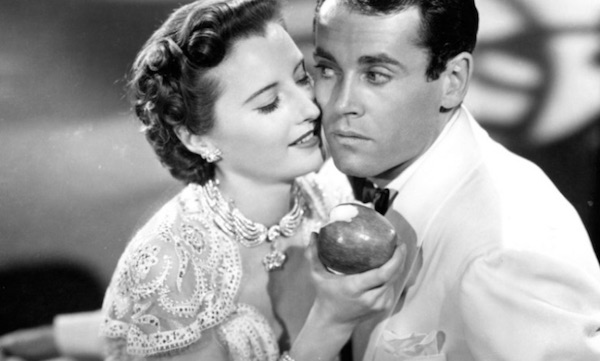
Eve (Barbara Stanwyck) tempts Charles (Henry Fonda) in Preston Sturges' The Lady Eve, from one of my favorite posts from the past 5 years. Image source: Hollywood Soapbox

This post is the 511th published on Exotic and Irrational Entertainment, and marks E&I's 15th anniversary (the very first post, on Jonathan Lethem's The Disappointment Artist, John Ford's The Searchers, and Alfred Hitchcock's Vertigo, was published on July 22, 2007).

E&I began as a way for me to explore my "indefensible obsessions": literature, primarily from the 18th and 19th centuries, and especially by women authors; opera, primarily from the 17th and 18th centuries; and Indian movies, primarily those produced by the mainstream commercial Hindi film industry known as Bollywood. Although in the five years since my 10th anniversary post I've lost touch with current developments in Indian cinema, my other obsessions have certainly continued unabated (and have been joined by a few others).

So in honor of the 15th anniversary of E&I, here is a list of 10 of my favorite posts (or post series) from the past 5 years:

Books:

Angela Carter: A post on Edmund Gordon's biography The Invention of Angela Carter, plus four posts devoted to the best of her fiction, including the evocative The Magic Toyshop and the uncanny tales of The Bloody Chamber. (September–October 2018)
Daphne du Maurier, My Cousin Rachel: Du Maurier's fiction has always been popular, but has long been viewed with unwarranted condescension by many literary critics. My Cousin Rachel (like "The Birds" and Rebecca) is another of her masterpieces of growing dread and inexorable fate. Margaret Forster's groundbreaking biography of Du Maurier, the first to reveal the extent of Daphne's same-sex attractions, was one of my favorite books of 2021. (April 2021, October 2021)
Joaquim Maria Machado de Assis: The 19th-century Brazilian author, the grandson of slaves, is amazingly modern in his subjects and style. I wrote posts on recent translations of his brilliant Posthumous Memoirs of Brás Cubas, in which a dead man looks back on his inconsequential life with ironic humor, and on his wistful final masterwork, Counselor Ayres' Memorial, in which an older man observes a young widow's struggles to remain in mourning as she is inexorably drawn back to life and love. (March 2018 and July 2020)
Margaret Oliphant, Miss Marjoribanks: Victorian novelist Margaret Oliphant is not as well-known today as her contemporaries Elizabeth Gaskell and George Eliot, but she can be equally acute about the strategies that determined, ambitious women in her era had to pursue in order to achieve their aims. In Miss Marjoribanks, the title character (pronounced "Marchbanks") wants to transform the moribund society of the town of Carlingford and inject some youth and life; her matchmaking is so successful that she almost runs out of eligible bachelors for herself. (August 2020)

Opera:

The mysteries of Dido and Aeneas: The greatest opera in English, Henry Purcell's Dido and Aeneas, is surrounded by mysteries. We don't have all the music: the scores that exist are incomplete copies that don't agree with one another, made for performances that occurred decades after Purcell's death in 1695. We don't know the date of the first performance, or who sang which roles: there is only a single surviving copy of Nahum Tate's libretto from the first (or at least a very early) performance "by young gentlewomen" at a Chelsea boarding-school. In this post I discuss new evidence that has emerged in the last 15 years or so that may enable us to provide at least partial answers to some of the major questions that remain about this opera. (March 2018)
Vittoria Tesi: The first Black prima donna: Vittoria Tesi, the first Black or biracial prima donna, is an extraordinary and ground-breaking figure. She was a star singer who performed on equal terms with other superlative singers of the mid-18th century. And yet I've been listening to Baroque opera for nearly 30 years and can't recall having heard her name before. This post series attempted to bring together all the documented information about Tesi, including some amazing descriptions and images of extravagant Baroque opera spectacles in which she participated. I included arias from the roles she peformed, and identified (for the first time, to my knowledge) a possible image of her father as a young servant in the Medici household. (March–May 2022)
The operas of Antonio Salieri: In the play and film Amadeus, the composer Antonio Salieri is portrayed as "the patron saint of mediocrity," so envious of Mozart's talent that he finally poisons him. One of the many problems with this image is that during Mozart's lifetime Salieri was by far the more successful composer, and Mozart and his librettist Lorenzo Da Ponte drew inspiration from Salieri's work in creating their own. In my post on Salieri's La grotta di Trofonio (The cave of Trofonio) I show that it influenced Mozart's Don Giovanni and Così fan tutte (All women are the same), while in the post on Salieri's La scuola de' gelosi (The school of jealousy) I show that it helped shape Mozart's Le nozze di Figaro (The Marriage of Figaro) as well as Così. The third Salieri opera that I've written about, the one-act Prima la musica, poi le parole (First the music, then the words), was actually a joint production with Mozart, who wrote his own one-act opera, Der Schauspieldirektor (The impresario) to be performed the same evening. In my post on La scuola I wrote, "Salieri may not have been Mozart, but being Salieri was more than sufficient." (December 2018, March 2021, July 2021)

Film:

René Clair: Between the mid-1920s and the early 1930s, years spanning the transition between silent and sound films, French director René Clair directed a series of now-classic comedies. Entr'acte (1924) and The Italian Straw Hat (1927) exploit the visual possibilities of film to tell a series of running jokes. In Sous les toits des Paris (Under the roofs of Paris, 1930), the protagonist is a sheet-music peddler whose code of class loyalty leads to a prison term for a crime he didn't commit. Clair's visual inventiveness and working-class sympathies perhaps reached their highest expression in the gentle humor and humanistic ideals of À nous la liberté! (Give us freedom!, 1931), in which an escaped prisoner becomes a wealthy industrial magnate, only to be reminded of his principles by an encounter with his former cellmate. (September–December 2017)
Ester Krumbachová: A survey of three films written and designed by Krumbachová, a central figure in the Czech New Wave cinema of the 1960s: the surreally feminist Daisies (1966), the bitterly funny and morally chilling A Report on the Party and Guests (1967), and the dreamlike Valerie and Her Week of Wonders (1970). A few years after the 1968 Soviet invasion ended the Prague Spring, Krumbachová was blacklisted for a decade, but these films remain as a testament to the courage and creativity of Krumbachová and her colleagues. (November 2018)
Preston Sturges: Between 1940 and 1944 seven comedies written and directed by Preston Sturges were released by Paramount Studios. There's not a dud among them, and some are among the best comedies ever produced in Hollywood. In my view Sturges' peak achievement is The Lady Eve (1941), with Barbara Stanwyck and Henry Fonda, but others might vote for Sullivan's Travels (1942), with Joel McCrea and Veronica Lake, or the rueful Hail the Conquering Hero (1944), with Eddie Bracken and Ella Raines. (May 2021)

Over the past decade and a half this blog has received (to my astonishment) 657,000 page views. This is a particularly gratifying surprise given that my average post is probably close to two thousand words long, and some far exceed that total. My deepest thanks to everyone who has stopped by E&I since 2007 to read my thoughts and share their own. While I can't guarantee that I'll be continuing for another 15 years, I have no plans to stop writing anytime soon. Take that as fair warning!

Thursday, November 11, 2021

Favorites of 2021: Movies

Rock Hudson and Jane Wyman in Douglas Sirk's All That Heaven Allows (1955). Image source: Criterion.com

This past year I found myself rewatching films I'd first seen years or decades ago. I do this a good deal in most years, but this year it seemed as though rewatched films were a larger proportion of my viewing. So at the end of my list of favorite films first seen in the past twelve months I've added a couple ringers: movies that I first watched decades ago, but which on re-viewing I felt deserved a place on my favorites list. 

In ascending chronological order by year of release:

Nightmare Alley (1947). Screenplay by Jules Furthman, based on the novel by William Lindsay Gresham; directed by Edmund Goulding.

Coleen Gray (as Molly performing in her stage persona "Electra") in Nightmare Alley.

Stan Carlisle (Tyrone Power, playing against his usual romantic-hero type) is a carny, drifting along and looking for a hustle. Trading on his good looks, he seduces the sideshow psychic Zeena (Joan Blondell). When her husband Pete dies (an accident that Stan has a hand in), Zeena enlists Stan as a partner in her act and teaches him the secret communication code that makes her seem clairvoyant. Once he learns the code, Stan and his (younger, prettier) lover Molly (Coleen Gray) leave the carnival and head for the big city to make their fortune with an upscale nightclub act.

Unfortunately for Stan, "consulting psychologist" Lilith (Helen Walker, with tightly coiffed/repressed hair) comes to the nightclub one night. Soon they've formed a partnership: Lilith feeds Stan information from therapy sessions with her wealthy clients, enabling him to extort ever-increasing sums of money from them by pretending to commune with the spirits of their long-lost loved ones. But "psychic" Stan doesn't see that he's the one being conned. . .

The carnival sequences are authentically seedy, in part because a real carnival was rented and installed on the backlot. Screenwriter Jules Furthman (To Have and Have Not, The Big Sleep) had to tone down many aspects of Gresham's novel, thanks to the Production Code, but the movie is still remarkably dark. Power gives an excellent performance as Stan, a guy for whom no scam, however successful, is ever quite enough, and whose fall leads him to make a desperate choice. Equally courageous is Joan Blondell, whose Zeena is a once-beautiful woman whose face and body are beginning to show the effects of her hard life. And Helen Walker makes a coolly calculating femme fatale, as she would in the next film on my favorites list.

Impact (1949). Screenplay by Dorothy Reid and Jay Dratler, directed by Arthur Lubin.

Helen Walker (as Irene Williams) in Impact.

San Francisco auto magnate Walter Williams (Brian Donleavy) dies in a fiery crash on a mountain road. Or at least that's the way it looks. Just before the crash, though, Williams was assaulted by a hitchhiker, shoved unconscious off a cliff and left for dead. Instead it was his passenger who was behind the wheel when Williams' speeding car plunged off the twisting road in the dark and exploded in flames, burning the driver's body beyond recognition.

When Williams returns to consciousness he's dazed. He crawls back up to the road and climbs into the back of a moving van that had stopped at the accident scene. Unnoticed by the movers as they drive off, the next day he wakes up with a splitting headache as they pull into a small town in Idaho. There he discovers the news of his "death" and a dawning realization: his wife Irene (Helen Walker) and the "cousin" she'd asked him to give a lift to (Tony Barrett) had plotted to murder him. And that insight leads inevitably to the conclusion that they must have been lovers.

In Idaho Williams meets the owner of a struggling gas-station, the war widow Marsha Peters (Ella Raines), and—his former life shattered—decides to stay on and help her as "Bill Walter." Eventually, though, he reveals his true identity, and at Marsha's urging returns to the Bay Area to clear his wife of murder charges in his "death"—only to find himself arrested, accused by Irene of killing her lover. Now Marsha must race against time to try to prove his innocence. . .

Impact offers some nice twists on the noir formula: instead of the Good Wife versus the seductive Other Woman, this time it's the seductive Bad Wife who (twice!) tries to do away with her husband, and the good Other Woman who tries to save him. The movie's chief attractions are the adversaries in that battle: the striking Ella Raines (of Hail the Conquering Hero), and Helen Walker, once again playing an ice-cold femme fatale with chilling effectiveness.

Love Me or Leave Me (1955). Screenplay by Daniel Fuchs and Isobel Lennart; directed by Charles Vidor.

Doris Day (as Ruth Etting) wearing a Helen Rose creation in Love Me or Leave Me.

The story of a nightclub singer's rise to stardom and marriage to a controlling, violent man may have attracted its star Doris Day because of the parallels to her own life. Singing hopeful Ruth Etting (Day) is spotted in a 10-cents-a-dance joint by Chicago gangster Martin Snyder (James Cagney). Snyder aggressively takes charge of Ruth's career, strong-arming Ruth's way into a job singing a warm-up jingle for a male headliner, and then engineering the headliner's no-show so that Ruth can go on in his place. A radio show follows, the Ziegfeld Follies are soon calling, and Ruth becomes the toast of Broadway—but she still somehow manages to keep Snyder at arm's length. Snyder's frustration and jealousy are further inflamed by Ruth's musical director Johnny Alderman (Cameron Mitchell), who has made no secret of his attraction to her. Ruth returns Johnny's feelings, but her career is tied to Snyder. Snyder ultimately coerces Ruth into marriage, resulting in misery for all three.

Day, dressed in a series of glamorous Helen Rose gowns, surprises by playing Ruth as a woman whose sweet appearance conceals a will of steel: she knows what she wants and goes after it, even at the cost of her own happiness. Cagney gives a fiercely driven performance as Snyder, the intensity of whose passion for Ruth is never enough to evoke responsive feelings in her. Cagney manages to make Snyder sympathetic in his inability to help himself despite his recognition of the hopelessness of his situation.

In addition to the strong script and performances, Day sings a dozen standards, including the title track, "Ten Cents A Dance," "Mean to Me," "I'll Never Stop Loving You," "You Made Me Love You," and a lush, emotionally freighted version of "Never Look Back":

https://youtu.be/rpdO0HFQ23c?t=2

All That Heaven Allows (1955). Screenplay by Peg Fenwick after a story by Edna L. Lee and Harry Lee; directed by Douglas Sirk.

Rock Hudson (as Ron Kirby) and Jane Wyman (as Cary Scott) in All That Heaven Allows.

Cary Scott (Jane Wyman) is a well-off widow in a New England town whose life revolves around her country-club friends and her college-age children. Passion is missing—until she meets Ron Kirby (Rock Hudson), a much younger arborist (Hudson was actually only 7 years younger than Wyman, but Ron is supposed to be 15 years younger than Cary). Ron lives "simply" (in a gorgeously renovated old mill that would cost several decades of my salary) and invites Cary to dinner with his carefree bohemian friends; soon they are falling in love.

But Cary's country-club set is disapproving, and both her son and her daughter react badly (neither of them thinks it's appropriate for their middle-aged mother to be interested in love and sex). Her son actually buys her a TV set for company; in a brilliant reverse-angle shot she sees herself reflected in the screen as if trapped within it. Will Cary be able to summon the emotional strength to find happiness with Ron, or will she conform to the expectations of her neighbors and the wishes of her children and remain walled up alive in her comfortable tomb?

All That Heaven Allows is stunningly filmed in deeply saturated Technicolor by Sirk and cinematographer Russell Metty. The screen is flooded with gorgeous reds and golds when she and Ron embrace, and conversely when they are separated the winter landscape seems drained of color; Cary is often placed behind window frames as if behind prison bars. Sirk's use of shadows is as visually evocative as in a black and white film.

Portrait of a Lady on Fire (Portrait de la jeune fille en feu, 2019). Written and directed by Céline Sciamma.

Noémie Merlant (as Marianne) and Adèle Haenel (as Héloïse) in Portrait of a Lady on Fire. Image source: UCSD Guardian

Beautifully photographed and delicately understated, Céline Sciamma's film focuses on the impossible and doubly forbidden love between the artist Marianne and her aristocratic subject Héloïse. Their love is impossible because, as Héloïse's companion (and secretly the painter of her portrait), Marianne is essentially a high-status servant in the household of the Countess, Héloïse's mother. Their love is doubly forbidden because it is both homoerotic and adulterous: Héloïse's marriage has been contracted and is imminent; Marianne has been hired to paint her wedding portrait.

Portrait of a Lady on Fire could not have been designed to be more enticing to us with its 18th-century setting, scenic locations, elegant interiors, lovely clothes, simmering erotic tension, hopeless love, passionate Vivaldi, intelligent script, and appealing actors (Noémie Merlant as Marianne and Adèle Haenel as Héloïse). What more could we ask for?

Ringers:

The Lady Eve (1941). Written and directed by Preston Sturges.

Barbara Stanwyck (as the Lady Eve) and Henry Fonda (as Charles Pike) in The Lady Eve.

The Lady Eve is the quintessential Sturges comedy. Charles Pike (Henry Fonda), heir to the "Pike's Pale Ale" fortune, is returning to New York from a snake-hunting expedition to the Amazon. On board the same ocean liner are Jean Harrington (Barbara Stanwyck) and "Colonel" Harry (Charles Coburn), a father-daughter team of card sharps planning to fleece him and the other rich passengers along the way. Charles, who has been in paradise and is bringing home a snake, is about to fall.

The Lady Eve is the best of Sturges' movies, which is saying a great deal, and has one of the cleverest, funniest closing scenes in all American movie comedy. This was the peak experience of our home Preston Sturges film festival this year. If you've never seen it, viewing is highly recommended, and if (like me) you have seen it before, a rewatch is in order.

Oh! What a Lovely War (1969). Screenplay by Len Deighton (uncredited), based on the stage musical Oh, What a Lovely War! developed by Joan Littlewood's Theatre Workshop; directed by Richard Attenborough.

This post will be published on Veterans' Day in the U.S., commemorating the 11th hour of the 11th day of the 11th month of 1918, the moment when fighting was halted on the Western Front in World War I. That nearly 3,000 men were killed on that same day in the hours before the official cessation of hostilities is one more example of the horrific waste of life in that conflict, which resulted in the deaths of millions of soldiers and civilians, and permanent injury or disability to millions more.

Oh! What A Lovely War is a savage satire of the blunders and lies that led to and sustained the First World War. The home front, where brass bands play, musical hall stars exhort men to join up, and the appalling casualties are posted like cricket scores, is represented by Brighton Palace Pier; the battle front is depicted in all its muddy death-dealing horror. 

You'll recognize virtually every notable British stage and screen actor of the time, including Dirk Bogarde (The Servant), Edward Fox (The Day of the Jackal), John Gielgud (Secret Agent), Ian Holm (Dreamchild), Laurence Olivier (Rebecca), Michael Redgrave (The Lady Vanishes) and his daughter Vanessa (Mary, Queen of Scots), Ralph Richardson (The Holly and the Ivy), Maggie Smith (The Prime of Miss Jean Brodie), and Susannah York (Tom Jones)—and if you have a sharper eye than mine you may spot Jane Seymour (Dr. Quinn, Medicine Woman) as a chorus girl. I first saw this when I was about 16, and the final shot has stayed with me ever since. The film was made around the time of the fiftieth anniversary of the end of the war, but its message seems aimed as well at the brutal campaign the U.S. was then waging in Vietnam. Oh! What A Lovely War will only lose its impact when working-class young men are no longer sent off to die in meaningless conflicts by rich old men who direct the carnage from a safe distance—which is to say, never.

https://www.youtube.com/watch?v=ynEWZF1bkLQ

Honorable mentions:

Cluny Brown (1946). Screenplay by Samuel Hoffenstein and Elizabeth Reinhardt, based on the novel by Margery Sharp; directed by Ernst Lubitsch.

Helen Walker (as the Honorable Betty Cream) in Cluny Brown.

The final film completed by Ernst Lubitsch before his death, Cluny Brown features his trademark lightness of touch as well as typically risqué dialogue, this time featuring plumbing as a metaphor for sex.

As the plumber-heroine Cluny, Jennifer Jones displays an unsuspected flair for comedy and a British accent that often vanishes completely, while as Adam Belinski, a penniless Czech refugee from the Nazis, Charles Boyer offers his usual suavity. Helen Walker (of Nightmare Alley and Impact) plays the Honorable Betty Cream, the presumptive fiancée of Andrew (Peter Lawford), an upper-crust son and heir. Betty and Andrew have had a row, and over the course of a country-house weekend Cluny (a maid/plumber) and Adam (a houseguest) present romantic complications for the couple, and each other. Andrew is sincere but a bit dim, while Betty is self-possessed, coolly witty, and gets some of the better lines.

Cluny Brown may not rank with Lubitsch's greatest work—for that you'll need to watch Trouble in Paradise—but it is a charming and affectionate send-up of British manners and mores, and its oppositions are never simple ones. It makes me wonder why both Jennifer Jones and Helen Walker didn't get to play more comic roles.

Les Liaisons Dangereuses 1960 (1959), screenplay adapted from the novel by Pierre Choderlos de Laclos by Roger Vailland, Roger Vadim and Claude Brulé; directed by Vadim.

Les Liaisons Dangereuses 1960 could almost be mistaken as a product of the French New Wave. An updating of Pierre Choderlos de Laclos' 1782 novel in letters of aristocratic libertinage to the milieu of the Parisian haute-bourgeoisie in the late 1950s, Vadim's film seems to have been explicitly modelled on Louis Malle's Ascenseur pour l'échafaud (Elevator to the Gallows, 1958). Like Malle's film, Liaisons is shot in black and white, stars Jeanne Moreau, and is set to a superb jazz soundtrack (by Thelonious Monk and Art Blakey & the Jazz Messengers in Liaisons, by Miles Davis in Ascenseur).

Valmont (Gérard Philippe) and Juliette (Moreau), a well-off married couple, have agreed to sleep with other people, but have also pledged to be completely honest with each other; they have vowed "not to accept the lies that degrade other couples." But their apparent openness devolves into an intra-marital power struggle that brings disaster to everyone whose lives they touch, including the teenaged Cécile Volanges (Jeanne Valérie), her fiancé Jerry Court (Nicholas Vogel), her college-student lover Danceny (Jean-Louis Trintignant), and the devoted wife Madame de Tourvel (Annette Vadim).

The updating of the novel works surprisingly well. To the novel's letters the film adds phone calls, tape recordings, and telegrams; most of the translations required by the temporal leap forward by nearly two centuries maintain the spirit of the original. Some "modern" touches don't work so well, however. There's a scene where a jazz band (Art Blakey's Jazz Messengers) sends women into an orgiastic frenzy of dancing, like something out of Joseph March's The Wild Party (1928). And Vadim gives a smarmy introduction to the film in which he Explains It All To Us; one of its more memorable lines concerns "young women freed from sex-related social constraints and that burst open, buoyantly, like ripe fruits."

Vadim's appalling introduction aside, Les Liaisons Dangereuses 1960 largely succeeds on its own terms: it's sleek and chic and has excellent leads in Philipe and Moreau, who are flattered by the gorgeous black-and-white photography of Marcel Grignon. But, like the novel, it could have been a blistering critique of gendered power relations. That would have required, though, some self-critical reflection on the part of Vadim, whose later career (he wrote and directed Barbarella (1968), among other films) demonstrates that he forever remained a prisoner of the idea that women's sexual freedom should primarily benefit men.

Other Favorites of 2021:

Sunday, October 31, 2021

Favorites of 2021: Books

Reality keeps outstripping invention these days, so it may come as no surprise that I found that 2021 was not a great year for fiction. In any case, I found fewer favorites among my reading (both fiction and non-) than usual. My apologies for the truncated lists that follows. My favorites, as always drawn from books first read (but not necessarily first published) in the past twelve months, in the order in which they were encountered:

FICTION

Emily Eden: The Semi-Attached Couple and The Semi-Detached House (Dial Press/Virago, 1979)

Emily Eden was born in the year the 21-year-old Jane Austen began writing Pride and Prejudice, and died in the year the 49-year-old George Eliot began writing Middlemarch. As this chronology suggests, Eden is a bridge between the fictional worlds of Austen and Eliot. Her witty, ironic style echoes Austen, while her fictional themes of unhappy marriages and the social constraints on women anticipate those of Eliot and other late Victorian writers such as Anthony Trollope and Elizabeth Gaskell.

In The Semi-Attached Couple (1859), Lord Teviot marries local beauty Helen Beaufort, but the marriage is not a success. He is short-tempered and jealous, and she is quick to take offense. They seem to willfully misunderstand one another. In her portrait of their union Eden anticipates Eliot's dissection of the mismatched marriages of Dorothea Brooke and Casaubon or Lydgate and Rosamond Vincy.
Yes, I knew Helen from her childhood, and had thought that such a gentle, gay creature could never be touched by the cares and griefs that fall on the common herd. . .Why was she to escape? I do not wish to be cynical; but if a stone is thrown into our garden, is it not sure to knock off the head of our most valuable tulip? If a cup of coffee is to be spilled, does it not make a point of falling on our richest brocade gown? If we do lose our reticule, does not the misfortune occur on the only day on which we had left our purse in it? (Vol. I, Ch. I)
But unlike in Middlemarch, the central marriage in The Semi-Detached Couple does not end in the death of one of the partners or with the couple chained together endlessly in mutual misery. Instead, like Austen, Emily Eden enables her characters to find happiness at last: ". . .give them time and opportunity, and there is no saying whether the warm heart will not soften and conquer the hard one at last." (Vol. II, Ch. VI)

The Semi-Detached House (1860) was written decades before The Semi-Attached Couple, but then left in a drawer for 30 years until the success of the latter enabled the earlier manuscript to be dusted off and published.

The novel's heroine is Blanche, Lady Chester, who, while her husband is away on a diplomatic mission, takes the abode of the title during her pregnancy (a word that never occurs in the novel; you have to read carefully not to be surprised when she goes into labor). "Semi-detached" means, in the way of all real-estate listings, completely attached, and Blanche is at first concerned about the proximity of her plebeian next-door neighbors, the Hopkinsons. But she is soon chastened when she learns of the dangers of prejudice and comes to know of the Hopkinsons' decency, generosity, and goodness.

As I wrote in my post about the Virago Modern Classics omnibus edition of the novels, "Emily Eden's fiction features scenes of marital disharmony, class snobbery, political chicanery, and financial fraudulence, but it is not primarily for their plots that her novels deserve to be read. Instead, it is her witty and ironic narrative voice that makes her seem to speak to us so vividly."


Daphne du Maurier: My Cousin Rachel (Gollancz, 1951)

For many years I uncritically dismissed Daphne du Maurier's fiction (without, of course, bothering to read any of it). But I discovered that her fiction is far from escapist; instead, often for the women in her novels there is no escape.

My Cousin Rachel (1951) is another of du Maurier's under-celebrated works. It is set sometime in the first half of the 19th century (there are no trains or telegrams, only carriages and letters). The 24-year-old Philip has inherited the estate of his cousin and guardian Ambrose, who died in Italy after marrying his young Anglo-Italian cousin Rachel.

The beautiful Rachel, left penniless by the terms of Ambrose's will, comes to England to meet Philip. Do her gestures of affection merely express her gratitude for Philip's increasingly extravagant gifts and financial support, or is she manipulating him to try to gain control over the estate? Philip finds himself torn between his suspicions of Rachel's complicity in his guardian's death and his increasingly ardent feelings:
 . . .every day, haunted still by doubt, I ask myself a question which I cannot answer. Was Rachel innocent or guilty?. . .How soft and gentle her name sounds when I whisper it. It lingers on the tongue, insidious and slow, almost like poison, which is apt indeed. It passes from the tongue to the parched lips, and from the lips back to the heart. And the heart controls the body, and the mind also. Shall I be free of it one day?. . .Perhaps, when all is said and done, I shall have no wish to be free. (Chapter One)
My Cousin Rachel is a novel of doublings, recapitulations, and the haunting of the living by the dead. These are recurrent themes in du Maurier's fiction, along with the unbridgeable gulf of understanding between men and women and the misapprehensions and jealousies which that gulf inspires. This is hardly the stance of a writer of "escapist women's romance"; as critic Nina Auerbach writes, "I was, and remain, enthralled by Daphne du Maurier because of her antiromantic refusal to satisfy predictable desires."


Honoré de Balzac: Père Goriot (Penguin, 1951, translated by Marion Ayton Crawford)

Père is a seemingly simple word to translate: it means "Father." And indeed, late Victorian translator Ellen Marriage renders the title of Balzac's novel as Father Goriot. [1] But that makes the title character sound like a priest, which assuredly he is not. Marion Ayton Crawford, translator of the first Penguin edition, rendered the title as Old Goriot, which captures the sense of dismissive familiarity which can be suggested by "Père," but misses the crucial implication that the character is in a literal sense a father. Olivia McCannon, the translator of the new Penguin edition (2011), Englishes the title as Old Man Goriot, which is even more chummy than Old Goriot but also elides his central paternal role. Perhaps the best choice is made by those translators who leave it in the original.

Père Goriot, a former merchant, lives in poverty in the Paris boarding house of the penny-pinching Madame Vauquer. Goriot has transferred all of his substantial wealth (earned by profiteering on flour in periods of food scarcity during the Revolution) to his two daughters, who have married well, if not wisely. The daughters, now the Countess de Restaud and the Baroness de Nucingen, refuse to acknowledge their father openly (though they are not above appealing to him privately to cover their debts and those of their feckless lovers, which he does at great personal sacrifice).

A second narrative concerns Eugène Rastignac, a young law student from the provinces who also lives at Madame Vauquer's. After encountering the alluring world of Parisian high society he is determined to enter it, even after he learns what's required to do so: large sums of money, promotion by a fashionable and well-connected woman, and a ruthless determination to use and discard others for his own advantage. Unfortunately for Rastignac, there are men far more ruthless than he is who have no scruples about twisting his ambitions to their own ends.

Père Goriot was published about halfway through what became Balzac's 90-plus novel series La Comédie humaine. It contains some extended (and effective) melodramatic scenes, and some sensationalistic elements (such as a criminal kingpin living in disguise in the same boarding house, whose funds and cynicism are both seemingly unlimited).

But fundamentally Père Goriot conveys the insight, a decade before Marx and Engels, that in a capitalist society the social and emotional bonds between people are reduced to a cash nexus. As Engels wrote in The Condition of the Working Class in England (1845), ". . .the social war, the war of each against all, is here [in great cities] openly declared. . .People regard each other only as useful objects; each exploits the other, and the end of it all is, that the stronger treads the weaker under foot." [2] Or, as Balzac puts it,
. . .Rastignac. . .saw Paris spread out below on both banks of the winding Seine. . .there lay the splendid world that he had wished to gain. He eyed that humming hive with a look that foretold its despoilation, as if he already felt on his lips the sweetness of its honey, and said with superb defiance,

'It's war between us now!'

Honorable mentions

In a different year, either or both of these novels might have made it into my Favorites list. Generally for a book to be a favorite it doesn't have to be flawless, but I have to think that I might want to re-read it someday; neither of these books ultimately met that criterion.

Shirley Jackson: The Haunting of Hill House (Viking, 1959)
". . .the uncanny is nothing else than a hidden, familiar thing that has undergone repression and then emerged from it. . ."
—Sigmund Freud, "The 'Uncanny'" [3]
Like Freud, Shirley Jackson locates the uncanny in the return of the repressed. Eleanor Vance is a shy, lonely woman who spent her teens and twenties as a caregiver for her disabled mother, for whose recent death she feels an ineradicable guilt. When Eleanor is invited to spend a few weeks at Hill House as part of a group that will be investigating paranormal phenomena—the house is rumored to be haunted—she eagerly seizes on the chance to break out of her stultifying routines.

Besides Eleanor and Dr. John Montague, who is leading the investigation, only two other people wind up coming to the house. They are Theodora, an artist who lives in Greenwich Village with her partner (whose sex is never specified), and Luke Sanderson, the nephew and heir of the owner of Hill House. The house has a history of unexplained deaths and suicides, and it's not long before strange things start happening: doors shut by themselves; the guests repeatedly get lost in the mazelike first floor trying to find their way to the dining room, as though walls and doors are shifting locations; everyone feels a barrier of bitterly cold air outside the nursery; and Eleanor senses a repulsive smell that prevents her from entering the library.

On the second night, after Theodora has painted Eleanor's toenails red (an intimate act with a hint of sex) and everyone has gone to bed, Eleanor hears the voice of her dead mother calling her. She flees in panic to Theodora's room, where the two women cower together as an unseen force crashes against the door. The next morning the ambiguous words "HELP ELEANOR COME HOME" are found scrawled in a hallway. More terrifying and inexplicable things happen, both to Eleanor alone and to others when they are with her. Despite her fear, she feels strangely drawn to the house, and to the library, where a suicide occurred.

In The Haunting of Hill House Jackson effectively creates an eerie atmosphere. But if the weird phenomena are all in Eleanor's mind, no one else should experience them. And if the phenomena are somehow external manifestations of Eleanor's psychosexual conflicts, then everyone in the house should experience them. While that's true of some of the phenomena, some are felt, seen, heard, or smelled only by Eleanor, and some are experienced only by other members of the group. Which leads to the conclusion that the house is "really" haunted, and contains some malevolent force—perhaps the misogynistic spirit of its first owner Hugh Crain—that acts selectively on the inhabitants, but mainly targets women (and especially Eleanor). Your full enjoyment of the book may depend on how willing you are to suspend disbelief and accept this implication.

The novel has been filmed several times. If you're looking for Halloween or All Souls' Day viewing, the first version, The Haunting (1963), features Julie Harris as Eleanor and Claire Bloom as Theodora, and was directed by Robert Wise as a change of pace between his duties on West Side Story and The Sound of Music.


Kazuo Ishiguro: Klara and the Sun (Knopf, 2021)

In an interview with The Guardian Kazuo Ishiguro once said, "I tend to write the same book over and over, or at least, I take the same subject I took last time out and refine it, or do a slightly different take on it." That subject is our partial and distorted perspective on ourselves and our world. In an Ishiguro novel the reader's understanding slowly and almost imperceptibly diverges from those of the main characters, until we know more about them and their situation than they do.

The main character in Klara and the Sun is a solar-powered android, or AF (Artificial Friend). Klara, although she has remained on display unsold until her model is slightly outdated, is finally chosen as a companion by Josie, a young girl suffering from a life-threatening illness. Through Klara's eyes we gradually learn more about what has caused Josie's condition and why, in this near-future world, many children are reliant on AFs. We also recognize the irony that Klara is kinder, less judgmental and more selfless than her human owners.

My favorite of Ishiguro's novels is The Unconsoled, a strange, dreamlike work in which a classical pianist is supposed to give a concert but can never quite make it to the stage. Klara and the Sun is not as richly imaginative as that novel, nor does it quite achieve the pathos of Never Let Me Go (which has a similar near-future setting) or provide quite as keen a sense of growing dismay as An Artist of the Floating World or Remains of the Day. Still, in a year where much of the fiction I read was disappointing, Ishiguro's measured, precise prose and daring choice to write from the point of view of a non-human consciousness offered many pleasures.

Speaking of disappointing fiction. . .

Biggest disappointment

Maggie O'Farrell: Hamnet (Knopf, 2020)

Maggie O'Farrell's novel about Shakespeare's son has been highly, not to say extravagantly, praised. It won prizes (the 2020 National Book Critics Circle Award for Fiction and the 2020 Women's Prize for Fiction, whose jury called it "truly great") and was named to many "best fiction of the year" lists, including those of the New York Times, The Guardian, and LitHub. Hamnet's cover blurbs call it "a thing of shimmering wonder" (David Mitchell), "beautifully imagined and written" (Claire Tomalin), "finely written" (Sarah Moss), full of "flawless sentences" (Emma Donoghue), or "one of the best novels I've ever read" (Mary Beth Keane).

I seem to be in a minority of one: I found O'Farrell's writing at times unwittingly anachronistic ("epicentre" was coined in the 19th century), dully repetitious (the word "noise" is used eight times in the first six pages), disconcertingly inconsistent (on a hot windless summer day a fire is left burning untended in an empty house and the drapes—a rare thing in 16th-century England—are moving in the non-existent breeze), or simply wrong (a sigh involves an exhalation, not an inhalation). And all of these examples (and more) come from the very first chapter.

For me details matter, especially in historical fiction, and most especially when they are so carefully established and emphasized by the author. And as regular readers know (see my comment on Michael Chabon twice bungling the Celsius temperature scale in The Amazing Adventures of Kavalier and Clay), I'm one of those unfortunates for whom lapses like the ones I've listed are so grating they render imaginative entry into O'Farrell's fictional world impossible.

NONFICTION

Margaret Forster: Daphne Du Maurier: The Secret Life of the Renowned Storyteller (Doubleday, 1993)

Daphne du Maurier came from a famous family. Her grandfather George du Maurier wrote the hugely popular novel Trilby (1894), in which the manipulative (and literally hypnotic) musician Svengali transforms the working-class Trilby O'Ferrall into a star singer. Daphne's aunt, Sylvia Llewelyn Davies, was an artist and the mother of the five boys who inspired J.M. Barrie's Peter Pan (1904). Her father, Gerald du Maurier, was a theatrical manager and actor who played the dual role of Captain Hook and the father of the Darling children in the première performance of Barrie's play.

Gerald and his actress wife Muriel had three daughters; Daphne was the middle child. Although her parents were highly self-involved, Daphne adored her father and sensed (or was told) that he had really wanted a boy. Perhaps this contributed to her feeling that she had a dual nature that was both female and male.

Forster was given access to Daphne's intimate letters, and her groundbreaking biography was the first to reveal the extent of Daphne's same-sex attractions. In 1947 Daphne had sailed to America with Ellen Doubleday, the wife of her American publisher Nelson Doubleday, to defend herself in a plagiarism case brought against her novel Rebecca (1938). In a letter written to Ellen after Daphne had returned to England, she explained that as a child she had imagined herself "never being a little girl. Always being a little boy. And growing up with a boy's mind and a boy's heart. . .so that at eighteen this half-breed fell in love, as a boy would, with someone quite twelve years older than himself who was French and had all the understanding in the world, and he loved her in every conceivable way." This first love was Fernande Yvon, a teacher at Daphne's boarding school in the mid-1920s. "And then the boy realised he had to grow up and not be a boy any longer, so he turned into a girl, and not an unattractive one at that, and the boy was locked in a box forever."

At age 25 in 1932 Daphne had married army officer Frederick Browning, and the couple had three children. But 15 years later at Daphne's first sight of Ellen, the boy inside her had escaped once more: she felt like "a boy of eighteen all over again with nervous hands and a beating heart, incurably romantic and wanting to throw a cloak before his lady's feet." In court the plaintiff's lawyer had called Daphne a liar, and she thought "this was so very perceptive of him. . .my life has been one long lie as far back as I can remember."

Ellen could not reciprocate Daphne's love. (A later trip the two women took together to Italy did not end well; after "one kiss which lasted about forty seconds" Ellen tearfully reiterated to Daphne her inability to feel more than friendship for her.) But in the fall of 1948 Daphne met the married actress Gertrude Lawrence, for whom she had written the starring role in September Tide (a play that heterosexualized her love for Ellen). The two women embarked on passionate affair.

Forster's biography is not only revelatory about Daphne's life, it is insightful about her work and provides a rich context for the harrowing masterpieces Rebecca, My Cousin Rachel (which also draws on her feelings for Ellen), and "The Birds." The biography is also vividly written, perhaps because Forster herself was a novelist; 1965's Georgy Girl was made into a successful film whose title song was a hit for The Seekers. In 2007 the biography was itself made into the faithful and evocative film Daphne, directed by Clare Beavan and starring Geraldine Somerville as Daphne, Elizabeth McGovern as Ellen Doubleday, and Janet McTeer as Gertrude Lawrence—also recommended.


Victoria Sweet: God's Hotel: A Doctor, A Hospital, and A Pilgrimage to the Heart of Medicine (Riverhead Books, 2012)

While writing her doctoral thesis on Hildegard of Bingen, the 12th-century visionary and healer, Victoria Sweet worked as a physician at San Francisco's Laguna Honda Hospital ("God's Hotel"). Laguna Honda is a long-term care facility for the indigent with chronic or recurring health issues; Sweet calls it "the last almshouse."

Her time there enabled her to integrate her work as a doctor and her research in medical history into a practice she calls "slow medicine" (the title of another of her books). Patients were often sent to Laguna Honda after receiving hurried emergency room treatment elsewhere, and as Sweet reports, they had frequently been given mistaken diagnoses and were taking incorrect or overprescribed medications. Seeing the patients over days and weeks rather than minutes, observing closely, and listening carefully to what they had to say about their own conditions allowed Sweet and the other doctors at Laguna Honda time "to think, to read, to consult, to catch their mistakes." It is a kind of medicine that is as much art and intuition as science, but, as evidenced by the many compelling stories Sweet tells, can be highly effective even, or perhaps especially, in difficult or intractable cases.

Many thanks to the good friend who read this in his book group and immediately realized that both I and my partner would love it. He was right.

Honorable mentions

Joan Schenkar: The Talented Miss Highsmith: The Secret Life and Serious Art of Patricia Highsmith (St. Martin's, 2010)

Like Daphne du Maurier, Patricia Highsmith wrote books that were too popular to be taken seriously by literary gatekeepers during her lifetime. Her novels won many awards for crime and mystery writing, but no National Book Awards, National Book Critics' Circle Awards, or Pulitzer Prizes—nor even, so far as I am aware, any nominations. Joan Schenkar's thoroughly researched and well-written biography convincingly advances a claim that Highsmith's work, as the subtitle has it, is not only popular but "serious art."

Despite her relative neglect by the literary establishment, Highsmith's writing met with immediate success. Her first novel, Strangers On A Train (1950), was made into a film by Alfred Hitchcock (his company paid her $7500 for the film option, roughly equivalent to ten times that amount today). Her second novel, The Price of Salt (1952), was published under the pseudonym Claire Morgan due to its lesbian theme (an affair between Therese, a young woman trying to make her way in New York, and Carol, an older woman going through a divorce and a custody battle over her young daughter); by 1958 it had sold over a half-million copies, and by 1963 had more than a million copies in print. Her fourth novel, The Talented Mr. Ripley (1955), inaugurated the series of Ripley novels which has sustained her reputation ever since. [4]

Schenkar is an nigh-ideal biographer of Highsmith: she knew Highsmith personally and was a later participant the Manhattan lesbian culture that helped to shape her. Schenkar is also an engaging and inventive writer: she organizes the book thematically, rather than chronologically, which seems an especially fruitful approach to the life and work of a writer obsessed with doubles, repetitions, and recurrences.

But the problem with Schenkar's biography is that Highsmith could be thoughtless as a friend, completely careless of the feelings and sensibilities of those around her, utterly lacking in generosity, and thoroughly nasty when drunk (and she was drunk pretty much all the time). To her credit Schenkar does not try to gloss over how unpleasant Highsmith could be. But it becomes tiresome to read example after example of Highsmith's incorrigible behavior, and ultimately it's difficult to enjoy spending 700 pages in her company.


Olivia Laing: To the River: A Journey Beneath the Surface (Canongate, 2012)

To the River is Olivia Laing's account of her solo trek tracing the entire course of the River Ouse, from its headwaters near Haywards Heath in southeastern England to the English Channel at Newhaven, midway between Brighton and Eastbourne. (Ouse is pronounced, we learn, like "ooze," not like "douse.") It's not a long journey, perhaps 30 miles (roughly 50 kilometers), but the river's meandering course passes through a landscape rich in both beauty and history.

The history that Laing recounts is fascinating. In 1264 the Battle of Lewes, pitting the armies of barons led by Simon de Montfort against that of the autocratic King Henry III and his son Prince Edward, was fought in the hills, fields and marshes surrounding the village of Lewes. After great loss of life on both sides, the barons defeated King Henry and forced him to make concessions (at least temporarily).

In 1912 the fossil remains of the "missing link" between ape and man were found by amateur archaeologist Charles Dawson in gravel beds near Piltdown. Alas, in 1953 Piltdown Man was definitively exposed as a hoax; Dawson had combined human and orangutan bones to construct his "missing link."

Also in 1912, Virginia Woolf and her husband Leonard rented Asham House in Beddingham, about a two miles southeast of Lewes. In 1919 they bought the Round House (actually an octagonal former windmill) down the narrow Pipe Passage from the High Street in Lewes, and then within a year sold it to buy the larger Monk's House in Rodmell, about 3 miles south by road. They split their time between Monk's House and London until 1940, when they moved permanently into Monk's House to avoid the Blitz (bombing destroyed both their London homes). It was from Monk's House on 28 March 1941 that a despairing Virginia, suffering from the deep depression that she'd periodically experienced throughout her adult life, walked down to the Ouse, filled the pockets of her coat with stones, and waded into the river until she was in water over her head. Leonard found her suicide note later that day; her body was found three weeks later about a mile downstream.

Laing's prose, though, is not quite as compelling when she's describing the landscape. She falls into the nature-writer convention of providing long lists of the common names of the flora and fauna she observes as a substitute for description. That's fine if you have the wildflowers of Sussex committed to memory, but if not, it's meaningless. And when she tries to write poetically the effect can sometimes seem overdone. Which is why, despite the engaging history it retells, Laing's book did not finally make my list of favorites.


Geoff Dyer: Out of Sheer Rage: Wrestling With D.H. Lawrence (North Point Press, 1998)

The cover of the hardback edition of Out of Sheer Rage boasts a blurb from no less an eminence than John Berger:  "The kind of book that gives literary criticism a bad name. Hilarious!"

It's certainly the funniest book you'll ever read about D.H. Lawrence, who was notably humorless. Although it's not actually a book about Lawrence, thankfully—if it had been, I doubt I ever would have read it. Instead it's a book about being unable to write a book about Lawrence, due variously to distractedness, a tendency to procrastination, and a compulsive need to visit locations associated with Lawrence, combined with a neurotic avoidance of any person or text that would serve as a primary source about Lawrence.

To give you the flavor (and test your tolerance for Dyer's approach), here is a characteristic passage from late in the book:
Writers suffer more from the flu than other people and I suffer more from the flu than other writers. If you're going out to an office or a factory every day then there's always a holiday element in being sick. You might not feel great but you are at least having a few days at home: it's a rest, a chance to watch afternoon telly. Whereas writers are home all day anyway; they can watch all the afternoon telly they want. What the flu does is stop them working—so there is, albeit in heavily diluted form, a sense of being on some kind of holiday. Whereas for me, even when I was feeling a hundred per cent I rarely got down to any work. I could be in the best of health and all I did was mope around, shuffle around in my slippers, wait for the early-evening news. In terms of what I got up to on a daily basis there was next to no difference between my healthy routine and my flu routine. Basically, I realised when I was laid up with flu, I lived each day as though I was laid up with the flu even when I didn't have flu. Having flu made no difference—except that I felt terrible. As well as feeling terrible from the flu I also felt terrible about the way I squandered my flu-less days—and by squandering my flu-less days I also made the days when I had flu even worse because if I had stuck to a rigid work schedule I could at least have enjoyed flu as a relief from work. As it was, having flu was simply an intensification of everyday misery; all flu did, I realised, was render bearable misery unbearable. But in retrospect even this unbearable misery—I've said it before and I might well say it again—turns out to have been bearable. Life is bearable even when it's unbearable: that is what is so terrible, that is the unbearable thing about it.
Except for many people, life isn't bearable when it's unbearable. Perhaps because I read Out of Sheer Rage right after reading about Virginia Woolf's suicide in To the River, I was sensitized to the position of privilege that Dyer is writing from. He lives in London and Paris, but relocates to Rome to move in with his girlfriend; they later travel to paradisical Greek islands (which eventually pall) and to Taos, New Mexico. Nice work if you can afford not to do it.

Into this non-narrative Dyer inserts (so to speak) graphic and gratuitous descriptions of the sex he's having with his girlfriend. Perhaps in this book it's intended as a Lady Chatterley's Lover allusion, but since similar scenes occur in every book of Dyer's I've read, no matter what the subject, I have to conclude that he includes them to prove something to himself or to his readers. In any case, for this reader the sex scenes were unnecessary and unwelcome.

The book is filled with ironic paradoxes like the one quoted above, but in my view Dyer makes that move a time or two or three too often. His grasping for excuses not to get on with writing about Lawrence eventually becomes predictable, and so loses comic impact. Perhaps he was hoping that, as with a Monty Python routine, if he described his self-constructed impediments often enough the fact that repetition had drained them of humor would actually make them funny again. Alas, for me it never reached that condition of secondary hilarity. But there's certainly enough primary hilarity in the first part of the book to make it worth including here, despite everything I've outlined above.

Biggest disappointment:

Victoria Wilson: A Life of Barbara Stanwyck: Steel-True, 1907-1940 (Simon and Schuster, 2013.)

Barbara Stanwyck led a life that seems almost as improbable as the plot of a Hollywood movie. Born Ruby Stevens and orphaned by the time she was four, she grew up in foster homes and with overburdened relatives. By age fourteen she was working as a chorus girl in New York nightclubs, and before she was 20 had begun appearing in movies. Her first films were not successful, but her husband Frank Fay paid for a screen test that convinced director Frank Capra to cast her in Ladies of Leisure (1930). After it did well at the box office, Stanwyck went on to appear in a series of Pre-Code films now considered classics. And instead of fading in the late 1930s, like many other Pre-Code actresses, Stanwyck appeared in films directed by King Vidor, Cecil B. DeMille, and Preston Sturges. She would go on to star in films directed by Capra (again—they made five films together), Billy Wilder, Howard Hawks, Fritz Lang and Douglas Sirk, becoming one of Hollywood's highest-paid stars.

This material would seem to require little effort on the part of a biographer to maintain the reader's avid interest. But Victoria Wilson's A Life of Barbara Stanwyck: Steel True, 1907-1940 is such a mess it's hard to know where to begin. It offers page after page (nearly 900 of them) of runaway research, poor writing and sloppy editing. (Ironically, Wilson is a senior editor at Alfred Knopf.) Wilson seems to have no sense of the significant—or even relevant—detail, and no idea what to leave out.

Amid all the dross Wilson does manage to record a few insights about Stanwyck's film work, but they are buried in such a mass of undifferentiated detail that they lose impact. Steel-True reads like a first draft that went straight to the printer; the book would be twice as good if it were half as long. Is there no such thing as a copy editor any more?

One also quails at the thought of the second volume to come, covering her remaining 48 films and television career. Wilson takes about 800 pages to cover the years 1927-1940; at that rate she has about 3000 pages to go before her biography will be complete. The time required to read Wilson's recounting of Stanwyck's life would be far more profitably spent watching Stanwyck's movies instead.

Other Favorites of 2021:


  1. Is "Ellen Marriage" her mother's bitter joke: "Hell in marriage"?
  2. Friedrich Engels, "The Great Towns," from The Condition of the Working Class in England in 1844, translated by Florence Kelley Wischnewetzky, George Allen & Unwin, 1892. https://gutenberg.org/ebooks/17306.
  3. Sigmund Freud, "The Uncanny." Translated by Alix Strachey. First published in Imago, Band V, 1919. https://web.mit.edu/allanmc/www/freud1.pdf
  4. $7500 film option for Strangers On A Train: Donald Spoto, The Dark Side of Genius: The Life of Alfred Hitchcock, Ballantine Books, 1984, p. 341. Sales of The Price of Salt:  Yvonne Keller, "Pulp Politics: Strategies of Vision in Pro-Lesbian Pulp Novels, 1955-1965," in Patricia Juliana Smith, ed. The Queer Sixties, Routledge, 2013, p. 2.