Showing posts with label movies. Show all posts

Sunday, June 14, 2026

Delightful French films, part 2: The Crime Is Mine

Still of Madeleine in the dock from The Crime is Mine

Pauline (Rebecca Marder) and Madeleine (Nadia Tereszkiewicz) in François Ozon's The Crime is Mine. Image source: RMITV.org

What if pleading guilty to a murder solved all your problems?

In The Crime is Mine (Mon crime, 2023), it's the mid-1930s, jobs in Paris are hard to come by, and everything is going wrong for Madeleine (Nadia Tereszkiewicz) and Pauline (Rebecca Marder). Madeleine is a young actress still waiting for her big break, and Pauline passed the Bar a year ago but is yet to score a client. The roommates owe five months' rent on their 6th-floor walk-up garret and are facing eviction.

Madeleine goes to meet with the big-time theatrical producer Montferrand (Jean-Christophe Bouvet) and is offered a bit part in his new play—on the condition that she join him two afternoons a week in his bachelor apartment. She has to fight him off before she stalks out. Her weaselly lover André (Édouard Sulpice) visits with the news that he's getting engaged to a rich heiress to pay off his gambling debts, and plans to set Madeleine up as his mistress in an apartment owned by his future in-laws. "No rent!" he tells her enthusiastically.

Still of Andre trying to convince Madeleine to become his mistress from The Crime is Mine

"A dream life!": André (Édouard Sulpice) tries to convince Madeleine (Nadia Tereszkiewicz) to become his mistress in François Ozon's The Crime is Mine.

Meanwhile, Pauline is having no better luck. She offers her legal services to a corrupt businessman who is about to be arrested, only to discover that thirteen lawyers have been there before her. And if Madeleine's love life is overcrowded with cads, Pauline's is "a desert."

"Let's be sensible and kill ourselves," Madeleine proposes, and puts a revolver to her head. Pauline ends the mock-suicide by offering Madeleine a ham-and-butter sandwich on baguette and an evening at the movies. In one of the many metacinematic and metatheatrical scenes in The Crime is Mine, they go to see Mauvaise Graine (Bad Seed, 1935), the first film directed by Billy Wilder. [1]

But then the producer Montferrand is found shot to death, and suspicion falls on Madeleine as the last person known to have seen him alive. Pauline sees the proceedings as an employment opportunity for Madeleine: after all, witnesses are paid 12 francs a day. The incompetent, pompous investigating judge Rabusset (Fabrice Luchini) interrogates Madeleine by conjuring lurid scenarios, which are visualized as black-and-white silent melodramas: she murdered him in cold blood for money, and she'll be sentenced to 20 years of hard labor; she was his pregnant former mistress who murdered him in desperation when he wouldn't take her back, and she might be sentenced to five years in prison.

Still in black-and-white silent film style of Madeleine threatening Montferrand with a gun from The Crime is Mine

Madeleine (Nadia Tereszkiewicz) threatens Montferrand (Jean-Christophe Bouvet) in the vivid imagination of investigating judge Rabusset (Fabrice Luchini) in The Crime is Mine.

Then Pauline supplies a scenario that comes closest to the truth: Montferrand tried to rape Madeleine, and she killed him with his own gun in self-defense. On learning that if the jury accepts the plea of self-defense she might walk free, Madeleine confesses.

Pauline now has her first client, and plans to turn the courtroom into a theater to whip up a public fervor. Madeleine now has her first starring role. "Since no one will defend us," Pauline tells the all-male jury, "we women must defend ourselves."

Still of Pauline making her closing statement to the jury from The Crime is Mine

"Madeleine Verdier killed to defend herself": Pauline (Rebecca Marder) makes her closing statement to the jury in The Crime is Mine.

She frames Montferrand's murder as an act of protest and resistance against a French society "dominated and corrupted by men." The proceedings in the courtroom are frequently interrupted by applause (from the women in attendance) and booing (from the men). Madeleine's trial is now front-page news, and she an overnight succès de scandale. But then the prosecutor turns their feminist defense against them: Madeleine must be made an example of, or every man must fear being killed in cold blood by the women in his life. He calls for the death penalty. . .

All the actors clearly relish their roles, and amid the fast-paced farce there are some quieter, subtler moments. There's a scene during the trial when it comes out that Madeleine and Pauline share a bed. "The lawyer and the criminal are strange bedfellows," Inspector Brun (Régis Laspalès) notes slyly, while the prosecutor (Michel Fau) exclaims that the murder is now explained by their "unnatural pairing" and "hatred of men." Pauline leaps to her feet to defend herself and her client. The men making these accusations have never known hardship or poverty. Yes, the two women share a bed—to keep warm and save space in their tiny apartment. "Forget the banal insinuations of these pathetic men," Pauline tells the jury.

We begin to suspect, though, that there's a reason beyond her poverty and rather severe fashion sense for the lack of men in Pauline's life. When Madeleine calls her "darling" and kisses her forehead, Marder shows us Pauline's sudden flush of embarrassment; the kiss and endearment clearly mean something far different to her than to Madeleine. And when the two women take a bath together and Madeleine unselfconsciously gets out and dons a robe, the camera lingers on Pauline's wistful face as she gazes after her.

Still of Pauline in the bath from The Crime is Mine

"Silence is far more eloquent": Pauline (Rebecca Marder) in The Crime is Mine.

Based on the 1934 play Mon Crime by Georges Berr and Louis Verneuil, The Crime is Mine has a brilliantly clever script by François Ozon and his frequent collaborator Philippe Piazzo (they also co-wrote Frantz, one of my favorite films of 2017) and is wittily directed by Ozon. There's a reason Billy Wilder is invoked: with its sequence of surprising reversals, The Crime is Mine plays like one of Wilder's classic Hollywood comedies, which is high praise indeed. Many thanks to the dear friends who recommended this movie to us; let me pass on the favor by urging anyone who likes sparkling comedy to put it at the top of their watchlist.

Last time: Jane Austen Wrecked My Life


  1. Mauvaise Graine has several plot parallels with The Crime is Mine, including an impulsively committed crime and a rich father who disowns his displeasing son.

Sunday, June 7, 2026

Delightful French films, part 1: Jane Austen Wrecked My Life

Still from Jane Austen Wrecked My Life depicting Agathe (Camille Rutherford) attempting to write

Agathe (Camille Rutherford) failing to make progress on her novel in Jane Austen Wrecked My Life. Image source: Film Obsessive

The French seem to do certain things better than almost anyone else: food, wine, women's fashion, perfume, not to mention political protests and universal healthcare. To this list we can add charming romantic comedies. We recently saw two excellent French films at the recommendation of dear friends; neither is flawless, but both are delightful.

Still from Jane Austen Wrecked My Life depicting Agathe (Camille Rutherford) reading outside Shakespeare and Company, Paris

Agathe (Camille Rutherford) reading outside Shakespeare and Company, Paris. Image source: Cinemaclock.com

Indeed, part of the message of Jane Austen Wrecked My Life (Jane Austen a gâché ma vie, 2024) is that nothing is, or should be, flawless, because then it would not be real. (By the way, the movie is not based on Beth Patillo's 2009 novel Jane Austen Ruined My Life; instead, it's an original film written and directed by Laura Piani.)

Agathe (Camille Rutherford) is a huge Jane Austen fan who works in the legendary Paris literary mecca Shakespeare and Company; somehow in the film the bookstore is never mobbed with tourists as it is in real life. Inspired by her love of Austen's writing, Agathe wants to follow in her footsteps and become a novelist. But as with many another would-be writer, she finds it almost impossible to actually put words to paper; she's too daunted by her model and too afraid of proving her lack of talent to herself.

Then her friend and coworker Félix (Pablo Pauly) finds the opening pages of a novel that Agathe has recently begun but made little progress on. Unbeknownst to Agathe, Félix applies on her behalf to a writing retreat, and sends her unfinished pages as a sample. To Agathe's astonishment she is awarded a two-week Jane Austen Residency on an English country estate owned by descendants of the Austen family. Filled with trepidation, but with Félix's encouragement/insistence, Agathe decides to go.

On her arrival on the other side of the channel Agathe is met by Oliver (Charlie Anson). The son of the couple who run the residency and a professor of literature, Oliver has been tasked with driving Agathe to the house.

Still from Jane Austen Wrecked My Life depicting Oliver (Charlie Anson) and Agathe (Camille Rutherford) on the ferry dock

Oliver (Charlie Anson) and Agathe (Camille Rutherford). Image source: RogerEbert.com

As the journey begins he immediately gets on her wrong side. Despite being a descendant of the Austens, Oliver tells her that he doesn't think much of great-great-great-great Aunt Jane's novels: who cares which rich man the heroine marries? Agathe is angered by his dismissal of Austen's work, finding him arrogant and far too sure of his ill-informed opinions. Austen's novels, she tells him, were the first to depict women as fully realized human beings with both virtues and flaws, rather than as idealized beings or symbols.

(Brief aside: It's not quite true that Austen was the first to depict flawed but sympathetic women in fiction, as long-time readers of this blog know well. See posts on Fanny Burney, Charlotte Smith and Maria Edgeworth as some earlier examples; Burney and Edgeworth novels are mentioned (along with those by Ann Radcliffe) in Northanger Abbey, and the title of Pride and Prejudice may have been suggested to Austen by novels of Smith or Burney.)

We may begin to suspect that Oliver's resemblance to a certain handsome but haughty Austen character means that he and Agathe are meant to be together, once he allows himself to be a little more open and vulnerable. But the ardent yet unreliable Félix presents a complication, especially when he shows up at the residency's concluding Regency costume ball to dance with (and seduce?) Agathe.

Still from Jane Austen Wrecked My Life depicting Félix (Pablo Pauly) surprising Agathe (Camille Rutherford) at the Regency costume ball

Félix (Pablo Pauly) surprises Agathe (Camille Rutherford) at the Regency costume ball. Image source: CultureFly.com

But does Félix take love seriously enough? Will Oliver recognize that he has a few things still to learn, and not only about Jane Austen? And will Agathe choose to embrace romance, or will she give herself the space to make progress on her writing and sort out her feelings?

Had Piani's movie been only funny, literate, well-written and -acted, with an appealing heroine facing a difficult romantic dilemma, it would have been entertaining enough (though, of course, not flawless). But the final scenes of the film are extraordinary.

Back at Shakespeare and Company, Agathe organizes a reading by the San Francisco poet Jack Hirschman.

Photo of poet Jack Hirschman at Caffe Trieste in San Francisco in 2016

Poet Jack Hirschman at Caffe Trieste, San Francisco, 2016. Photo credit: Christopher Michel. Image source: Wikimedia Commons

Hirschman is not a fictional character, although he passed away before the film was made and is portrayed by the renowned director Frederick Wiseman (!). (Wiseman himself passed away in February of this year, at age 96.) I encountered Hirschman on the page for the first time because he edited (and did much of the translation for) the Artaud Anthology published by San Francisco's City Lights Books. And I encountered him in person because he frequented the Caffe Trieste in North Beach, just a few blocks away from City Lights, where he could often be found distributing his drawings for free to the other customers.

I was astonished to see Hirschman appear as a character at the dénouement of a French romantic comedy. Hirschman (Wiseman) recites the poem "Path," which urges the reader or auditor to "learn sincerity of intent by letting/life enter," perhaps the lesson that Agathe (and we) have needed reminding of all along.

https://youtu.be/R1-f0EdHhT4

Path, by Jack Hirschman

Go to your broken heart.
If you think you don’t have one, get one.
To get one, be sincere.
Learn sincerity of intent by letting
life enter because you're helpless, really,
to do otherwise.
Even as you try escaping, let it take you
and tear you open
like a letter sent
like a sentence inside
you've waited for all your life
though you’ve committed nothing.
Let it send you up.
Let it break you, heart.
Broken-heartedness is the beginning
of all real reception.
The ear of humility hears beyond the gates.
See the gates opening.
Feel your hands going akimbo on your hips,
your mouth opening like a womb
giving birth to your voice for the first time.
Go singing whirling into the glory
of being ecstatically simple.
Write the poem.

Next time: The Crime is Mine

Saturday, January 24, 2026

The Strange Love of Martha Ivers

The Strange Love of Martha Ivers. Starring Barbara Stanwyck (Martha Ivers), Van Heflin (Sam Masterson), Lizabeth Scott (Toni Marachek), and Kirk Douglas (Walter O'Neil). Screenplay by Robert Rossen, after the short story "Love Lies Bleeding" by John Patrick; directed by Lewis Milestone. Produced by Hal Wallis, distributed by Paramount Pictures, 1946.

Poster for The Strange Love of Martha Ivers

Poster for The Strange Love of Martha Ivers. Image source: imdb.com

Film noir is often portrayed as an urban genre: the noir classics The Maltese Falcon and The Lady from Shanghai are set in San Francisco; The Big Sleep and Double Indemnity are set in Los Angeles; Call Northside 777 and Undertow are set in Chicago; and Phantom Lady and Laura are set in New York, to mention just a few examples of many. There was even a post-WWII trend of noir films that announced their urban locations in the title, such as The Naked City, Cry of the City, Dark City, and Night and the City.

But in the world of noir, evil is not confined to cities—it saturates the whole of American society. In movies such as Shadow of a Doubt, The Postman Always Rings Twice, Out of the Past, and The Big Heat, suburbs and small towns are not havens of tranquility and safety, but sites of corruption, murder, blackmail, and betrayal.

Which brings us to The Strange Love of Martha Ivers. In 1928 in Iverstown, a Pennsylvania steel town, a teenaged Martha Ivers (Janis Wilson) is being raised as the ward of her strict aunt (Judith Anderson, the domineering housekeeper Mrs. Danvers in Hitchcock's Rebecca). The aunt owns the town's mill, which she runs with an iron fist with the aid of her fawning factotum O'Neil (Roman Bohnen). Martha hates her aunt and tries to run away with bad boy Sam Masterson (Darryl Hickman), but she is caught and brought back (for what we learn is the fourth time).

Janis Wilson, Judith Anderson and Roman Bohnen in <i>The Strange Love of Martha Ivers

Janis Wilson (young Martha), Judith Anderson (Mrs. Ivers) and Roman Bohnen (Mr. O'Neil) in The Strange Love of Martha Ivers. Image source: listal.com

When later that same night Martha tries running away with Sam again, her aunt hears a noise and comes to investigate. Their encounter ends with Martha wresting her aunt's walking stick from her hand and striking her in the head, causing a fatal fall down the stairs.

When O'Neil bursts in, Martha blames the assault on a nonexistent intruder. O'Neil's son Walter (Mickey Kuhn) has witnessed it all, but under the questioning of his father corroborates Martha's story. O'Neil immediately suspects the truth, and under the guise of solicitous concern for Martha's welfare seizes the opportunity for blackmail: "You poor child; you'll be all alone in the world now. . .But you needn't be afraid. We'll always be with you, Walter and I. We'll never leave you." Indeed. An alcoholic ex-millworker who'd been fired by Mrs. Ivers is picked up, and—thanks to the testimony of Martha, supported by Walter—is swiftly convicted of the murder and hanged.

Flash forward 18 years to 1946. On her aunt's death Martha inherited the mill, which over time she has hugely expanded, from 3,000 workers to 30,000. "I did it all by myself," the adult Martha (Barbara Stanwyck) says. (We don't doubt that Martha is a supremely competent corporate executive—she's Barbara Stanwyck, after all—but wartime demand for steel may have played a part.) Her money was used by Walter's father to send his son to Harvard; although Martha despises Walter, their shared guilt binds them together, and they are now married. The adult Walter (Kirk Douglas, in his first film role) tries to quiet his conscience and soothe the miseries of his unreciprocated love for Martha with drink.

Kirk Douglas and Barbara Stanwyck in a publicity still from The Strange Love of Martha Ivers

Kirk Douglas (Walter) and Barbara Stanwyck (Martha) in a publicity still from The Strange Love of Martha Ivers. Image source: Crooked Marquee

Sam left Iverstown the night of the murder and has grown up as a drifter and a gambler, but he's his own man and lives by his own moral code. Discharged from the army and driving west, the adult Sam (Van Heflin) has an accident on the road outside of Iverstown (paging Dr. Freud!) and is stuck in town until the car is repaired.

When he stops by his childhood home, now a women's rooming house, he meets Toni Marachek (Lizabeth Scott), who has "been away for awhile"—in jail for theft. She's out on parole and is supposed to catch a bus back to her hometown, but sees a chance for a fresh start out west with Sam.

Publicity still of Lizabeth Scott in The Strange Love of Martha Ivers

Lizabeth Scott (Toni Marachek) in The Strange Love of Martha Ivers. Image source: Wikipedia.com

She's not the only woman in Iverstown imagining a future with Sam; when he inevitably encounters Martha, her teenaged feelings for him are reawakened. The stage is set for a love quadrangle, with both women vying for Sam, and Walter justly perceiving Sam as a rival for Martha. He also recognizes Sam as a threat to reveal the truth about that fatal night almost two decades ago, a threat that must be dealt with. Revelations about the past, betrayal, and death will soon follow.

At times The Strange Love of Martha Ivers feels almost as claustrophic as Luis Bunuel's The Exterminating Angel. All the characters are trapped. Most obviously, Martha and Walter are inextricably tied to one another by their mutual guilt. But neither Sam nor Toni can escape Iverstown: the bus somehow always leaves without Toni, while Martha makes sure that the repairs on Sam's car make no progress. 

There's also no escape for Sam and Toni from the power of Martha and Walter. When Martha surprises Toni and Sam together in their connecting hotel rooms, Sam snaps, "Even a crummy hotel like this has a switchboard." "I have special privileges this hotel, Sam," Martha replies. "I own it." But Martha, rich and alluring as she is, represents the past for Sam; Toni is the future.

Sam, Toni and Martha in Sam's hotel room

Van Heflin (Sam Masterson), Lizabeth Scott (Toni Marachek), and Barbara Stanwyck (Martha Ivers) in The Strange Love of Martha Ivers. Image source: Feminéma

Even when Walter orders some goons to beat up Sam and dump him 25 miles out of town, Sam must return to settle the score. Only when the past has been confronted and everything is out in the open can any fresh starts be made. But Martha and Walter are trapped together in a web of lies from which there is no escape.

Director Lewis Milestone (All Quiet on the Western Front, Ocean's 11) heightens the sense of confinement through the tight framing of the characters in medium shots and close-ups or isolating them against dark backgrounds, while cinematographer Victor Milner (who worked extensively with both Ernst Lubitsch and Preston Sturges) effectively employs silhouettes and shadows to create sense of mystery. (It always seems to be night in Iverstown, and raining more often than not.) The one misstep is the sometimes overwrought score by composer Miklós Rózsa (Double Indemnity, Spellbound), which can seem mis-matched to the gritty mise-en-scène.

The Strange Love of Martha Ivers is full of surprises. For me the first was Van Heflin's standout performance as the morally ambiguous but sympathetic Sam. Until I saw this movie Van Heflin's name in the credits was not an inducement to watch, but I'll have to explore more of his filmography.

Barbara Stanwyck and Van Heflin in a publicity still from The Strange Love of Martha Ivers

Barbara Stanwyck (Martha Ivers) and Van Heflin (Sam) in a publicity still from The Strange Love of Martha Ivers. Image source: The Cinematheque

This is even more true of Lizabeth Scott. During filming she was just 23, and The Strange Love of Martha Ivers was only her third film. But she completely inhabits the character of Toni, a woman who has been crushed by circumstances. Although she looks and sounds like Lauren Bacall, Toni doesn't share her strength: any bravado she might once have possessed has been beaten out of her by life. Lizabeth Scott made a specialty of roles in noir films, and beyond this movie so far I've only seen Dark City. I definitely want to see more.

John Kellogg, Lizabeth Scott, and Van Heflin in The Strange
  Love of Martha Ivers

John Kellogg (Joe), Lizabeth Scott (Toni), and Van Heflin (Sam) in The Strange Love of Martha Ivers. Image source: Heart of Noir

Kirk Douglas is totally convincing as the conscience-ridden, alcoholic Walter. Just a year later he played the suave mobster Whit Sterling in Out of the Past, and soon thereafter became a top-billed star. But in his first role he shows that he is not only a movie star, but an actor of surprising range.

And what is there to say about Barbara Stanwyck that hasn't already been said? Martha Ivers is amoral, selfish, willful, ruthless and brutal, but also indomitable, independent, and smart: she knows what she wants and goes after it. She recognizes that Sam represents her last chance of happiness, but ultimately that it's impossible for them to be together—a realization that has tragic consequences, and not only for her.

Kirk Douglas, Van Heflin, and Barbara Stanwyck in The Strange Love of Martha Ivers

Kirk Douglas (Walter), Van Heflin (Sam), and Barbara Stanwyck (Martha) in The Strange Love of Martha Ivers. Image source: Daily Motion

Many thanks to the dear friends who invited us to see The Strange Love of Martha Ivers on the big screen (at Berkeley's Pacific Film Archive), as it and all films should be seen.

Sunday, December 28, 2025

Favorites of 2025: Movies and television

Television

For us this was an especially rich year for television series, beginning in May with PBS's Miss Austen, which also rounded out the Austen 250th anniversary year with its rebroadcast in November. In between we caught up on three series we'd missed the first go-round.

Miss Austen. Written by Andrea Gibb, based on the novel by Gill Hornby; directed by Aisling Walsh. Produced by BBC Studios and PBS Masterpiece, 4 episodes, 2025.

Keeley Hawes as Cassandra Austen in Miss Austen

Keeley Hawes (Cassandra Austen) in Miss Austen. Image credit: BBC. Image source: RadioTimes.com

Miss Austen is a wonderful, complex, historically-informed series that rewards repeated viewings. E&I favorite Keeley Hawes (featured in previous favorites Wives & Daughters (1999) and Tipping the Velvet (2002)) is the Miss Austen of the title, Jane Austen's older sister Cassandra. It's 1840, 23 years after Jane's premature death, and Cassandra's co-sister-in-law Eliza Lloyd Fowle (Madeline Walker) has died in possession of dozens of letters from Jane. Both Cassandra and her overbearing sister-in-law Mary Lloyd Austen (a wonderfully awful Jessica Hynes), Eliza's sister and the widow of Cassandra's brother James, arrive at the Fowle home to support Eliza's bereaved daughter Isabella (Rose Leslie)—but also in desperate competition to find the letters. Mary wants them as part of her research for a biography she's planning to write about James, while Cassandra dreads the prospect of Jane's witty and indiscreet private letters being published. [1]

Cast of Miss Austen

Rose Leslie (Isabella Fowle), Keeley Hawes (Cassandra Austen), Mirren Mack (the servant Dinah), and Jessica Hynes (Mary Lloyd Austen) in Miss Austen. Image credit: Robert Viglasky/BBC. Image source: RadioTimes.com

Spoiler alert, but not really: it's Cassandra who finds the letters and manages (despite several close calls) to conceal their discovery from the insistently inquisitive Mary. Re-reading them inspires in Cassandra memories of her engagement to Eliza's brother-in-law Tom Fowle (Calam Lynch), and his untimely death on a voyage to the West Indies (a real-life occurrence). It also brings back memories of Cassandra's life with Jane. A word has to be said about Patsy Ferran's vibrant embodiment of Jane: both the actress and the writing in these scenes are absolutely brilliant. Hers is by far the best portrayal of Jane we've seen, far surpassing those of Olivia Williams in the sour Miss Austen Regrets (BBC, 2007) and Anne Hathaway in the glamorized and falsified Becoming Jane (2007).

Cast of Miss Austen

Patsy Ferran (Jane Austen), Madeleine Walker (Eliza Fowle), Synnøve Karlsen (young Cassandra Austen), and Liv Hill (young Mary Lloyd) in Miss Austen. Image credit: Robert Viglasky/Bonnie Productions and PBS Masterpiece. Image source: TVinsider.com

Together, Hawes and the well-cast Synnøve Karlsen as her younger self give an immensely sympathetic portrayal of Cassandra, whose emotional wounds from the death of her fiancé and of Jane, and her sorrow at feeling unable to accept the love of the (fictional) suitor Henry Hobday (Max Irons), are freshly reopened by Jane's letters. The depiction of Cassandra is so touching, in fact, that we are lured into hoping that the wrong character will find the letters—because Cassandra's purpose in seeking them is to ensure that they can never be brought to light. Miss Austen enables us to see that act as one of love, as well as of destruction.

A sequel, Miss Austen Returns, based on Gill Hornby's novel The Elopement, has been announced from the same creative team, with Keeley Hawes reprising her role as Cassandra. We're very much looking forward to it—especially if Patsy Ferran also returns as Jane.

Fingersmith. Written by Peter Ransley, based on the novel by Sarah Waters; directed by Aisling Walsh. Produced by BBC Television, 3 episodes, 2005.

Still from Fingersmith

Elaine Cassidy (Maude Lily) and Sally Hawkins (Sue Trinker) in Fingersmith. Image credit: Aisling Walsh.

A con man nicknamed "Gentleman" (Rupert Evans) plots to cheat the sheltered heiress Maud Lily (Elaine Cassidy) out of her inheritance by marrying her, getting control of her money, and then committing her to an insane asylum. To further his scheme he recruits Sue Trinker (Sally Hawkins), an orphan raised as a thief in the slums of London, to go to work under a false identity as the heiress's maid. Sue is tasked with becoming Maud's confidante and advisor, and urging her to elope with Gentleman. Contrary to plan, she falls in love with the intended victim. But in Sarah Waters' twist-filled story, who will wind up betraying whom?

Everyone is perfectly suited to their roles. The locations evoke almost too viscerally the crowded slums of Victorian London and the decaying grandeur of the country estate of Maud's creepy guardian Uncle Christopher (Charles Dance). And Aisling Walsh's direction brings out many fleeting subtleties and nuances in the interactions among the characters. (A word of caution: the series, like the book, features some disturbing and violent scenes.) Brilliant work all around—but I recommend seeing it after you've read the book. For more on Waters' novel, please see the full-length review of Fingersmith, which was also one of my favorite books of 2025.

Hornblower. Written by Russell Lewis ("The Even Chance"), Mike Cullen ("The Examination for Lieutenant"), Patrick Harbinson ("The Duchess and the Devil"), Chris Ould ("The Frogs and the Lobsters"), T.R. Bowen ("Mutiny"), Ben Rostul ("Retribution"), Niall Leonard ("Loyalty"), and Stephen Churchett ("Duty"), based on the novels Mr. Midshipman Hornblower, Lieutenant Hornblower, and Hornblower and the Hotspur by C.S. Forester; directed by Andrew Grieve. Produced by ITV, 8 episodes, 1998–2003.

Ioan Gruffudd as Horatio Hornblower

Ioan Gruffudd as Horatio Hornblower. Image source: Into the Woods

While I gravitate to period literary dramas full of rustling muslin and subtle social and emotional nuance, my loving partner loves manly swashbuckling tales from the era of tall ships. (I'll leave it to the amateur psychologists among my readership to speculate about the reasons for our complementary tastes.) Hornblower stars Ioan Gruffudd (William Wilberforce in Amazing Grace) as Horatio Hornblower, who at the start of the first episode is a raw midshipman and by the end of the series has been promoted to post-captain. [2]

Gruffudd is surprisingly convincing as young midshipman (at 17 Hornblower is getting a late start—some of his peers would have already served onboard for five years), whom we gradually see mature and gain confidence as battle succeeds battle. He manages the action scenes with panache, although Hornblower is not your typical action hero: when ordered the climb the rigging on the heaving ship Hornblower's fear of heights and tendency to seasickness come to the fore. A regular presence is Hornblower's sometime commanding officer and mentor Captain Edward Pellew (Robert Lindsay), an all-too-rare example of both competence and decency in the hierarchy of the Royal Navy.

Still from Hornblower Loyalty

Still from Hornblower: Loyalty (2003), showing the realism of the series' sailing ships and armaments. Image source: Internet Movie Firearms Database.

The episodes feature Hornblower in action against the French during the Napoleonic wars. But the films don't only show us broadsides and boardings, the brutality of naval close combat in the early 19th century. They also portray the daily indignities of life on board crowded ships with no privacy, the constant jockeying for position and testing of authority among the men, and the sheer difficulties of navigating and maneuvering ships entirely dependent on the power of the wind. The sailing and battle scenes are generally well-filmed, detailed and vividly realistic.

Still from Hornblower Loyalty

Still from Hornblower: Loyalty (2003): Greg Wise as loyalist Major Andre Côtard in the foreground. Image source: Internet Movie Firearms Database.

If you liked the movie Master and Commander: The Far Side of the World (2003, based on two Patrick O'Brien novels), the Hornblower series is 13+ hours of similarly perilous situations, hair-breadth escapes, and pitched ship-to-ship battles whose outcomes depend as much on wit and skill as on sheer firepower.

Agatha Christie's Poirot. Written by Clive Exton ("The Mysterious Affair at Styles," S3.E1, "The Murder of Roger Ackroyd," S7.E1, and "Murder in Mesopotamia," S8.E2), Anthony Horowitz ("Hickory Dickory Dock," S6.E2, "Lord Edgeware Dies," S7.E2, and "Evil Under the Sun," S8.E1), Kevin Elyot ("Death on the Nile," S9.E1), and others, based on the novels of Agatha Christie. Directed by Edward Bennett (10 episodes), Renny Rye (9 episodes), Andrew Grieve (9 episodes), Brian Farnham (6 episodes), and others. Produced by ITV, 1989–2013.

David Suchet as Hercule Poirot

David Suchet as Hercule Poirot. Image source: Virtual-History.com

There are 70 (!) episodes of Agatha Christie's Poirot, starring David Suchet as the eponymous Belgian detective hero of Christie's first novel, the locked-room country house mystery The Mysterious Affair at Styles, and many subsequent novels and stories. My loving partner and I must have been among the last people on the planet who hadn't yet seen an episode. And so far we've only managed to see seven episodes scattered over five seasons; clearly we have some catching up to do. But we've been struck by the attention to period detail in the costumes and settings—every episode we've seen has been gorgeous to look at—and by how skillfully David Suchet renders Poirot as a multidimensional character, not just a collection of impeccable suits, behavioral quirks and catchphrases.

Honorable mention, Jane Austen division

Death Comes to Pemberley. Written by Juliette Towhidi, based on the novel by P.D. James after characters from Jane Austen's Pride and Prejudice; directed by Daniel Percival. Produced by BBC Drama Productions and PBS Masterpiece, 3 episodes, 2013.

Anna Maxwell Martin as Elizabeth Bennet

Anna Maxwell Martin as Elizabeth Darcy in Death Comes to Pemberley. Image credit: Daniel Percival.

Jane Austen famously has little to say about what happens to her heroines and heroes after they marry in the final pages of her novels. In Pride and Prejudice we hear about many other characters' reactions, but of Elizabeth and Darcy very little. Elizabeth does write to her aunt Mrs. Gardiner after her engagement and before her marriage, "I am the happiest creature in the world. Perhaps other people have said so before, but no one with such justice" (Ch. LX).

Faced with only vague accounts of the couple's post-wedding felicity, multiple authors have been unable to resist the temptation to carry the story forward. In her 2011 novel which is the basis of this three-episode 2013 BBC series, P.D. James concocts a murder mystery that takes place roughly six years after the events of Pride and Prejudice. The scoundrel George Wickham is the prime suspect (of course!), but as we might guess from time-honored mystery conventions, the character found kneeling next to the still-warm corpse crying out "I killed him, I killed him!" is rarely the true culprit.

Jenna Coleman as Lydia Wickham

Jenna Coleman as Lydia Bennet Wickham.

On the plus side, Jenna Coleman, who plays the young Queen Victoria in the excellent ITV series Victoria (2016-19), is delightful in the role of the pleasure-loving flirt Lydia Wickham. Matthew Goode nicely suggests Wickham's highly mixed character, nine parts blackguard to one part brave soldier with his own peculiar sense of honor (which evidently does not extend to women). And of course the costumes, sets and locations provide copious eye-candy, along with visual allusions to the brilliant 1995 BBC adaptation of Pride and Prejudice starring Jennifer Ehle as Elizabeth and Colin Firth as Darcy. As Darcy in Death Comes to Pemberley, Matthew Rhys is directed to assume the taciturn, glowering, haughty character of Darcy's first appearance in Pride and Prejudice, rather than the kinder, gentler Darcy that six years of marital bliss with Elizabeth would surely have produced.

Juliette Towhidi's script is filled with un-Austenesque language, and the story involves multiple implausibilities and incongruities. So the series satisfies neither as a continuation of Pride and Prejudice nor as a mystery. The main reason to watch is E&I favorite Anna Maxwell Martin's excellent performance as Elizabeth Bennet Darcy; whether her performance will outweigh the series' many annoyances will depend on the viewer. For more, please see the full-length review of Death Comes to Pemberley.

Mansfield Park. Written by Ken Taylor, based on the novel by Jane Austen; directed by David Giles. Produced by BBC Television, 6 episodes, 1983.

Sylvestra Le Touzel as Fanny Price

Sylvestra Le Touzel as Fanny Price in Mansfield Park. Image source: Jane Austen Reviews

From the update to Six months with Jane Austen: Favorite adaptations and final thoughts:

This adaptation is far from perfect. The annoying music by composer Derek Bourgeois that plays during the opening and closing titles is far out of period—it sounds like it dates from eight or nine decades after the time in which the novel is set. As with other BBC series of the era it was shot on video, and so the image is soft-grained and flattened. And despite the five-hour running time, the conclusion feels rushed: we cut too quickly from Edmund Bertram's revelation of Mary Crawford's worldly principles to his wondering "whether a very different type of woman might not do just as well—or a great deal better." The delicious comedy of Austen's final chapter—"I purposely abstain from dates on this occasion, that every one may be at liberty to fix their own, aware that the cure of unconquerable passions, and the transfer of unchanging attachments, must vary much as to time in different people"—is, alas, missing.

But otherwise the dramatization by Ken Taylor is very faithful to the novel, with large chunks of the dialogue coming straight from Austen. Sylvestra Le Touzel, familiar from many later roles (including Amazing Grace and my favorite adaptation of Northanger Abbey), plausibly looks Fanny Price's age (18 at the end of the novel), and credibly expresses her mix of social timidity and moral strength—although perhaps she is directed to convey wide-eyed panic once or twice too often. Nicholas Farrell is an ideal Edmund; we can believe him principled, and yet subject to temptation against his better judgment. The other actors' performances are good across the board. Special honors from this viewer go to Anna Massey as a wonderfully horrible Mrs. Norris, and to Jackie Smith-Wood as the flirtatious and harp-playing Mary Crawford.

Movies

This was a year when we spent most of our viewing time with television series or streamed operas and concerts. Of the few movies we saw for the first time (as opposed to rewatching), none quite rose to the status of a favorite, and only one merited an honorable mention (see below). But there was one memorable film rewatch event that surprised and delighted in equal measure:

Clueless. Written and directed by Amy Heckerling, based on Emma by Jane Austen, 1995.

Still from Clueless

Brittany Murphy as Tai (Harriet Smith), Alicia Silverstone as Cher (Emma), and Stacy Dash as Dionne in Clueless. Image source: TVinsider.com

This July marked the 30th anniversary of the release of Amy Heckerling's high school comedy Clueless, an occasion that inspired a Jane Austen Society of North America watch party at which Heckerling was an honored guest.

In the film Cher (Alicia Silverstone) is the glamorous queen bee of Bronson Alcott High School. She spends her time organizing the social lives of her friends, and her special project is the new girl Tai (Brittany Murphy). Although Cher generally keeps boys at a distance, when a handsome and stylish new guy appears, Christian (Justin Walker), she finds herself unexpectedly becoming attracted to him. Meanwhile, Cher's sardonic stepbrother Josh (Paul Rudd) finds fault with everything she does. Any resemblance to Emma Woodhouse, Harriet Smith, Frank Churchill, and Mr. Knightley in Austen's Emma is purely intentional.

I confess that the first time I saw Clueless, about two decades after its release and more than three decades after I'd graduated from high school, I felt I'd waited too long to see it; I later wrote that "I liked this movie less than I was expecting to." I found some of the humor crude or slapsticky (it is, of course, a high school comedy), and felt like I'd long ago aged out of its target audience.

But the watch party, with running chat commentary by hundreds of JASNA members attuned to every Emma allusion, was thoroughly (or "Totally!", as Cher might say) enjoyable and enabled me to see the film with renewed appreciation. I updated Six months with Jane Austen: Favorite adaptations and final thoughts, "After a Jane Austen Society of North America Clueless watch party today, I find I have to upgrade my estimation of this movie. Cher is a wonderful comic creation, delightfully portrayed by Alicia Silverstone. She's not exactly Emma, but there are many clever parallels to scenes from the book. (And some equally clever divergences: Christian is concealing a different sort of romantic secret than Frank Churchill.) Heckerling's script includes some priceless, laugh-out-loud lines, and the film just glows thanks to her direction and Bill Pope's cinematography. I'm glad I gave it a second chance."

Honorable mention

Amazing Grace. Written by Steven Knight; directed by Michael Apted, 2006.

Ioan Gruffudd as William Wilberforce in Amazing Grace

Ioan Gruffudd as William Wilberforce in Amazing Grace. Image credit: Michael Apted.

This film is a well-intentioned portrayal of the role of William Wilberforce (Ioan Gruffudd of Hornblower) in the struggle to end the British slave trade in the late 18th and early 19th centuries. It has an amazing cast, with costume designs and hair or wig styles often directly modelled on paintings of the historical figures they are portraying.

But as I wrote in my full-length review of Amazing Grace, "despite the excellence signalled by the director [Michael Apted of the Up documentary series] and cast, as well as the evident care taken with many of the costumes and settings, the screenplay by Steven Knight (Dirty Pretty Things (2002)) undermines the entire enterprise. It simplifies, and at times falsifies, the complex history of abolition in Britain. . .[The] social background to Wilberforce's actions is largely absent, and several important figures, such as the advocate Granville Sharp, the poet William Cowper, and the former slave Ignatius Sancho, are missing entirely. Other major abolitionists such as Thomas Clarkson [Rufus Sewell] and Olaudah Equiano [Youssou N'Dour] are given merely supporting roles. . .Perhaps only someone such as Ken Loach or Mike Leigh (writer and director of Peterloo (2018)) could do greater justice to the complexity of the movement for abolition and the failings, inconsistencies, and conflicts, as well as the courage and rectitude, of those who ultimately brought an end to British slavery."

Other favorites of 2025:


  1. The family trees in Deirdre Le Faye's Jane Austen: A Family Record, Second Edition (Cambridge, 2004, "Family pedigrees," [pp. 345–355]), were of immense help in figuring out all the characters and their relation(s) to one another. "Family pedigrees," though, makes the Austens and their relatives sound like dogs or horses.
  2. C.S. Forester wrote a dozen or so Hornblower titles, which follow Hornblower up the command chain to admiral. Hornblower's career is modelled loosely on that of Lord Horatio Nelson, hero of Trafalgar. 

Sunday, July 13, 2025

Amazing Grace: William Wilberforce and the abolition of the British slave trade

Image of the DVD cover of Amazing Grace

Amazing Grace DVD cover. Image source: Amazon.com

Amazing Grace (2006) tells the story of William Wilberforce and the abolitionist campaign in Britain in the late 18th and early 19th centuries. Directed by Michael Apted (the Up series (1963-2019)), the film has a cast that is, well, amazing:

  • Ioan Gruffudd (Phillip Bosinney in The Forsyte Saga (2002), to choose just one earlier role) as William Wilberforce:

    Ioan Gruffudd as William Wilberforce

    A note on his depiction: Portraits of Wilberforce from the 1790s generally show him with powdered hair or a powdered wig; unpowdered natural hair would seem to date from a somewhat later period.

    Portrait of William Wilberforce by Karl Anton Hickel, 1794

    Portrait of William Wilberforce by Karl Anton Hickel, 1794. Image credit: Wilberforce House Museum/Bridgeman Images. Image source: Art UK

  • Romola Garai (Gwendolen Harleth in Daniel Deronda (2002)) as his wife Barbara Spooner Wilberforce:


    Costume designer Jenny Beavan and the hair stylists seem to be modelling Barbara Wilberforce's look on Georgiana Cavendish, Duchess of Devonshire, with her big hair. . .

    Portrait of Georgiana, Duchess of Devonshire, by Thomas Gainsborough, 1783

    Portrait of Georgiana, Duchess of Devonshire (detail), by Thomas Gainsborough, 1783. Image source: National Gallery of Art 1937.1.93

    . . .and big hats:

    Romola Garai as Barbara Spooner Wilberforce

    Portrait of Georgiana, Duchess of Devonshire, by Thomas Gainsborough, 1784

    Portrait of Georgiana, Duchess of Devonshire (detail), by Thomas Gainsborough, 1784. Image credit: Kensington Palace Crown to Couture exhibition.

    Georgiana Cavendish would have been several rungs above Barbara Spooner Wilberforce on the social ladder, and so the Duchess's style was probably quite a bit grander. This is confirmed by what must be the wedding portrait of Barbara Spooner, which shows her in a relatively simple empire-waisted dress and without an elaborate coiffure.

    Barbara Spooner Wilberforce by John Russell

    Portrait of Barbara Spooner Wilberforce by John Russell, ca. 1797. Image source: Wikimedia Commons

    This portrait was used by Beavan as a model for Barbara Spooner's wedding dress in the film, though the movie version is less demure and there is no veil:


  • Benedict Cumberbatch (Freddy in Tipping the Velvet (2002)) as Prime Minister William Pitt the Younger:

    Benedict Cumberbatch as Prime Minister William Pitt the Younger

    Cumberbatch is good physical casting for this role, as can be seen from the portrait below. Pitt was in his mid-twenties in 1783, the year of his appointment as Prime Minister:

    Portrait of William Pitt the Younger by George Romney circa 1783

    Portrait of William Pitt the Younger (detail) by George Romney, c. 1783. Image source: Tate Gallery

  • Nicholas Farrell (Edmund Bertram in Mansfield Park (1983)) as Henry Thornton, anti-slavery evangelist, Member of Parliament for Southwark, and cousin of Wilberforce:

    Nicholas Farrell as Henry Thornton

    Henry Thornton in a mezzotint from 1802:


    Henry Thornton (detail), mezzotint by James Ward, after a portrait by John Hoppner, 1802. Image source: National Portrait Gallery NPG D14768

  • Sylvestra Le Touzel (Fanny Price in Mansfield Park (1983)) as his wife Marianne Sykes Thornton:

    Sylvestra Le Touzel as Marianne Sykes Thornton

    Marianne Sykes Thornton is the only one of the major characters for whom I couldn't find a contemporary likeness.
  • Albert Finney (Dr. Austin Sloper in Washington Square (1997)) as John Newton, evangelical priest, former slaveship captain, and writer of the words to the hymn "Amazing Grace":

    Albert Finney as John Newton

    Contemporary portraits show John Newton to be a weatherbeaten but conventionally attired clergyman, not the hair-shirted wigless penitent portrayed by Finney:

    Portrait of John Newton by John Russell 1788

    Portrait of the Rev. John Newton by John Russell, 1788. Image source: Hymnology Archive

  • Michael Gambon (Squire Hamley in Wives and Daughters (1999)) as Charles Fox, Whig leader in the House of Commons:

    Michael Gambon as Charles Fox

    A contemporary portrait of Fox:

    Charles Fox by an unknown artist, 1790-95

    Portrait of Charles James Fox (detail), by an unknown artist, ca. 1790–95. Image credit: Parliamentary Art Collection. Image source: Art UK

  • Ciaran Hinds (Captain Frederick Wentworth in Persuasion (1995)) as (not yet) Lord Tarleton:

    Ciaran Hinds as Lord Tarleton

    Portrait of then-Lieutenant Colonel Banastre Tarleton in the year of the Parliamentary debate on the American War of Independence depicted in Amazing Grace; Hinds definitely captures Tarleton's military bearing and intense gaze.

    Colonel Tarleton by Joshua Reynolds, 1782

    Portrait of Colonel Tarleton (detail), by Joshua Reynolds, 1782. Image source: National Gallery NG5985

  • Toby Jones (Smee in Finding Neverland (2004)) as the Duke of Clarence, (not yet) King William IV:

    Toby Jones as the Duke of Clarence

    Miniature of the Duke of Clarence around the time he entered Parliament in 1789:

    Miniature of the Duke of Clarence in 1789 by Richard Cosway

    Portrait of King William IV [the Duke of Clarence] (detail), by Richard Cosway, circa 1789. Image source: National Portrait Gallery NPG L176

  • Youssou N'Dour (the Senegalese pop star) as the formerly enslaved writer and antislavery activist Olaudah Equiano:

    Youssou N'Dour as Olaudah Equiano

    Equiano's appearance seems to be based in part on the famous portrait in the Royal Albert Memorial Museum (RAMM) in Exeter:

    Portrait of a Man in a Red_Suit

    Portrait of a Man in a Red Suit, attributed to Allan Ramsay. Image credit: RAMM. Image source: Wikimedia Commons

  • Bill Paterson (Mr. Gibson in Wives and Daughters (1999)) as (not yet) Lord Dundas (i.e., Henry Dundas, Viscount Melville after 1802), a proponent of gradual abolition:

    Bill Paterson as Lord Dundas

    Henry Dundas in 1782, after a portrait by Joshua Reynolds:

    Mezzotine of Henry Dundas in 1782

    Henry Dundas, 1st Viscount Melville (detail), mezzotint by John Raphael Smith, after portrait by Sir Joshua Reynolds, 1782. Image source: National Portrait Gallery NPG D19829

  • Rufus Sewell (Will Ladislaw in Middlemarch (1995)) as Thomas Clarkson, the advocate of abolition:

    Rufus Sewell as Thomas Clarkson

    The appearances of Sewell and Finney seem to be the designers' greatest departures from the guidance provided by historical portraiture. All likenesses of Clarkson that I've seen show him in a powdered wig or in shortish natural hair, not with Sewell's flowing locks:

    Portrait of Thomas Clarkson by Carl Fredrik von Breda, 1788

    Portrait of Thomas Clarkson (detail) by Carl Fredrik von Breda, 1788. Image source: National Portrait Gallery NPG 235

But despite the excellence signalled by the director and cast, as well as the evident care taken with many of the costumes and settings, the screenplay by Steven Knight (Dirty Pretty Things (2002)) undermines the entire enterprise. It simplifies, and at times falsifies, the complex history of abolition in Britain.

Meanwhile, its frequent jumps in time and place can be confusing. The main action occurs over a 25-year span (1782–1807), but to my inexpert eye the characters all look roughly the same ages in nearly every scene. As a result it's often not immediately apparent when or where a scene is taking place. As one example among many, in the first scene of the film Wilberforce meets Barbara Spooner in Bath. Their marriage doesn't occur until 80 minutes later in this nearly two-hour long movie. It feels as though their courtship must have gone on for years. So I was surprised to learn that in actuality they had a whirlwind courtship: they met on 15 April 1797 and Wilberforce proposed eight days later; they were married on 30 May.

The movie portrays Wilberforce in heroic terms; early in the film Marianne Thornton calls him "the most committed abolitionist in Britain." While Wilberforce was the leading Parliamentary advocate of ending the horrific slave trade, the bills he brought before the House of Commons beginning in 1791 did not actually address the abolition of slavery or the emancipation of the enslaved. 

The House of Commons 1793-1794 by Karl Anton Hickel

The House of Commons 1793–1794, by Karl Anton Hickel. Image source: National Portrait Gallery NPG 745

It's important to look at Wilberforce's attitudes and actions in the context of his own era. Wilberforce and his allies moved to end the slave trade while leaving slavery untouched, no doubt, because they believed ending the slave trade was at the limit of what was politically possible. But at the time there were committed abolitionists who fought to end slavery completely in the British colonies. A Quaker petition submitted to Parliament in 1783 in support of an earlier bill on the slave trade stated,

Under the countenance of the laws of this country, many thousands of these our fellow-creatures, entitled to natural rights of mankind, are held, as personal property, in cruel bondage.

The petition, which carried 273 signatures, is clearly a call for ending the "cruel bondage" of slavery, not only the slave trade, and restoring to the enslaved the "natural rights of mankind." Quakers would continue to be among the leaders of the anti-slavery movement in Britain (as well as the U.S.), which also involved Anglicans, Catholics, and others.

In Amazing Grace this social background to Wilberforce's actions is largely absent, and several important figures, such as the advocate Granville Sharp, the poet William Cowper, and the former slave Ignatius Sancho, are missing entirely. Other major abolitionists such as Thomas Clarkson and Olaudah Equiano are given merely supporting roles.

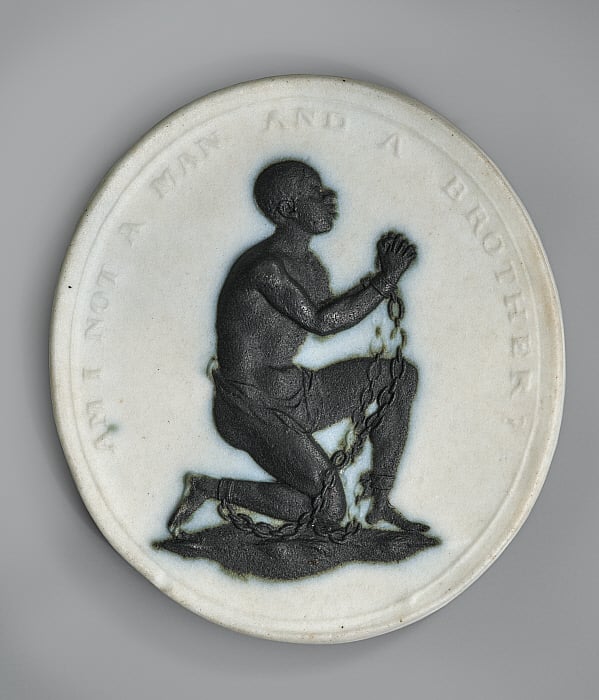
Clarkson and Sharp, along with Josiah Wedgwood (also absent from the film), were among the founding members of the Society for the Abolition of the Slave Trade in 1787. Wedgwood's medallion "Am I Not a Man and a Brother?" was created for the members of the Society.

Am I not A Man And A Brother medallion by Josiah Wedgwood

"Am I Not A Man And A Brother?" Jasperware medallion produced for the Society for Effecting the Abolition of the Slave Trade, designed by Josiah Wedgwood, c. 1787–1790, originally modelled by William Hackwood. Dimensions: 1.13" wide by 1.25" high. Image source: Clark Art Institute, 2021.11.1

Equiano's 1789 autobiography went through nine editions over the five years following its first publication. He embarked on speaking tours, and was also a founder of the Sons of Africa, an abolitionist organization of formerly enslaved men that also included Ottobah Cugoano. As you may have guessed, neither the Sons of Africa nor Cugoano is mentioned in the movie.

Frontispiece and title page of The Interesting Narrative of the Life of Olaudah Equiano, or Gustavus Vassa, the African, Written by Himself, Vol. I (London, 1789). Image source: Internet Archive

And Cowper's poem The Negro's Complaint (1788) was reprinted for decades. The following illustration is from an 1826 edition:


Image source: Internet Archive

The poem reads in part,

Forc'd from home and all its pleasures,
Afric's coast I left forlorn;
To increase a stranger's treasures,
O'er the raging billows borne;

Men from England bought and sold me,
Paid my price in paltry gold;
But though slave they have enroll'd me
Minds are never to be sold.

Still in thought as free as ever,
What are England's rights, I ask,
Me from my delights to sever,
Me to torture, me to task?

Also missing from Amazing Grace is Chief Justice Lord Mansfield.

William Murray, first Earl of Mansfield, in his robes as Lord Chief Justice, by John Singleton Copley, 1783

Portrait of William Murray, 1st Earl of Mansfield, in his official robes as Lord Chief Justice (detail), by John Singleton Copley, 1783. Image source: National Portrait Gallery NPG 172 

Mansfield's opinions in the Somerset and Zong Massacre cases were celebrated among abolitionists. He and his wife also raised their mixed-race niece, Dido Elizabeth Belle, on equivalent terms with her white cousin Elizabeth Murray.

Dido Elizabeth Belle and Lady Elizabeth Murray by David Martin, 1776

Dido Elizabeth Belle and Elizabeth Murray (detail), by David Martin, c. 1776. Image source: Kenwood House

More than four decades later Mansfield was still so well-known that a novel set on the English estate of a slave-owner referenced him in its title: Mansfield Park.

All this is not to diminish Wilberforce's crucial role in the abolition of the British slave trade. He was a remarkable man who advocated for the end of the inhumane shipment of kidnapped Africans, as property, to the plantations of the New World, a stance shared by a distinct minority of those who held political power at the time. But Wilberforce did not almost single-handedly bring about the abolition of the slave trade. Far more attention should have been paid to the social movements that shaped and supported him.

Beyond this distortion, though, Knight's screenplay depicts incidents that either did not happen as shown, or could not have happened at all. Early in the film we see a 1782 debate in the House of Commons about the continuing war against American independence. In that debate Wilberforce, opposing the continuation of the war, engages with the Duke of Clarence (the future King William IV) and Lord Tarleton, a former military commander wounded in that war. Afterwards, during a card game between Wilberforce and the Duke at a gentleman's club, the Duke attempts to wager ownership of his black coachman (and the script has him use the n-word).

Screenshot of Toby Jones as the Duke of Clarence in 1782

Toby Jones as the (future) Duke of Clarence in 1782.

However, the Duke of Clarence and Wilberforce could not have debated in the House of Commons in 1782, or ever, because the Duke sat in the House of Lords, which he didn't join until he received his dukedom in 1789 or 1790. Another small detail: in 1782 then-Prince William, the future Duke of Clarence, was only 17; Toby Jones, the actor who plays him, was 40 at the time of filming.

Prince William, later Duke of Clarence, future King William IV (detail), by Thomas Gainsborough, 1782. Image source: Royal Collection Trust RCIN 401010

Finally, Prince William could not have wagered ownership of his black coachman in a card game, because he did not have an enslaved coachman: Lord Mansfield's decision in the 1772 Somerset case was widely interpreted as banning slavery in England. As Cowper wrote in The Timepiece, Book II of The Task (1785):

Slaves cannot breathe in England; if their lungs
Receive our air, that moment they are free,
They touch our country and their shackles fall.

But perhaps the most ironic error in the film occurs in the scene where Wilberforce sings the hymn "Amazing Grace," which, of course, gives the film its title. The words were written by the former slaveship captain John Newton, a friend and collaborator of the missing Cowper. But the familiar tune Wilberforce sings was not associated with Newton's words until several years after Wilberforce's death; the hymn had been sung to perhaps 20 different tunes during his lifetime.

Printed text of the words to Amazing Grace by John Newton

"Amazing Grace," I. Chronicles. XLI. Faith's review and expectation. Chap. xvii. 16. 17. From Olney Hymns by the Rev. John Newton (New York, 1808), p. 38. Image source: Internet Archive

The movie is also extremely partial in its portrayal of Wilberforce, who was a rich landowner who used his position to oppose political reform and increase his own wealth. In 1815 he supported the passage of the Corn Laws, which imposed minimum prices and import tariffs on grains; higher prices on agricultural commodities benefited owners of farmland and harmed wage-laborers. As a direct result of the Corn Laws the price of staple foods such as bread and oats rose significantly and hunger became widespread. (The legislation would not be overturned until 1846, the second year of a devastating famine in Ireland.)

In 1819 workers held a mass rally in Manchester's St. Peter's Field calling for universal manhood suffrage. Their ultimate aim was to ensure that their voices would be represented in Parliament and the Corn Laws repealed. The unarmed crowd was attacked by cavalry regiments that hacked at them with swords and trampled them with their horses. More than a dozen people, including women and a two-year-old child, were killed. The event came to be known as Peterloo, a reference to the mass slaughter on the fields of Waterloo.

1819 print of the Peterloo Massacre by Richard Carlile

Peterloo Massacre, Manchester, print published by Richard Carlile, 1819. Image credit: Manchester Libraries. Image source: Wikimedia Commons

In the aftermath of the Peterloo Massacre, Wilberforce supported the repressive Six Acts that restricted or suspended civil liberties. Wilberforce may have been a passionate advocate for the end of the trade in slaves, but once the formerly enslaved joined the ranks of wage-laborers they would be free to starve along with their fellow workers.

In 1833, on his deathbed, Wilberforce was informed that a bill to abolish slavery in Britain and its colonies was sure to pass in Parliament. "Thank God," he is reported to have said, "that I should have lived to witness a day in which England is willing to give twenty millions sterling for the abolition of alavery." It should be noted, though, that the £20 million he referred to was not given as reparations to emancipated slaves descended from generations of men, women and children who had been kidnapped or born into bondage, and whose grueling labor had been compelled by force for the benefit of their masters. Instead, it was given to slave owners as compensation for the loss of their property. Also, abolition did not take full effect until 1840; even then, exceptions were made for India, Ceylon, and the island of Saint Helena off the west coast of Africa.

These moral compromises may have been thought to be politically necessary for passage of the Slavery Abolition Act. However, as historian Eric Williams has argued, slavery and the plantation economy it supported were becoming less profitable by the decade. It's hard not to see this action as self-dealing by those who held power and derived much of their wealth, directly or indirectly, from slavery.

Amazing Grace ignores such contradictions and offers in their place a simplified view of Wilberforce's character and actions. Perhaps only someone such as Ken Loach or Mike Leigh (writer and director of Peterloo (2018)) could do greater justice to the complexity of the movement for abolition and the failings, inconsistencies, and conflicts, as well as the courage and rectitude, of those who ultimately brought an end to British slavery.