Newspaper noir: While the City Sleeps

Lobby card for When the City Sleeps (1956), directed by Fritz Lang. Image source: FilmAffinity US
In film noir, we're faced with a world of corruption and evil which leaves no character untouched. The morally compromised protagonist may be an ex-con (Jeff Bailey in Out of the Past (1947)), sleep with his partner's wife (Sam Spade in The Maltese Falcon (1941)), or stick his neck out for none of the desperate refugees who crowd into his bar (Rick Blaine in Casablanca (1943)). But he moves through the world abiding by his own hard-won code, although it may lead him into danger or even death. A late Fritz Lang film, While the City Sleeps (1956), takes the morally compromised protagonist to new depths.
A killer is stalking women in New York City. A librarian and a schoolteacher—symbols of vulnerable single womanhood—have been found brutally murdered; at the scene of the first crime, "Ask Mother" has been written on the wall with the victim's lipstick. The New York Sentinel newspaper whips up a frenzy (and boosts circulation) by leading almost every edition with screaming headlines about the Lipstick Killer. [1]

The Sentinel whips up a frenzy.
At this moment of crisis Walter Kyne (Vincent Price), the idle and pleasure-loving son of the founder of the Sentinel, takes over the flagship paper his father built over decades and ran with an unerring news sense even as he laying dying in his sickbed. Kyne has no intention of being a hands-on owner; he just wants to enjoy the vast wealth his inherited media empire generates. But he has no idea which of several candidates to choose to run the place in his absence.
So Kyne creates a new position, Executive Director (or as he describes it, "someone to do the actual work"). To fill it he sets up a cutthroat competition to solve the Lipstick Killer case, which pits the smarmy head of the wire service Mark Loving (George Sanders), the hard-nosed managing editor of the newspaper Jon Griffith (Thomas Mitchell), and the playboy photo service chief Harry Kritzer (James Craig) against one another. The paper's star reporter and the anchor of its nightly television news show, Ed Mobley (Dana Andrews), tries to keep himself above the fray, but that proves to be impossible.
The newsroom is an incestuous stew. Mobley is dating Loving's virginal secretary Nancy Liggett (Sally Forrest), whom Loving also—Lovingly?—drapes his arm around when she's in his office.

Nancy attempts to peel Loving's hand off her shoulder while taking dictation.
Meanwhile, Loving has a dissatisfied mistress, columnist Mildred Donner (Ida Lupino), whom he sends to seduce Mobley to get information. She doesn't seem too unhappy about the assignment.

Mildred gives Mobley the eye over a drink or four.
And Kritzer is sleeping with Kyne's brassy wife Dorothy (Rhonda Fleming), who tries to plant suggestions in her husband's ear that favor her lover. In a coincidence that will have importance in the plot, their love nest is directly across the hall from Nancy's apartment.
Incidentally, any resemblance between Ed Mobley and Edward Murrow is probably intentional. The film is adapted by veteran screenwriter Casey Robinson from Charles Einstein's 1953 novel The Bloody Spur (whose title is taken from Shakespeare's Julius Caesar: "But hollow men, like horses hot at hand,/Make gallant show and promise of their mettle./But when they should endure the bloody spur,/They fall their crests and, like deceitful jades,/Sink in the trial"). At the time Einstein's novel was published, Murrow's television career was well underway; by the time the film was in production his two 1954 CBS See It Now programs on Senator Joseph McCarthy had made Murrow the image of the fearless, incorruptible journalist.

Edward R. Murrow in the 1950s. Image source: Golden Globes
In collusion with the police detective leading the case, Mobley's longtime friend Lt. Burt Kaufman (Howard Duff), Mobley hatches a plan. On his newscast, as the camera zooms in for a closeup, he taunts the watching killer (John Barrymore, Jr.) as a "momma's boy" who reads "the so-called comics" (a copy of The Strangler, a lurid comic book in the style of EC's Crime SuspenStories, is left at the scene of the second murder).

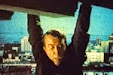
Mobley taunts the watching Lipstick Killer
The gay-baiting and comics condemnation are very much of their time; the dual moral panics of the Lavender Scare led by McCarthy and Senator Everett Dirksen, and the anti-comics crusade led by psychologist Frederic Wertham (author of Seduction of the Innocent (1954)), reached their peak around the time of Lang's film. [2]

Cover of Crime SuspenStories No. 23, July 1954, illustrating the story "Last Resort" by George Evans. Cover artist: George Evans. Image source: CGC Comics
Still on-air, Mobley then announces his engagement to Nancy, setting up his fiancée as bait for the killer. Nancy learns about the scheme only after Mobley's news show; it's confirmed when she sees the pairing of the engagement announcement with the latest Lipstick Killer story on the front page.

"Lipstick Killer as Mama's Boy/ Congratulations: Edward Mobley to wed Nancy Liggett"
With understandable reluctance, and after Mobley points out the plain-clothes detective who will be shadowing her, Nancy agrees to the fait accompli. After all, what could possibly go wrong?
The corruption and injustice of society and the darkness of the psyche were themes Lang had long explored, first in Weimar Germany (Dr. Mabuse, der Spieler (Dr. Mabuse, The Gambler, 1922), Metropolis (1927), Spione (Spies, 1928), and M (1931)) and later continued in his Hollywood films such as You Only Live Once (1937), The Woman in the Window (1944), and his American masterpiece The Big Heat (1953). But the protagonist setting up his fiancée to be attacked by a serial killer is eyebrow-raising even among the grim scenarios of Lang's other films.
At the same time, Lang's direction of While The City Sleeps seemed to me often to lack the distinctiveness of much of his earlier work. The cinematography by Ernest Laszlo, who also shot Impact (1949), D.O.A. (1949), and Kiss Me Deadly (1955), is sometimes flat—though it's hard to tell if it's primarily the fault of the grainy Warner Bros. Archive Collection DVD transfer I watched.
The scenes that bring out the best in Lang and Laszlo are late in the film, as Mobley chases the killer through the deep shadows of the subway tunnels, providing an opportunity for some taut suspense and striking images as trains bear down on the men in the darkness.

Mobley chases the Lipstick Killer through the subway tunnels.
While The City Sleeps is one of Jonathan Rosenbaum's alternative list of the 100 best American feature films that didn't make the American Film Institute's 1998 list of the 100 greatest American movies. I think there are some other films (and even some other Fritz Lang films) I'd probably put on my alternative 100 list before this one; The Big Heat is a glaring omission on both Rosenbaum's and AFI's lists. But While the City Sleeps is definitely worth watching, especially if you're an Ida Lupino fan—her character is deliciously duplicitous, while remaining fundamentally sympathetic as a woman using her considerable allure to maneuver for power in a man's world.
- There was a real "Lipstick Killer" on whom this character was based, who may have killed two adult women and a six-year-old girl in Chicago in late 1945 and early 1946. The murderer used the second victim's lipstick to scrawl a message on the wall of her apartment: "For heavens sake catch me before I kill more I cannot control myself." 17-year-old William Heirens confessed under duress to the killings and was sentenced to three life terms in prison. Characters in the film refer to this real-life case and even quote the "I cannot control myself" message.
- Also very much of their time is a work culture where all the women in the newsroom are seen as fair game by the men; every character smokes at any opportunity, indoors or out; and they all pound down alcohol at an alarming rate—we see Mobley in particular get absolutely hammered more than once.




No comments :
Post a Comment