Sunday, December 8, 2019

Favorites of 2019: Books

FICTION

My fiction reading in 2019 was dominated by two authors: George Sand, of whose vast oeuvre I sampled four novels representing different periods in her life, and Samuel Richardson, whose seven-volume Sir Charles Grandison was my summer reading project. I do notice that my alienation from contemporary fiction seems to be growing: books that didn't make the list included Trust Exercise by Susan Choi, Thus Bad Begins by Javier Marias (The Infatuations was one of my Favorites of 2013), and Grand Union by Zadie Smith (her essay collections Changing My Mind and Feel Free both made earlier favorites lists). As you'll see, all of my favorite fiction of 2019 was published in the 18th or 19th centuries. In the order read:

Marianne, by George Sand, edited and translated by Sîan Miles, Carroll & Graf Publishers, 1988; originally published 1876.
What's next for us? You, for sure, will produce desolation, while I will produce consolation. . .You make the people who read you sadder. As for me, I would like to make them less sad.
—George Sand to Gustave Flaubert [1]
Pierre, a shy bachelor approaching middle age, is asked by a former acquaintance to try to arrange a marriage between his artistic son Philippe and a young village woman, Marianne. The sudden appearance of a suitor for Marianne who is young, handsome and rich forces Pierre to recognize his own hopeless love for her. What he doesn't realize is that his inability to express his feelings may inadvertently drive Marianne into the arms of the new arrival. Marianne, though, has her own ideas about whom, or whether, she will marry.

Flaubert wrote to Sand,
Marianne moved me deeply and two or three times I wept. I recognized myself in the character of Pierre. Certain pages seemed to me fragments of my own memoirs, supposing I had the talent to write them in such a way! How charming, poetic and true to life it all is! La Tour de Percemont [published together with Marianne] pleased me extremely. But Marianne literally enchanted me. . .Anyway, this time I admire you completely and without the least reservation. [2]
Marianne inspired me to read backwards through George Sand's work, selecting novels that marked particularly notable relationships in her life: her thinly fictionalized portrait of the pianist and composer Frédéric Chopin in Lucrezia Floriani (1846), of the opera singer and composer Pauline Viardot in Consuelo (1842), and of Sand's early marriage in Indiana (1832); I also read Alfred de Musset's fictionalized version of their grand affair in Confessions of a Child of the Century (1836). For more on Marianne, including its connection to her late-life friendship with Flaubert and the bloody military assault on the Paris Commune, please see George Sand and Gustave Flaubert: Marianne.

Sir Charles Grandison, v. 1, by Samuel Richardson, originally published 1753.
'Sir Charles Grandison! That is an amazing horrid book, is it not? —I remember Miss Andrews could not get through the first volume.'
'It is not like Udolpho at all; but yet I think it is very entertaining.'
'Do you indeed! —you surprize me; I thought it had not been readable.'
—Isabella Thorpe speaking to Catherine Morland in Jane Austen's Northanger Abbey [3]
Isabella Thorpe was not the only one who thought Samuel Richardson's The History of Sir Charles Grandison (1753) unreadable. Samuel Johnson, a contemporary of Richardson's, said that "if you were to read Richardson for the story, your impatience would be so much fretted that you would hang yourself." [4] But Sir Charles Grandison was one of Jane Austen's favorite heroes, and this year I decided to find out why.

While over the course of its seven (!) volumes Richardson's narrative becomes increasingly repetitive, suspenseless and moralizing, the first volume is really quite gripping. It introduces us to the smart, witty, generous, wise and beautiful Harriet Byron. Harriet, in London visiting relatives, is abducted from a masquerade ball by an aggressive suitor, Sir Hargrave Pollexfen. He takes her blindfolded and gagged in his carriage, accompanied by armed servants on horseback, galloping down the road from London to his estate in Windsor. There on his isolated estate he plans to forcibly marry Harriet and then rape her. These, no doubt, are the scenes that Isabella Thorpe considers "amazing horrid."

But on the narrow road crossing Hounslow Heath outside of Windsor Sir Hargrave's carriage meets another one going the opposite direction, towards London. That carriage belongs to Sir Charles Grandison, who hears a woman cry out. . .

The first volume of Sir Charles Grandison displays Richardson's many virtues as a novelist, particularly his ability to create deeply sympathetic female characters and to render events with vivid emotional immediacy. These are clear reasons for Jane Austen's admiration. But as Jane's brother Henry wrote, "Richardson's power of creating, and preserving the consistency of his characters, as particularly exemplified in 'Sir Charles Grandison,' gratified the natural discrimination of her mind, whilst her taste secured her from the errors of his prolix style and tedious narrative." [5]

So while Volume 1 is one of my favorite novels of 2019, the prolix style and increasingly tedious narrative of Volumes 2 through 7 are my collective Biggest disappointment of 2019. For more on Sir Charles Grandison and its connections to Austen and her novels, please see Sir Charles Grandison, Volume 1: The abduction.
    Dangerous Liaisons, by Pierre Choderlos de Laclos, translated with an introduction and notes by Helen Constantine, Penguin, 2007; originally published 1782.

    After seven volumes of Sir Charles' relentless virtue I needed to wallow in some wickedness in the worst way. And where better to find it than in the company of the ruthless libertines the Vicomte de Valmont and the Marquise de Merteuil? Les Liaisons dangereuses is told in letters mainly between these two former lovers as they plot to debauch the innocent Cécile Volanges and the virtuous Madame de Tourvel; but of course they are also scheming against one another. The novel has lost none of its power to shock and seems only to gain in relevance with the passage of time. It was impossible to read in 2019 without thinking about recent public revelations of women's sexual exploitation by powerful men.

    Helen Constantine's translation uses a relatively modern vocabulary and is sometimes over-explanatory. The gain in clarity comes at the cost of some 18th-century elegance. I noticed only one misstep, but it was a major one: it changes the meaning of a key moment during Valmont's sexual coercion of Cécile Volanges. Here is Constantine's rendering of the Vicomte's letter to the Marquise after he has surprised Cécile asleep in her bed:
    As I had not come there for a chat, after calming her initial fears, I took a few liberties. Probably they did not teach her at the convent what different dangers timid innocence may be exposed to, or all she must protect so as not to be taken by surprise. For, bringing all her attention and strength to bear upon defending herself from my kiss, which was just a false attack, everything else was left undefended. How could I not take advantage! So I changed tactics, and immediately took up my position. . .One hand busy restraining [Cécile has tried to reach the bell pull to summon her servants], the other caressing. . .

    Finding me adamant to all entreaties, she was reduced to saying what she would and would not allow. [6] You may be thinking I sold my important position for a high price; but I promised everything for a kiss. It is true that, once the kiss was over, I did not keep my promise, but I had good reason. Had we agreed it should be taken or given? Through bargaining, we agreed upon a second. And that one, it was promised, would be received. So, guiding her timid arms around my body, I clasped her more amorously with the one that was free, and that sweet kiss was indeed received. . .

    All this trust merited some reward, so I immediately granted the request. Her hand withdrew. But by some extraordinary chance I found myself taking its place. . . (Letter 96)
    "Her hand": in Constantine's version Cécile withdraws her protective hand from between her legs, suggesting that she is consenting to some degree, or at the very least, remarkably unwary. However, this is a misunderstanding of what is happening that gives this scene a diametrically opposite meaning from the original. It is not, as Constantine has it, Cécile's hand that is wedged between her legs, but Valmont's.

    Constantine's confusion may have arisen because in French "hand" (whether it belongs to a man or woman) is a feminine noun: la main. Here is the original:
    Tant de bonne foi méritait récompense, aussi ai-je aussitôt accordé la demande. La main s'est retirée, mais je ne sais par quel hasard je me suis trouvé moi-même à sa place.
    P. W. K. Stone's 60-year-old translation, which Constantine's replaces in the Penguin Classics series, gets it right:
    So much good faith deserved its reward, and I immediately granted the request. The hand was withdrawn; but by some extraordinary chance I found that I myself had taken its place.
    "The hand": it is Valmont who is "in position," it is he that guides Cécile's arms around him (so she can't be guarding herself), it is he that has only one hand free, and it is he who is granting the request. The hand withdrawn from between Cécile's legs is his. What this means is that Cécile does not consent, tacitly or otherwise. When she agrees to a kiss she is bargaining with her rapist, who of course simply takes further advantage.

    Les liaisons dangereuses was the most compelling book I read this year. Not only for its urgent topicality, although the Marquise de Merteuil's account (Letter 81) of the stratagems she has learned to adopt in order to survive in a man's world is as searing today as when it was written. Les liaisons dangereuses is also brilliantly written and plotted. However, I suggest seeking out Stone's translation, which retains a bit more of the flavor of the prose of the period, and in which this key scene is accurately rendered.
    Orley Farm, by Anthony Trollope, originally published 1861.

    As ever, what is most interesting about Trollope's writing isn't his Victorian attitudes or the mechanics of his plots (although in this novel, as in the later The Last Chronicle of Barset, he wrings the maximum amount of suspense from the question of the innocence or guilt of a major character). Rather, it is his articulation of observed traits of character. Three examples:

    Of Joseph Mason, who is planning to bring a criminal action against his stepmother Lady Mason because he is convinced that his father's will, which left Orley Farm to his younger stepbrother Lucius, was forged. 
    There is nothing perhaps so generally consoling to a man as a well-established grievance; a feeling of having been injured, on which his mind can brood from hour to hour, allowing him to plead his own cause in his own court, within his own heart,—and always to plead it successfully. [7]
    Of Mr. Furnival, a barrister in late middle age, who takes on Lady Mason's case despite his uncertainty about her innocence because of her elegance, vulnerability and still-youthful beauty.
    The body dries up and withers away, and the bones grow old, the brain, too, becomes decrepit, as do the sight, the hearing, and the soul. But the heart that is tender once is tender to the last. [8]
    Of Lucius, Lady Mason's son, who wants to revenge the stain on his mother's reputation resulting from the lawsuit:
    Life did not come easy to him, and the effort which he was ever making was always visible. All men should ever be making efforts, no doubt; but those efforts should not be conspicuous. [9]
    Trollope himself recognized that character, rather than plot, was preeminent in his novels. In An Autobiography he wrote, "The plot of Orley Farm is probably the best I have ever made," but "the highest merit which a novel can have consists in perfect delineation of character, rather than in plot." [10] Trollope is right: his novels will continue to be read not because of the cleverness of his plots but because of his insight into character.

    NONFICTION

    Mary Astor's Purple Diary: The Great American Sex Scandal of 1936, written and illustrated by Edward Sorel, Liveright, 2016.

    Like many people, I know Mary Astor thanks to one role: her indelible performance as the devious Brigid O'Shaughnessy opposite Humphrey Bogart as Sam Spade in The Maltese Falcon (1941). But, as I learned from Sorel's book, Astor had a screen career that stretched over four decades, from the silents through the mid-1960s.

    Born Lucile Vasconcellos Langhanke in Quincy, Illinois in 1906, Mary Astor was a product of the Hollywood studio system. Her story was typical: exploited by ambitious parents, discovered while still a teenager, and chosen as a co-star and sexual partner by a much older and more famous actor (in her case, John Barrymore). In the mid-1930s, unhappily married, Astor made a bid for freedom. Her scandalous "purple diary," discovered by her husband and entered as evidence in a child custody case, detailed her many love affairs and became headline fodder for the newspapers for weeks during the summer of 1936.

    Sorel tells this story while also recounting his own early struggles as an illustrator, the failure of his first marriage, and meeting the woman who would become his second wife. He discovered the Purple Diary scandal while renovating his New York apartment in the 1960s: stuffed under layers of decaying linoleum were yellowed newspapers from thirty years earlier with screaming headlines: "ASTOR DIARY ECSTACY" [sic]; "G. S. KAUFMAN TRYST BARED." (Yes, that's George S. Kaufman, author of You Can't Take It with You.) Sorel is an engaging narrator (he terms Astor's travails a "screwball tragedy"), his illustrations are vivid, and he is very sympathetic to his not-always-well-behaved subject. The book makes a case for Astor as an underappreciated actress, and it will make you want to watch one (or more) of her many films. I had forgotten that she was in Red Dust (1932), The Prisoner of Zenda (1937), The Palm Beach Story (1942), and Meet Me In St. Louis (1944). And, of course, The Maltese Falcon.

    Totally Wired: Postpunk Interviews and Overviews, by Simon Reynolds, Soft Skull, 2010.

    Totally Wired is a byproduct of Reynold's earlier Rip It Up and Start Again: Postpunk 1978-1984 (Penguin, 2006). I didn't care much for Rip It Up, starting with its ridiculous periodization of punk (April 1976-October 1977, in case you were wondering), continuing through its narrow categorization or outright exclusion of bands, and ending with nearly 200 pages devoted to "New Pop"—synth-pop outfits that often included former members of punk bands, but were anti-punk in aesthetic: slick, glossy, commercial. Dave Rimmer's book about the New Pop band Culture Club was accurately titled (in terms of their sound, anyway) Like Punk Never Happened.

    But strangely, the interviews Reynolds conducted as research for Rip It Up end up being far more interesting than the conclusions he drew from them. While Reynolds isn't above asking leading questions of his subjects, the experiences of the people he interviews aren't as neatly pigeonholed as Rip It Up tries to make them seem. Also, as John Robb's Punk Rock: An Oral History proves, the voices of participants (even well after the fact) are much more engaging than journalistic retrospect.

    There are many expected names with practiced (but entertaining) stories here, including Mark Mothersbaugh (Devo), David Byrne (Talking Heads), John Peel (BBC Radio 1 DJ), and Tony Wilson (Factory Records founder). But there are also conversations with the less well known, such as Dennis Bovell (Dub Band leader and producer of The Slits and Linton Kwesi Johnson), Andy Gill (the brilliant guitarist of Gang of Four), Martin Brahmah (guitarist for The Fall), and Paul Haig (lead singer of Josef K.).

    Looking at the list of interviewees, though, makes starkly apparent that women are woefully underrepresented: only five of the 32 interviews included in the book are of women. To name them: Gina Birch (The Raincoats), Lydia Lunch (Teenage Jesus & the Jerks), Alison Statton (Young Marble Giants), Linder Sterling (Ludus), Ari Up (The Slits). Even if the punk and post-punk scenes often reproduced the sexism of the larger culture, they also opened up a space for women to step onstage or into the studio, and many seized the opportunity. Where are the voices of Gaye Advert (The Adverts), Ros Allen, Bethan Peters, and Julz Sale (Delta 5), Deanna Ashley, Mia Levin and Cecilia Lynch (Frightwig), Adele Bertei (Bush Tetras and The Bloods), Jane Crockford and Kate Korus (Mo-dettes), Ana da Silva (The Raincoats), Penelope Houston (The Avengers), Poison Ivy (The Cramps), Debora Iyall (Romeo Void), Sara Lee (Gang of Four), Marlene Marder and Klaudia Schiff (Kleenex/Liliput), Palmolive (The Slits and The Raincoats), Tessa Pollitt (The Slits), Sue White and Sally Webster (The Mutants), and Lesley Woods (Au Pairs)? Where is Poly Styrene (X-Ray Spex)? Or Kim Gordon (Sonic Youth)? I could go on, but I think it's clear: Totally Wired is enjoyable, but a book of interviews featuring women in punk and post-punk is desperately needed.

    Sounds and Sweet Airs: The Forgotten Women of Classical Music, by Anna Beer, Oneworld Publications, 2016.

    Speaking of woeful underrepresentation, in Sounds and Sweet Airs Anna Beer highlights eight women composers, from Francesca Caccini in the early 17th century through Elizabeth Maconchy in the 20th. If you're thinking "Who?" that's precisely Beer's point. Although not all of the composers featured in the book are forgotten women, as the subtitle has it—there are dozens of recordings of works by Barbara Strozzi, Fanny Mendelssohn and Clara Schumann currently available, to name just three of Beer's subjects—they are all under-performed and under-recorded with respect to their male counterparts.

    They also faced far greater barriers to success. Marriage and motherhood meant that women were expected to place needs of spouses and children ahead of their own. When she turned 18 Nannerl Mozart was no longer allowed to tour with her younger brother Wolfgang and was discouraged by her father from composing. Fanny Mendelssohn was lectured by her father: "Music. . .can and must be only an ornament, never the root of your being and action. . .You must. . .prepare more earnestly and eagerly for your real calling, the only calling of a young woman—I mean the state of a housewife." Alma Schindler had composed more than a hundred lieder before becoming the wife of Gustav Mahler; a few months before their marriage he wrote to her: "You have only one profession from now on: to make me happy!. . .The role of 'composer,' the 'worker's' role falls to me, yours is that of loving companion and understanding partner. . .You must give yourself to me unconditionally, shape your future life, in every detail, entirely in accordance with my needs."

    Beer's book offers fascinating short biographies of women composers who struggled to create despite such obstacles. Its only major flaw is that there are many other deserving subjects that Beer did not have the room to cover in detail in a single volume. Hildegard of Bingen, the Countess of Dia, Amy Beach, Ethel Smyth, Ruth Crawford Seeger, Mary Lou Williams, and many others deserve a sequel. For my full post, please see Sounds and Sweet Airs: The Forgotten Women of Classical Music.

    Handel in London: The Making of a Genius, by Jane Glover, Pegasus Books, 2018.

    George Frideric Handel was born in Saxony and as a young man travelled to Italy, but most of the works by which he is known today were written in London. The English capital was, as Jane Glover's subtitle has it, the making of a genius. Glover situates Handel's musical activities within the context of the political upheaval in Britain during the first half of the 18th century: riots, rebellions, and deep antagonisms within the royal family, all of which Handel had to negotiate without a misstep. Powerful aristocratic factions tried to foment rivalries between Handel and other composers, but he never allowed professional conflicts to become personal. His resilience in the face of the failure of two of his opera companies, and his ability to reinvent himself when disaster arrived, are truly remarkable.

    Glover is a well-known conductor specializing in the music of the Baroque. Her discussions of Handel's operas and oratorios offer insights that come from deep exploration, made accessible for readers (like me) who lack a musicological background. She makes the offstage drama affecting Handel's opera companies and the sometimes knotty politics of Hanoverian Britain admirably clear, but always keeps the focus on Handel's magnificent music. For my full post, including an aria apiece from the opera Rinaldo (his first London triumph) and the oratorio Jephtha (one of his last major works), please see Handel in London: The Making of a Genius.

    Recognition in Mozart's Operas, by Jessica Waldoff, Oxford University Press, 2006.

    It's rare that a book transforms my appreciation of a work, but Jessica Waldoff's Recognition in Mozart's Operas helped me hear his early opera La Finta Giardiniera (The Pretend Garden Girl) with new ears. In that opera the Count Belfiore, in a jealous rage, has stabbed his fiancée the Marchesa Violante and left her for dead. She survives, and in the disguise of a servant, "Sandrina," goes to work as a gardener at the mansion of the town's mayor, the Podestà. When the Count arrives at the mansion with his new  fiancée, the Podesta's daughter, the stage is set for an abduction, a mad scene, a sleep scene, and lovers getting mixed up in the dark. In the end, Sandrina confesses her true identity and is reunited with her would-be murderer for a happy (?!) ending.

    But Waldoff connects the libretto's seeming absurdities with the 18th-century culture of sensibility exemplified by the novels of Samuel Richardson. La Finta Giardiniera was a loose adaptation of another opera by composer Niccolò Piccinni and librettist Carlo Goldoni, La buona figliuola (The good daughter), itself an adaptation of Richardson's Pamela. Fainting and going mad were the ways virtuous women expressed profound emotion in novels (true also in Richardson's Clarissa and Sir Charles Grandison). By adopting these conventional manifestations of sensibility, Sandrina is paradoxically signalling the truth of her feelings.

    Although I picked up this volume at a used book sale for its discussions of Le Nozze di Figaro (The Marriage of Figaro), Don Giovanni (Don Juan), Cosi fan tutte (That's what they all do), and La clemenza di Tito (The mercy of Titus), it was the chapters devoted to an opera I didn't think I liked that wound up being the most memorable. A recording of La Finta Giardiniera conducted by Nikolaus Harnoncourt and starring Edita Gruberova as Sandrina was among my Favorites of 2019: Recordings.

    Honorable mention, nonfiction
     
    Boswell's London Journal, 1762-1763, edited by Frederick Pottle, Reprint Society, 1952.

    In November 1762 the 22-year-old James Boswell came to London from his native Scotland. He and his father were at odds: his father wanted him to become a lawyer, and Boswell wanted to be an Army officer. To gain a military commission without purchasing it outright aristocratic patronage was needed, and Boswell set out, unsuccessfully, to cultivate it. His father gave him an allowance of £200 a year, but for a young man on his own in London and whose habits were not very abstemious this amount did not go far (Boswell was constantly running out of funds before his next installment).

    And this raises one of the issues with Boswell's journal: Boswell himself is not a particularly attractive figure. He's ambitious for fame but wants to get by on as little actual work as possible. He tries to ingratiate himself with established literary figures, with mixed results. He pursues sex with married women, actresses, and prostitutes, and gets the clap from one of his conquests. He shows up at the first night of a play with a group of friends determined to heckle the actors and get the play cancelled (they failed). He is constantly making resolutions—to drink less, to be more pious, to avoid prostitutes—and then breaking them only days, or hours, afterwards. In short, he's a typical 22-year-old. Except that he grew up to write one of the great biographies in English: The Life of Samuel Johnson.

    Other favorites of 2019:


    1. The George Sand-Gustave Flaubert Letters, translated by Aimee L. McKenzie, Boni and Liveright, 1921, Sand to Flaubert, 18th and 19th December, 1875. Translation slightly altered. http://www.gutenberg.org/cache/epub/5115/pg5115-images.html.
    2. The George Sand-Gustave Flaubert Letters. Flaubert to Sand, Friday evening [14 April?] 1876. Translation slightly altered. http://www.gutenberg.org/cache/epub/5115/pg5115-images.html
    3. Jane Austen, Northanger Abbey, John Murray, 1818 [published December 1817], Vol. I, Ch. VI.
    4. James Boswell, The Life of Samuel Johnson, Oxford University Press, 1965, p. 480. 
    5. Henry Austen, "A Biographical Notice of the Author," Northanger Abbey and Persuasion, John Murray, 1818. 
    6. This sentence is an example of Constantine's tendency to explain too much. The original reads "Les prières me trouvant inexorable, il a fallu passer aux offres." Stone's rendering catches the tone much better: "Entreaties found me inexorable and she was reduced to making offers."
    7. Anthony Trollope, Orley Farm, Chapman and Hall, 1862, Vol. 1 Ch. VIII.
    8. Orley Farm, Vol. 1 Ch. XXVI.
    9. Orley Farm, Vol. 1 Ch. XXVII.
    10. Trollope, An Autobiography, William Blackwood and Sons, 1883, Ch. IX.

    Friday, November 29, 2019

    Favorites of 2019: Live performances


    Ars Minerva Artistic Director Céline Ricci. Photo: Martin Lacey Photography. Image source: sfgate.com

    On this Thankgiving weekend I'm grateful for the amazing live performances we've seen over the past year. Our favorites in the categories of opera, concert and recital, and dance:

    OPERA

    Ermelinda. Libretto by Francesco Maria Piccioli, composed by Domenico Freschi. Nikola Printz (Ermelinda), Sara Couden (Ormondo/Clorindo), Kindra Scharich (Rosaura), Justin Montigne (Aristeo), Deborah Rosengaus (Armidoro). Period-instrument orchestra conducted by Jory Vinikour; stage direction by Céline Ricci. ODC Theater, seen November 24, 2019, produced by Ars Minerva.


    Nikola Printz as Ermelinda. Photo: Valentina Sadiula. Image source: SF Examiner

    My idea of heaven is a Baroque opera where all the leading roles call for voices in the mezzo-soprano or contralto range; watching Ermelinda I was in a state of sheer bliss. The latest discovery of Ars Minerva director Céline Ricci, Ermelinda may have been the group's best production yet.

    Composer Domenico Freschi wrote Ermelinda to be performed at the villa of the powerful Contarini family near Padua in the Veneto, where Marco Contarini had built two orphanages and a large private theater. Like the famed Ospedale della Pietà in Venice, Marco's orphanages took in girls who were foundlings—often children born out of wedlock, sometimes to noble families—and provided them with musical training. (Given what we know of the behavior of rich men towards vulnerable young women, we have to wonder whether Marco also had motives other than the musical for his benevolence.) Ermelinda, performed at the Villa Contarini in 1681 for a visiting Polish prince, has no tenor, baritone or bass parts because it was likely sung by an all-female cast drawn from the orphanages. More than three centuries later, Ricci found the score in the Contarini music collection, now housed in the Marciana Library in Venice; the San Francisco performances were likely the first since the work's première.

    The story features disguise, feigned madness, star-crossed lovers, imprisonment in chains, false reports of death, attempted suicide, and a happy ending snatched in the final moments from the jaws of tragedy. In other words, Ermelinda has all the elements of a typical Baroque opera. But what was far from typical was Ricci's inventive direction and the inspired work of her superlative cast, which made it all work brilliantly onstage.

    Prince Ormondo of Phoenicia (contralto Sara Couden) travels to the remote countryside in disguise as the rustic "Clorindo" in search of his lover Ermelinda (mezzo-soprano Nikola Printz), who has been sequestered there by her suspicious father Aristeo (countertenor Justin Montigne). "Clorindo" encounters a nobleman, Armidoro (mezzo-soprano Deborah Rosengaus), who invites him home. Armidoro himself is in love with Ermelinda, and his sister Rosaura (mezzo-soprano Kindra Scharich) is quickly smitten with "Clorindo."

    Scharich offered a scintillating comic turn as the lovelorn Rosaura. Her gorgeous voice and compelling stage presence were known to me from previous Ars Minerva productions such as The Amazons in the Fortunate Isles and La Circe as well as from her superb lieder recitals and recordings, but I had no idea that she was such a terrific comedienne. Her reactions were priceless, as in Act I where she is beginning to bemoan the "madness" of "Clorindo" and to her annoyance is prompted (or mocked) by the orchestra with famous laments from later operas by Handel and Gluck. It's a moment in which director Ricci signals that Rosaura is both genuinely distressed, but also getting secret pleasure from watching her own performance of her feelings.

    This is the sort of theatrical duality that is a key to Baroque opera, where stock situations give rise to real emotions. Ricci and her singers and musicians skillfully enhanced the opera's humor but also gave due weight to its genuine pathos. The sorrowful arias sung by each member of the central love polygon in the second half were affecting and beautifully performed. Freschi's music is filled with striking melodies, and the many musical pleasures of this score were showcased by the fluent playing of the musicians under the leadership of harpsichordist Jory Vinikour.

    Every element of the production enhanced the whole; special mention has to be made of Matthew Nash's costumes (especially Rosaura's flamboyant gown, a visual correlative to her flamboyant personality), Entropy's scene-setting projections, and Thomas Bowersox's lighting, which created distinct spaces and moods with minimal means.

    In Ermelinda Ricci unearthed a true gem. But its rediscovery was only the first step in realizing this delightful production. The success of Ars Minerva's Ermelinda was due not only to Ricci's painstaking archival research, but to her unerring eye and ear, her highly imaginative staging that turned what might have been limitations into virtues, and her ability to pull together singers, musicians and a creative team who were wholly committed to her vision. Ermelinda was a triumph.

    Rusalka. Libretto by Jaroslav Kvapil, composed by Antonín Dvořák. Rachel Willis‐Sørensen (Rusalka), Brandon Jovanovich (Prince), Kristinn Sigmundsson (Vodník, the Water Goblin), Jamie Barton (Ježibaba), Sarah Cambidge (Foreign Princess), with the San Francisco Opera Orchestra and Chorus conducted by Eun Sun Kim; production by David McVicar. War Memorial Opera House, seen June 23, 2019, produced by San Francisco Opera.


    Rusalka (Rachel Willis‐Sørensen) and her father Vodník, the Water Goblin (Kristinn Sigmundsson) in 
    San Francisco Opera's production of Rusalka. Photo: Cory Weaver. Image source: San Francisco Opera.

    Complaining about San Francisco Opera is an irresistible pastime to which this writer isn't immune (see "Pounding us over the head with Tosca"). However, in the 2018-19 season General Director Matthew Shilvock programmed three great but rarely-performed operas, Richard Strauss's Arabella, Handel's Orlando, and Dvořák's Rusalka. All offered excellent singers and magnificent music, but Rusalka had the added bonus of a generally well-conceived and visually striking production by David McVicar. Note to Shilvock: more operas beyond the "twelve chestnuts," please!

    CONCERT AND RECITAL

    Tallis Scholars: Music Inspired by the Sistine Chapel. First Congregational Church, Berkeley, April 4, 2019. Produced by Cal Performances.


    Photo credit: Clive Barda. Source: Cal Performances
      By my count this concert was the seventh time the Tallis Scholars had appeared at Cal Performances in the past 10 years, and they will appear again next May. I confess that sometimes when seeing them listed in the season brochure I've felt a twinge of Tallis Scholars fatigue (I know, this is the sort of problem that many people would love to have). The Early Music series usually only features three or four groups, and it feels as though one slot is almost always reserved.

      But every time I attend a Tallis Scholars concert I am amazed anew by their sound, which is both extremely precise and beautifully blended, and by the sheer aural magnificence of their chosen repertory. This program featured music inspired by the Sistine Chapel, including compositions by Palestrina, Festa, Carpentras, Morales and Josquin written to be performed in it (often the composers were members of the choir themselves; in 1998 a worker discovered Josquin's name carved into a Sistine Chapel wall).  And of course, the concert 's peak was the performance of best-known work associated with the chapel, Allegri's Miserere:


      Iestyn Davies and Thomas Dunford: England's Orpheus. First Congregational Church, Berkeley, May 19, 2019. Produced by the San Francisco Early Music Festival.


      Image source: SFEMS.org

      Iestyn Davies' sweet-toned countertenor was ideal for this program of songs by John Dowland, Henry Purcell, and George Frideric Handel, accompanied by Thomas Dunford's lute. The second half of concert was especially striking, when Purcell's "Music for a while shall all your cares beguile" was followed by Dowland's "Come again, sweet love doth now invite," Purcell's "O solitude, my sweetest choice," Handel's "Oh Lord whose mercies numberless" (from Saul), and Purcell's "An Evening Hymn." The movements from Bach's Cello Suite No. 1 that Dunford played between songs seemed out of context, as though they belonged to a different concert program, but they had the virtue of separating and highlighting each of Davies' superb performances. The last encore (of three!) was a special surprise, suggesting an affinity that none of us had suspected (especially those of us who had never heard the song before):


      Vocalists and Orchestra from the American Bach Soloists Academy: Bach, Lotti, Handel. Elijah McCormack, soprano, and Allison Gish, mezzo-soprano, with the Orchestra of the ABS Summer Academy conducted by Jeffrey Thomas, San Francisco Conservatory of Music, August 9, 2019. ABS Festival & Academy.


      Image source: SFCV.org

      The ABS Festival & Academy is a wonderful two-week-long event every summer that gives audiences the opportunity to see young players and singers showcased in repertory that's often performed nowhere else. This concert featured some beautiful sacred music in the first half: J. S. Bach's unusually scored "Trauerode" (Mourning Ode) for the Electress of Saxony, and Antonio Lotti's celebratory "Mass for Three Choirs," featuring elaborate vocal and instrumental effects.

      But the best was saved for the secular second half: Handel's Terpsicore, a prologue written for the 1734 revival of his opera Il Pastor Fido (The Faithful Shepherd). Terpsichore is the Muse of Dance (as viewers of the Rita Hayworth movie Down to Earth know well), and Terpsicore's many dance interludes were designed by Handel to highlight the innovative skills of the French danseuse Marie Sallé. Alas, there was no room on the stage at the SF Conservatory of Music for a dancer, but the interludes were brilliantly performed by the young musicians. Even better, though, was the musical dialogue between Apollo, the god of music and dance (Allison Gish), and Erato, the muse of lyric and erotic poetry (Elijah McCormack). Gish's rich mezzo-soprano and McCormack's brighter soprano were well-matched. Both were capable of handling florid runs, but could also bring out all the emotion in the slower music. The words they sang together in praise of dance applied just as well to their own performances: "Col tuo piede brilla Amor, e fa l'anima goder! Co' tuoi giri incanti 'l cor stupefatto dal piacer." Or, "With your steps Love shines, and makes the soul rejoice! Your every turn enchants the heart stupefied with pleasure."

      Voices of Music: Concerto delle donne. Sophie Junker and Sherezade Panthaki, sopranos, with Voices of Music directed by Hanneke van Proosdij and David Tayler. St. Mark's Lutheran Church, San Francisco, seen October 12, 2019. Produced by Voices of Music.


      Sophie Junker (left) and Sherezade Panthaki. Image source: Voices of Music

      Speaking of being stupefied with pleasure, that was pretty much our state after this program of music written for or influenced by the concerto delle donne. The Consort of Women, a group of virtuoso singers at the court of Duke Alfonso II d'Este of Ferrara in the last decades of the 16th century, was renowned for its performances of "secret music" (musica secreta). The music was secret in multiple senses: it was private, and only those invited by the duke could hear it; and because it was in a new style, it was kept closely guarded (it was only published after the duke's death in 1597 ended d'Este rule). The music featured ornate vocal lines and vivid word-painting with expressive dissonances at key moments, and much of it was written by the court composer Luzzascho Luzzaschi. Other composers came to Ferrara from across Italy to hear the group, write music for them, and take back these innovations to their own courts (one such visitor was madrigalist and murderer Carlo Gesualdo). Soon the style that Luzzaschi had pioneered became the seconda practica, or "new [second] practice," adopted and developed even further by Monteverdi and other composers from the generations that followed.

      In the program note Voices of Music implies that composers of instrumental music also took up the seconda practica, writing pieces with "'dueling' treble parts with competitive imitations and ornamentations." To perform these virtuosic pieces by composers such as Salomone Rossi and Dario Castello the Voices of Music continuo group of Hanneke van Proosdij on harpsichord and organ, David Tayler on archlute and baroque guitar, and Elizabeth Reed on viola da gamba were joined by Elizabeth Blumenstock and Alana Youssefian on violin. Youssefian visibly responded to the sounds she and Blumenstock were producing with a wide-eyed wonder that was shared by the audience.

      The instrumental music alone would have made this concert one of our favorites of the year, but even better were the vocal pieces by Luzzaschi and later composers such as Monteverdi, Marco Uccellini and Barbara Strozzi, performed by sopranos Sophie Junker and Sherezade Panthaki. Panthaki has appeared often with early-music groups such as the Philharmonia Baroque Orchestra; Junker, who performs largely in Europe, was a voice new to us and a wonderful discovery. In the surpassingly beautiful duets their voices were exquisitely intertwined.

      From the concert, Salomone Rossi's  Sonata quarta 'l'arie di Ruggiero':


      DANCE

      Mark Morris Dance Company: Mozart Dances. Mark Morris Dance Company with Inon Barnatan and Colin Fowler, pianos, and the Berkeley Symphony conducted by Fowler.   Zellerbach Hall, UC Berkeley, seen September 22, 2019. Produced by Cal Performances.


      Image source: Cal Performances

      I wrote about the "austere (but often quite beautiful)" movement in Mark Morris' Mozart Dances when it was new (it was only the eighth post on E & I). Seeing it again after more than a decade confirmed my initial impression that this is one of Morris' strongest works. While in the allegro sections Mozart's music has a bright and sunny quality, the dancers repeat movements that express supplication, rejection, and pain. As I wrote in 2007, "in many places in Mozart Dances the music is suggesting one thing while the dance is telling us another. For a choreographer who is sometimes accused of slavishly illustrating musical structure, Morris has done something striking here: he uses the structure, but alters the emotional meaning." Many thanks to Cal Performances for bringing this modern masterpiece back to Berkeley.

      Other favorites of 2019:

      Monday, November 18, 2019

      Favorites of 2019: Recordings

      The following recordings, all first heard in the past twelve months, got stuck on repeat in my player for weeks at a time. In chronological order by musical era:

      CHORAL MUSIC

      Manuel Cardoso: Requiem, Lamentations, Magnificat and Motets. Cupertinos, directed by Luís Toscano. Hyperion, recorded 2016.


      One of the great benefits of the early music revival has been the rediscovery and performance of unjustly neglected works. Manuel Cardoso was a Portuguese composer of sacred polyphony in the early 17th century who was previously unknown to me. This disc, a Gramophone Award winner this year in the Early Music category, offers a selection of his works: Lamentations for Maundy Thursday, a requiem mass, a Magnificat, and several motets. Cardoso's music occasionally features almost Gesualdo-like dissonance, especially appropriate, perhaps, in music that invites us to contemplate suffering and death. The Portuguese group Cupertinos, also new to me, have a distinctive sound, both ethereal and mournful.

      SOLO RECITAL

      Alessandro Scarlatti & Giovanni Bononcini: Cantate da camera; Il lamento d'Olimpia. Gloria Banditelli, alto, with Ensemble Aurora conducted by Enrico Gatti. Tactus, recorded 1988.

      Alessandro Scarlatti, an Italian composer of the generation before Vivaldi, was a major exponent of the cantata form. He composed more than 600, but it is uncertain whether "Bella madre dei fiori" was actually one of them. What isn't uncertain, though, is the music's high quality. Giovanni Bononcini, ten years younger than Scarlatti, moved to London in 1720 and became a colleague of and rival to Handel. The two Bononcini cantatas on this disc were published in London the year after his arrival, but were probably composed several years earlier. The final section of the second one, "Care luci del mio bene," seems to have inspired Handel's melody for "Myself I shall adore" from Semele two decades later. These elegant miniature dramas of unhappy love are exquisitely sung by Gloria Banditelli, whose voice has a dark, plangent quality. An excerpt from "Bella madre dei fiori" (Fair mother of the flowers):


      https://youtu.be/L-SxC7pySis?t=854 [selection ends at 17:13]

      Venez chère ombre. Eva Zaïcik, mezzo-soprano, with Le Consort directed by Justin Taylor. Alpha, recorded 2018.


      Eva Zaïcik is a graduate of Le Jardin des Voix, the young artist program of Les Arts Florissants—always a strong recommendation. She has a rich mezzo-soprano with, to my ears, an especially attractive lower register; her wide range is shown to great advantage on this recording. She and her collaborators Le Consort, led by Justin Taylor, have made a selection of French Baroque cantates and cantatilles, which Taylor in his booklet-note calls "chamber tragedies." The pieces date from the early 18th century and generally feature mythological heroines; the composers include Lefebvre, de Montéclair, Courbois and Clérambault. Over half of the pieces are claimed to be world premiere recordings, and all of these performances are revelatory. Lefebvre's "Venez chère ombre" (O come, beloved spirit):


      Handel's Last Prima Donna: Giulia Frasi in London. Ruby Hughes, soprano, with the Orchestra of the Age of Enlightenment conducted by Laurence Cummings. Chandos Chaconne, recorded 2017.


      An Italian opera singer who came to London in the early 1740s, Giulia Frasi sang in works by a variety of composers. She is best known, though, for her performances in Handel's oratorios, originating the roles of Solomon's Queen, the Queen of Sheba, and First Harlot in Solomon (1749), the title roles in Susanna (1749) and Theodora (1750), and Iphis in Jephtha (1752). She was part of the company that performed Messiah annually at Foundling Hospital under Handel's direction (or, later, in his presence). Charles Burney wrote of Frasi that she "had a clear and sweet voice, free from defects, and a smooth and chaste style of singing; which though cold and unimpassioned, pleased natural ears. . ." [1] Ruby Hughes does not sound cold or unimpassioned, but it would not be unfair to say that she has a similarly pure delivery. Rather than over-emoting, she allows the expressiveness of the music to shine through in selections from Handel, Handel's assistant John Christopher Smith, Thomas Arne, and a name new to me, Philip Hayes. "Why is death for ever late?" from Arne's Artaxerxes (1762):


      Fanny Mendelssohn: Lieder. Julianne Baird, soprano, with Keith Weber, fortepiano. Newport Classic, recorded 1998.


      Anna Beer's Sounds and Sweet Airs: The Forgotten Women of Classical Music is one of my favorite books of 2019, and it was thanks to Beer's chapter on Fanny Mendelssohn Hensel that I picked up this disc when I spotted it in a record store bargain bin. There are only a handful of recordings solely devoted to Fanny Mendelssohn's songs; this one features adventurous early-music soprano Julianne Baird accompanied on period-appropriate fortepiano by Keith Weber. The notes of the fortepiano have a quicker decay than those of a modern concert piano; the sound is perhaps drier and less lush, and as a result the singer is more exposed. Baird brings purity of tone and simplicity of approach to these surpassingly lovely melodies; her art is to make them sound artless.

      Honorable mention

      All of the following recordings just missed being included in my favorites; in another year (or on another day) they might have made it. In chronological order by musical era:

      Charpentier: Histoires sacrées. Ensemble Correspondances directed by Sébastien Daucé, Harmonia Mundi. A very welcome contribution to the ongoing rediscovery of the music of Marc-Antoine Charpentier, this double-CD (plus DVD) set features oratorio-like sacred dialogues.

      Anima sacra. Jakub Józef Orliński, countertenor, with Il pomo d'oro directed by Maxim Emelyanychev, Erato. Although Orliński lacks Philippe Jaroussky's sheer beauty of tone and extraordinary musicality, he gets major points for seeking out for his debut recording excellent sacred music by little-known Baroque composers such as Nicola Fago, Domenec Terradellas, Domenico Sarro and Gaetano Maria Schiassi.

      Vivaldi: Musica sacra per alto. Delphine Galou, contralto, with Accademia Bizantina directed by Ottavio Dantone, Naïve. For me, the definitive performances of this repertory are by the Italian alto Sara Mingardo, but Galou makes her own distinctive contribution in this wonderful music.

      Handel: Italian cantatas. Sabine Devieilhe, soprano, and Léa Desandre, mezzo-soprano, with Le Concert d'Astrée directed by Emmanuelle Haïm, Erato. Two French sopranos, rising stars of Baroque performance, join forces on an album of dramatic cantatas composed by Handel while visiting Italy in his early 20s.

      Alma Mahler: Complete Songs. Lilli Paasikivi, mezzo-soprano, with the Tampere Philharmonic Orchestra, arranged and conducted by Jorma Panula, Ondine. Another exploration inspired by Anna Beer's book about women composers, this disc features Finnish mezzo-soprano Lilli Passikivi as the vocal soloist in Panula's lush Strauss-like orchestrations of Alma Mahler's sixteen surviving lieder.

      OPERA

      Wolfgang Amadeus Mozart: La Finta Giardiniera (The Pretend Garden Girl, 1775). Soloists with the Concentus Musicus Wien conducted by Nikolaus Harnoncourt. Teldec Das Alte Werk, recorded 1991.


      I had the unfortunate experience of seeing a 2002 SF Opera Center production of La finta giardiniera misdirected by Jossi Wieler and Sergio Morabito, whose contempt for opera, its performers and its audiences was all too clear. For no discernable reason the directors set the opera in a hideous 1960s rec center and required the female singers to spend much of the opera wandering about the stage in their underwear while simulating sexual acts on the (fully clothed) male cast members. The plot didn't help matters: in a fit of jealous rage Count Belfiore has stabbed his fiancée the Marchesa Violante and left her for dead. Unbeknownst to him she has recovered, but fearing renewed assault the Marchesa disguises herself as a servant, "Sandrina," and goes to work as a gardener at the mansion of the town's mayor, the Podestà. A year later the Count is betrothed to the Podestà's niece Arminda and comes to the mansion to receive his blessing for the union. An abduction, a mad scene, lovers getting mixed up in the dark, and a sleep scene follow before Sandrina confesses her true identity and she and the Count are reconciled for a happy (?) ending.

      What the appalling production and ludicrous libretto had concealed was that the opera is full of wonderful music. And even the libretto is not quite as absurd as it first appears. In her book Recognition in Mozart's Operas (2006), scholar Jessica Waldoff connects Sandrina's seeking refuge in fainting, madness and sleep with the 18th-century culture of sensibility. In fact, Waldoff shows that La finta giardiniera is one of several loose adaptations of Samuel Richardson's sentimental novel Pamela (1740). Having an opera buffa heroine disguised as a gardener (or another member of the servant class) became a widely adopted device after the success of Carlo Goldoni and Niccolò Piccinni's Pamela opera La buona figliuola (1760).

      But most of all, there's the music, written when Mozart was only 19 but already developing the mature artistry that would reach its peak a decade later in his three collaborations with librettist Lorenzo da Ponte. While the libretto of this opera (variously ascribed to Ranieri de' Calzabigi or Giuseppe Petrosellini) is nowhere near that quality, Mozart still manages to find every opportunity for brilliant musical realization.

      This live recording from 1991 is strongly cast: the women include Edita Gruberova, Charlotte Margiono, Monica Bacelli, and Dawn Upshaw. Harconcourt's conducting drives the comedy forward but gives moments of reflection and pathos their full due. I'm thankful that encountering Waldoff's book this year inspired me to give this work another chance.

      Sandrina's "Geme la tortorella" (The cry of the turtledove), sung by Edita Gruberova:


      Update 2021-10-25: Last week we learned the sad news that Edita Gruberova had died at age 74. After an extraordinarily long and distinguished career, she had given her final staged opera performances in March 2019 as Elisabetta in Donizetti's Roberto Devereaux at the Bayerische Staatsoper. In September 2020, with concert halls and opera houses closed due to the pandemic, Gruberova announced her retirement. Fortunately she has left an extensive recorded legacy, including roles in Mozart (the Queen of Night in The Magic Flute, Konstanze in Die Entführung aus dem Serail, Fiordiligi in Così fan tutte, Giunia in Lucio Silla, and, of course, Sandrina), Haydn (Gabriel in Die Schöpfung), Offenbach (the four love-objects in The Tales of Hoffmann), and Richard Strauss (Zerbinetta in Ariadne auf Naxos, Hermione in Die Ägyptische Helena).

      Honorable mention

      Antonio Salieri: La scuola de' gelosi (The school of jealousy). Soloists with L'arte del mondo conducted by Werner Ehrhardt. Deutsche Harmonia Mundi, recorded 2016.

      Count Bandiera lusts after Ernestina, the wife of the merchant Blasio. The Lieutenant, Blasio's cousin and the count's friend, advises the Countess and Blasio to make their partners jealous in turn. If two couples switching partners under the manipulative guidance of a man who stands outside of their entanglements and wants to teach them a lesson seems familiar, it's the plot of the Mozart-da Ponte opera Cosi fan tutte, ossia La scuola degli amanti (That's how they all are, or The school for lovers). And if the scene of the Count propositioning his own wife in disguise seems familiar, it's also a key scene in the Mozart-da Ponte opera Le nozze di Figaro (The Marriage of Figaro). But Salieri's opera was composed in 1778, eight years before Figaro and more than a decade before Cosi. That doesn't make it the superior work of art, but it does make it very much worthy of interest. This is a well-performed live recording; most of the soloists are Italian, and conductor Ehrhardt has an excellent sense of pace and comic momentum. The only reason it did not make my list of favorites is that Salieri and his librettist Caterino Mazzolà are not quite Mozart and da Ponte. Still, I will be returning to this opera with pleasure.

      Other favorites of 2019:


      1. Quoted in Richard Luckett, Handel's Messiah: A Celebration. Harcourt Brace, 1992, pp. 159-160.

      Wednesday, November 13, 2019

      Favorites of 2019: Movies and television

      Gate of Hell. Image source: The Criterion Collection

      Movies

      Since 2019 still has seven weeks to go, you might think it's a bit early to begin posting about my favorites. But my usually deliberate writing pace has slowed even further recently due to a heavy schedule both at and outside of work. So I'm beginning to list my favorites now in the hope of actually finishing before the end of the year.

      A heavy work and personal schedule means that my six favorites and three honorable mentions have been drawn from only about 30 films watched this year. And as always my choices are made from films first seen, but not necessarily first released, in the past twelve months or so.

      Narrative film

      As Hollywood films get more and more franchise- and merchandise-driven we seem to have become part of an audience that studios are increasingly uninterested in appealing to. So in 2019 we found the greatest pleasure in movies produced outside the United States. In the order viewed:

      Shoplifters (Manbiki Kazoku, 2018), written and directed by Hirokazu Kore-eda.

      Image source: Asia Pacific Screen Awards: Best Screenplay, 2018

      What at first seems like it may be a warm story about a plucky intentional family getting by on the margins through love and solidarity gradually grows more complicated, and more grim. The man, Osamu (Lily Franky), has been laid off after an injury, and supports the family by shoplifting with the boy, Shota (Kairi Jō)—who, it turns out, is not the biological child of Osamu and his wife Nobuyo (Sakura Ando). Neither is the young woman, Aki (Mayu Matsuoka), who does thinly disguised sex work as a bar hostess; she is instead related to the old woman whose house they all live in, Hatsue (Kirin Kiki).

      Image source: Asia Pacific Screen Awards: Best Screenplay, 2018

      The family expands when Osamu and Shota bring home a young girl, Yuri (Miyu Sasaki) who is neglected and abused by her parents; is it a rescue, or a kidnapping? And when Osamu and Shota train Yuri as a shoplifting accomplice, is that another form of abuse? Finally, we learn of the dark secret that binds Osamu and Nobuyo, and which again blurs the line between rescue and crime. Ultimately, we discover that in a corrupt, violent and unjust world no one's motives or actions can be unmixed. It is an insight of Brechtian bleakness, but lacking any of Brecht's hope for the transformation of the brutally mercenary society in which we all find ourselves.

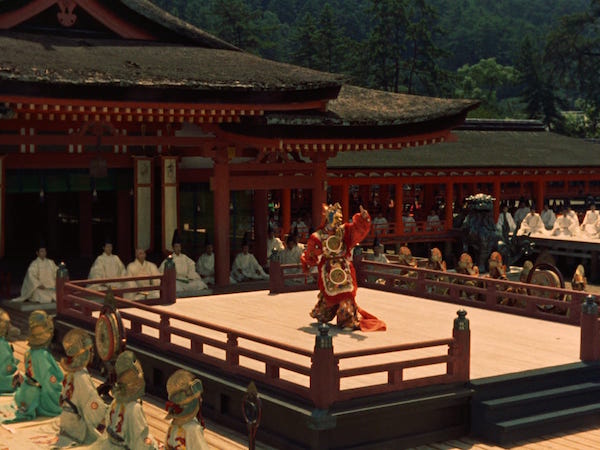
      Gate of Hell (Jigokumon, 1953), written and directed by Teinosuke Kinugasa.

      Image source: The Criterion Collection

      Gate of Hell has the stark simplicity of a Kabuki tragedy; only afterwards do you realize that it can be read as a postwar parable about rapacious militaristic values and their disastrous consequences. After catching a glimpse of the exquisite Lady Kesa (Machiko Kyō), the samurai Morito Endo (Kazuo Hasegawa) burns with unquenchable desire. She is married to court official Wataru Watanabe (Isao Yamagata), but Morito plans to sneak into his bedroom one night and murder him as he sleeps. Lady Kesa apparently acquiesces, but she has a plan of her own to thwart dishonor. . .

      Image source: The Criterion Collection

      I have long associated the Japanese cinema of the 1950s with the black & white masterpieces of Kurosawa, Mizoguchi and Ozu. One surprise of Gate of Hell is that it features gorgeous color cinematography (it was among the earliest color films by a Japanese director). It's a visual feast: the costumes are sumptuous, and many shots are framed to look like living Ukiyo-e prints (a connection made explicit at the opening of the film). The performances are powerful, the story compelling and multi-layered.

      War and Peace (Voyna i mir, 1967), written by Vasily Solovyov and Sergei Bondarchuk based on the novel by Leo Tolstoy; directed by Bondarchuk.

      Image source: The Criterion Collection

      Speaking of visual feasts, clearly no expense was spared in filming this adaptation of Tolstoy's great novel. The ball scene has hundreds, and the battle scenes thousands, of costumed extras. Bondarchuk offers both vast spectacle and intimate scenes where fates turn on a single remark or glance.

      Across the four separate films that make up War and Peace we follow the intertwined fates of three main characters (and two dozen or so minor ones): the upright-to-a-fault Prince Andrei Bolkonsky; his friend Pierre Bezukhov, whose sudden elevation to wealth and high social status does not bring happiness; and Natasha Rostova, the young woman they both come to love. Their private dramas of sacrifice, betrayal, and reconciliation are set against the public calamities of Napoleon's campaigns, with the last two films featuring the invasion of Russia in 1812, the capture and burning of Moscow, and the grueling retreat of the French Army at the start of the bitter Russian winter.

      The justly celebrated battle scenes are mind-boggling in scale, and vividly depict the chaos and brutality of Napoleonic warfare. As you watch the trailer, remind yourself that this is not CGI:

      https://www.youtube.com/watch?v=3DqanxfecIA

      The most arresting performance among an excellent cast is that of Ludmila Savelyeva as Natasha Rostova. A 19-year-old dancer when she was cast, Savelyeva is radiant as the excited 14-year-old attending her first ball, and over the 7-year course of the story convincingly becomes a sadder, wiser, and more self-aware woman. Bondarchuk himself played Pierre, who is prey to enthusiasms and impulses but who, despite his nearly fatal misadventures, manages to retain a fundamental decency. Vyacheslav Tikhonov was reportedly Bondarchuk's third choice to play Prince Andrei, but he acquits himself nobly.

      Prince Andrei (Vyacheslav Tikhonov) and Nastasha Rostova (Ludmila Savelyeva). Image source: The Criterion Collection

      It helps to have some familiarity with the novel. Scenes sometimes begin in progress, and the characters aren't always explicitly identified. (I had a hard time telling the roistering soldiers Dolokov (Oleg Yefremov) and Kuragin (Vasily Lanovoy) apart.) And Bondarchuk is a little too fond of "artistic" directorial effects. But these are minor flaws in what is an unforgettable experience. We watched the 403-minute Russian Cinema Council edition of the film released on DVD in 2003; the Criterion Collection has recently issued a 422-minute restoration which is now the definitive version. With this film, more is definitely better.

      Honorable mentions, romantic comedy division:

      Crazy Rich Asians (2018), written by Peter Chiarelli and Adele Lim based on the novel by Kevin Kwan, directed by Jon M. Chu

      Eleanor Young (the great Michelle Yeoh), Nick Young (Henry Golding), and Rachel Chu (Constance Wu) in Crazy Rich Asians. Image source: Juice Online

      Isn't It Romantic (2019), written by Erin Cardillo, Dana Fox, and Katie Silberman, directed by Todd Strauss-Schulson

      Josh (Adam Devine), Natalie (Rebel Wilson), and Isabella (Priyanka Chopra) in Isn't It Romantic. Image source:  Brightest Young Things

      Harrowing masterpieces of world cinema aren't the only movies we watch and enjoy; both of these romantic comedies also hit our sweet spot. Crazy Rich Asians was criticized by some on its release as offering a fantasy image of Asian and Asian-American life. To which we respond, it's a romantic comedy, a genre not known for rubbing viewer's faces in gritty realism. Isn't It Romantic cleverly sidesteps the fantasy/reality issue by making most of the film the heroine's dream, and affectionately sending up many rom-com conventions—including the girl who realizes too late that her best friend is her perfect match (see Emma). Crazy Rich Asians embraces those conventions—the girl from a middle-class family rejected by her boyfriend's super-wealthy relatives (see Pride and Prejudice)—in a satisfying way. Both are worth your time if you're a rom-com fan; if you're not, you're sentenced to watch It Happened One Night this weekend.

      Honorable mention, classic Bollywood division

      Amar Akbar Anthony (1977), screenplay by Prayag Raj, scenario by K. K. Shukla, dialogues by Kader Khan, directed by Manmohan Desai

      Amar (Vinod Khanna), Akbar (Rishi Kapoor), and Anthony (Amitabh Bachchan) in disguise. Image source: indianexpress.com

      Regular readers of this blog are probably aware that I am not the world's biggest fan of masala, but Amar Akbar Anthony has snuck at least partly under my defenses. After taking the fall for his boss and serving prison time for an accidental death he didn't cause, the poor but honest Kishanlal (Pran) returns home to find his family starving and his wife (Nirupa Roy) dying of tuberculosis. He confronts his gangster boss Robert (Jeevan) for neglecting them in his absence, and after much dishoom-dishoom and a car chase is apparently killed.

      Miraculously (a word that has to be used often in summaries of masala plots) Kishanlal survives, and carries off a crate of his boss's gold—a good trick, as a crate of gold that size would weigh more than a ton. But Kishanlal discovers that his wife has gone to commit suicide (thanks to a providential bolt of lightning, she's blinded instead). He takes his three little boys to a park and tells them to wait for him (at the foot of a Gandhi statue, on August 15), but when he returns after his escape from Robert's henchmen they have disappeared. Inadvertently separated and apparently abandoned, they have been taken in by a Catholic priest, a Hindu police officer, and a Muslim tailor (who also finds Ma and brings her home to unknowingly raise her own son). Kishanlal, bereft, vows revenge; he will use his newfound wealth to supplant and humiliate Robert.

      Jump cut to 25 years later: Anthony (Amitabh Bachchan) is a two-fisted, good-hearted bhai who rules his lane, Amar (Vinod Khanna) has become a tough but honest cop, and Akbar (Rishi Kapoor) has become a famous qawwali singer. When a blind old woman (guess who—wait, wasn't she dying of tuberculosis 25 years ago?) is hit by a car and needs an emergency transfusion, all three men (who, of course, all share her blood type) volunteer. As the blood of the three strangers who are her unsuspecting Hindu, Muslim and Christian sons mingles in Ma's veins to give her life—symbolism, anyone?—the credits begin to roll. The opening credits; this is just the pre-credit sequence.

      Will the family finally recognize one another and be reunited? Will Ma regain her sight and Kishanlal his moral center? Will each of the men find true love (the heroines include Neetu Singh, Parveen Babi and a young Shabana Azmi)? And will they ultimately unite to vanquish the bad guys? Is this a Manmohan Desai movie?

      For a typically thoughtful review of the film, please see Philip Lutgendorf's Notes on Indian popular cinema.

      Documentary

      After I put together this list of favorite documentaries, I realized that all the films on it are about women over 60. That says something noteworthy about this cultural moment.

      Joan Jett: Bad Reputation (2018), directed by Kevin Kerslake.

      Image source: billboard.com

      As a teenager in 1975 Joan Jett founded the Runaways. After the acrimonious split of the band four years later she started over from scratch, recruiting a backup band from musicians in the LA and SF punk scenes (including the drummer from the Avengers). She dubbed them the Blackhearts, and they toured nonstop, selling Jett's self-recorded and -pressed album from the trunk of her manager Kenny Laguna's car. Jett and the Blackhearts went into the studio in 1981 to record another album, their first as a group; the title track was a gender-reversed cover of the glam rock band the Arrows' "I Love Rock 'n' Roll":

      https://www.youtube.com/watch?v=ZQh6heYYOU0

      From that same album Joan Jett and the Blackhearts would have a second huge hit with another cover song: Tommy James and the Shondells' "Crimson and Clover." But this time Jett didn't reverse the genders. Some complain that Jett has never made a public statement about her sexuality (as if that's anyone's business but her own). Of course she hasn't—except for the most public statement she could possibly make. Here is a live performance from the mid-1990s:

      https://youtu.be/-KU7MuONSd0

      "Now I don't hardly know her / But I think I can love her / Crimson and clover / When she comes walking over / I've been waiting to show her / Crimson and clover / Over and over / My, my, such a sweet thing / I want to do ever-y-thing / What a beautiful feeling."

      Jett is still passionate about performing live; she plays dozens of gigs a year with the Blackhearts (we just missed a chance to see her in July). This documentary features interviews with Jett, her friends and admirers, combined with footage spanning her career—and of course it's filled with her music. Jett seems like someone it would be great to sit down with over beers while she puts another dime in the jukebox, and the movie captures her onstage energy, her fierce integrity, and her delightfully raspy speaking and singing voice. A must for fans; if you aren't one, watch this movie and you will be.

      RBG (2018), directed by Betsy West and Julie Cohen.

      Ruth Bader Ginsburg. Photographer: Steve Petteway. Image source: Wikimedia Commons

      Only the second woman appointed to the Supreme Court (after Sandra Day O'Connor), and the first Jewish woman, Ruth Bader Ginsburg broke barriers throughout her career. In 1956 she was one of only nine women in the entering class at Harvard Law, which included more than 500 men. After transferring to Columbia Law and graduating first in her class,  she was rejected from every law firm and clerkship she applied to until some major arm-twisting on the part of one of her law professors. When she joined the faculty of Rutgers Law School in 1963 she was only the 19th woman ever appointed to a tenure-track or tenured law professorship in the United States; when she moved to Columbia Law School in 1972 she became its first tenured female faculty member. [1]

      In the early 1970s Ginsburg co-founded the Women's Rights Project at the American Civil Liberties Union, which litigated hundreds of cases of discrimination based on gender. She argued six cases before the Supreme Court, and won five. After serving as a judge for the US District Court of Appeals for more than a decade she was nominated for the Supreme Court in 1993 by Bill Clinton, and was confirmed by a highly partisan Senate 96-3.

      The film not only documents Ginsburg's pioneering work for equality under the law. It also succeeds in showing the personal side of this reserved and private person, including the love of opera she shared with the late Antonin Scalia (we see footage from an appearance she made in the speaking role of the Duchess of Krakenthorp in a production of The Daughter of the Regiment at Washington National Opera in 2016). The movie and its subject are delightful; let's fervently hope that Ginsburg chooses not to retire anytime soon.

      Tea with the Dames (2018)

      The Dames Maggie Smith, Joan Plowright, Eileen Atkins and Judi Dench. Image: NY Times

      Four of the greatest actresses of their generation, all Dames Commander—Joan Plowright, Maggie Smith, Judi Dench, and Eileen Atkins—sit down over tea (and as the sun sets, something a bit stronger) and reminisce about their lives and roles. What more do you need to know?

      Television

      Slings & Arrows (2003-2006), created by Susan Coyne, Bob Martin, and Mark McKinney

      Oliver (Stephen Ouimette) offers some unwanted advice to Geoffrey (Paul Gross). Image source: NY Times

      Ordinarily my favorites list is limited to movies and TV shows first experienced in the previous 12 months, but this is actually a rewatch. We first saw Slings & Arrows back in 2008 at the suggestion of some dear friends who thought we would love it. They were absolutely right, but at the time I wasn't posting favorites lists. Inspired by coming across the DVD at a thrift store this summer we watched it again, and found it to be just as brilliant and funny the second time.

      Set at the New Burbage Shakespeare Festival, Slings & Arrows follows the fortunes of a theater company that bears a striking (but surely coincidental!) resemblance to the Stratford Festival in Ontario. (Richard Burbage was Shakespeare's leading man in the Lord Chamberlain's (later King's) Men, originating the roles of Hamlet, King Lear, and Richard III, among others.)

      Geoffrey Tenant (Paul Gross), a former star actor at the festival, is brought in to rescue the festival's season as artistic director after the accidental death of the previous incumbent Oliver Welles (Stephen Ouimette). The festival was the scene of Geoffrey's greatest triumphs and worst failure: he is haunted by the memories of his onstage breakdown during a performance of Hamlet. He's also haunted by Oliver, whose restless spirit can't quite let go; his kibitzing ghost offers sardonic running commentary to Geoffrey, who is of course the only person who can see or hear him (shades of Banquo's ghost). Complicating matters is the presence of Geoffrey's old flame Ellen Fanshaw (Martha Burns), whose betrayal of him with otherwise strictly gay Oliver triggered Geoffrey's breakdown. Geoffrey must do battle with the forces of mediocrity and commercialization represented by the shallow, trend-driven director Darren Nichols (Don McKellar) and the festival's business manager, Richard Smith-Jones (Mark McKinney), whose bland conventionality is doubly signaled by his hyphenated name. (It's really, of course, Richard's capable, overworked and underappreciated assistant Anna Conroy (Susan Coyne) who keeps the festival going.)

      Slings & Arrows is brilliantly conceived. Each season centers on the production of a single Shakespeare play: Hamlet, Macbeth, and King Lear. But the other productions of the festival and the barely controlled backstage chaos provide an authentic backdrop for the mainstage drama. And sometimes the backdrop becomes the foreground: in Season 3 a Rent-like musical being workshopped at the festival becomes hugely popular and threatens to crowd out the problem-filled production of Lear.

      For anyone who has ever been part of putting on a show either onstage or backstage, Slings & Arrows can be painfully funny. The writers obviously have experience of theaters large and small—scene after carefully-observed scene rings true. But the series is so well-written, -structured and -acted that even those who have only ever been in the front of the house should find it compelling. Highly recommended.

      Other favorites of 2019:


      1. Herma Hill Kay, "Ruth Bader Ginsburg, Professor of Law," Columbia Law Review, v. 104(2), 2004, pp. 2-20. http://scholarship.law.berkeley.edu/cgi/viewcontent.cgi?article=1019&context=facpubs