Thursday, March 17, 2016

Six months with Jane Austen: Mansfield Park and slavery I

Dido Elizabeth Belle and Elizabeth Murray by David Martin 1776

Dido Elizabeth Belle and Elizabeth Murray (detail), by David Martin, c. 1776. Image source: Kenwood House

Fanny Price and Dido Elizabeth Belle

A young girl whose parents are not able to raise her advantageously is sent to live with her wealthy relatives. There she is brought up and educated as though she were their daughter.

This is the story of Fanny Price in Mansfield Park (1814); it is also the real-life story of Dido Elizabeth Belle, the young woman with the lively, impish expression on the left in the portrait above. Dido was the "natural child" of Captain John Lindsay and a West Indian slave named Maria Belle, or Bell. Dido had been born in 1761 in the Caribbean, where Lindsay's ship HMS Trent had been stationed during the Seven Years' War (Maria Belle may have been imprisoned on a Spanish slave ship captured by HMS Trent). After the war's end, Lindsay returned to England with Maria and his young daughter, and transferred the girl to the care of his childless maternal uncle and his wife. [1]

Her adoptive parents christened her Dido (the name of the mythological queen of the North African city-state of Carthage). At about the same time they also adopted Dido's cousin Elizabeth Murray, whose mother had recently died. They raised the two girls together on terms of equivalence, if not quite of equality (note that in the portrait both women look forthrightly at the viewer, and that their heads are at the same level). The exact nature of the girls' relationship is not known, but from the evidence of the portrait and the account of a contemporary visitor who wrote that Dido "walked with the company in the gardens, one of the young ladies having her arm within the other," it seems to have been loving and sisterly. [2]

The Oxford Dictionary of National Biography states that Dido "held a position balanced between family member and servant and was in charge of the dairy and poultry yard," but that status would not explain why she was taught to read and write; provided with a substantial allowance, expensive furniture, and gifts; and why her adoptive father was said to dote on her. [3] The 2007 Slavery and Justice Exhibition at Kenwood House suggested that "her position in the household may have been that of a loved but poor relation"—much like Fanny Price at Sir Thomas Bertram's estate, Mansfield Park. [4]

The name of Dido's adoptive father was William Murray, Lord Mansfield.

In August 1805, Elizabeth, now Lady Elizabeth Finch-Hatton, was visited at her home Eastwell Park in Kent by her neighbor Edward Knight and a family party that included his visiting sister. Although the sister was delighted with Lady Elizabeth's sons, she was unimpressed by their mother, writing in a letter, "I have discovered that Lady Elizabeth, for a woman of her age and situation, has astonishingly little to say for herself..." [5]

Perhaps Edward Knight's sister, Jane Austen, would have more thoroughly enjoyed conversation with Dido. But by this time, Dido had died; she too had married (though to a man much lower on the social scale than Elizabeth's husband) and had children, but had passed away in 1801. Despite their overlapping family connections—the Hattons were relatives of the Bridges who were relatives of the Knights who were relatives of the Austens—there is no evidence that Jane Austen ever met Dido. But she almost certainly knew her story, and from the evidence of Mansfield Park, adopted elements of Dido's situation in creating her heroine Fanny Price. [6]

Next time: Mansfield Park and slavery II: Lord Mansfield and the antislavery movement

Last time: Pride and Prejudice and the marriage market

Other posts in the "Six months with Jane Austen" series:


  1. J. K. Laughton, rev. Clive Wilkinson, "Lindsay, Sir John (1737–1788), naval officer," Oxford Dictionary of National Biography, http://www.oxforddnb.com/view/article/16710?docPos=9. Lindsay and Maria Belle next traveled to Florida together in 1764. They apparently later returned together to England, but in 1772 Lindsay deeded a plot of land to Maria (at the corner of Lindsay and Mansfield Streets) and granted her freedom (see http://www.telegraph.co.uk/culture/film/10863078/Dido-Belle-Britains-first-black-aristocrat.html).
  2. Thomas Hutchinson, 1779 (Dido was 17 or 18 at the time), as quoted in Paula Byrne's The Real Jane Austen: A Life in Small Things, William Collins, 2014, p. 214.
  3. Reyahn King, "Belle [married name Davinier], Dido Elizabeth (1761?–1804)," Oxford Dictionary of National Biography, http://www.oxforddnb.com/view/article/73352/
  4. Slavery and Justice Exhibition at Kenwood House, https://historicengland.org.uk/research/inclusive-heritage/the-slave-trade-and-abolition/slavery-and-justice-exhibition-at-kenwood-house/
  5. Jane Austen, letter to Cassandra Austen, 24 August 1805. http://www.pemberley.com/janeinfo/brablet6.html#letter33
  6. In Paula Byrne's The Real Jane Austen, whose chapter "The Daughter of Mansfield" was the inspiration for this post, the author speculates that Edward Austen's adoption by the wealthy Knights, or Elizabeth Murray's adoption by the wealthy Mansfields, might have been the inspiration for Fanny Price in Mansfield Park (see Chapter 1, "The Family Profile"). But Edward was adopted as the son and heir of the Knight family estate; elements of Fanny's situation seem to parallel much more closely that of Dido, the "loved but poor relation."

Thursday, March 10, 2016

In memoriam: Alan Curtis, Nikolaus Harnoncourt, Pierre Boulez

The past few months have seen the passing of three conductors, each of whom was in his own way revolutionary:


Alan Curtis, 1934-2015

Alan Curtis died on July 15 of last year after a fall at his home in Florence. Curtis was a key figure in the rediscovery of Baroque opera. With the period-instrument group he founded, Il Complesso Barocco, and a team of renowned international singers including Joyce DiDonato, Karina Gauvin, Anne Hallenberg, Sandrine Piau, and many others, he recorded more than a dozen operas by Handel, along with operas by Vivaldi, Gluck, and other composers. (For my review of one of his many excellent recordings, please see Handel's Floridante.) Many of his projects were world premiere recordings.

Curtis was also a highly regarded musical scholar. He was the first to propose that much of the last act of Monteverdi's final opera L'incoronazione di Poppea (The Coronation of Poppea), including its famous concluding duet "Pur ti miro," was not actually composed by Monteverdi—a position now widely accepted. His research and his long acquaintance with Baroque performance traditions enabled him to reconstruct performance scores for operas for which sometimes only fragmentary materials survived.

Curtis led the musical forces for Berkeley West Edge Opera's production of Handel's Serse (Xerxes) in 2010. This was an astonishing undertaking for a small, underfunded local company that at the time was performing in a high school theater. Curtis was able to bring in musicians from many Bay Area early music groups and to recruit a soprano of international stature, Paula Rasmussen, for the title role. The staging by company artistic director Mark Streshinsky was a bright, bold updating that highlighted the work's ironic and comic elements. It was a brilliant success. Here's a small taste: Atalanta's aria "Un cenno leggiadretto," sung by Anna Slate:


By all accounts Curtis was a warm and generous colleague; you can read more about his life and work in this memorial article from Limelight magazine, and in reminiscences posted on the UC Berkeley Department of Music website.


Nikolaus Harnoncourt, 1929-2016

Like many early-music groups, Alan Curtis' Il Complesso Barocco was founded in the 1970s. Nikolaus Harnoncourt formed Concentus Musicus Wien with his wife Alice more than two decades earlier, in 1953. Pioneers in the performance of 17th- and 18th-century music on period instruments, they rehearsed for four years before appearing in public, and then didn't issue their first recording until five years after that. Over the decades, though, they issued hundreds of recordings, with a special focus on Bach: Harnoncourt led highly regarded performances of the St Matthew and St John Passions, the B minor Mass, and (together with Gustav Leonhardt) the complete cantatas.

Harnoncourt was known for his highly personal approach to music from the Baroque, Classical, and even Romantic repertory. The results could sometimes be jarring, or even grating. I found his landmark 1974 recording of Monteverdi's Poppea to be unlistenable, and I'm not the only one. Charles Downey, in a review on Ionarts, wrote that "Harnoncourt responded to the absence of indications for instrumentation...by over-orchestrating the score most fancifully for a vast consort of instruments that do not always sound all that good. Every time the honking shawms come out of their cage, one just cringes."

But his approach could also bring out fiercely dramatic qualities in music that could sound polite or staid in other hands. Harnoncourt was at his best as a conductor of music by composers who emphasized strong contrasts, such as Haydn and Mozart; I reviewed his superb recording of Armida in my post on Haydn's operas. But I think my favorite Harnoncourt-conducted opera is Mozart's Mitridate, re di Ponto (Mithridates, King of Pontus) as seen in Jean-Pierre Ponelle's 1986 film. From that production, here is the first aria of Queen Aspasia (Yvonne Kenny), "Al destin, che la minaccia":


Harnoncourt's exhilarating conducting is essential to the success of Ponelle's film, which records a performance given without an audience in Vicenza's Palladio-designed Teatro Olimpico. A production that could have seemed mannered, or whose energy might have flagged due to the circumstances under which it was filmed, instead sweeps you up in the emotions of the characters.

For more detail on Mitridate, please see my post "The insane frenzy of an illicit love." A fuller account of Harnoncourt's life is offered by Barry Millington's article in The Guardian.


Pierre Boulez, 1925-2016

It might seem as though Pierre Boulez's musical ideas were diametrically opposed to those of Curtis and Harnoncourt. After all, Curtis and Harnoncourt were primarily concerned with recovering the music of the past. As a composer and conductor Boulez was an uncompromising modernist who was quoted as saying that opera as an art form had ended with Berg, and that the solution to opera's endless repetition of a relative handful of works would be to "blow the opera houses up."

However, in the polemical essays collected in his book Text and Act (Oxford, 1995), musicologist Richard Taruskin argued that the early music movement was, in fact, a modernist project. He suggested that contemporary performances of both early and 20th-century music shared ideological and musical approaches. One key element that united them was a rhetorical insistence on Werktreue, or performing music in a way that remained as true as possible to a composer's intentions. Taruskin felt, though, that the early music movement's claims of "authenticity" were meaningless. In his view they simply provided an unnecessary justification for performances that reflected a modern taste that favored fleet tempi and transparent textures. You don't have to fully accept all of Taruskin's arguments to feel that perhaps these three conductors had more in common than might appear on the surface.

Although he claimed that opera was dead, Boulez was at the podium for two of the most significant opera productions of the past 40 years: the centenary Ring Cycle at Bayreuth in 1976, and the first performance of the Friedrich Cerha completion of Alban Berg's unfinished Lulu at the Paris Opera in 1979, both directed by Patrice Chéreau. Although initially greeted with protests (not least among some of the singers and musicians), the Wagner production has come to be seen as transformative. Chéreau's brilliant realization of George Bernard Shaw's insight that the Ring functions as a parable of 19th-century capitalism gave many, myself included, a way to approach Wagner's epic for the first time. It remains a highly compelling concept, despite the flood of imitative and inferior Regietheater that has swept onto opera stages in the years since. And the Boulez-Chéreau Lulu production set a new standard for this work. So it is very odd that Paul Griffith's lengthy New York Times obituary of Pierre Boulez mentions both productions only in passing.

Neither opera can be easily excerpted, but the famous opening of Act III of Die Walküre (The Valkyrie) will give you a good sense of what was radically different in Boulez's approach. While it may lack the overwhelming force of some other conductors' readings, you can hear details of the music that are often obscured in a wall of sound. Boulez wanted to defamiliarize this music so that we could learn to hear it again:


Avoiding the overly familiar, and making the well-known new again, were principles that Curtis, Harnoncourt, and Boulez held in common, despite the differences in their preferred repertory. We are fortunate that all three were active at a time when their work, particularly in opera, could be thoroughly documented by recordings. Their deaths within a few months of one another mark the passing of an era.

Thursday, March 3, 2016

Six months with Jane Austen: Pride and Prejudice and the marriage market


But there certainly are not so many men of large fortune in the world, as there are pretty women to deserve them.
—Jane Austen, Mansfield Park [1]

All of Jane Austen's six novels follow the heroine's (or heroines') journey from love—or, to use other words that occur in her novels, regard, esteem, gratitude, and attachment—to marriage. At a time when few women had sufficient means to live independently and divorces were difficult to obtain, the choice of a marriage partner was a fateful one. It was also a difficult one, thanks to a combination of interrelated demographic, geographic, and economic factors.

Skewed demographics in the marriage market

The population demographics of the early 19th century in England were skewed in a way that disadvantaged young single women. In the figures from the 1811 census, females outnumbered males by a substantial margin in almost every English county. In Hertfordshire, Derbyshire, and Kent—the three principle counties in which the action of Pride and Prejudice takes place—there were 11,000 more females than males. The problem was worse in some other counties: in the densely populated Middlesex, the county immediately to the south of Hertfordshire and adjacent to London, there were nearly 84,000 more females than males. Of course, only about a third of the population was of marriageable age—for those seeking a first marriage, generally between 15 and 34—but clearly there were considerably more women than men in the marriage market. Also, on average women married men who were about two years older than themselves, and the population of eligible men declined with increasing age. [2]

Another factor skewing the marriage-age population was that Austen's novels were written during the time of the Napoleonic Wars and continuing military conflict between Britain and the newly independent United States. Roughly half a million men were serving in Britain's armed forces and were not counted in the 1811 census; of course, most of them were also not available as marriage partners. (The soldiers quartered at Meryton at the beginning of Pride and Prejudice are a regiment of the militia, which remained on home soil in order to defend against French invasion or violently suppress unrest among industrial or agricultural workers.)


Geographic drawbacks

It is significant, I think, that in Pride and Prejudice all of the men in whom the Bennet sisters express a marital interest, or who express a marital interest in them—Darcy, Bingley, Wickham, Mr. Collins, and Colonel Fitzwilliam—come from outside the Bennets' home county of Hertfordshire. The limited society of a small village or town might provide few potential marriage partners. Mrs. Bennet boasts to Darcy that "we dine with four-and-twenty families," unaware that she has just confirmed his observation that "In a country neighbourhood you move in a very confined and unvarying society." [3] At the beginning of the 19th century only about a third of the population of England lived in towns of 2500 inhabitants or more, and London was the only city with more than 100,000 inhabitants. Most women faced a pool of potential suitors that was indeed "confined and unvarying."

Class and economic limitations

Marital choice, restricted by demographics and geography, was also circumscribed by class. Because in landed families elder sons inherited (see Sense and Sensibility, inheritance, and money), they were often expected to enlarge estates and solidify family ties through marriage. In Pride and Prejudice, Lady Catherine de Bourgh tells Elizabeth Bennet that she has long been planning for the marriage of her nephew Darcy and her daughter; their marriage would unite the substantial estates of Pemberley and Rosings Park:
"From their infancy, they have been intended for each other. It was the favourite wish of his mother, as well as of hers. While in their cradles, we planned the union: and now, at the moment when the wishes of both sisters would be accomplished in their marriage, to be prevented by a young woman of inferior birth, of no importance in the world, and wholly unallied to the family!" [4]
Mr. Bingley, an elder son who does not own an estate because his fortune, inherited from his father, "had been acquired by trade," [5] also faces familial expectations about his marriage. Bingley's sister Caroline writes to Jane Bennet that he is expected to marry Darcy's sister Georgiana, and that "her relations all wish the connection as much as his own." [6] As Elizabeth says to her sister Jane, "They may wish many things besides his happiness; they may wish his increase of wealth and consequence; they may wish him to marry a girl who has all the importance of money, great connections, and pride." [7]

Younger sons, who did not generally inherit land, might also feel the need to augment their wealth through marriage. As Darcy's cousin Colonel Fitzwilliam tells Elizabeth,
"Younger sons cannot marry where they like."
"Unless where they like women of fortune, which I think they very often do."
"Our habits of expense make us too dependent, and there are not many in my rank of life who can afford to marry without some attention to money."
"Is this," thought Elizabeth, "meant for me?" and she coloured at the idea; but, recovering herself, said in a lively tone, "And pray, what is the usual price of an earl's younger son? Unless the elder brother is very sickly, I suppose you would not ask above fifty thousand pounds." [8]
Austen's novels are peopled with younger sons, such as Edmund Bertram (Mansfield Park), Henry Tilney (Northanger Abbey), and Captain Frederick Wentworth (Persuasion), while Edward Ferrars (Sense and Sensibility) has been disinherited—essentially, he is an elder son forced to change places with a younger one. All four must overcome disapproval or the familial expectation and promotion of a different preferred partner before they can unite with the heroine in marriage. [9]

It wasn't only sons, of course, who attempted to marry to economic advantage. In Pride and Prejudice, Charlotte Lucas explains to Elizabeth why she has accepted the proposal of the priggish, pompous Mr. Collins:
"I am not romantic, you know. I never was. I ask only a comfortable home; and considering Mr. Collins's character, connections, and situation in life, I am convinced that my chance of happiness with him is as fair, as most people can boast on entering the marriage state."

Elizabeth...had always felt that Charlotte's opinion of matrimony was not exactly like her own, but she could not have supposed it possible that when called into action, she would have sacrificed every better feeling to worldly advantage. [10]
"Better feelings," though, might be considered a luxury by women who, in the absence of a husband of at least some means, might face poverty, isolation, or (worse, in some cases) indefinite residence in her parents' home.

But women attempting to "marry up" were facing the highly stratified nature of the British class system. In the early 19th century, the pseudo-gentry, gentry, and aristocracy together made up less than a third of British families. [11] A daughter of a clergyman, barrister, small estate owner, or successful tradesman would find that most of the men she encountered on a daily basis would be considered unsuitable as objects of her matrimonial aspirations.

The top of the wealth pyramid was very narrow; one economic historian has estimated that in 1790 there were only 400 landowning families with annual incomes between £5000 and £50,000 per year. [12] In 1803 there were more than 2 million families in England; even if inflation and population growth between 1790 and 1803 had increased the number of families in the highest income brackets, they still represent a fractional percentage of the population. Considered in purely economic terms, Elizabeth Bennet is fortunate indeed to marry Darcy, whose annual income is reported to be £10,000, and her sister Jane nearly as lucky to marry Bingley, whose fortune is in the neighborhood of £100,000. These two young men would have been among the wealthiest bachelors in England.


The experience of re-reading Pride and Prejudice

I had read Pride and Prejudice three times (over 20 years) before embarking on the Six Months with Austen project. But I was surprised to find that this time it seemed like a different novel. Mainly, I found it to be more explicit than I remembered. I had prided myself on divining what I thought were hidden feelings in the characters, and subtle nuances of their situations. But, like a certain character of Austen's, I discovered to my chagrin that my pride was mistaken: Austen is generally very clear about her characters' thoughts and feelings. This did not diminish Pride and Prejudice in my view in any way; it remains for me, thanks to the delightfully witty, flawed, and sympathetic character of Elizabeth Bennet, Austen's most purely enjoyable novel.

Next time: Mansfield Park and slavery I: Fanny Price and Dido Elizabeth Belle
Last time: Sense and Sensibility, inheritance and money

Other posts in the "Six months with Jane Austen" series:


Picture credits, from top to bottom:
  1. Thomas Lawrence, Portrait of Charlotte and Sarah Carteret-Hardy, 1801 (detail)
  2. Thomas Lawrence, A Double Portrait of the Fullerton Sisters, 1825 (detail)
  3. Thomas Lawrence, Portrait of Miss Rosamond Croker, 1827 (detail)
References:
  1. Jane Austen, Mansfield Park, Volume I Chapter i; Chapter 1
  2. For 1811 demographic figures, see "Population Statistics: Comparison of Population, England, by County, 1801 and 1811" (http://www.napoleon-series.org/research/abstract/population/population/britain/c_popcomp.html). The percentage of the population between the ages of 15 and 34 in the 1810s was estimated from "Table 1: The age distribution of the population of England and Wales, 1821-1971" in Francois Bedarida, A social history of England, 1851-1975, Methuen, 1979, p. 13.
  3. Austen, Pride and Prejudice, I. ix.; 9.
  4. Pride and Prejudice, III. xiv.; 56.
  5. Pride and Prejudice, I. iv.; 4.
  6. Pride and Prejudice, I. xxi.; 21.
  7. Pride and Prejudice, II. i.; 24.
  8. Pride and Prejudice, II. x.; 33. Fifty thousand pounds would result in an annual income of about  £2500. To put this in context, we learn that Elizabeth herself will ultimately receive £1000 from her mother, resulting in an annual income of about £50.
  9. Edmund Bertram is expected to marry Mary Crawford (who possesses £20,000). Henry Tilney's father initially promotes his attachment to Catherine Morland when he thinks she is rich, but abruptly reverses himself when he discovers that she has no fortune. When Captain Wentworth is merely penniless Lieutenant Wentworth, his suit for Anne Elliot's hand is strongly opposed by Lady Russell. And Fanny Ferrars Dashwood, Edward's brother, makes her disapproval of the attachment between her brother Edward Ferrars and her sister-in-law Elinor Dashwood so apparent that the Dashwood women feel that they have no choice but to move out of the family home. (Edward is later disinherited by his mother for refusing to break his engagement with another woman of no fortune, Lucy Steele.)
  10. Pride and Prejudice, I. xxii.; 22.
  11. "Table 6: Social hierarchy and size of income from the seventeenth to the twentieth century (in percentages) 1688-1867: England and Wales" in Francois Bedarida, A social history of England, 1851-1975, Methuen, 1979, p. 216.
  12. Referenced in James Heldman, "How Wealthy is Mr. Darcy—Really? Pounds and Dollars in the World of Pride and Prejudice." Persuasions 12, 1990, 38-49. http://jasna.org/persuasions/printed/number12/heldman.htm Heldman's calculations of the modern equivalents of early 19th century wealth are somewhat dubious; a more nuanced attempt is made by Katherine Toran in "The Economics of Jane Austen’s World," Persuasions On-Line, 36(1), 2015. http://jasna.org/persuasions/on-line/vol36no1/toran.html Although exact comparisons are, of course, impossible, she calculates that Darcy's income represents something between about US$1 million and US$16.5 million in today's currency.

Sunday, February 28, 2016

Christmas noir: Remember the Night


Four years before they appeared as the fatally attracted couple in Billy Wilder's film noir classic Double Indemnity, Fred MacMurray and Barbara Stanwyck co-starred in Remember the Night (1940, directed by Mitchell Leisen, screenplay by Preston Sturges). Up until now I've always thought that the bleakest holiday movie was Frank Capra's It's a Wonderful Life (1946), but Remember the Night manages to be even darker. The DVD cover calls it "a heartwarming holiday classic"; heartwrenching is more like it.

The movie begins a few days before Christmas. Amid the New York holiday throngs, "Lee Leander" (Stanwyck) is arrested for shoplifting an expensive bracelet. [1] It's clear that she does so deliberately and with premeditation—it's not a misunderstanding or a moment of forgetfulness. Despite being caught red-handed, she pleads not guilty and is put on trial. Rising young assistant district attorney John Sargent (MacMurray) is picked to prosecute the case because of his track record of convicting women: he uses his "niceness" to sway juries whose sympathies might otherwise lie with the accused.

We learn during the trial that Lee has a history of thievery, committed under a series of aliases; this is far from her first offense. But with a dramatic closing argument her lawyer is about to get her acquitted when Sargent, seizing on a technical error by the defense, presses for a continuation until after the holidays. Lee, on the verge of freedom, is remanded to spend Christmas and New Year's Eve in jail. Sargent feels a twinge of conscience, and in an impulsive moment of generosity asks bondsman Fat Mike (Tom Kennedy) to bail her out.

Fat Mike brings Lee to Sargent's apartment. He thinks that Sargent has bailed her out in exchange for sex, and she thinks the same thing:
Sargent: "What are you doing here?"
Lee: "I don't know yet, but I've got a rough idea." [2]


After Sargent explains that he isn't expecting any favors, the conversation takes a turn:
Lee: "You mean, I don't have to stay here if I don't want to?"
Sargent (trying to get her to leave): "You most certainly do not."
Lee (after a moment's thought): "Then I'll stay—but I won't be forced."
Sargent: "Hey, now, wait a minute!..."
Lee: "You know, there's nothing so dangerous as a square shooter. If all men were like you there wouldn't be any nice girls left."
It's remarkable that in an era which was governed by the puritanical Production Code, the heroine of Remember the Night—a serial thief who has clearly faced sexual coercion in the past—can frankly express her willingness to sleep with the hero. Stanwyck, of course, often played hardbitten but sympathetic women with complicated histories; it's difficult to imagine any other actress in this role.

One reason Lee is willing to stay is that she has no other place to go: the hotel where she's been staying has locked her out for non-payment (perhaps this was the motive for shoplifting the bracelet). Sargent, though, just wants to get rid of her. He's about to drive back to Indiana to see his mother for Christmas, and Lee is a complication he doesn't need. But then he finds out that Lee grew up just 50 miles away from his home town:
Sargent: "How long since you've been home?"
Lee: "Never."
Sargent: "Why?"
Lee: "I ran away."
Sargent: "Well, I don't know what the circumstances were, of course..."
Lee: "Not so hot."
Sargent tries to give her some reassurance: "Time takes care of those things." (The very next thing we learn is that Lee's father is dead; perhaps time has taken care of some of those things.)

Sargent has a brainstorm: he offers to take Lee back to see her mother for Christmas, and pick her up on his way back. As the sentimental "My Indiana Home" plays in the background (with an uncredited Martha Mears on vocals), Lee—overcome by Sargent's kindness, and feeling a surge of misplaced nostalgia—lets her emotions sway her judgment. As we know from other films noir, that's never a good idea.


After downing a couple of scotches (it's 1940, after all), they hit the road. Our first sign that things aren't going to go smoothly on this trip is that in the middle of the night they encounter a detour, take a wrong turn and wind up stranded in a cow pasture. The next morning a shotgun-toting farmer arrests them for trespassing, destruction of property (his fence), and petty larceny (a thermos of fresh milk), hinting that Sargent has brought Lee across state lines for immoral purposes. They're dragged before the local justice of the peace, where it's clear that the farmer and the justice make a nice supplemental income from wayward travellers. After giving obviously false names, they're facing jail time when Lee tosses a lit match into an overflowing wastepaper basket; in the ensuing chaos they escape. Both literally and metaphorically, Sargent has left the straight and narrow:
Lee: "It must feel kind of funny for you to be a fugitive from justice."
Sargent: "Very funny"...
Lee: "It's better than going to jail, isn't it? I told you my mind worked differently!"
Sargent: "Do you realize that house is probably in flames a mile high?"
Lee: "I hope it is."
Sargent: "Well so do I—but what's that got to do with the morals of the case?"
Lee: "What have morals got to do with it? You've treated me like your sister."
By the time they roll into Lee's home town, night has fallen again, and she's feeling very apprehensive about seeing her mother for the first time in ten years. The dark, gloomy family home does not make her feel less nervous:


And for good reason. What follows is one of the most harrowing mother-daughter confrontations in American film. Ten years has not dimmed the anger of Lee's mother (Georgia Caine) or softened her animosity towards her daughter. By the end of their brief but bitter conversation the tough, cynical Lee is in tears. "I've forgotten how much that woman hates me...and how much I hate her," she says, a line still retains the power to shock.

Sargent realizes that it would be cruel to leave the desolated Lee on her own, and on the spur of the moment he decides that he's going to bring her home with him. Sargent's family is everything that Lee's isn't: warm, welcoming, and nonjudgmental, even after he's revealed to his widowed mother exactly who Lee is, and what awaits them when the holidays are over. Mrs. Sargent (Beulah Bondi) refuses to believe that Lee is a hardened criminal:
Mrs. Sargent: "Do you remember when you took my egg money I was going to buy a new dress with? And then how hard you worked to pay it back when you did understand?"
Sargent: "You made me understand."
Mrs. Sargent: "No, dear. It was love that made you understand."
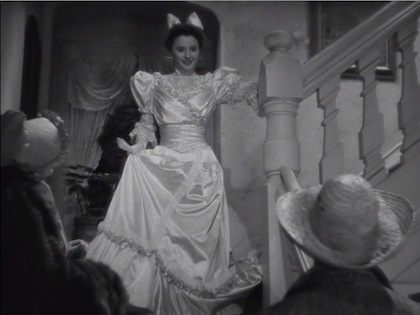
Love was missing from Lee's home, but she finds it in Sargent's. His mother and his Aunt Emma (Elizabeth Patterson) give her acceptance and trust, and she discovers in herself some unexpected yearnings for domesticity. She is falling in love with Sargent and his world, but he's steadfastly oblivious to his own developing feelings. At least, that is, until the night of the "old-fashioned" barn dance on New Year's Eve, when Lee appears in Aunt Emma's old wedding dress:


Up until now, Lee has generally worn black; in a white bridal gown, she appears transformed, and Sargent suddenly realizes how dazzling she is. If their journey together has caused Sargent to bend the laws he is sworn to uphold, it has shown Lee what it might mean to have a loving home and family. As Sturges later wrote of Remember the Night, "love reformed her and corrupted him." [3]

But Sargent is not the only one who is newly aware of his feelings; his mother also perceives them, and is troubled. That night after the dance she visits Lee as she's getting ready for bed. The conversation that follows is devastating, as Mrs. Sargent gently pleads with Lee not to allow her love for her son to destroy everything that he has worked for, and everything he might become. For the second time in the journey, Lee faces the blasting of her hopes, and is left in tears.

On the way back to New York Sargent and Lee drive through Canada. (When asked at the border crossing for his reason for entering Canada, Sargent replies, "I'm a fugitive from justice." The border guard laughs.) At Niagara Falls, Lee tries to convince Sargent that neither of them loves the other. But, if he didn't before, Sargent now knows his true feelings. He spins a fantasy of their marriage and honeymoon:
Sargent: "You know where we're going on our honeymoon? Niagara Falls."
Lee: "Aren't we there now, darling?"


The spectacular falls (even if they are a studio effect) and their association with weddings and honeymoons sweep away the lovers' hesitations for one night. But when they return to New York, reality sets in. As Lee says to Sargent, "People aren't responsible for what they say in Niagara Falls. This is New York, this is today, and this is different." A resumption of her trial awaits.

Sargent now faces a critical choice. If Lee is acquitted, he can marry her, but the marriage would put an end to his career in the D.A.'s office and to his potential future in politics. If he wins a conviction, Lee will be sentenced to jail, and they'll be separated, possibly for years. Of course, Lee also has a critical choice to make, and it turns out that her choice will be decisive...

With its excellent cast, sharp dialogue, and understated direction, Remember the Night has all the ingredients of a Hollywood classic. So why isn't it better known? While its subject matter is pretty dark—a manipulable, corrupt, and unjust legal system; poverty; parental violence and abuse; social stigma—that's also true of other films that are far more famous: Double Indemnity, for one.

Perhaps one issue is Remember the Night's ambiguous ending; we're unsure of the couple's future, although it's clear that the odds are against them. But perhaps another reason this film hasn't quite achieved the same classic status as some of Sturges' other movies is the depiction of Sargent's manservant Rufus. Rufus is dimwitted, cringingly servile, and speaks in broad dialect. Near the beginning of the movie, Sargent's superior calls his apartment, and Rufus answers the phone:
Sargent: "If that's the office tell 'em I've already left."
Rufus: "Yassuh...yassuh....well, if dis is de office he's already lef'."
District Attorney: "Oh, my, no, this isn't his office! You just tell him a young woman wants to make an appointment with him."
Rufus: "It ain't de office...a young woman want to make an appointment wid you." [4]
Etc. The actor who portrayed Rufus was Fred "Snowflake" Toones, listed in the credits only as "Snowflake" (as my partner said after the credits, "I wouldn't want my name associated with that role either"). Toones, a dark-skinned black man—thus the "hilarity" of his stage name—was frequently cast in stereotypical servant, janitor, waiter, or shoeshine boy roles. (It must be noted, though, that his appearance as a cowering club car porter in Sturges' The Palm Beach Story (1942) hasn't seemed to affect the reception of that film.) Toones may have laughed, or seethed, all the way to the bank, but he can't be blamed for the racist caricature he was repeatedly called on to play. His scenes are hard to watch, though, and they mar what's otherwise a bleak masterpiece of Christmas noir.


  1. Stanwyck's character is rarely addressed by name in the movie, and it's clear that Lee Leander is not her birth name. In the trial scene her lawyer calls her "Anna-Rose Malone, sometimes known as Lee Leander," and her mother's name will turn out to be Malone. However, Preston Sturges' script (reprinted in Three More Screenplays by Preston Sturges (University of California Press, 1998) and the film's credits refer to her as Lee Leander, and as we'll see, there are significant reasons beyond her need for criminal aliases for her to have taken on a new identity. The one time that Sargent introduces her, midway through the film, it's highly significant that he calls her by her chosen rather than her birth name.
  2. This and all following quotes except the last one are transcribed dialogue from the film, which differs from the script published in Three More Screenplays by Preston Sturges, University of California Press, 1998. In my view, in every case where there is a difference between the scene as it appears in the film and the published script, the scene as shot is superior.
  3. Preston Sturges by Preston Sturges, Simon & Schuster, 1990, p. 288
  4. Three More Screenplays, pp. 337-338. I've quoted from Sturges' published screenplay so that I can't be accused of exaggerating the representation of Rufus' speech.

Sunday, February 14, 2016

The other Barber of Seville

The composer Giovanni Paisiello at the clavichord,
by Marie Louise Élisabeth Vigée Le Brun, 1791 (detail)

Two hundred years after its first performance, Rossini's Barber of Seville (in Italian, Il barbiere di Siviglia) remains one of the best-known and most-produced operas in the repertory. According to Operabase, in the past five years alone it has received more than 2300 performances in over 500 productions internationally. San Francisco Opera has presented it in four of the past dozen seasons, including two of the last three. Music from the opera crops up in movies (Breaking Away), cartoons (the Bugs Bunny Rabbit of Seville), and commercials.

But the first performance of Rossini's Barber on February 20, 1816 was almost its last. It was a notorious fiasco. The mishaps on stage at the Teatro Argentina in Rome—a singer tripped and gave himself a bloody nose, and a wandering cat upstaged the diva (twice!)—were nothing compared to what went on in the audience. From the first moments of the opera, whistling, catcalls and shouted abuse rained down on Rossini (who was directing from the keyboard) and drowned out much of the music.

What was upsetting to some members of that first-night audience was that another version of Barber already existed. Composed by Giovanni Paisiello in 1782 to a libretto by Giuseppe Petrosellini, the earlier Barber—an adaptation of the first play in Pierre Beaumarchais' Figaro trilogy—was an international hit and audience favorite. First written for the court theater of Russian empress Catherine the Great, it was quickly produced in other European cities such as Naples, Venice, Amsterdam, London, Lisbon and Madrid.

In Vienna in 1783, Paisiello's Barber was seen by a young composer searching for an operatic subject. Inspired by Barber's comic possibilities (and its popularity—it was performed during every opera season in Vienna for five years after its debut), the composer recruited a librettist to write a sequel based on the second play in the Beaumarchais trilogy, The Marriage of Figaro. That composer—Mozart, of course—included several musical allusions to his inspiration, quoting Paisiello's descending three-note motif ("Fiii-ga-ro") in the Figaro overture, and including an amorous serenade (Cherubino's "Voi che sapete") that has striking similarities to Barber's "Saper bramate," seen below:


Count Almaviva is serenading Rosina, the beautiful young ward of the miserly Dr. Bartolo, who keeps her a virtual prisoner in his home. To make matters even worse, Bartolo is planning to marry Rosina against her will. Almaviva, struck by Rosina's beauty, enlists the aid of the canny barber of the opera's title, Figaro, to disguise himself, gain entry to Bartolo's home, and rescue her.

Rosina is attracted to this handsome stranger and desperate to escape the lecherous clutches of Dr. Bartolo. At the close of the first part of the opera she sings "Giusto ciel," a plea to heaven to witness the truth of her affections for the man she thinks is a poor student, and to grant her peace:


The soprano performing Rosina in this recent production from the Teatro Verdi di Sassari is Gabriella Costa.

You may notice a resemblance between "Giusto ciel" and "Porgi amor," an aria for the Countess Almaviva (who is, of course, also Rosina) in The Marriage of Figaro. Again that resemblance is a deliberate evocation of Paisello's opera [1]. Such references, which Mozart and his librettist Lorenzo Da Ponte could assume would be recognized by their audience, created emotional continuity between the characters in Barber and those same characters in Figaro, the events of which take place a few years after those in Barber.

As these excerpts demonstrate, Paisiello's treatment of Barber is less farcical than Rossini's later version. But the high musical quality and humanistic warmth of Paisiello's opera ultimately could not compete against the sheer tunefulness and manic comic energy of Rossini's version. Despite that first-night demonstration against Rossini's opera, it went on to be a success, and within a few years Paisiello's opera was no longer performed. Despite occasional revivals in Europe and two or three (out of print) recordings, Paisiello's opera today remains, unjustly, a rarely-heard obscurity.

Enter West Edge Opera, a tiny Bay Area company with imagination and daring far beyond those of many much larger and richer organizations. Artistic director Mark Streshinsky and musical director Jonathan Khuner once again made virtues of necessity in their semi-staged concert version of Paisiello's Barber (seen February 9). The stripped-down musical forces (violin, cello, oboe and keyboards) and intimate non-traditional venue (the downtown Berkeley roots-music club Freight & Salvage) heightened the work's immediacy. Khuner's witty supertitles and the committed performances of an excellent cast (special mention must be made of Sara Duchovnay's Rosina and Nicholas Nackley's Figaro) made for an evening of sheer delight.

In the opera's finale ensemble, Khuner cleverly interpolated a few bars each of Bartolo's "La Vendetta" from The Marriage of Figaro and Figaro's "Largo al factotum" from Rossini's Barber. The seamlessness with which these musical quotations could be inserted showed just how much the later (and now vastly more famous) composers owed to Paisiello. It was another demonstration of how thoughtfully the WEO artistic team approaches its productions.

WEO's Opera Medium Rare season continues on March 20 (Mills College) and March 22 (Freight & Salvage) with the other La bohème, composed by Ruggero Leoncavallo almost simultaneously with Puccini's version. It will be followed by the company's Summer Festival 2016, featuring Janáček’s The Cunning Little Vixen, Thomas Adés’ Powder Her Face, and Handel’s wickedly cynical Agrippina.


  1. In Mozart's Operas (University of California, 1990) Daniel Hearst has outlined many of the musical and thematic connections between Paisello's Barber and Mozart's Marriage of Figaro, including those between "Giusto ciel" and "Porgi amor."