Sunday, July 27, 2025

"So rapturous a delight": What Jane Austen's characters read (and why), part 1

The Reader by Marguerite Gerard 1786

The Reader by Marguerite Gérard and Jean Honoré Fragonard, c. 1786. Image source: The Fitzwilliam Museum, Cambridge

In her book What Jane Austen's Characters Read (and Why) (Bloomsbury Academic, 2024), Persuasions editor Susan Allen Ford examines the reading preferences of Austen's characters as a key to understanding them more deeply. In this post series I will look at each of Austen's canonical novels to see what this perspective can tell us in particular about her heroines, along with a few other major characters.

". . .her favourite authors were brought forward and dwelt upon with so rapturous a delight": Sense and Sensibility

Reading is crucially important, of course, for Sense and Sensibility's Marianne Dashwood, whose headlong passion for Willoughby is fueled by their common enthusiasm for the poetry of James Thomson, William Cowper, and Walter Scott:

. . .she proceeded to question him on the subject of books; her favourite authors were brought forward and dwelt upon with so rapturous a delight, that any young man of five and twenty must have been insensible indeed, not to become an immediate convert to the excellence of such works, however disregarded before. Their taste was strikingly alike. The same books, the same passages were idolized by each—or if any difference appeared, any objection arose, it lasted no longer than till the force of her arguments and the brightness of her eyes could be displayed.

. . .His society became gradually her most exquisite enjoyment. They read, they talked, they sang together; his musical talents were considerable; and he read with all the sensibility and spirit which Edward [Ferrars] had unfortunately wanted. . .

Marianne began now to perceive that the desperation which had seized her at sixteen and a half, of ever seeing a man who could satisfy her ideas of perfection, had been rash and unjustifiable. (Ch. X)

Marianne imagines herself to be a Romantic heroine, only to plummet from "so rapturous a delight" into the depths of life-threatening despair when Willoughby proves himself to be conventional after all: insincere, inconstant, callous.

Illustration by Hugh Thomson of Marianne fleeing the parlour in tears

"[Marianne came hastily out of the parlour] apparently in violent affliction." Illustration by Hugh Thomson for Sense and Sensibility, Macmillan and Co., 1896. Image source: Project Gutenberg

It says a great deal about the importance of books to Marianne that when she undertakes to cure herself from excessive imaginative engagement with her favorite authors, she intends to do so through more reading. She tells Elinor,

I have formed my plan, and am determined to enter on a course of serious study. . .there are many works well worth reading at the Park; and there are others of more modern production which I know I can borrow of Colonel Brandon. By reading only six hours a-day, I shall gain in the course of a twelve-month a great deal of instruction which I now feel myself to want. (Ch. XLVI)

"Craving to be frightened": Northanger Abbey

Catherine Morland in Northanger Abbey also over-identifies with her reading. Her vivid imagination is filled with "horrid scenes" from Ann Radcliffe's The Mysteries of Udolpho and other Gothic novels. "To say the truth," she tells new acquaintances Eleanor and Henry Tilney, "I do not much like any other" (Ch. XIV). And when General Tilney invites her to the family's ancient home, her thrilling fears run rampant:

The night was stormy; the wind had been rising at intervals the whole afternoon; and by the time the party broke up, it blew and rained violently. Catherine, as she crossed the hall, listened to the tempest with sensations of awe; and, when she heard it rage round a corner of the ancient building and close with sudden fury a distant door, felt for the first time that she was really in an abbey. Yes, these were characteristic sounds; they brought to her recollection a countless variety of dreadful situations and horrid scenes, which such buildings had witnessed. . .

The storm still raged, and various were the noises, more terrific even than the wind, which struck at intervals on her startled ear. The very curtains of her bed seemed at one moment in motion, and at another the lock of her door was agitated, as if by the attempt of somebody to enter. Hollow murmurs seemed to creep along the gallery, and more than once her blood was chilled by the sound of distant moans. Hour after hour passed away, and the wearied Catherine had heard three proclaimed by all the clocks in the house before the tempest subsided or she unknowingly fell fast asleep. (Ch. XXI)

Ford points out insightfully that, absorbed in her own dark fantasies, Catherine "doesn't notice that Eleanor, clothed always in white, is the real gothic heroine of the Abbey" (p. 57): motherless, isolated and alone, forcibly separated from her betrothed, and compelled to obey her domineering father's imperious, angry commands, circumstances that result in her "habitual suffering" (Ch. XXXI).

Illustration by Hugh Thomson of General Tilney angrily pacing the drawing room

"General Tilney was pacing the drawing room." Illustration by Hugh Thomson for Northanger Abbey, Macmillan and Co., 1897. Image source: Internet Archive

Like Marianne Dashwood, Catherine must also be "cured" of her excessive imagination. In Catherine's case, it is not through a self-administered course of rational study, but rather a sudden humiliating sense of her own folly. When Henry Tilney discovers that she suspects that his father, like the villain of a Gothic novel, has had a role in his mother's death, he gently chastens her:

"If I understand you rightly, you had formed a surmise of such horror as I have hardly words to—Dear Miss Morland, consider the dreadful nature of the suspicions you have entertained. What have you been judging from? Remember the country and the age in which we live. . .Consult your own understanding, your own sense of the probable, your own observation of what is passing around you. . .Dearest Miss Morland, what ideas have you been admitting?"

They had reached the end of the gallery, and with tears of shame she ran off to her own room.

Illustration by Hugh Thomson of Henry Tilney surprising Catherine Morland at Northanger Abbey

"'Mr. Tilney!' she exclaimed." Illustration by Hugh Thomson for Northanger Abbey, 1897. Image source: Internet Archive

The visions of romance were over. Catherine was completely awakened. Henry’s address, short as it had been, had more thoroughly opened her eyes to the extravagance of her late fancies than all their several disappointments had done. Most grievously was she humbled. Most bitterly did she cry. It was not only with herself that she was sunk—but with Henry. Her folly, which now seemed even criminal, was all exposed to him, and he must despise her forever. . .She hated herself more than she could express.

. . .Her thoughts being still chiefly fixed on what she had with such causeless terror felt and done, nothing could shortly be clearer than that it had been all a voluntary, self-created delusion, each trifling circumstance receiving importance from an imagination resolved on alarm, and everything forced to bend to one purpose by a mind which, before she entered the abbey, had been craving to be frightened. She remembered with what feelings she had prepared for a knowledge of Northanger. She saw that the infatuation had been created, the mischief settled, long before her quitting Bath, and it seemed as if the whole might be traced to the influence of that sort of reading which she had there indulged.

Charming as were all Mrs. Radcliffe’s works, and charming even as were the works of all her imitators, it was not in them perhaps that human nature, at least in the Midland counties of England, was to be looked for. (Ch. XXIV–XXV)

Interestingly, when Henry urges Catherine to "consult. . .your own observation of what is passing around you," it is an echo of Walter Scott's praise of Austen in an unsigned review of Emma published in the The Quarterly Review of October 1815. Her novels, he wrote,

proclaim a knowledge of the human heart. . .presenting to the reader, instead of the splendid scenes of an imaginary world, a correct and striking representation of that which is daily taking place around him. . .The narrative of all her novels is composed of such common occurrences as may have fallen under the observation of most folks; and her dramatis personæ conduct themselves upon the motives and principles which the readers may recognize as ruling their own and that of most of their acquaintances. . .All [of her characters'] entanglements bring on only a train of mistakes and embarrassing situations. . .in which the author displays her peculiar powers of humor and knowledge of human life.

The endings to both Sense and Sensibility and Northanger Abbey may make some think that Austen is suggesting that women must renounce their imaginative lives as a precondition to be considered fit for marriage by their future husbands. But I don't think that's so. We learn of Catherine and Henry, 

it will not appear, after all the dreadful delays occasioned by the General’s cruelty, that they were essentially hurt by it. . .the General’s unjust interference, so far from being really injurious to their felicity, was perhaps rather conducive to it, by improving their knowledge of each other, and adding strength to their attachment. (Ch. XXXI)

"Improving their knowledge of each other" does not sound as if Catherine is suppressing vital parts of herself or trying to fit into her partner's preconceived ideas of female perfection, but rather that each is learning to appreciate the other as they are, "adding strength to their attachment."

And as for Marianne?

Marianne Dashwood was born to an extraordinary fate. She was born to discover the falsehood of her own opinions, and to counteract, by her conduct, her most favourite maxims. . .Instead of falling a sacrifice to an irresistible passion, as once she had fondly flattered herself with expecting, instead of remaining even for ever with her mother, and finding her only pleasures in retirement and study, as afterwards in her more calm and sober judgment she had determined on,—she found herself at nineteen, submitting to new attachments, entering on new duties, placed in a new home, a wife, the mistress of a family, and the patroness of a village.

Far from her vivacity being crushed, it seems that Marianne has a greater influence on Colonel Brandon than he on her. Formerly "silent and grave" and suffering under an "oppression of spirits" due to deep emotional wounds resulting from a long-lost love, Colonel Brandon finds that

in Marianne he was consoled for every past affliction;—her regard and her society restored his mind to animation, and his spirits to cheerfulness; and that Marianne found her own happiness in forming his, was equally the persuasion and delight of each observing friend. Marianne could never love by halves; and her whole heart became, in time, as much devoted to her husband, as it had once been to Willoughby. (Ch. L)

Perhaps Austen is suggesting that love and imagination are not entirely incompatible.

Other posts in this series:

Sunday, July 20, 2025

Fingersmith

Cover of Fingersmith by Sarah Waters, 2002

Cover of the U.S. edition of Fingersmith by Sarah Waters (Riverhead, 2002). Image source: Underground Books on Abebooks.com

The story may sound familiar to anyone who has seen Park Chan-wook's The Handmaiden (2016): a man plots to cheat a sheltered heiress out of her inheritance by marrying her, getting control of her money, and then committing her to an insane asylum. To further his scheme he recruits a young woman, a thief, to go to work under a false identity as the heiress's maid and become her confidant and advisor. Contrary to plan, the maid falls in love with the heiress. But who will wind up betraying whom?

Park's film was based on Sarah Waters' third novel, Fingersmith (2002). "Finger-smith" is 19th-century slang for pickpocket or petty thief, but it has the broader connotation of someone adept with their fingers, which can also be interpreted sexually (as Waters, whose first novel also had a Victorian slang title with a sexual meaning, Tipping the Velvet (1998), surely intended).

Definition of finger-smith from A Dictionary of Slang by Eric Partridge

From Eric Partridge, A Dictionary of Slang and Unconventional English, Routledge & Kegan Paul, 1937, p. 277. [1] Image source: Internet Archive

Fingersmith is set around the time of Wilkie Collins' The Woman in White (1860), from which, along with his Fallen Leaves (1879) and The Dead Secret (1857), as well as Dickens' Oliver Twist (1838), the novel draws elements of its plot.

Sue Trinker, an orphan who has just turned 17, has been raised in Mrs. Sucksby's Lant Street lodging-house in London's gritty Southwark. Lant Street existed at the time the novel is set, and still does. In the 1860 map below, it is outlined in blue.

Lant Street on 1860 map of London

Smith's New Map of London (detail) showing Lant Street, by C. Smith & Son, 1860. Image source: Library of Congress

Lant Street was where, in the mid-1820s, an impoverished 12-year-old boy lodged in an attic room so that he could visit his father in Marshalsea Prison, just a few hundred yards away across the Borough High Street next to St. George the Martyr Church. [2] His father was imprisoned for debt—a sentence that could end only after the debt was paid—and the boy sustained himself as far as he was able by working grueling hours in Warren's Blacking Factory across the River Thames at Hungerford Stairs. As you may have realized, the boy was named Charles Dickens. He would later write a novel, Little Dorrit (1857), which features a father imprisoned in Marshalsea for debt and a child, his youngest daughter Amy, who works long days as a seamstress to support both herself and him.

Illustration by Phiz of Little Dorrit leaving Marshalsea Prison on the title page of the novel by Dickens

Illustration by Phiz (H[ablot]. K[night]. Browne) on the title page of Dickens' Little Dorrit showing Amy leaving Marshalsea Prison. The Chapman & Hall edition has no date, but the illustration is from the first edition published by Bradbury & Evans in 1857. Image source: HathiTrust

So Waters does not choose Lant Street at random as the location for Mrs. Sucksby's house. And as her Dickensian name suggests, Mrs. Sucksby is a baby-farmer, a woman who takes in other women's (often illegitimate) children for a fee. Sue herself was one of the infants left in her care; her mother never returned because, as Mrs. Sucksby has told her, her mother was a thief, and was arrested, convicted and hanged for a stabbing death that took place during a robbery.

As Sue relates of her life in Lant Street in Part One of the novel,

All about me other infants came, and stayed a little, then were claimed by their mothers, or found new mothers, or perished; and of course, no-one claimed me, I did not perish, and instead I grew up, until at last I was old enough to go among the cradles with the bottle of gin and the silver spoon, myself. (pp. 11–12)

Gin, laudanum or paregoric (both of the latter were solutions of opium in alcohol) were often used by baby-farmers to quieten a baby's cries of hunger. It's an early hint to the reader of what lies beneath Mrs. Sucksby's genial and matronly demeanor.

"Baby-Farming," British Medical Journal, 21 December 1867. [3] Image source: HathiTrust.org

Sue has not only survived, she has become a favorite of Mrs. Sucksby's. Like her compatriots in the household, the lodger couple Jack and Dainty, she has been trained from childhood as a beggar and pickpocket and sent out into the streets of London. They bring money, handkerchiefs, rings, and watches home to Mrs. Sucksby; she sells the goods on to Mr. Ibbs, a sharp-dealing fence whose locksmith shop occupies the ground floor of the lodging-house. Stealing is a dangerous business: in the 1850s and -60s children caught stealing could be sentenced to months of hard labor, while as they grew older the penalties could stretch into years. (For children, hard labor and reformatories had replaced the punishment of confinement to prison hulks and transportation to a penal colony that were common in the 1830s, when adult thieves could be hanged.)

Illustration of the Artful Dodger picking a man's pocket by George Cruikshank for Charles Dickens' Oliver Twist

"Oliver amazed at the Dodger's mode of going to work." Illustration by George Cruikshank for Charles Dickens's Oliver Twist (1837–39). Image source: Internet Archive

Richard Rivers, a thief, card-sharp and con man known as "Gentleman" because he claims to be the disowned son of a lord, is also part of Mrs. Sucksby's criminal family. One night he comes to Lant Street with some news. He's discovered the existence of an orphaned young woman, Maud Lilly, who lives on the crumbling estate of Briar as the ward of her uncle. The uncle collects books and prints, and has hired Gentleman, who has certain artistic talents, to come live at Briar and prepare his precious prints to be bound into albums. While there, Gentleman has discovered that Maud stands to inherit £15,000 if she marries—but will be left penniless if she remains unwed.

Back at Lant Street Gentleman outlines his plan: on his recommendation, Sue will be hired as a lady's maid to Maud; once she gains Maud's confidence, she will encourage her to trust in Gentleman's assurances and agree to his plan to elope. After they are married, Gentleman will dispose of Maud by committing her to an insane asylum, pay Sue £2000 (or so he says), and keep the rest of Maud's inheritance for himself.

Dainty looked at him then. . .She said, in a whisper:

"Ain't it terribly wicked, Gentleman, what you mean to do?"

I don't believe any of us had thought it, before that moment. Now Dainty said it, and I gazed about me, and nobody would catch my eye. (p. 28)

But after bargaining her share up to £3000, Sue agrees—an early sign to the reader, along with her dosing the babies with gin, that Sue has been in training to become another Mrs. Sucksby.

Once Sue agrees to play a role in Gentleman's scheme, things move rapidly. For the first time in her life she travels out of London, arriving at looming mansion of Briar on a cold, dark, windswept night (Waters employs the Gothic tropes effectively and knowingly). Sue has come to serve Maud with the intention of betraying her, but as time passes she discovers a sympathy for a fellow orphan that grows into a stronger emotion. One night in bed together the innocent Maud asks Sue to instruct her in a wife's duties to her husband on her wedding night. An embrace leads to a kiss that leads to another, and the women spend an impassioned night together.

But unbeknownst to Sue, Maud is not quite as pure a lily as her name implies. Her uncle's books are pornographic, and since the age of 12 she has been made to read them aloud to gatherings of his fellow aficionados. Now, at 17, Maud sees Gentleman as her first means of escape from her uncle's obsessions; but at the same time she also perceives his essentially fraudulent nature. So while Gentleman spends his time with Maud trying to seduce her, she pretends to be a demure, naïve girl who is hesitant to accede to his wishes.

Title page of Memoirs of a Woman of Pleasure Vol. I [by John Cleland], "From the original corrected edition with a set of elegant engravings," London, 1766. Image source: Internet Archive

After her night with Sue, which was initially part of this charade, Maud is torn. But she realizes that her newly awakened feelings for Sue will have to be suppressed if she is to elope with Gentleman and claim her inheritance. Sue is also deeply conflicted, but to escape her own prison of poverty and danger she steels herself to carry out Gentleman's plot and help him condemn Maud to spend the rest of her life in a madhouse.

Waters writes energetically and vividly about life in mid-Victorian London, the vitality of the teeming city contrasting with the hunger and poverty of so many living there. Among those who must eke out an existence on the margins, Waters portrays camaraderie and solidarity, but also duplicity and treachery, and a casualness about human life perhaps to be expected in those for whom it is generally nasty, brutish and short.

She has mastered the art of the dramatic dilemma and the startling plot twist as well as any of her Victorian models: deceptions abound, and none of the main characters turns out to be quite what they seem. She also provides her characters with comprehensible, if criminal, motives for their often-abhorrent actions in the brutal struggle for survival. Waters' deployment of tropes from sensationalist novels is expert, and shows her deep immersion in and profound enjoyment of her Victorian predecessors. Fingersmith is highly recommended, and sure to be one of my favorite books of 2025.

Coda: The 2005 BBC TV series

Sally Hawkins (Sue), Elaine Cassidy (Maud), and the back-silhouette of Rupert Evans (Gentleman) in Fingersmith.

In 2005, Fingersmith was adapted as a three-episode BBC TV series starring Sally Hawkins (Zena Blake in Tipping the Velvet, 2002) as Sue Trinker, Elaine Cassidy (Katherine Glendenning in The Paradise, 2012–13) as Maud Lilly, Rupert Evans (Frank Churchill in Emma, 2008) as Gentleman, Charles Dance (Mr. Tulkinghorn in Bleak House, 2005) as Maud's uncle Christopher Lilly, and Imelda Staunton (Miss Pole in Cranford and Return to Cranford, 2007–09) as Mrs. Sucksby. It was adapted by Peter Ransley and directed by Aisling Walsh (Miss Austen, 2025).

As this list suggests, the casting is spot-on. Hawkins is a superb actress, of course, but everyone is perfectly suited to their roles. (Charles Dance is an even creepier and more domineering Uncle Christopher than in the novel, where he is a somewhat shadowy character.) The locations evoke almost too viscerally the crowded slums of Victorian London and the decaying grandeur of Briar. And Aisling Walsh's direction brings out many fleeting subtleties and nuances in the interactions among the characters. (A word of caution: the series, like the book, features some disturbing and violent scenes.) Brilliant work all around—but I recommend seeing it after you've read the novel. 


  1. Abbreviations used in Partridge's Dictionary of Slang: C: century; low: low slang; Vaux: sourced from J.H. Vaux's "Glossary of Cant, 1812"; c: cant, or underworld slang; — 1823: in use before 1823; ob: obsolescent; Egan's Grose: sourced from Francis Grose's Classical Dictionary of the Vulgar Tongue, edited by Pierce Egan, 1823. For a definition of "tipping the velvet," see "velvet, tip the" in Partridge.
  2. On the map St. George the Martyr is the black rectangle just above the word "Church" (for Church Street) to the right of the blue highlight box; Marshalsea was the building just north of the church that begins at the first "R" in Borough High Street.
  3. Mrs. Jagger was a baby farmer exposed in late 1867 under whose care during the previous three years several dozen infants had died of starvation. Charlotte Windsor or Winsor was convicted in 1865 of taking in and murdering an infant boy for a fee; "testimony revealed that Mrs. Winsor conducted a steady trade of boarding illegitimate infants for a few shillings a week or putting them away for a set fee of 3 to 5 pounds." From "Bastardy and Baby Farming in Victorian England" by Dorothy L. Haller, p. [6].

Sunday, July 13, 2025

Amazing Grace: William Wilberforce and the abolition of the British slave trade

Image of the DVD cover of Amazing Grace

Amazing Grace DVD cover. Image source: Amazon.com

Amazing Grace (2006) tells the story of William Wilberforce and the abolitionist campaign in Britain in the late 18th and early 19th centuries. Directed by Michael Apted (the Up series (1963-2019)), the film has a cast that is, well, amazing:

  • Ioan Gruffudd (Phillip Bosinney in The Forsyte Saga (2002), to choose just one earlier role) as William Wilberforce:

    Ioan Gruffudd as William Wilberforce

    A note on his depiction: Portraits of Wilberforce from the 1790s generally show him with powdered hair or a powdered wig; unpowdered natural hair would seem to date from a somewhat later period.

    Portrait of William Wilberforce by Karl Anton Hickel, 1794

    Portrait of William Wilberforce by Karl Anton Hickel, 1794. Image credit: Wilberforce House Museum/Bridgeman Images. Image source: Art UK

  • Romola Garai (Gwendolen Harleth in Daniel Deronda (2002)) as his wife Barbara Spooner Wilberforce:


    Costume designer Jenny Beavan and the hair stylists seem to be modelling Barbara Wilberforce's look on Georgiana Cavendish, Duchess of Devonshire, with her big hair. . .

    Portrait of Georgiana, Duchess of Devonshire, by Thomas Gainsborough, 1783

    Portrait of Georgiana, Duchess of Devonshire (detail), by Thomas Gainsborough, 1783. Image source: National Gallery of Art 1937.1.93

    . . .and big hats:

    Romola Garai as Barbara Spooner Wilberforce

    Portrait of Georgiana, Duchess of Devonshire, by Thomas Gainsborough, 1784

    Portrait of Georgiana, Duchess of Devonshire (detail), by Thomas Gainsborough, 1784. Image credit: Kensington Palace Crown to Couture exhibition.

    Georgiana Cavendish would have been several rungs above Barbara Spooner Wilberforce on the social ladder, and so the Duchess's style was probably quite a bit grander. This is confirmed by what must be the wedding portrait of Barbara Spooner, which shows her in a relatively simple empire-waisted dress and without an elaborate coiffure.

    Barbara Spooner Wilberforce by John Russell

    Portrait of Barbara Spooner Wilberforce by John Russell, ca. 1797. Image source: Wikimedia Commons

    This portrait was used by Beavan as a model for Barbara Spooner's wedding dress in the film, though the movie version is less demure and there is no veil:


  • Benedict Cumberbatch (Freddy in Tipping the Velvet (2002)) as Prime Minister William Pitt the Younger:

    Benedict Cumberbatch as Prime Minister William Pitt the Younger

    Cumberbatch is good physical casting for this role, as can be seen from the portrait below. Pitt was in his mid-twenties in 1783, the year of his appointment as Prime Minister:

    Portrait of William Pitt the Younger by George Romney circa 1783

    Portrait of William Pitt the Younger (detail) by George Romney, c. 1783. Image source: Tate Gallery

  • Nicholas Farrell (Edmund Bertram in Mansfield Park (1983)) as Henry Thornton, anti-slavery evangelist, Member of Parliament for Southwark, and cousin of Wilberforce:

    Nicholas Farrell as Henry Thornton

    Henry Thornton in a mezzotint from 1802:


    Henry Thornton (detail), mezzotint by James Ward, after a portrait by John Hoppner, 1802. Image source: National Portrait Gallery NPG D14768

  • Sylvestra Le Touzel (Fanny Price in Mansfield Park (1983)) as his wife Marianne Sykes Thornton:

    Sylvestra Le Touzel as Marianne Sykes Thornton

    Marianne Sykes Thornton is the only one of the major characters for whom I couldn't find a contemporary likeness.
  • Albert Finney (Dr. Austin Sloper in Washington Square (1997)) as John Newton, evangelical priest, former slaveship captain, and writer of the words to the hymn "Amazing Grace":

    Albert Finney as John Newton

    Contemporary portraits show John Newton to be a weatherbeaten but conventionally attired clergyman, not the hair-shirted wigless penitent portrayed by Finney:

    Portrait of John Newton by John Russell 1788

    Portrait of the Rev. John Newton by John Russell, 1788. Image source: Hymnology Archive

  • Michael Gambon (Squire Hamley in Wives and Daughters (1999)) as Charles Fox, Whig leader in the House of Commons:

    Michael Gambon as Charles Fox

    A contemporary portrait of Fox:

    Charles Fox by an unknown artist, 1790-95

    Portrait of Charles James Fox (detail), by an unknown artist, ca. 1790–95. Image credit: Parliamentary Art Collection. Image source: Art UK

  • Ciaran Hinds (Captain Frederick Wentworth in Persuasion (1995)) as (not yet) Lord Tarleton:

    Ciaran Hinds as Lord Tarleton

    Portrait of then-Lieutenant Colonel Banastre Tarleton in the year of the Parliamentary debate on the American War of Independence depicted in Amazing Grace; Hinds definitely captures Tarleton's military bearing and intense gaze.

    Colonel Tarleton by Joshua Reynolds, 1782

    Portrait of Colonel Tarleton (detail), by Joshua Reynolds, 1782. Image source: National Gallery NG5985

  • Toby Jones (Smee in Finding Neverland (2004)) as the Duke of Clarence, (not yet) King William IV:

    Toby Jones as the Duke of Clarence

    Miniature of the Duke of Clarence around the time he entered Parliament in 1789:

    Miniature of the Duke of Clarence in 1789 by Richard Cosway

    Portrait of King William IV [the Duke of Clarence] (detail), by Richard Cosway, circa 1789. Image source: National Portrait Gallery NPG L176

  • Youssou N'Dour (the Senegalese pop star) as the formerly enslaved writer and antislavery activist Olaudah Equiano:

    Youssou N'Dour as Olaudah Equiano

    Equiano's appearance seems to be based in part on the famous portrait in the Royal Albert Memorial Museum (RAMM) in Exeter:

    Portrait of a Man in a Red_Suit

    Portrait of a Man in a Red Suit, attributed to Allan Ramsay. Image credit: RAMM. Image source: Wikimedia Commons

  • Bill Paterson (Mr. Gibson in Wives and Daughters (1999)) as (not yet) Lord Dundas (i.e., Henry Dundas, Viscount Melville after 1802), a proponent of gradual abolition:

    Bill Paterson as Lord Dundas

    Henry Dundas in 1782, after a portrait by Joshua Reynolds:

    Mezzotine of Henry Dundas in 1782

    Henry Dundas, 1st Viscount Melville (detail), mezzotint by John Raphael Smith, after portrait by Sir Joshua Reynolds, 1782. Image source: National Portrait Gallery NPG D19829

  • Rufus Sewell (Will Ladislaw in Middlemarch (1995)) as Thomas Clarkson, the advocate of abolition:

    Rufus Sewell as Thomas Clarkson

    The appearances of Sewell and Finney seem to be the designers' greatest departures from the guidance provided by historical portraiture. All likenesses of Clarkson that I've seen show him in a powdered wig or in shortish natural hair, not with Sewell's flowing locks:

    Portrait of Thomas Clarkson by Carl Fredrik von Breda, 1788

    Portrait of Thomas Clarkson (detail) by Carl Fredrik von Breda, 1788. Image source: National Portrait Gallery NPG 235

But despite the excellence signalled by the director and cast, as well as the evident care taken with many of the costumes and settings, the screenplay by Steven Knight (Dirty Pretty Things (2002)) undermines the entire enterprise. It simplifies, and at times falsifies, the complex history of abolition in Britain.

Meanwhile, its frequent jumps in time and place can be confusing. The main action occurs over a 25-year span (1782–1807), but to my inexpert eye the characters all look roughly the same ages in nearly every scene. As a result it's often not immediately apparent when or where a scene is taking place. As one example among many, in the first scene of the film Wilberforce meets Barbara Spooner in Bath. Their marriage doesn't occur until 80 minutes later in this nearly two-hour long movie. It feels as though their courtship must have gone on for years. So I was surprised to learn that in actuality they had a whirlwind courtship: they met on 15 April 1797 and Wilberforce proposed eight days later; they were married on 30 May.

The movie portrays Wilberforce in heroic terms; early in the film Marianne Thornton calls him "the most committed abolitionist in Britain." While Wilberforce was the leading Parliamentary advocate of ending the horrific slave trade, the bills he brought before the House of Commons beginning in 1791 did not actually address the abolition of slavery or the emancipation of the enslaved. 

The House of Commons 1793-1794 by Karl Anton Hickel

The House of Commons 1793–1794, by Karl Anton Hickel. Image source: National Portrait Gallery NPG 745

It's important to look at Wilberforce's attitudes and actions in the context of his own era. Wilberforce and his allies moved to end the slave trade while leaving slavery untouched, no doubt, because they believed ending the slave trade was at the limit of what was politically possible. But at the time there were committed abolitionists who fought to end slavery completely in the British colonies. A Quaker petition submitted to Parliament in 1783 in support of an earlier bill on the slave trade stated,

Under the countenance of the laws of this country, many thousands of these our fellow-creatures, entitled to natural rights of mankind, are held, as personal property, in cruel bondage.

The petition, which carried 273 signatures, is clearly a call for ending the "cruel bondage" of slavery, not only the slave trade, and restoring to the enslaved the "natural rights of mankind." Quakers would continue to be among the leaders of the anti-slavery movement in Britain (as well as the U.S.), which also involved Anglicans, Catholics, and others.

In Amazing Grace this social background to Wilberforce's actions is largely absent, and several important figures, such as the advocate Granville Sharp, the poet William Cowper, and the former slave Ignatius Sancho, are missing entirely. Other major abolitionists such as Thomas Clarkson and Olaudah Equiano are given merely supporting roles.

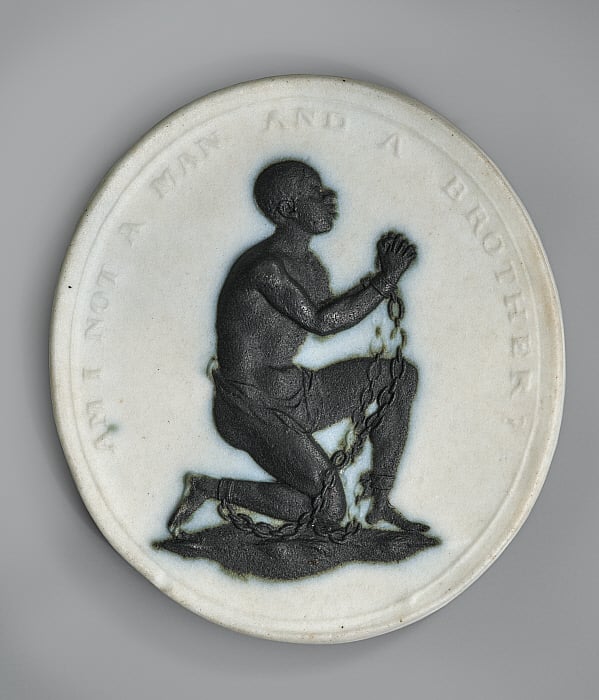
Clarkson and Sharp, along with Josiah Wedgwood (also absent from the film), were among the founding members of the Society for the Abolition of the Slave Trade in 1787. Wedgwood's medallion "Am I Not a Man and a Brother?" was created for the members of the Society.

Am I not A Man And A Brother medallion by Josiah Wedgwood

"Am I Not A Man And A Brother?" Jasperware medallion produced for the Society for Effecting the Abolition of the Slave Trade, designed by Josiah Wedgwood, c. 1787–1790, originally modelled by William Hackwood. Dimensions: 1.13" wide by 1.25" high. Image source: Clark Art Institute, 2021.11.1

Equiano's 1789 autobiography went through nine editions over the five years following its first publication. He embarked on speaking tours, and was also a founder of the Sons of Africa, an abolitionist organization of formerly enslaved men that also included Ottobah Cugoano. As you may have guessed, neither the Sons of Africa nor Cugoano is mentioned in the movie.

Frontispiece and title page of The Interesting Narrative of the Life of Olaudah Equiano, or Gustavus Vassa, the African, Written by Himself, Vol. I (London, 1789). Image source: Internet Archive

And Cowper's poem The Negro's Complaint (1788) was reprinted for decades. The following illustration is from an 1826 edition:


Image source: Internet Archive

The poem reads in part,

Forc'd from home and all its pleasures,
Afric's coast I left forlorn;
To increase a stranger's treasures,
O'er the raging billows borne;

Men from England bought and sold me,
Paid my price in paltry gold;
But though slave they have enroll'd me
Minds are never to be sold.

Still in thought as free as ever,
What are England's rights, I ask,
Me from my delights to sever,
Me to torture, me to task?

Also missing from Amazing Grace is Chief Justice Lord Mansfield.

William Murray, first Earl of Mansfield, in his robes as Lord Chief Justice, by John Singleton Copley, 1783

Portrait of William Murray, 1st Earl of Mansfield, in his official robes as Lord Chief Justice (detail), by John Singleton Copley, 1783. Image source: National Portrait Gallery NPG 172 

Mansfield's opinions in the Somerset and Zong Massacre cases were celebrated among abolitionists. He and his wife also raised their mixed-race niece, Dido Elizabeth Belle, on equivalent terms with her white cousin Elizabeth Murray.

Dido Elizabeth Belle and Lady Elizabeth Murray by David Martin, 1776

Dido Elizabeth Belle and Elizabeth Murray (detail), by David Martin, c. 1776. Image source: Kenwood House

More than four decades later Mansfield was still so well-known that a novel set on the English estate of a slave-owner referenced him in its title: Mansfield Park.

All this is not to diminish Wilberforce's crucial role in the abolition of the British slave trade. He was a remarkable man who advocated for the end of the inhumane shipment of kidnapped Africans, as property, to the plantations of the New World, a stance shared by a distinct minority of those who held political power at the time. But Wilberforce did not almost single-handedly bring about the abolition of the slave trade. Far more attention should have been paid to the social movements that shaped and supported him.

Beyond this distortion, though, Knight's screenplay depicts incidents that either did not happen as shown, or could not have happened at all. Early in the film we see a 1782 debate in the House of Commons about the continuing war against American independence. In that debate Wilberforce, opposing the continuation of the war, engages with the Duke of Clarence (the future King William IV) and Lord Tarleton, a former military commander wounded in that war. Afterwards, during a card game between Wilberforce and the Duke at a gentleman's club, the Duke attempts to wager ownership of his black coachman (and the script has him use the n-word).

Screenshot of Toby Jones as the Duke of Clarence in 1782

Toby Jones as the (future) Duke of Clarence in 1782.

However, the Duke of Clarence and Wilberforce could not have debated in the House of Commons in 1782, or ever, because the Duke sat in the House of Lords, which he didn't join until he received his dukedom in 1789 or 1790. Another small detail: in 1782 then-Prince William, the future Duke of Clarence, was only 17; Toby Jones, the actor who plays him, was 40 at the time of filming.

Prince William, later Duke of Clarence, future King William IV (detail), by Thomas Gainsborough, 1782. Image source: Royal Collection Trust RCIN 401010

Finally, Prince William could not have wagered ownership of his black coachman in a card game, because he did not have an enslaved coachman: Lord Mansfield's decision in the 1772 Somerset case was widely interpreted as banning slavery in England. As Cowper wrote in The Timepiece, Book II of The Task (1785):

Slaves cannot breathe in England; if their lungs
Receive our air, that moment they are free,
They touch our country and their shackles fall.

But perhaps the most ironic error in the film occurs in the scene where Wilberforce sings the hymn "Amazing Grace," which, of course, gives the film its title. The words were written by the former slaveship captain John Newton, a friend and collaborator of the missing Cowper. But the familiar tune Wilberforce sings was not associated with Newton's words until several years after Wilberforce's death; the hymn had been sung to perhaps 20 different tunes during his lifetime.

Printed text of the words to Amazing Grace by John Newton

"Amazing Grace," I. Chronicles. XLI. Faith's review and expectation. Chap. xvii. 16. 17. From Olney Hymns by the Rev. John Newton (New York, 1808), p. 38. Image source: Internet Archive
The movie is also extremely partial in its portrayal of Wilberforce, who was a rich landowner who used his position to oppose political reform and increase his own wealth. In 1815 he supported the passage of the Corn Laws, which imposed minimum prices and import tariffs on grains; higher prices on agricultural commodities benefited owners of farmland and harmed wage-laborers. As a direct result of the Corn Laws the price of staple foods such as bread and oats rose significantly and hunger became widespread. (The legislation would not be overturned until 1846, the second year of a devastating famine in Ireland.)

In 1819 workers held a mass rally in Manchester's St. Peter's Field calling for universal manhood suffrage. Their ultimate aim was to ensure that their voices would be represented in Parliament and the Corn Laws repealed. The unarmed crowd was attacked by cavalry regiments that hacked at them with swords and trampled them with their horses. More than a dozen people, including women and a two-year-old child, were killed. The event came to be known as Peterloo, a reference to the mass slaughter on the fields of Waterloo.

1819 print of the Peterloo Massacre by Richard Carlile

Peterloo Massacre, Manchester, print published by Richard Carlile, 1819. Image credit: Manchester Libraries. Image source: Wikimedia Commons

In the aftermath of the Peterloo Massacre, Wilberforce supported the repressive Six Acts that restricted or suspended civil liberties. Wilberforce may have been a passionate advocate for the end of the trade in slaves, but once the formerly enslaved joined the ranks of wage-laborers they would be free to starve along with their fellow workers.

In 1833, on his deathbed, Wilberforce was informed that a bill to abolish slavery in Britain and its colonies was sure to pass in Parliament. "Thank God," he is reported to have said, "that I should have lived to witness a day in which England is willing to give twenty millions sterling for the abolition of alavery." It should be noted, though, that the £20 million he referred to was not given as reparations to emancipated slaves descended from generations of men, women and children who had been kidnapped or born into bondage, and whose grueling labor had been compelled by force for the benefit of their masters. Instead, it was given to slave owners as compensation for the loss of their property. Also, abolition did not take full effect until 1840; even then, exceptions were made for India, Ceylon, and the island of Saint Helena off the west coast of Africa.

These moral compromises may have been thought to be politically necessary for passage of the Slavery Abolition Act. However, as historian Eric Williams has argued, slavery and the plantation economy it supported were becoming less profitable by the decade. It's hard not to see this action as self-dealing by those who held power and derived much of their wealth, directly or indirectly, from slavery.

Amazing Grace ignores such contradictions and offers in their place a simplified view of Wilberforce's character and actions. Perhaps only someone such as Ken Loach or Mike Leigh (writer and director of Peterloo (2018)) could do greater justice to the complexity of the movement for abolition and the failings, inconsistencies, and conflicts, as well as the courage and rectitude, of those who ultimately brought an end to British slavery.

Wednesday, June 18, 2025

"Twenty times the use a man is": Two Chronicles of Carlingford

Cover of The Rector and The Doctor's Family by Margaret Oliphant

Can there be too much of a good thing? I was once among those who approached the extremely prolific writers of the nineteenth century with skepticism and condescension. Given their astonishing productivity, how could authors such as Anthony Trollope (47 novels), Ellen Wood (51 novels), or George Sand (70 novels) be any good?

But more prolific than any of them was Margaret Oliphant, who published 98 novels before her death in 1897 at age 69. In an earlier post on her novel Miss Marjoribanks I discussed Oliphant's lifelong need to write in order to escape her deceased husband's debts and provide for two brothers (one an alcoholic, one a widowed business failure), two nieces, a nephew, and her two adult sons. None of her male dependents could bestir themselves to find gainful employment; they all lived off her earnings from publication, and all predeceased her.

The contrast between capable women and weak, ineffectual, vacillating, indolent, selfish, or just plain helpless men is a recurring theme in Oliphant's fiction. As Nettie Underwood says in The Doctor's Family, "a woman is, of course, twenty times the use a man is, in most things" (p. 170).

Oliphant was hugely popular in her day; in the 1860s she outsold Dickens, Thackeray and Trollope. But almost immediately after her death she fell into obscurity and her books went out of print. It wasn't until the late 1960s that her work found a champion in the critic Q.D. Leavis, and over the next two decades some of her books were reissued.

The Oliphant novels that are most often reprinted are the Chronicles of Carlingford series, possibly inspired by Trollope's Chronicles of Barsetshire and Elizabeth Gaskell's Cranford novels and stories. By common consensus Miss Marjoribanks (pronounced "Marchbanks," 1866) is the best of her novels, and both it and Phoebe, Junior (1876), the final two books in the Carlingford series, made my Favorites of 2020: Books list.

Margaret Oliphant around 1860

Margaret Oliphant, ca. 1860. From The Bookman. Image source: Reveries Under the Sign of Austen, Two

Oliphant is still little known and undervalued, however: apparently deemed unsellable, a copy of the 1986 Virago Classics edition of The Rector and The Doctor's Family (1861), the second entry in the Carlingford series, recently showed up on the free cart at my local library book sale, and so found its way onto my shelves.  [1]

The Rector and The Doctor's Family brings together two works in which a character must take on a heavy and unanticipated duty. The title character of the 35-page The Rector is the new Rector of Carlingford, Morley Proctor, who is suddenly called to the deathbed of one of his parishioners. But Proctor is a socially awkward bachelor scholar of ancient Greek who has taken his new post primarily to provide his widowed mother with a comfortable home; he has no idea how to provide spiritual ease to a dying person.

The sufferer lay breathing heavily in the poor apartment. She did not look very ill to Mr Proctor's inexperienced eyes. Her colour was bright, and her face full of eagerness. Near the door stood Miss Wodehouse, looking compassionate but helpless, casting wistful glances at the bed, but standing back in a corner as confused and embarrassed as the Rector himself. [Miss Wodehouse's sister] Lucy was standing by the pillow of the sick woman with a watchful readiness visible to the most unskilled eye—ready to raise her, to change her position, to attend to her wants almost before they were expressed. . .The poor Rector, taking the seat which the little maid placed for him directly in the centre of the room, looked at the nurse and the patient with a gasp of perplexity and embarrassment. A deathbed, alas! was an unknown region to him.

"Oh, sir, I'm obliged to you for coming—oh, sir, I'm grateful to you," cried the poor woman in the bed. "I've been ill, off and on, for years, but never took thought to it as I ought. I've put off and put off, waiting for a better time—and now, God help me, it's perhaps too late. Oh, sir, tell me, when a person's ill and dying, is it too late?"

Before the Rector could even imagine what he could answer, the sick woman took up the broken thread of her own words, and continued—

"I don't feel to trust as I ought to—I don't feel no confidence," she said, in anxious confession. "Oh, sir, do you think it matters if one feels it?—don't you think things might be right all the same though we were uneasy in our minds? My thinking can't change it one way or another. Ask the good gentleman to speak to me, Miss Lucy, dear—he'll mind what you say."

A look from Lucy quickened the Rector's speech, but increased his embarrassments. "It—it isn't her doctor she has no confidence in?" he said, eagerly.

The poor woman gave a little cry. "The doctor—the doctor! what can he do to a poor dying creature? Oh, Lord bless you, it's none of them things I'm thinking of; it's my soul—my soul!"

"But my poor good woman," said Mr Proctor, "though it is very good and praiseworthy of you to be anxious about your soul, let us hope that there is no such—no such haste as you seem to suppose."

The patient opened her eyes wide, and stared, with the anxious look of disease, in his face.

"I mean," said the good man, faltering under that gaze, "that I see no reason for your making yourself so very anxious. Let us hope it is not so bad as that. You are very ill, but not so ill—I suppose."

Here the Rector was interrupted by a groan from the patient, and by a troubled, disapproving, disappointed look from Lucy Wodehouse. This brought him to a sudden standstill. He gazed for a moment helplessly at the poor woman in the bed. If he had known anything in the world which would have given her consolation, he was ready to have made any exertion for it; but he knew nothing to say—no medicine for a mind diseased was in his repositories. He was deeply distressed to see the disappointment which followed his words, but his distress only made him more silent, more helpless, more inefficient than before.

After an interval which was disturbed only by the groans of the patient and the uneasy fidgeting of good Miss Wodehouse in her corner, the Rector again broke silence. The sick woman had turned to the wall, and closed her eyes in dismay and disappointment—evidently she had ceased to expect anything from him.

"If there is anything I can do," said poor Mr Proctor, "I am afraid I have spoken hastily. I meant to try to calm her mind a little; if I can be of any use?"

". . .If you'd tell me—if you'd say a prayer—ah, Miss Lucy, it's coming on again."

In a moment Lucy had raised the poor creature in her arms, and in default of the pillows which were not at hand, had risen herself into their place, and supported the gasping woman against her own breast. It was a paroxysm dreadful to behold, in which every labouring breath seemed the last. The Rector sat like one struck dumb, looking on at that mortal struggle. Miss Wodehouse approached nervously from behind, and went up to the bedside, faltering forth questions as to what she could do. Lucy only waved her hand, as her own light figure swayed and changed, always seeking the easiest attitude for the sufferer. As the elder sister drew back, the Rector and she glanced at each other with wistful mutual looks of sympathy. Both were equally well-disposed, equally helpless and embarrassed. How to be of any use in that dreadful agony of nature was denied to both. They stood looking on, awed and self-reproaching. (pp. 22–24)

After his abject failure at this moment of crisis the Rector is confronted with unwelcome self-knowledge and faced with a life-altering choice.

The young doctor whose services are irrelevant to the dying woman's needs in "The Rector" is the focus of the novella The Doctor's Family. Edward Rider is struggling to establish a medical practice in Carlingford when his precarious situation is made catastrophically worse by the arrival in town of his ne'er-do-well brother Fred. [2]

Soon afterwards Fred's long-suffering wife Susan and Susan's younger but more active and competent sister Nettie show up on the doctor's doorstep, having followed Fred from Australia. This meeting marks the moment that Dr. Rider first learns that Fred has a family.

"Be seated, please," said the doctor, with dreadful civility, "and compose yourselves. Fred is well enough; as well as he ever is. I don't know," added poor Rider, with irrestrainable bitterness, "whether he is quite presentable to ladies; but I presume, madam, if you're his wife, you're acquainted with his habits. Excuse me for being quite unprepared for such a visit. I have not much leisure for anything out of my profession. I can scarcely spare these minutes, that is the truth; but if you will favour me with a few particulars, I will have the news conveyed to my brother. I—I beg your pardon. When a man finds he has new relations he never dreamed of, it naturally embarrasses him at the moment. May I ask if you ladies have come from Australia alone?"

"Oh, not alone; the children are at the hotel. Nettie said it was no use coming unless we all came," said his new sister-in-law, with a half-sob.

"The children!" Dr Rider's gasp of dismay was silent, and made no sound. He stood staring blankly at those wonderful invaders of his bachelor house, marvelling what was to be done with them in the first place. Was he to bring Fred down all slovenly and half-awakened? was he to leave them in possession of his private sanctuary? The precious morning moments were passing while he pondered, and his little groom fidgeted outside with a message for the doctor. While he stood irresolute, the indefatigable Nettie once more darted forward.

"Give me Fred's address, please," said this managing woman. "I'll see him, and prepare him for meeting Susan. He can say what he pleases to me; I don't mind it in the very least; but Susan of course must be taken care of. Now, look here, Dr Edward; Susan is your sister-in-law, and I am her sister. We don't want to occupy your time. I can manage everything; but it is quite necessary in the first place that you should confide in me."

"Confide!" cried the bewildered man. "Fred is not under my authority. He is here in my house much against my will. He is in bed, and not fit to be awakened; and I am obliged to tell you simply, ladies," said the unfortunate doctor, "that my house has no accommodation for a family. If you will go back to the hotel where you left the children"—and here the speaker gave another gasp of horror—"I'll have him roused and sent to you. It is the only thing I can do."

"Susan can go," said the prompt Nettie; "I'll stay here until Fred is ready, and take him to see them. It is necessary he should be prepared, you know. Don't talk nonsense, Susan—I shall stay here, and Dr Rider, of course, will call a cab for you."

"But Nettie, Nettie dear, it isn't proper. I can't leave you all by yourself in a strange house," remonstrated her sister.

"Don't talk such stuff; I am perfectly well able to take care of myself; I am not a London young lady," said the courageous Nettie. "It is perfectly unnecessary to say another word to me—I know my duty—I shall stay here."

With which speech she seated herself resolutely in that same easy-chair which Fred had lolled in last night. . .She sat there looking with her bright eyes into the vacant air before her, in a pretty attitude of determination and readiness, beating her little foot on the carpet. . .He could not tell in the world what to say to her. To order that creature out of his house was simply impossible; to remain there was equally so; to leave them in possession of the field—what could the unfortunate young doctor do? One thing was certain, the impatient patient could no longer be neglected; and after a few minutes longer of bewildered uncertainty, Dr Rider went off in the wildest confusion of mind, leaving his brother's unknown family triumphant in his invaded house. (pp. 50–52)

Of course, the doctor does not yet realize that he is utterly smitten by Nettie. Once he recognizes his own feelings, though, he is given pause by the prospect of Fred and his family hanging on as his dependents for the rest of their lives, and of Fred's deservedly poor reputation besmirching his own.

Some people are compelled to take the prose concerns of life into full consideration even when they are in love, and Edward Rider was one of these unfortunate individuals. The boldness which puts everything to the touch to gain or lose was not in this young man. He had been put to hard encounters enough in his day, and had learned to trust little to chance or good fortune. He did not possess the boldness which disarms an adverse fate, nor that confidence in his own powers which smooths down wounded pride, and accounts even for failure. He was, perhaps it is only right to say, not very capable of heroism: but he was capable of seeing the lack of the heroic in his own composition, and of feeling bitterly his own self-reproaches, and the remarks of the world, which is always so ready to taunt the very cowardice it creates. . .Dr Rider, eager as love and youth could make him, was yet incapable of shutting his eyes to the precipice at his feet. That he despised himself for doing so, did not make the matter easier. These were the limits of his nature, and beyond them he could not pass. (p. 97)

But even if Dr. Rider is able to overcome his concerns about his brother and his family, will Nettie's overwhelming sense of duty to her sister's children and their mother allow her to acknowledge and return Dr. Rider's feelings?

Nettie did not know why the wind went so chill to her heart after she had taken off her shawl. She did not see the unequal sod under her feet as she went back upon that dread and solemn road. Nothing in the world but what she had to do occupied the throbbing heroic heart. There was nobody else to do it. How could the girl help but execute the work put into her hand?. . .Nettie did not think over these particulars with self-pity, or wonder over her hard lot. She did not imagine herself to have chosen this lot at all. There was nobody else to do it—that was the simple secret of her strength. (pp. 114, 118)

The stories brought together in The Rector and The Doctor's Family span nearly the full range of tone that Oliphant commands in the Chronicles of Carlingford, from the appalling horror of death to the familiar comedy of acute social discomfiture. As I wrote of Oliphant's fiction in the post on Miss Marjoribanks, "as long as there are readers who appreciate wicked irony, keen wit, emotional complexity, and independent, self-directed women, [it] will be (re)discovered, and treasured." The Chronicles of Carlingford are available as ebooks through Project Gutenberg, the Internet Archive, and HathiTrust.

Margaret Oliphant in 1881

Margaret Oliphant by Frederick Sandys, 1881. Image source: National Portrait Gallery, London


  1. The Chronicles of Carlingford series includes the story "The Executor," (1861) and the volumes The Rector and The Doctor's Family (1861), Salem Chapel (1863), The Perpetual Curate (1864), Miss Marjoribanks (1866), and Phoebe, Junior (1876)
  2. The established physician in Carlingford, who treats all the well-to-do patients in Grange Lane, is Dr. Marjoribanks. The old doctor is nearing retirement, and Dr. Rider has considered proposing marriage to his only daughter Lucilla as a means of ensuring that he will inherit the practice.