Monday, October 19, 2015

The Lubitsch Touch

Ernst Lubitsch

In the late 1930s and early 1940s, Ernst Lubitsch directed comedies that should be familiar to every lover of classic Hollywood. Among them are Ninotchka (1939), in which Soviet commissar Greta Garbo is seduced by decadent Paris and suave Melvyn Douglas; The Shop Around the Corner (1940), in which James Stewart and Margaret Sullavan fall in love with one another as anonymous pen pals, although neither realizes that their correspondent is actually an annoying co-worker; and To Be Or Not To Be (1942), Carole Lombard's final film, in which she plays an actress in Nazi-occupied Poland who uses her thespian skills to foil the Gestapo.

But a decade before he created "that late series of masterworks...which stands as one of the enduring glories of the American cinema," [1] Lubitsch had directed a series of films that brought to American movies the lighthearted but sophisticated sensibility of operetta—the famed "Lubitsch Touch." As LA Times critic Michael Wilmington once described Lubitsch's films, they are "at once elegant and ribald, sophisticated and earthy, urbane and bemused, frivolous yet profound." [2] What follows is a brief survey from our recent viewing of some of Lubitsch's early sound films.

The comedies

Trouble in Paradise
 
Trouble in Paradise (1932; written by Lubitsch and Samson Raphaelson, based on a play by Aladár László): When people speak of the "Lubitsch Touch," this is the kind of film they have in mind. Herbert Marshall and Miriam Hopkins portray expert thieves masquerading as aristocrats, who find each other's duplicity romantically and professionally irresistible. Kay Francis plays a French parfumier who is their intended next victim, until Marshall discovers that she's already being robbed...by her accountant. His chivalrous feelings soon begin to develop into something more; can he steal from a woman he loves? Charles Ruggles and Edward Everett Horton provide their usually brilliant comic support. Lubitsch himself later wrote that "As for pure style, I think I have done nothing better or as good as Trouble in Paradise" [3]. It's tempting to agree with him; this is one of the greatest classic Hollywood comedies.

Design for Living

Design for Living (1933; written by Ben Hecht, based—very loosely—on the play by Noël Coward) revisits the love triangle at the heart of Trouble in Paradise, but reverses the genders. In bohemian Paris Miriam Hopkins plays the muse to painter Gary Cooper and playwright Frederic March. Edward Everett Horton is the hopelessly bourgeois husband Hopkins ultimately abandons for art and love; the film's ending, with its suggestion of an adulterous ménage à trois, was scandalous. I find that this film doesn't quite match the effervescence of Trouble in Paradise, mainly because of its earthbound male leads, but it's still very much worth seeing. Don't expect to hear much of Coward's dialogue, though.

The musicals

 
The Love Parade (1929; written by Guy Bolton and Ernest Vajda, based on the play Le Prince Consort by Jules Chancel and Leon Xanrof) is a film of many firsts: it was the first sound film directed by Lubitsch, and it was the first film musical to integrate the songs into the narrative rather than staging them as separate numbers. It was also the first movie role of a moderately successful Broadway actress named Jeanette MacDonald. Her co-star was a French music-hall performer who had appeared in one other Hollywood musical, Maurice Chevalier.

You may feel, as I did, that the names Jeanette MacDonald and Maurice Chevalier in a movie's credits are not enticements to viewing. I thought of her as the increasingly implausible ingénue of a series of often-parodied musicals with the bland Nelson Eddy in the late 30s and early 40s. And I knew Chevalier mainly from his creepy performance as an aged roué in Gigi (1958), and from a sequence in Marcel Ophuls' The Sorrow and the Pity (1969) in which, accused of collaboration during WWII, he shifts uncomfortably in front of the camera as he makes an unconvincing denial.

But in the Lubitsch musicals, I encountered something quite different from my preconceptions of both of these performers. In contrast to her image in many of her later films, MacDonald is often photographed by Lubitsch wearing sheer negligées or clinging Travis Banton gowns. She sings in a high soprano with a tight vibrato—not a particularly sensuous sound, at least to my ears—but the lyrics and settings can be quite suggestive.

In MacDonald's first appearance in The Love Parade, she's reluctantly awakened from a "wonderful, gorgeous" dream, caresses herself, sighs, and hugs her pillow (not the only time pillows will be human surrogates in a Lubitsch film). Dressed only in a filmy negligée, she then sings of her "Dream Lover" (music by Victor Schertzinger, lyrics by Clifford Grey).

MacDonald is Queen Louise of Sylvania, whose courtiers are anxious to get her married. Chevalier is Count Renard, a womanizing attaché to Sylvania's Parisian embassy, who is recalled after a scandal involving the ambassador's wife. The Queen is intrigued rather than angered by the Count's reputation, though, and soon develops romantic feelings for him.

These films were made before Chevalier's Gallic charm curdled into Gallic smarm. He and MacDonald have excellent comic and romantic chemistry, as shown in "Anything to Please the Queen":


Louise and Renard marry, but he quickly discovers that as the Queen's consort he has no real power or function. Chafing at his subordinate role, he threatens to leave her unless he is treated like a king, and the couple and the kingdom are thrown into crisis.

The Count's demand to make the decisions for the powerful and independent Queen Louise is the most dated thing about The Love Parade, but in other ways it can seem remarkably modern. The conventional view of early sound films is that they were severely constrained by the limits of the new technology: cameras were placed in soundproof boxes, and due to the fixed microphones actors had to remain in place while speaking. Although The Love Parade doesn't always avoid a certain staginess, the camera zooms and pans a good deal, and there's a Busby Berkeley-like "March of the Grenadiers" number.

And it has to be said that the film's sexual mores aren't entirely prehistoric. When Louise first meets Renard, he offers to remain by her side "from morning to night"; after their reconciliation, he makes the offer again, but she suggests that instead he should stay with her "from night to morning." The frank acknowledgement of her desire and the lack of sexual hypocrisy are characteristic of Lubitsch's Pre-Code films.

With its intimacy, quick pace, racy dialogue and narratively-integrated songs, the film was unlike any other musical of the era. And audiences responded: it was a huge hit, rescued Paramount Studios' financial fortunes, and made both MacDonald and Chevalier into major stars.


Monte Carlo (1930; written by Ernest Vajda, based on plays by Hans Müller-Einigen and Evelyn Greenleaf Sutherland and a story by Booth Tarkington) was Lubitsch's follow-up to The Love Parade. Countess Helene (MacDonald) is a runaway bride fleeing her wedding to the priggish Duke Otto (Claud Allister) for the third time. She takes an express train to Monte Carlo, where in a bid to become financially independent she gambles recklessly and loses everything. In the casino she's spotted by Count Rudolph (Jack Buchanan), who is intrigued by this mysterious and daring beauty.

Rudolph later encounters a man who tells him that he's seen the Countess in the morning, dressed only in her negligée, hair tousled…Rudolph is crestfallen and jealous until he finds out that the man he's speaking with is the Countess's hairdresser. Rudolph then bribes him to become his replacement, "Rudy," in order to insinuate himself into Helene's life and heart.

The plan works, and the Countess is falling in love with Rudy, until her maid (Zasu Pitts) reminds her of the incompatibility of their social stations. Helene rejects the man she thinks is a humble hairdresser just as Duke Otto shows up to retrieve her. Financially desperate, she's on the verge of once again agreeing to marry Otto when she attends an opera whose plot exactly parallels her situation. The opera ends unhappily, with the central couple separated forever, and the Countess begins to reconsider her rejection of Rudolph...

Alas, the seemingly effortless "Lubitsch Touch" required just the right combination of ingredients to succeed, and in Monte Carlo the recipe is off. Fatally for the movie's charm, it features Buchanan as the romantic hero rather than Chevalier. (If Buchanan looks and sounds vaguely familiar, he was later to play director Jeffrey Cordova in the Fred Astaire-Cyd Charisse musical The Band Wagon (1947)). Buchanan's leering smile lacks warmth, and he's not nearly as dashing a figure as Chevalier. And although Richard Whiting and W. Franke Harling's music was a hit at the time, I found it to be forgettable, with Leo Robin's lyrics often straining too hard to be clever. It doesn't help that the disjunction between the fantasy world of the super-rich in the film and the looming reality of the Great Depression is so glaring. Better things were to come.


The Smiling Lieutenant (1931; written by Samson Raphaelson and Ernest Vajda, based on the operetta Ein Walzertraum by Oscar Straus, Leopold Jacobson and Felix Dörmann): After his experience with the uncharismatic Buchanan, Lubitsch must have realized that Chevalier was a much better leading man. His next film features Chevalier as the dashing Lieutenant Niki von Preyn, whose smile and wink at his girlfriend Franzi (Claudette Colbert), the leader of an all-girl cabaret orchestra, is intercepted by the sheltered Anna, Princess of Flausenthurm (Miriam Hopkins). Anna soon convinces herself that she is in love, and decides that she wants to marry the unwitting Niki—and what Anna wants, her father the king arranges. Niki wakes up one morning to discover that he's now Anna's prince consort.

But he refuses to have anything to do with her, and continues to have assignations with Franzi. Anna, hurt and frustrated, has Franzi brought to the palace so that she can confront her. Really, though, she wants to see this alluring Other Woman and learn the secret of attracting Niki's attentions. In a burst of sisterly sympathy for the unhappy Anna, Franzi gives the frumpy princess the answer in "Jazz up your lingerie" (music by Oscar Straus with lyrics by Clifford Grey):


The Smiling Lieutenant is soufflé-light, and wouldn't succeed if it weren't for its delightful cast. Hopkins went on to star in Lubitsch's Trouble in Paradise and Design for Living; Colbert would work with Lubitsch again, along with Design for Living's Gary Cooper, in Bluebeard's Eighth Wife (1938); and Chevalier went on to reunite with Jeanette MacDonald in Lubitsch's next musical project, One Hour With You.


One Hour With You (1932; written by Samson Raphaelson, based on the play Only a Dream by Lothar Schmidt) was a musical remake of Lubitsch's silent film The Marriage Circle (1924). Chevalier is a Parisian doctor, Andre, and MacDonald is his wife Colette. Their marriage is happy until Colette's married friend Mitzi (Genevieve Tobin) makes a play for Andre, who, despite his passionate love for Colette, is sorely tempted:


The music is by Oscar Straus, with lyrics by Leo Robin; by the way, the spyglass effect isn't Lubitsch's, but was unfortunately superimposed on this clip by the folks who uploaded it.

When Andre seems to find Mitzi's charms irresistible, the couple's predatory friend Adolph (Charles Ruggles) decides that he will offer to console the unhappy Colette. In her hurt and anger she seems willing to entertain his suggestion...but has Andre actually been unfaithful after all?

One Hour With You plays up its own theatricality, as characters directly address the camera and sometimes speak, as well as sing, in rhyme. I think it's the best of Lubitsch's Pre-Code musicals, in part because there are real emotional dilemmas at its heart. Although it was later nominated for an Academy Award for Best Picture, it was not a huge financial success, and Lubitsch decided to return to the spectacle (and the unreality) of the world of operetta for his next film.


The Merry Widow (1934; written by Ernest Vajda and Samson Raphaelson, based on the operetta by Franz Lehár, Victor Leon and Leo Stein): If The Love Parade was a film of firsts, The Merry Widow was a film of lasts: it was Lubitsch's final film with MacDonald and with Chevalier, and it was his final musical for almost a decade and a half (he died of a heart attack after 8 days of shooting on That Lady in Ermine (1948)).  It also represented the end of an era in which sexually suggestive dialogue and situations could easily make it past the censors: several minutes of cuts were demanded by Joseph Breen's new Production Code Administration before the film was approved for release.

The merry widow of the title is Sonia (MacDonald), who owns 52% of the kingdom of Marshovia (which bears a certain resemblance to Sylvania and Flausenthurm). When, after her year of mourning is over, Sonia leaves for Paris, King Achmed (George Barbier) becomes concerned that control of the Marshovian economy may fall into foreign hands. He decides to send a loyal subject to woo and marry her, and when the king finds the notorious ladies' man Count Danilo (Chevalier) in the boudoir of the Queen (Una Merkel), his choice is obvious. He dispatches Danilo to Paris to carry out his mission under the watchful eye of Ambassador Popoff (Edward Everett Horton).

After Danilo and Sonia meet and flirt at Maxim's, she discovers the marriage plot, and will have nothing more to do with Danilo; meanwhile, Danilo has truly fallen in love with Sonia, and is put on trial in Marshovia for refusing to go through with the scheme.


The music is by Lehár, adapted by Richard Rodgers with English lyrics by Lorenz Hart.

Of course, we know how everything will turn out in the end, but the plot is mainly an excuse for the lavish  (and Oscar-winning) sets by Cedric Gibbons and Fredric Hope, a spectacular Maxim's can-can number, gowns by Adrian, a seemingly infinite number of couples dancing to the famous Merry Widow waltz, and the still-effective MacDonald-Chevalier chemistry.

But it wasn't enough. With the advent of Busby Berkeley musicals like 42nd Street (1932) and Gold Diggers of 1933, and with the dawning of the Fred Astaire-Ginger Rogers partnership, movie musicals had gotten jazzier. Perhaps the operetta-based musicals favored by Lubitsch had begun to seem old-fashioned. In any case, The Merry Widow was not a financial success. For the next several years Lubitsch would take a step back from directing to focus on producing. When he returned to directing, he created the great comedies mentioned in the first paragraph of this post, but he would never complete another musical.

Trouble in Paradise and Design for Living are available from the Criterion Collection, as are the four Pre-Code Lubitsch musicals (The Love Parade, Monte Carlo, The Smiling Lieutenant, and One Hour WIth You) in an Eclipse Series box set. The Merry Widow is available in a restored version from Warner Archives/TCM.

--------

1. Dave Kehr, "The Lubitsch Touch, in Song: Warner Archive Restores ‘The Merry Widow’," New York Times, June 20, 2013: http://www.nytimes.com/2013/06/23/movies/warner-archive-restores-the-merry-widow.html

2. Michael Wilmington, "LACMA Marks Lubitsch Centenary," Los Angeles Times, May 29, 1992:
http://articles.latimes.com/1992-05-29/entertainment/ca-78_1_ernst-lubitsch

3. As quoted in Herbert Weinberg, The Lubitsch Touch: A Critical Study. New York: Dutton, 1968, p. 286.

Sunday, October 4, 2015

Misbehaving: Richard Thaler and behavioral economics


Richard Thaler was one of the inadvertent founders of the field of behavioral economics. I say "inadvertent" because it wasn't clear to Thaler or his colleagues exactly what he was doing when he started looking into what he called "The List": discrepancies he'd noted between the predictions of economic theory and the choices people actually make. Those discrepancies profoundly violated the principles of traditional economics—and, crucially, did so in ways that weren't attributable to random error.

Here's an example: Thaler gave half of the students in one of his Cornell classes a university coffee mug. The students with a mug were then asked to write down the minimum price at which they would sell it, and the students without a mug the maximum price at which they would buy one; sellers were then matched with buyers. According to classical economic theory, if the mugs were distributed randomly about half the students with a mug should value them less than students without one, and so roughly half the mugs should change hands.

That's not what happened—repeatedly. What Thaler found is that students with a mug—chosen randomly each time—generally valued it significantly more than students without one. On average only about 5% of the mugs changed hands, as opposed to the predicted 50%. That's a difference of an order of magnitude.

You may be thinking, "Who cares about a coffee mug?" But that's precisely the point: no one cares much, unless they already possess one. Simply owning a mug, even when they didn't pay for it, even when they had owned it for only a few minutes, made students value it more. This is a violation of a key tenet of rational choice economics, in which preferences (in this case, for owning or not owning a mug) are assumed to be stable.

The coffee mug experiment illustrated some key principles of the then-emerging field of behavioral economics—that is, economics that tries to take our observable behavior into account, instead of treating us like the super-rational, utility-maximizing, optimal-choice-making agents of traditional economic theory. (Thaler calls these theoretical beings "Econs.") The first principle is loss aversion: losses are more painful to us than gains are pleasurable—in fact, Thaler's colleagues Daniel Kahneman and Amos Tversky found that losses give us at least twice as much pain than gains of the same amount give us pleasure. (I've also written a post on Kahneman's fascinating book Thinking, Fast and Slow (Farrar, Straus & Giroux, 2011).)

The second principle is status quo bias: we are resistant to change. We tend to stick with what's familiar or what requires the least effort, even when we recognize that there may be benefits (in the mug experiment, cash) if we're willing to change. Together, these behaviors result in what Thaler calls "the endowment effect": our tendency to value things we own more highly than things we don't—and more highly than things, including cash, that we could exchange them for.

The endowment effect depends on our ignoring what economists call "opportunity costs." As an example, imagine that you're a sports fan who has just been given a free pair of tickets to a key playoff game. You might be able to sell the tickets for $1500, but many fans would choose to go to the game—after all, the tickets were free, weren't they? To an economist, though, there's no difference between using free tickets worth $1500 to go to the game and paying $1500 out of pocket to go to the game, since you could have had that money if you had sold the tickets.

This example also illustrates the effects of framing on our choices. If a friend were to give you as a gift a bottle of wine they'd bought at auction for $150, you'd probably elect to drink it (on a suitably special occasion, of course). However, if you were asked whether you'd be willing to spend $150 out of pocket on a bottle of wine and then drink it, you might very well say no. Again, to a traditional economist there's no difference between the outcomes of the two scenarios—in both, if you choose to drink the wine you'd be a bit tipsier and $150 poorer than you might otherwise have been—and so your choice should remain consistent. It shouldn't matter how the scenario is framed.

That almost no one but an economist thinks this way, though, did not seem to bother economists for about two centuries. Instead, economic models that assumed hyper-rational behavior came to determine much policy and law. But it turns out that many of our actual behaviors are, as an economist would say, sub-optimal. The status quo bias, for example, means that when we are required to opt in to beneficial programs, such as employer-matched 401(k) accounts, too often we don't.

Thaler co-wrote a book with legal scholar Cass Sunstein entitled Nudge: Improving Decisions about Health, Wealth, and Happiness (Yale University Press, 2008), which used the insights of behavioral economics to argue that instead of requiring people to opt in to beneficial programs, we should use the status quo bias for good and instead require them to opt out. Changing the default option can radically change participation rates.

But, of course, there's no reason why the principles of behavioral economics can't be used for other purposes as well, and they are: by political groups, advertisers, and companies trying to shift your choices in ways beneficial to them. Misbehaving is an entertaining way to increase your awareness of how, and how easily, we can be manipulated. And with that knowledge, perhaps, we can try to make our choices—political, social, and economic—more conscious ones.

Update 5 Oct 2015: Thaler has created a Misbehaving website which includes outtakes (passages cut from the final manuscript), resources for learning more, "characters" (colleagues mentioned in the book), and a blog discussing real-world applications of behavioral economics.

Update 9 October 2017: Richard Thaler has been awarded the Nobel Prize in Economics. The New York Times quotes Thaler as saying that he will spend the prize money "as irrationally as possible."

Sunday, September 27, 2015

A byproduct of confusion: Revenge of the Mekons


Rock documentaries tend to follow a highly conventional formula: Gather the remaining/surviving members of the band to recount its history, and a few Important People to testify to the band's significance. Intersperse the interviews with footage and photos of the band's origins and early success; descent into drug and alcohol addiction, mutual recrimination and breakup; and then eventual triumphant reunion/re-emergence (which is often the impetus for the documentary). Edit into a tidy 90 minutes, and you have your movie.

Joe Angio's Revenge of the Mekons (2013) conforms to much of this template, but the film explodes the limitations of its formula because the band that is its subject is anything but conventional. Although the Mekons are about to celebrate their 40th anniversary, they've never tasted mainstream popularity—either they've never aspired to it, or they simply have had no idea how to go about attaining it. As singer Sally Timms says when a clueless radio interviewer asks them to explain their "success," "The stock answer is the lack of it. Success is the thing that usually kills bands in the end. We haven't had any success, so we've had none of the attendant problems."

Of course, "success" depends on how you measure it, but four-figure album sales and the long grind of low-budget touring can also kill bands. The Mekons' good humor and mutual regard, though, seem to have survived their four decades together intact. They never got around to (or perhaps couldn't afford) the standard drug binges and resultant rock band acrimony, and they can't get back together because they've never broken up. As original Mekon Kevin Lycett told Spin magazine in 1986, "We couldn't be bothered." [1]

What they have done is continue to produce new music of consistently high quality. Depending on what you count they've issued something like 20 albums and nearly as many singles and EPs, and they now have a catalogue of well over 200 songs to draw on for their live shows.

Formed in 1977 by a group of leftist art students at Leeds University who hung out with the Gang of Four, the Mekons were initially more of a conceptual art project than a band. (The Mekon is the alien arch-villain of the futuristic Dan Dare comics.) None of the original members could play at more than a rudimentary level, and their sound was deliberately raw. In Angio's film we see Mary Harron (later a director and screenwriter) reading from a review she wrote of the band in 1979: "Although at times the Mekons sound wildly experimental, that's just a byproduct of confusion."


Despite (or perhaps because of) their defiant amateurism, the band was actually signed to Virgin Records and released an album in late 1979. The front cover showed a monkey sitting at a typewriter picking out the Shakespearean title of the album—almost (The Quality Of Mercy Is Not Strnen), while the back cover displayed a band photo of...the Gang of Four. Although the claim that this was an error by the record label is repeated in Angio's film, at the time the Gang of Four were on EMI, not Virgin—it sounds very much like a Mekons prank.

The Mekons were non-conformists even among punks: The Quality of Mercy includes the wistful "After 6," whose verse is a delicate tune that sounds like it could've have come from a less-slick version of Wire's 154 (the two albums were released almost simultaneously that fall). Clearly Virgin didn't really know what to do with them, and after releasing a double single (another Mekons paradox) let them go.

The band weathered the demise of punk rock by radically reinventing itself. When punk as both a social and musical movement began to ebb around the time of Margaret Thatcher's 1983 re-election and the miners' strike of 1984/85, the Mekons responded by incorporating elements of British folk and American country music into their sound. While the movie quotes Rolling Stone as saying that the Mekons invented alt-country, it isn't quite true. They weren't even the first punk band to go country: the Johnny-Rotten-less Sex Pistols had covered rockabilly Eddie Cochran in 1978, and in 1981 the Dils had re-formed themselves as the "cowpunk" Rank and File.

What made the Mekons unique was that they didn't attempt to turn country into punk, nor did they attempt to straightforwardly imitate country. Instead they found at the tail end of punk a kindred sensibility in classic country's pessimism, world-weariness and sense of inevitable loss, and they created a hybrid that drew on elements from both forms.


They incorporated traditional instruments such as the fiddle of Susie Honeyman (the Charlotte Rampling of rock) and the accordion of Rico Bell, but also employed pounding drums and squalling guitar feedback. For a taste, listen to the dueling vocals and guitars of Tom Greenhalgh and Jon Langford on "Hard to be Human" from their 1985 album Fear and Whiskey. (Since 1984 their excellent drummer has been Steve Goulding, formerly of Graham Parker and the Rumour; that's him, too, doing the famous drum part on Elvis Costello's "Watching the Detectives.")

They weren't remiss in paying homage to their influences: Fear and Whiskey includes a cover of Hank Williams' "Lost Highway," the 1985 Crime and Punishment Peel Sessions EP includes Merle Haggard's "(I'm Going Off Of The) Deep End," the 1986 album The Edge of the World includes a version of "Alone and Forsaken" which mashes up Hank Williams' original lyrics with the Velvet Underground's "Black Angel's Death Song," and in 1988 the Mekons and ex-Fall member Marc Riley collaborated on a tribute album to Johnny Cash, 'Til Things Are Brighter.

After four excellent albums in as many years on independent labels, the band had a brief brush with mainstream fame when they were signed by A&M Records in the late 1980s. In the film we see a giddy marketing promo done for A&M record pluggers, and a video for their song "Memphis, Egypt," that would have looked extremely strange on MTV (if it was ever aired). As Honeyman recounts in the movie, during the label's annual Christmas party all the new acts signed that year were announced—but the Mekons were somehow omitted from the list. It was an ominous sign of the amount of effort the label was going to put into promoting the band's new album, Rock 'n' Roll (which some of us still consider their best). As Honeyman says, "We left thinking, 'Back in the van.'"


After A&M unceremoniously dropped them, the band continued (and continued to change). They toured, participated in art installations, collaborated with author Kathy Acker (supplying bawdy sea shanties for performative readings of her 1996 novel Pussy, King of the Pirates), and periodically issued new albums. Angio's film has some remarkable performance footage of the Mekons over the years.

But "The Curse of the Mekons" (the title of their first post-A&M album) has continued to haunt the band to the present day. Their labels haven't adequately promoted their records, and critical raves somehow have never translated into robust album or ticket sales. At the beginning of Angio's film we see the band setting out on tour (loading their own instruments into the van; Langford says only half-jokingly that "We used to have a roadie, but he became too successful to work with us anymore.") In the middle of their set during the first show of the tour a classic Mekons moment occurs when they urge the crowd to come see them at the next night's show in Sheffield—only to learn from their fans that the gig has been cancelled ("There was an e-mail," the nonplussed band members are told).


Perhaps the most compelling sequence follows the writing sessions for their 2011 album Ancient and Modern. From a sentence in Arthur Machen's The Hill of Dreams ("He found himself, as he had hoped, afar and forlorn; he had strayed into outland and occult territory") we see the song "Afar and Forlorn" slowly take shape through the process of writing lyrics, rehearsing music, recording, and live performance. It's a stunning montage that takes perhaps two minutes in the movie, but spans at least a full year of real time. It makes you wonder just how long Angio spent shooting footage for the film; then again, the Mekons seem to inspire obsession in their fans and followers.

("Afar and Forlorn" is far from the only Mekons recording with a literary genesis; apart from the Kathy Acker project, the title of their 2000 album Journey to the End of the Night is taken from Céline's novel, Rock 'n' Roll's "Only Darkness Has The Power" is based on a passage in Paul Auster's The Locked Room, and Fear and Whiskey's "Flitcraft" on a parable told in Dashiell Hammett's The Maltese Falcon. I'm sure there are many others. Perhaps that's why the Mekons can count writers such as Jonathan Franzen, Luc Sante, and Greil Marcus—all of whom appear in the film—among their fans.)

So Revenge of the Mekons transcends its genre in the way that the Mekons themselves transcend theirs: by combining familiar elements in continually surprising ways. Highly recommended.

For more information:
----

1. Michael Kaplan, "Punks on the Lost Highway," Spin, October 1986, p. 12.

Sunday, September 20, 2015

Bollywood: A History

A monsoon-drenched Rekha in Utsav (The Festival, 1984)
The development of Hindi cinema offers an abundance of fascinating material to any writer. Studios such as the Hindustan Film Company, Bombay Talkies and RK Films were built on their founders' visions of possibility, willingness to take risks, tireless labor, and sometimes ruthless business practices. One of the biggest stars of the 1930s was a big-boned blonde woman named Mary Evans who did her own acrobatic fighting and horseback-riding stunts as "Fearless Nadia." Heroes such as Ashok Kumar, Dilip Kumar and Dev Anand came to Bombay without connections or experience, and within a few years became screen idols worshipped by millions. Amitabh Bachchan, a gangly outsider who had once failed a voice test to become an announcer for All-India Radio, was cast as the lead in Zanjeer (Chains, 1973) after four better-known actors turned down the role; his searing performance made him a superstar.

So while the still of Amitabh's frequent co-star Rekha on the cover of Mihir Bose's Bollywood: A History (Tempus, 2006) was certainly arresting, I picked up the book because of its back-cover claim to be "the first comprehensive history of India's film industry." Unfortunately, the hopes raised by that description were dashed almost immediately. Bose's book is superficial, partial, and reads as though an unedited first draft was mistakenly sent to the printer.

An early warning sign was the repetitive writing. At the beginning of the first chapter, we are told the story of a woman at a screening of the Lumière Brothers' film "'Condeliers' Square'" leaping to her feet because it appears that a "hansom cab" is about to burst through the screen (pp. 38-39). Then, on the very next page, we hear about a Lumière showing in which audience members seeing "L'Arrivée d'un gare de la Ciotat…vacated their seats in a hurry" in fear that an arriving train will crash through the screen. Was it the hansom cab, the train, or both?

Repetition is only one problem; the book is also filled with errors, typographical and otherwise. In the stories about the Lumière Brothers, for example, the titles of both films are misstated (the second one nonsensically), and there is no hansom cab in "La Place des Cordeliers" (not "Condeliers"): there is a horse-drawn streetcar and a delivery van, but no hansom cab, as you can see for yourself. Neither story is given a source, so there is no way to judge the credibility of the reported audience reactions. Repetition, errors, and vague sourcing remain issues throughout the book.

Names are frequently misspelled: the Hollywood actors were Walter Matthau and Jack Lemmon, not "Mathau" and "Lemon" (p. 256); the Hollywood producer of Algiers (1938) was Walter Wanger, not "Wagner" (p. 138); Shashi Kapoor's wife Jennifer's actor father was Geoffrey Kendal, and the drama award named after him is the Kendal Cup—neither is spelled "Kendall" (p. 270).

Worse than careless spelling, though, is Bose's carelessness with facts: actor Hrithik Roshan did not appear in Karan Arjun (1995), but instead served as an assistant to his director father Rakesh, so the film can hardly be "notched up" among Hrithik's "blockbusters" (p. 347). The name of Rekha's great 1981 courtesan film is Umrao Jaan, not Umrao Jaan Adda—the latter is the title of Mirza Hadi Ruswa's 1899 novel on which the film was based—and it does not quite tell "the story of a thirty-year-old abducted and sold to a brothel" (p. 235). Bose writes that "Karan Johar's Kuch Kuch Hota Hai was shot largely in Scotland," a claim that is true only of its title song (p. 349).

Writing of playback singing, Bose states,
In the 1930s and 40s, it was the norm for actors and actresses to both sing and act…But within a decade this breed completely vanished, so totally that cinemagoers of today's Bollywood would struggle to believe they ever existed…Bollywood had created a divide between singing and acting which has never been bridged. (pp. 93-94)
That this practice had "completely vanished" by the 1950s would come as a surprise to actor-singers Talat Mahmood and Kishore Kumar. Major contemporary stars Amitabh Bachchan, Shah Rukh Khan, and Aamir Khan have all on occasion done their own playback singing. Further examples abound; while playback singing remains the standard practice, this is hardly "a divide…which has never been bridged." Here is Amitabh singing the Holi song "Rang Barse Bheege Chunarwali" from Silsila (1981):


For a description of the film, including the significance of this scene, please see my post on Silsila.

Bose claims that an early Indian filmmaker, Dundiraj Govind Phalke, was "far ahead of his time" (p. 53) when in the credits of his 1919 film Kaliya Mardan he showed the faces of his actors dissolving into those of their characters in full makeup and costume. However, this practice was widespread in the silent film era: for example, it occurs in Louis Feuillade's Fantômas serial of 1911-1913.

Bose is not a film historian or critic—his background is in sports and business journalism, two fields that are prone to hyperbole—and it shows when he commits errors of overstatement like these. But Bollywood: A History is also filled with non sequiturs and garbled grammar. Here are some examples, chosen pretty much at random:
Page 132: "Like Ashok Kumar, but perhaps even more so, he [Dilip Kumar] taught himself acting…" So Dilip Kumar is even more like Ashok Kumar than…Ashok Kumar?

Page 266: "It may be a coincidence that 1969, the year of Bachchan's debut in films, was also the year Indira Gandhi made her decisive turn in Indian politics, a few months after Bachchan's arrival in Bombay but, nevertheless, it is of some significance." Or not.

Page 299: "Yet, if the Indian media was easily cowed down during the Emergency, one of the most fascinating aspects of that time was that it came just as many things were bubbling away, which was to determine the course of Indian life for the decades ahead." Was it?

Page 344: "If Aamir Khan is the modern-day Raj Kapoor, although very different in many ways, then Shah Rukh Khan, a Muslim born in New Dehli on November 2, 1965, and, like Aamir, married to a Hindu, Gauri Khan." Lucky Gauri!
Of course, occasional misspellings, grammatical awkwardnesses and factual errors are inevitable in any book-length project (this blog certainly has its share), but the sheer frequency of these problems in Bose's book is unacceptably high. And while omissions are perhaps inevitable, missing entirely from Bose's history or receiving only glancing mentions are such major heroines as Helen, Sharmila Tagore, Mumtaz, Sridevi, Mala Sinha, Shyama, Neetu Singh, Madhuri Dixit, Kajol, and Rani Mukerji, among many others. Also, Bose's discussion of dance—a highly significant element of Indian musical films—is very brief and wholly inadequate.

So Bollywood: A History is poorly written, sloppily edited, and narrowly conceived. Surely there's a recent one-volume history of Hindi cinema that's written in a lively style, is well-sourced and credible, and which gives appropriate emphasis to both the men and the women who have created and sustained this film industry. Isn't there?

Sunday, September 13, 2015

Obsession, perversity, and recapitulation: Hitchcock's Vertigo and its sources


Alfred Hitchcock was famous, or perhaps notorious, for making changes to novels and short stories when adapting them into films. Vertigo (1958) is a classic case in point. It was based on the 1954 novel D'Entre les Morts (From among the dead) by Pierre Boileau and Thomas Narcejac. The novel is centered on a detective, Flavières, who is hired to follow Madeleine, the wife of an old friend. Flavières soon falls in love with Madeleine, who believes herself possessed by an ancestor who committed suicide. When Madeleine herself dies, Flavières is bereft; when he meets a woman who reminds him of Madeleine, he begins to obsessively make her over in Madeleine's image in a doomed attempt to recapture the past.

There are many differences between the novel and the film. Hitchcock altered the novel's settings and character names, and added characters and scenes that didn't exist in the book. Perhaps the most radical change was in the timing of the revelation of Madeleine's identity: in the novel, there is a surprise twist at the end, while in Hitchcock's film, that twist is revealed at the beginning of the film's second part. As Hitchcock told François Truffaut, "Everyone around me was against this change; they all felt that the revelation should be saved for the end of the picture…We're back to our usual alternatives: Do we want suspense or surprise?" [1] As ever, he had no hesitation in making substantial changes to the source in order to make it more Hitchcockian.

One of those changes relates to a key scene in both the novel and the film: Madeleine's attempted suicide by drowning. In the novel, Madeline is standing alongside the Seine when she suddenly steps off the quay and plunges into the water. Flavières, who has been following her, leaps in after her and pulls her out. She is conscious:
Her eyes were open, gazing pensively at the sky, as though trying to recognize something.
"You're not dead," Flavières said simply.
Her eyes turned towards him, and her thoughts seemed to come back from some other world.
"I don't know," she said softly. "It doesn't hurt to die." [2]
Flavières carries her into a nearby café. There Madeleine is able to stand, shakily; the proprietress gives each of them some dry clothes to change into, and they return to Flavières's flat. As they enter, the phone is ringing: it's Madeleine's husband, who is concerned about her lengthy absence.

In the film this incident is altered and elaborated in ways that are highly significant. Madeleine (Kim Novak), followed by detective Scotty Ferguson (James Stewart), drives out to Fort Point underneath the Golden Gate Bridge.


Suddenly, she leaps into San Francisco Bay:


Scotty jumps in after her and pulls her out:


He carries her unconscious body to her car, where he tries to revive her without success:


There is a cut. When we next see Scotty, he's in his apartment; Madeleine is in his bed, and her clothes—all of them—are drying on a line.


Madeleine is awakened by the ringing of a phone: it's her husband, calling Scotty to find out where she is. She is shocked, first to discover that she's in a strange bed:


And next, by her realization that she's been completely undressed:


This moment—awkward and embarrassing for both of them—is also the moment when love begins to dawn between Madeleine and Scotty.

I had thought that this scene was simply one more example of Hitchcock improving on his literary sources: it provides a basis for Madeleine and Scotty's subsequent intimacy, while at the same time providing hints of Scotty's obsessiveness and perversity (particularly with regard to his minute attention to women's clothing).

But I think I've discovered that this scene has a cinematic as well as a literary source. Hitchcock seems to have adapted pivotal elements of this scene from another film: Hot Saturday (1932), a pre-Code film directed by William Seiter and starring Nancy Carroll, Randolph Scott, and Cary Grant.

In Hot Saturday, Ruth Brock (Carroll) tries to escape rumors that she's spent the night with rich ladies' man Romer Sheffield (Grant) by fleeing to the campsite of her earnest childhood friend Bill Fadden (Scott). Bill has returned to town after seven years away to do some geological exploration (but he's too shy to declare his real reason: his love for Ruth). A violent storm is raging, and as Ruth tries to reach the cave where Bill is staying, she slips and falls unconscious:


Bill hears a noise, investigates, and carries the unconscious Ruth into the cave:


Bill tries to revive her, without success.


 When Ruth awakes, her clothes—all of them—are drying on a line:


Ruth is at first shocked to discover that she's in Bill's bed:


And next, by her realization that she's been completely undressed:


The parallels between these two scenes seem too close to be coincidence. Although I know of no incontrovertible evidence that Hitchcock was familiar with Hot Saturday—it does not appear in the indexes of any of my small collection of books on Hitchcock—it was one of Cary Grant's first starring roles. Grant went on to star in four of Hitchcock's movies, and occupied a special place among Hitchock's leading men. Donald Spoto, in his biography of Hitchcock, wrote that "Cary Grant...represents what Hitchcock would like to have been." [3] Hitchcock himself, in an after-dinner speech given at the Screen Producers Guild in 1965, jokingly referred to Grant as his alter ego: "You may be sure that in securing an actor for my next picture I was more careful. I gave casting an accurate and detailed description of my true self. Casting did an expert job. The result: Cary Grant in Notorious." [4] It seems inconceivable that Hitchcock would not have seen all of Cary Grant's early films.

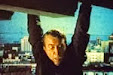
We know, too, that Hitchcock—shall we say, obsessively?—restaged and reworked similar scenes over multiple films. Such recapitulations have been the subject of at least one book, the not-very-enlightening Hitchock's Motifs by Michael Walker. Perhaps the most famous example is the heroine dangling from the face of Mt. Rushmore in North By Northwest (1959), prefigured more than two decades previously in Young and Innocent (1937):

Eva Marie Saint and Cary Grant in North by Northwest:


Nova Pilbeam and Derrick De Marney in Young and Innocent:


In North by Northwest Hitchcock is restaging, on a grander scale, a powerful scene from one of his earlier films. What makes the Vertigo scene I've discussed in this post so unusual is that Hitchcock seems to have been adapting a scene from another filmmaker's work, rather than his own.

Boileau and Narcejac's Vertigo can be borrowed with a free account from the indispensable Open Library. Hot Saturday is available on DVD in Universal's Pre-Code Hollywood Collection, and is worth seeing as an early example of Cary Grant's screen persona (as well as for its eyebrow-raising sexual mores).


  1. François Truffaut, Hitchcock, Revised Edition. Simon and Schuster, 1985, pp. 243-244.
  2. Pierre Boileau and Thomas Narcejac, Vertigo. Translated by Geoffrey Sainsbury. Dell, 1958, pp. 41-42.
  3. Donald Spoto, The Dark Side of Genius: The Life of Alfred Hitchcock. Ballantine, 1984, p. 442.
  4. Sidney Gottlieb, ed. Hitchcock on Hitchcock: Selected Writings and Interviews, University of California Press, 1995, p. 56.