Tuesday, July 21, 2009

Sahib Bibi aur Ghulam

I won't be able do justice to Sahib Bibi aur Ghulam (Master, Mistress, and Servant, 1962)--for one thing, I don't have the time to do a full post on the film right now, and for another, I feel that multiple viewings are required to fully understand and appreciate this profoundly melancholy and moving story.

One thing that's apparent from a first viewing, though, is how stunning the cinematography is (V. K. Murthy is the credited cinematographer). Just as in American cinema, Indian cinema clearly both gained and lost something with the introduction of color. So many frames of this film feature a strikingly complex interplay of light, shadow and form. This dance sequence for "Saakhiya Aaj Mujhe Neend Nahin Aayegi," probably directed by the film's star and producer, Guru Dutt (the dialogue sequences were directed by Abrar Alvi, who won the Filmfare Award for best director that year), demonstrates the beautifully composed images that are evident throughout the film. Note that the backup dancers are always in shadow, even as the courtesan (portrayed by Minoo Mumtaz) is bathed in light:


(Music by Hemant Kumar; lyrics by Shakeel Badayuni; sung by Asha Bhosle.)

To summarize the film's story briefly, poor but honest Bhoothnath (Dutt) comes to Raj-era Calcutta and through family connections winds up living in the haveli of dissolute Chhote Sarkar (Rehman) and his neglected wife, Chhoti Bahu (Meena Kumari, in a stunning performance). Bhoothnath finds work in a sindoor factory; the owner's daughter Jaba (Waheeda Rehman) at first mocks the shy and naïve Bhoothnath, but gradually more tender emotions begin to develop between them. Those feelings come to the fore as Jaba remembers key moments in their relationship in "Meri Baat Rahi Mere Man Mein"; Dutt daringly allows the screen to reach near black-out at several points:


Bhoothnath gradually becomes aware of Chhoti Bahu's great sadness, and feels deep empathy for her plight. Chhoti Bahu enlists Bhoothnath's help in her plans to win back her husband, but ultimately comes to realize that it is only by sharing her husband's love for drink that she can hold his interest. Bhoothnath watches helplessly as husband and wife spiral downward into the depths of addiction and despair, but he lends his support when Chhoti Bahu makes a last desperate attempt to save herself and her husband.

If you haven't seen Sahib Bibi aur Ghulam, I recommend it highly. I hope that someone like Philip Lutgendorf, Memsaab, Bollyviewer or Beth can give this film the full discussion that it deserves. One word of warning: The Eros DVD of the film that we watched is severely cut--at least one song and a lengthy sequence (featuring Bhoothnath getting caught up in the violence of the independence struggle, his wounding, Jabba's nursing him back to health, his departure to study architecture and his return) are missing. Be forewarned, and shame on Eros for offering a butchered version of this classic to unsuspecting viewers.

Update 28 November 2009: A thoughtful essay on Sahib Bibi aur Ghulam has appeared (or perhaps was always present?) on Philip Lutgendorf's Notes on Indian popular cinema (thanks Philip!). He writes: "...Guru Dutt's [film] uses the brilliant score of Kumar and Badayuni and the matchless b/w cinematography of V. K. Murthy (extraordinarily displayed, for example, in the courtesan dance sequence noted above, in which a brightly-lit soloist pirouettes in front of a shadowed ensemble and against a backdrop of gleaming neoclassical nudes — a dazzling display of revealed and concealed femininity, that alternates with the leering gaze of the patron) to produce...[a] complex and disturbing film about social decay and social change."

Philip and his partner Corey Creekmur have also written about Dutt's other masterpieces, Chaudhvin ka Chand (1960), Kagaaz Ke Phool (1959) and Pyaasa (1957)--I highly recommend reading their essays before viewing the films.

Thursday, July 9, 2009

Jhoom Barabar Jhoom


There's a kind of movie that I think of as "all premise, no delivery." APND movies have hooks or initial situations that are attention-grabbing, but then several things tend to happen: the characters and their relationships, once established, don't develop; the movie falls back on slapstick or caricature; the inevitable ending is delayed by the increasingly desperate machinations of the screenwriters; and last-minute reversals or dei ex machinis are thrown in to resolve the plot. I realize that having a gimmicky premise is almost the definition of a commercial movie. But it's how that premise is developed that separates the good films from the bad.

APND movies can be entertaining up to a point, which is usually intermission—and then they fall victim to the dreaded Curse of the Second Half. Examples are Heyy Babyy (2007; premise: bachelors care for a baby girl), Bachna Ae Haseeno (2008; premise: dumped Lothario apologies to mistreated past girlfriends), and now Jhoom Barabar Jhoom (Dance Baby Dance, 2007; premise: two strangers block any possibility of romantic attraction by telling each other that they're engaged—but are they?). Here's what didn't work for me in JBJ:
  1. When Alvira (Preity Zinta) and Rikki (Abhishek Bachchan) meet at London's Waterloo train station while ostensibly waiting for the arrival of their respective fiancés Steve (Bobby Deol) and Anaida (a virtually unrecogniable Lara Dutta), and each spins a lengthy story about how they met their significant other, it's obvious that those stories aren't true. Either Alvira and Rikki are lying to each other, or they're being scammed by their erstwhile lovers. (Which alternative it is doesn't get revealed until later, but it's absolutely clear that neither of their stories can be taken at face value.) So when the "surprises" are revealed in the second half they fall completely flat because we're at least 90 minutes ahead of screenwriter Habib Faisal.
  1. The direction by Shaad Ali (who also directed the superior Bunty Aur Babli (2005)) alternates between pedestrian and hyperkinetic, the choreography by Vaibhavi Merchant is uninspired, and the music by the usually reliable Shankar-Eshaan-Loy is often irritating. Two of the main songs feature English tag lines, always a bad sign. "Ticket to Hollywood" is a lame bhangra-hip-hop fusion that substitutes mugging for the camera for dancing. (A tip to S-E-L: "Monsieur" is not pronounced "mossy-eh.") And in "Kiss of Love," what does "Stay away from the kiss of love" really mean? Both numbers are pure filler, and aren't even entertaining filler. The "Bol Na Halke Halke" joint fantasy sequence would be lovely if Ali's overactive camera didn't spoil the mood, but it seems to belong to a different, better film. The only song that's truly memorable (in a good way) is the title track, picturized throughout the film on Amitabh Bachchan.
  1. Bobby Deol's poodle perm.
  1. The contrived, tacked-on, silly (and endless) dance competition climax, which arises from nothing but Habib Faisal's desperation. (Vaibhavi Merchant's lack of choreographic inspiration in this movie is especially apparent here.)
  1. The contrived, tacked-on, silly denouement.
The performances of Preity Zinta and Abhishek Bachchan—who manage to generate some charming onscreen chemistry despite the limitations of the screenwriter's imagination—and the super-cool cameos by Abhishek's dad aren't enough to rescue JBJ from its glaring flaws of writing and execution. Stay away, indeed. . .

Saturday, July 4, 2009

Punk and its aftermath: John Robb and Simon Reynolds

Two recent books try to capture the excitement and cultural flux of punk and its aftermath. Perhaps it's no surprise that the book that was written by a former punk and that allows other participants to speak about the music and the times is by far the more successful of the two.

John Robb was co-creator of the 1977-era fanzine The Rox, co-founder of the Blackpool band The Membranes and later a writer for the now-defunct Sounds magazine. His Punk Rock: An Oral History (Ebury Press, 2006) involved interviews with more than a hundred musicians, filmmakers, photographers, fanzine writers, and artists associated with what Robb calls first- and second-wave punk.

Robb and his sources take an expansive view of the movement. So the first hundred pages or so are devoted to punk precursors; the names you might expect are mentioned (Iggy & the Stooges, New York Dolls, the David Bowie of Ziggy Stardust, T. Rex, Roxy Music) but also some surprises; the pub rock scene also gets its due. And developments from 1980-84 are summed up in 50 pages at the end--mostly stories of commercial failure, personal friction and band break-ups.

The heart of the book, though, and what makes it especially worth reading, is the period between the formation of the Pistols and the Damned in 1975, and what Robb terms the peak of the second wave in 1979. One thing that becomes clear is how important fashion was to the British scene: looking right was more important than how you played. This book also acknowledges the hugely influential political punk of the anarchist band Crass, the pros and cons of the DIY aesthetic (back when recordings were physical objects, pressing, marketing and distributing them was an expensive and time-consuming process), and how issues of gender and age played out in the punk scene.

As Robb writes in his introduction, "I just wanted the story direct from the people who were there...and not the rubbish theories that were added on afterwards" (p. 2). It's not entirely possible to avoid retrospection, as all of the interviews were conducted at least 20 years after the events they describe, and some of the stories retold here are clearly well-worn. But in the main the interviewees are surprisingly frank about their experiences, and have interesting stories to tell. And Robb mainly avoids a tone of sentimental reminiscence; for him punk isn't about a particular sound, but about an endlessly renewing culture of resistance.

Rip it Up & Start Again: Postpunk 1978-1984 by Simon Reynolds (Penguin, 2006) is a retelling of punk's aftermath: bands like PiL, Gang of Four, Joy Division, Wire. The early sections of the book covering those bands are fascinating, perhaps because the music was (and is) so exciting.

But it quickly becomes apparent that there are two key problems with Reynolds' approach. The first is his restrictive view of punk. While I might have thought of Talking Heads or Devo as "new wave" rather than punk, I'm pretty sure that I never heard the term "post-punk" until much later. PiL, Gang of Four, Joy Division and Wire were all punk as far as I was concerned. Of course their music didn't sound identical to the Sex Pistols, but there was definitely an emotional continuity. For Reynolds punk begins with the release of the Ramones' debut album in April 1976 and ends with the release of Sex Pistols' Never Mind the Bollocks in late October 1977. Dang--I guess one reason punks took so much speed was to try to get their albums out before the deadline. Everything that comes later is (according to Reynolds) necessarily post-punk.

So Reynolds ignores bands that don't fit into this neat periodization. X-Ray Spex (debut album released in December 1977 or January 1978) isn't even mentioned (!); neither is Joan Jett (debut album 1980); neither is Patti Smith (a pre-post-punk, I guess she didn't realize she should've stopped releasing albums in 1976). The Raincoats and the Slits are both labelled post-punk, even though their first recordings are extremely raw and thrashy. The Au Pairs get a single paragraph, and the term "punk-funk" (which was so common back then that the Village Voice started printing it "p*nk-f*nk" because they thought it was becoming a cliché) isn't mentioned.

On the other hand, The Clash is pigeonholed (and dismissed) as punk, even though their second album Give 'Em Enough Rope--the first released in the U.S.--has songs that cross the five-minute mark, and they got more and more experimental over the double album London Calling, the "Black Market Clash" EP and the triple album Sandinista! Even their first album includes a great cover of Junior Murvin's reggae classic "Police & Thieves." (I guess the idea that a group could be both punk and post-punk explodes Reynolds' fixed categories.) The Buzzcocks get only a couple paragraphs, even though they released records until 1980 and worked with Joy Division's producer. Killing Joke gets a couple of paragraphs in a chapter on Goth (although the band helped originate elements of the Goth look, their first album was a punk-heavy metal fusion). You might remember bands like Elvis Costello & the Attractions or The Psychedelic Furs; as far as Rip It Up is concerned, though, they never existed.

As you might gather from the above, the first part of the book is a somewhat cursory survey of mostly British bands (plus Pere Ubu, Talking Heads and Devo) from the late 1970s. Whole books could be written about many of these bands; Reynolds gives a couple short chapters to PiL, but the rest of the groups get a few pages at most. I wondered why he was rushing through what would seem to be his main material. And here is where the second problem with the book became all too apparent: Reynolds was saving room for the 175 pages he devotes to "New Pop."

You'd think that Reynolds would give some attention to the LA punk scene and American hardcore. But since they were commercially negligible (we constantly hear about chart positions and Top of the Pops appearances of the British bands) they don't count in Reynolds' universe. Instead, he focusses on the artistically negligible "New Pop" bands like Adam & the Antz, Duran Duran and (egad!) Frankie Goes to Hollywood. These were bands that deliberately developed a sound "like punk never happened" (to quote the title of a 1982 book about Culture Club); they're post-punk only in the sense that they happened chronologically after punk. (Again, his terminology seems retrospective; at the time these bands were called "New Romantics.")

I can see how Reynolds gets there: many of the personnel associated with these bands had started out as punk scenesters. Malcolm McLaren, manager of the Sex Pistols, became the manager of Bow Wow Wow, a band led by sixteen-year-old Anabelle Lwin that layered pop-punk guitars over so-called Burundi beats. Most of the original Bow Wow Wow had been Adam Ant's punkish backup group before he went on to form another, poppier version with ex-Banshee Marco Pirroni (who is also featured in Robb's book). After Ian Curtis' suicide, three-fourths of Joy Division became three-fourths of New Order. The Human League started out as a Cabaret Voltaire-inspired electronic noise band sharing a record label with the Mekons and Gang of Four, only to shift into the far more commercial dance-music market along with other synth-pop bands like A Flock of Seagulls and Orchestral Maneuvers in the Dark.

I can remember going to the Roxie in New York in 1981 and hearing the Specials' "Ghost Town," Soft Cell's "Tainted Love" and Killing Joke's "Change" bumping up against one another, and sounding pretty good--apocalyptic dance music. But devoting pages of analysis to the pop vacuities of Visage? Haircut 100? Wham!? There's a far more interesting book on this period waiting to be written; I only wish Reynolds had followed his own advice, ripped it up and started again.

Friday, July 3, 2009

Section 377 overturned

"The Constitution of India recognises, protects and celebrates diversity. To stigmatise or to criminalise homosexuals only on account of their sexual orientation would be against the constitutional morality."
--Chief Justice Ajit Prakash Shah and Justice S. Muralidhar

Yesterday the Dehli High Court ruled unconstitutional the criminalization of homosexuality in Section 377 of the Indian Penal Code--a law originating with the 19th-century British colonial administration. Amrita of IndieQuill includes a link to the full decision in her thoughtful post; Nisha Susan of The Chasing Iamb offers a moving memorial to the human rights activist Familia; Vikram Doctor surveys the decision for The Economic Times of India; and Heather Timmons and Hari Kumar report on the decision for The New York Times. That article quotes chef Ritu Dalmia as saying "Today is a historical moment where at least some tiny steps have been taken, but there is still a very, very long road ahead."

The government is likely to appeal the decision to the Indian Supreme Court.

Monday, June 29, 2009

Rab Ne Bana Di Jodi

Rab Ne Bana Di Jodi (A Match Made in Heaven, 2008) is a film that divides people. At least it divides me from most other people, who hated it. Here are some sample responses:

"...a disappointingly ordinary and sloppy script that is not at all engaging beyond the first few minutes..." (theBollywoodFan)

"...nothing but mediocre fluff..." (Bitten By Bollywood)

"...it's not bad - it's terrible." (The Post-Punk Cinema Club)
In fact, PPCC's savaging dissuaded us from trying to see the movie in our regional Hindi cinema. We bought the DVD, of course, being the helpless Shah Rukh Khan fans that we are, but it was with some trepidation that we popped it into the machine.

And while RNBDJ isn't a timeless masterpiece of cinematic art, it isn't terrible. Despite its occasional weaknesses, implausibilities, and (as Beth points out in her mixed review) somewhat heavy-handed religiosity, we actually found it to be highly enjoyable.

As the film opens, Surinder Sahni (Shah Rukh Khan)--a quiet, ordinary office worker--is bringing home his new bride Taani (newcomer Anushka Sharma). It's a shock to see SRK so radically deglamorized as Suri:

Suri
We sense that something is wrong, and soon discover that Suri and Taani's marriage has been hastily arranged. Suri had been attending Taani's wedding as a guest of her father when the news came that on the way to the wedding the groom and his family had been killed in a horrific bus accident. Taani's father collapses, and on his deathbed begs her to marry Suri so that he can die in peace. Completely numbed by the loss of her fiance and the impending death of her father, Taani agrees.

So not only do Suri and Taani barely know one another, Taani is in deep mourning for her fiance, her father, and for her former life:
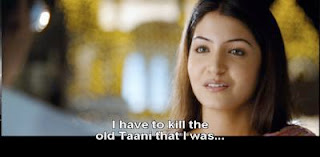
I have to kill the old Taani
Suri is older, and a painfully shy man. He's fallen instantly and hopelessly in love with the vivacious Taani, and expresses his wish for a "soft, sweet, slow" blossoming of affection in the delightful fantasy song "Haule Haule" (sung by Sukhwinder Singh; soundtrack composed by Salim-Sulaiman). But Suri realizes that a declaration of his feelings would be horrendously inappropriate. Not only that--Taani tells him straight out that love is out of the question:

I won't be able to love
So they sleep separately and eat meals in uncomfortable silence. Taani's one pleasure is going to the movies; there Suri sees her laugh for the first time since their marriage. When Taani starts attending dance classes, it gives Suri a (bad) idea: having his salon-owner buddy Bobby (Vinay Pathak) give him a makeover in the style of Taani's filmi heroes. In his new guise--torn T-shirts, tight jeans, gelled hair, and sans moustache--Suri goes to the dance class and by unlikely coincidence gets paired with Taani. Suri calls it the hand of God (we know better: it's the hand of screenwriter-director Aditya Chopra). Suri introduces himself to Taani with the generic filmi name "Raj Kapoor"; and it's not just Raj's clothes and hair that are different from Suri's, but his personality. Suri may be introverted, but Raj is brash and outspoken to the point of obnoxiousness.

Raj
Initially it's going to be a one-time thing, but as it turns out Suri actually enjoys being Raj and sharing the dance classes with Taani. Raj clearly has a freedom that Suri has never allowed himself; and he can express feelings that Suri could never utter:
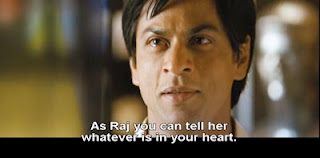
As Raj you can tell her what's in your heart
Taani is at first angered by Raj's outrageous flirting and his clueless incompetence on the dance floor, but soon comes to realize that under all his flash he's really a decent guy. In "Dance Pe Chance" (sung by Sunidhi Chauhan and Labh Janjua) we're treated to the amusing spectacle of Taani (Bollywood novice Sharma) schooling the awkward Raj (in reality the graceful and athletic superstar SRK) in Bollydance moves.

Suri also comes to realize that Raj isn't just liberating for him, but for Taani as well: she can dance, laugh, and recover something of her former high-spirited self in Raj's company. And here is where the flaws in Suri's plan become apparent. Taani enjoys herself so much with Raj that Suri starts to become jealous--of himself! He reads her newfound happiness with Raj as a sign of her dissatisfaction with Suri, and decides to force her to choose between them. As Bobby points out, this false choice is highly perverse:

You're being unfair to your wife, Suri
And this is where my logical brain centers, disarmed for most of the film, started to make their presence known again--but not before the gut-wrenching scene where Taani makes her choice.

Memsaab, in her insightful review, draws parallels between RNBDJ and a Barbara Cartland novel, Desire of the Heart. And she's exactly right: RNBDJ is a male romance, in which the characters of Suri and Raj represent the split in the male psyche: the geeky, quiet, considerate Suri, and the would-be hero Raj. Of course, Raj (being Suri) is fairly inept at playing the hero; and Suri (being Raj) eventually rises to the occasion and reveals the truth of his feelings to Taani.

All the principles give excellent performances in RNBDJ. It would have been easy for Shah Rukh to make Suri and Raj two entirely distinct characters, but SRK does something subtler: he lets us see the Suri inside Raj, and the Raj inside Suri. (His drunken conversation with himself just before the interval gets an instant nomination for my all-time SRK highlights disc.) Anushka Sharma believably negotiates Taani's rollercoaster of emotions; she's utterly charming in the role of an ordinary woman who finds herself in unexpectedly deep emotional waters. And Vinay Pathak does a great job as the volatile Bobby--if only all of us had friends so loyal. (Amazingly enough, we'd seen Vinay in Fire (1996), Hum Dil De Chuke Sanam (1998), Water (2005), and Aaja Nachle (2007), and didn't recognize him.)

The film is beautifully shot, and (a few lapses such as a magically vanishing scratch on Suri's forehead aside) well written. The Bollywood references are mind-bogglingly dense. As one example, when Raj takes his leave of Taani after the first dance class, he says, "Kabhi alvida naa kehna...hum hain rahi pyar ke...phir milenge....chalte chalte" (Never say goodbye...We are travellers on the path of love; we'll meet again as time goes by). This utterance includes references to no fewer than 8 films. Kabhi Alvida Naa Kehna is the title of a 2005 film starring SRK, and a phrase from the title song of the 1976 film Chalte Chalte. "Hum hain rahi pyar ke" is a song from the 1957 film Nau do Gyrah starring Dev Anand; it is also the title of a 1993 film starring Aamir Khan and Juhi Chawla. Phir Milenge is the title of a 2004 film starring Salman Khan and Shilpa Shetty. Chalte Chalte is the title of no less than three films, from 1947, 1976, and 2003 (the last starring SRK and Rani Mukherji); it's also a classic song from the film Pakeezah (1972). So one line has invoked all three superstar Khans, plus at least five vintage Bollywood films.

The references only get denser in the number "Phir milenge...chalte chalte" (sung by Sonu Nigam), which pays tribute to five Golden and Silver Age actors--Raj Kapoor, Dev Anand, Shammi Kapoor, Rajesh Khanna, and Rishi Kapoor--and their leading ladies. During a dull movie Taani dozes off and suddenly imagines Raj hijacking the onscreen action (with help from Kajol, Bipasha Basu, Lara Dutta, Preity Zinta and Rani):


Despite the inevitable echoes of its hilarious predecessors "Dhoom Taana" from Om Shanti Om (2007) and "Wod Ladki Hai Kahan" from Dil Chahta Hai (2001), this number works brilliantly on its own terms. theBollywoodFan has detailed 28 specific references in this song in a highly enjoyable YouTube playlist; the main ones seem to be Shree 420 (1955), Johnny Mere Nam (1970), Teesri Manzil (1966), Aap Ki Kasam (1974), and Hum Kisi Se Kum Nahin (1977).

So, as must be apparent, I join with Memsaab in disagreeing with the negative consensus on the film. I've already watched it three times, and I'm sure we'll return to it again in the future. Or as the film has it, phir milenge chalte chalte...