Saturday, April 29, 2023

Suggested reading: Will press lever for food

Cain by Henri Vidal

Cain having just murdered his brother Abel by Henri Vidal, 1896, Tuileries Garden, Paris. Photo credit: Alex E. Proimos; image source: Wikimedia Commons, CC BY 2.0 (Attribution 2.0 Generic)

1. Gen Z

Baby Boomers, Generation X, Millennials, Generation Z, and whatever comes after: generational labeling has never been so prevalent. But do generational labels and their accompanying generalizations really tell us anything that's not obvious?

In "Gen Z and Me" [1], Joe Moran, professor of English and cultural history at Liverpool John Moores University, points out that some generational differences are real (though their significance is another matter). In communication styles and the use of technology, for example, (most) members of Gen Z differ from (most) members of previous generations. In general, Gen Z derides email (requires too much time to read or write) and has developed elaborate unwritten rules defining online etiquette. The political attitudes of (many) members of Gen Z on issues such as gender and sexual identity, privacy, racial justice and climate change can also differ from those of (at least some) members of previous generations. But Moran points to two recent books that draw contrasting conclusions about what these technological and attitudinal differences really mean.

In Gen Z, Explained: The Art of Living in a Digital Age (University of Chicago Press, 2021), a Stanford anthropologist (Roberta Katz), an Oxford linguist (Sarah Ogilvie), an Oxford historian (Jane Shaw) and a Lancaster University—now King's College London—sociologist (Linda Woodhead) use interviews with college students try to explain Gen Z to everyone else. Moran writes that, according to Gen Z Explained, the members of Gen Z have

created rich and hard-to-penetrate subcultures. What they mostly like to do, the book argues, is to collaborate in leaderless groups. They use digital tools to create shared documents, sync their calendars, write and read fan fiction, play games together. They use apps to organise lift-sharing, couch-surfing and political activism. The authors further 'explain' Generation Z by pointing to the intricate language and etiquette of their online lives. Post-millennials can quickly convey their pleasure or displeasure through memes. They use emojis as a 'social lubricant' and bracket words with asterisks and tildes for emphasis and irony. Whether they write 'k' or 'kk' to mean 'OK' is charged with meaning. The first is curt; the second is cheerful and casual, a way to temper the brusqueness of the single letter. These tonal shadings matter because post-millennials like to state their intentions clearly. Self-labelling, especially of fine-grained sexual and gendered identities, has become an 'imperative'. They think it important to be themselves, to admit their struggles and vulnerabilities, to say what they mean. In the iGen Corpus, a digital data bank compiled by Ogilvie of seventy million words used by post-millennials, terms such as real, true, honest and fake occur far more often than in general language use.

But being earnest, creating subcultures and language that are impenetrable to people your parents' age and using technology that befuddles them are all just part of being in your teens and early twenties. Earlier generations did the same things, while members of their parents' generation rolled their eyes, complained, or thought that it heralded the end of civilization:

  • Gen Zers spend too much of their time bent over their phones texting their friends? "Youth is the age when people are most devoted to their friends or relations or companions, as they are then extremely fond of social intercourse and have not yet learnt to judge their friends or indeed anything else by the rule of expediency."
  • The mocking memes and references Gen Zers exchange seem bizarre? "If the young commit a fault, it is always on the side of excess and exaggeration. . .they carry everything too far, whether it be their love or hatred or anything else. . .Finally, they are fond of laughter and consequently facetious, facetiousness being a more cultivated form of insolence."
  • They are far too ready to take offense? "They are passionate, irascible and apt to be carried away by their impulses."
  • Their self-righteousness is irritating? "They think they know everything and are absolutely sure in their assertions; this is in fact the reason of their carrying everything too far."
  • They seize on and abandon trends with bewildering rapidity? "They are changeable too and fickle in their desires, which are as transitory as they are vehement; for their wishes are keen without being permanent, like a sick man's fits of hunger and thirst."

As you may have suspected, the quotes above are taken from a source written a few generations back: they're from Aristotle's Rhetoric, written two and a half millennia ago in the 4th century BCE. [2] For a compendium of similarly parallel comments about Gen Y/Millennials and the youth of previous generations, see "People have always whinged about young adults. Here's proof." [3]

In The Generation Myth: Why When You're Born Matters Less Than You Think (Basic, 2021, published in the UK as Generations: Does When You’re Born Shape Who You Are?), King's College London professor of public policy Bobby Duffy "argues that the discourse around generational difference is 'a mixture of fabricated battles and tiresome clichés'." In Duffy's view, most "generational difference" is a "lifecycle effect":

Sociologists give three explanations for the change in people’s attitudes and behaviours over time: period effects, lifecycle effects and cohort effects. Period effects describe change across all age groups: the result of sweeping societal shifts. Lifecycle effects describe change resulting from the ageing process or in response to key events such as leaving home, becoming a parent or retiring. Cohort effects describe change that results from shared generational experiences. Duffy, a professor of public policy, argues that the current discussion attributes too much to cohort effects and not enough to period and lifecycle effects.

In other words, many of what seem unbridgeable differences between older generations and Gen Z have to do with the phase of life, late adolescence and young adulthood, that Gen Z is passing through. Older people judge younger people not in comparison to the way they actually behaved when they were the same age, but in comparison to an idealized memory distorted by the way they are today: older, sadder, perhaps wiser, and probably further behind the technological curve.

One common complaint about (many) members of Gen Z is their sense of entitlement. Teachers complain that students seem to want infinitely flexible deadlines and to receive good grades no matter what their actual effort or achievement. This isn't because Gen Z members are uniquely lazy or incompetent, but because students have vastly more leverage now than in the past.

What grades really mean cartoon by Jorge Cham

"What grades really mean," by Jorge Cham, 2014. Image source: Piled Higher and Deeper (www.phdcomics.com)

2. "Liking" good grades

Grades have little to do with learning. They do not measure it, and if anything the emphasis placed on grades (a short-term goal based on punishment for failure) is actually counterproductive to expanding students' knowledge and capacities (a long-term and cumulative project based on engaging and rewarding curiosity).

There's another way in which grades are a meaningless measure: they shift over time so that similar levels of proficiency receive ever-higher levels of assessment. Grade inflation is real, but it is not the fault of either students or instructors. It is the inescapable result of our dysfunctional system of funding higher education. As Lorna Finlayson writes about the UK higher education system in "Everyone Hates Marking" [4]:

The proportion of firsts [first-class honours degrees] has more than doubled in the last ten years: it's simply not plausible that the overall standard of education has risen dramatically in this period. What has changed is the marketisation of universities, which introduced pressures that make so-called inflation inevitable, linking institutions' material fortunes to league table positions while financially incentivising the 'recruitment' of as many students as possible.

In both the US and Britain, state support of public higher education has plummeted. This has been a long-term trend over the past several decades, and its negative effects are now unavoidable. Colleges and universities are expected to make up the difference between lower levels of state support and ever-higher operating expenses by enrolling more students and charging higher tuition. In order to attract more students and charge them more, schools have to compete with each other in catering to their wants.

Of course, it's a Catch-22: more students require more dorms, more classrooms, more instructors, more support staff, and more library books, increasing costs further. And raising tuition is not only directly counter to the mission of public universities to provide an affordable education to every state resident who qualifies, it burdens students with ever-higher levels of debt.

Most of the additional instructors who are being hired to teach these larger undergraduate cohorts are part-time, non-tenure track adjunct lecturers. Since they generally have no research responsibilities, their continued employment from semester to semester is dependent almost entirely on good student evaluations of their teaching. However, student evaluations do not correlate with learning and have been shown to exhibit systematic gender, age, and racial bias. In addition, instructors who are perceived to be "tough graders" receive lower evaluations, particularly if they are women. [5]

Since it's so strongly in the economic interest of colleges and universities to enlarge enrollments, it's no mystery why grades for similar levels of proficiency keep moving up the scale: we have created a system in which, to remain employed, instructors must chase "likes" from their students. And students like good grades.

Will press lever for food cartoon by Craig Swanson

"Will press lever for food" by Craig Swanson. Image source: Perspicuity (www.perspicuity.com)

3. The Reaction Economy

This is an example of what William Davies terms "The Reaction Economy" [6]. He writes,

The behaviourist tradition that came to dominate American psychology in the 20th century, pioneered by John B. Watson after the First World War and later identified with B.F. Skinner, was established with the explicit aim of rendering human responses predictable and thereby controllable. Psychology would abandon any theory of mind in favour of data on observable behaviour. Behaviourists imagined a wholly conditioned, programmable person. . .

The behaviourist tradition has revealed a lot about how humans (and other animals) respond to different stimuli. . .But it tells us nothing about the vast amounts of time and labour that societies such as ours now invest in actively trying to generate and capture reactions of various kinds, not just in science laboratories or hospitals, but across the economy, public sphere and civil society.

On the contrary: far from telling us nothing about the reaction economy, behaviorism's explicit goal is "predictable and thereby controllable" responses; think of laboratory rats pressing levers for a reward. And the biggest behaviorist experiment in human history is currently underway. On social media, search engines and other commercial sites companies track your "engagement," clicks and "likes," and sell your attention to advertisers based on predictions of your behavior. Your responses to the ads you see become more data points in an endless feedback loop. This system has been memorably described by social psychologist Shoshana Zuboff as "surveillance capitalism." And the engine driving it is the technology sector centered in Northern California that since at least 1970 has been called Silicon Valley.

Apple new campus building in Cupertino, California

Cupertino, California: Aerial photo of Apple new campus building, April 13, 2017. Photo credit: Uladzik Kryhin. Image source: Shutterstock

4. Silicon Valley

The man who founded what became Silicon Valley was William Shockley. As a researcher at Bell Labs in New Jersey after World War II Shockley co-invented the transistor, for which he and his colleagues jointly won the Nobel Prize in Physics in 1956. That same year he founded Shockley Semiconductor Laboratory in Mountain View, California, in what was then known as the Santa Clara Valley. A key reason for Shockley's choice of location: his mother lived in Palo Alto, home of Stanford University and the next town over as you headed north from Mountain View towards San Francisco.

Shockley had a good eye for talent, but as John Lanchester writes in "Putting the Silicon in Silicon Valley" [7], he was "an outstandingly horrible human being." He divorced his wife when she was diagnosed with uterine cancer, he actively promoted racist and eugenicist views, and few could stand to work with or for him. Just a year after the founding of Shockley Semiconductor eight of its leading researchers left to found a rival company, Fairchild Semiconductor. A decade later two of the eight, Robert Noyce (co-inventor of the integrated circuit) and Gordon Moore (formulator of Moore's Law) split off from Fairchild to form Intel. Along with Texas Instruments, Fairchild and Intel dominated microchip design for decades.

But manufacturing chips was expensive, even in the low-wage nonunion states to which these companies moved their production, and in 1968 to increase profits Texas Instruments built a chip fabrication plant in Taiwan. Lanchester writes, "The investment would also give the US a stake in defending Taiwan, at a time when America’s enthusiasm for Asian military adventures was at a low ebb. TI committed to build their Taiwan fab [fabrication plant] in 1968. In 1980 they shipped their billionth chip. A new strategy was in place."

A key figure in the strategic integration of Taiwan into the microchip supply chain and thus the US military perimeter was a man named Morris Chang. Born in mainland China in 1931, he emigrated to the US in 1949, and after getting bachelor's and master's degrees at MIT and a TI-sponsored PhD at Stanford, eventually became vice-president in charge of TI's microchip division.

After leaving TI, in 1987 Chang founded the Taiwan Semiconductor Manufacturing Company (TSMC), which for decades has produced many of the most advanced microchips. Advanced microchips are crucial to the development of new military technologies, including AI.

Risk

Risk 60th Anniversary Edition Board Game created by by Albert Lamorisse and produced by Hasbro. Image source: Best Buy

5. Meet the new strategy, same as the old strategy

A major driver of China's interest in absorbing Taiwan is that by seizing the world's most advanced microchip fabrication plants it would control the chip supply to the rest of the world—most especially the US—and gain a large technological and military advantage.

As Lanchester writes,

China has to import powerful microchips. The numbers involved are substantial. For most of this century, China has spent more money on importing microchips than it has on importing oil. . .China is acutely aware of its dependence on the West in this area.

In October 2022, the Biden administration instituted a ban on advanced microchip exports to China by US companies and any foreign companies that use US microchips—in practice, a global ban (although enforcing it is another question).

This has disturbing parallels with the events leading up to World War II in the Pacific. In July 1940 the US placed an aviation fuel and scrap iron embargo on an expansionist Japan that had already brutally invaded and occupied Manchuria and was in renewed conflict with China. In September 1940 Japan allied itself with Nazi Germany and Fascist Italy. The US imposed a total oil embargo in August 1941; four months later on 7 December Japan attacked Pearl Harbor, and a month after that invaded the Dutch East Indies, a major producer of rubber and oil. [8]

Lanchester concludes,

The chip ban has been described as a 'declaration of economic war'. And perhaps not only economic war. The assumption in military circles is that AI is going to be crucial to the next wave of innovation in warfare. The AI revolution will depend on new chip technology. The second Cold War is going to be a military-technological contest just like the first one, and once again semiconductors are going to be central. We are starting to get glimpses of what that might look like, with the first arrivals of drone swarms on battlefields. Coming soon: unmanned vehicles, fire-and-forget missiles, 'loitering munition systems' and facial recognition assassination drones. Advanced chips are as crucial to the process of designing new weapons systems as to the weapons themselves, because the majority of testing for these systems is done on computers. Fingers crossed that all this helps with avoiding World War Three.

Yeah—embargoes worked so well at heading off World War II.

Update 5 July 2023: An article in The Guardian today, "Chip Wars" by Amy Hawkins, reports that the Biden administration is considering expanding existing restrictions to include some less advanced chips, as well as some cloud services. The Netherlands, home of advanced-chip maker ASML, is also expected to increase its restrictions. On 30 June the Dutch government announced that export restrictions on photolithography equipment manufactured by ASML that is used to etch circuits onto microchips would go into effect on 1 September.

Update 16 November 2025: In late October of this year Amanda Claybaugh, the dean of Harvard College (the undergraduate programs of Harvard University), released a report on grade inflation at her institution. It points out that "in 2005, As accounted for 24% of all grades awarded in Harvard College; in 2015, for 40.3%; in 2025, for 60.2%." Harvard's median undergraduate grade-point average is now 4.0.

Students self-report spending about 12 hours per week per course on academic work, which is similar to the time spent in 2005. However, faculty in reading-intensive disciplines report that students are entering their classes "with less experience reading complex prose and less capacity for focus and sustained attention," and that in response "they've had to trim some readings and drop others entirely, that they've had to switch from novels to short stories." And yet grades inexorably keep rising.

Claybaugh's white paper points to a number of reasons for this, but a key one is competition for resources. You might think that Harvard would be insulated from these sorts of market pressures on grades; it has the largest endowment of any university in the world, which is approaching US$60 billion, and can afford to reject 96% of applicants. However, Claybaugh writes that faculty "know that they are competing with one another for students. With good enrollments come guaranteed teaching for graduate students, the possibility of more faculty lines for departments, and the opportunity to introduce students to the subjects we've devoted our lives to studying. It makes sense, in this context, for faculty to lower standards in order to raise enrollments. 'Grading at Harvard is in a race to the bottom,' one faculty member observed. 'This is a classic game theory problem.'" In this case, of course, "the bottom" is the top of the grading scale. And if this is true at Harvard, of all places, grade inflation pressures are even greater at institutions that are more dependent on enrollments simply to meet their operating expenses.


  1. London Review of Books, Vol. 45, No. 4, 16 February 2023: https://www.lrb.co.uk/the-paper/v45/n04/joe-moran/gen-z-and-me
  2. The Rhetoric of Aristotle, translated, with an analysis and critical notes, by J.E.C. Welldon. Macmillan, 1886, Book II, Section xii, pp. 164-166 (translation slightly altered). https://babel.hathitrust.org/cgi/pt?id=hvd.hxjtry&view=1up&seq=216
  3. Amanda Ruggeri, "People have always whinged about young adults. Here's proof." BBC Worklife, 2 October 2017. https://www.bbc.com/worklife/article/20171003-proof-that-people-have-always-complained-about-young-adults.
    See also: John Protzko and Jonathan W. Schooler, 2019, "Kids these days: Why the youth of today seem lacking," Science Advances, Vol. 5, No. 10:eaav5916. https://www.ncbi.nlm.nih.gov/pmc/articles/PMC6795513/pdf/aav5916.pdf;
    Jessica Kitt, 2013, "Kids These Days: An Analysis of the Rhetoric against Youth across Five Generations," https://cah.ucf.edu/writingrhetoric/wp-content/uploads/sites/27/2019/10/KWS2_Kitt.pdf
  4. London Review of Books, Vol. 45, No. 6, 16 March 2023. https://www.lrb.co.uk/the-paper/v45/n06/lorna-finlayson/diary
  5. Heather E. Campbell, 2019, "JPAE at 25: Looking back and moving forward on teaching evaluations," Journal of Public Affairs Education, Vol. 25, Issue 1, pp. 23-29, DOI: https://doi.org/10.1080/15236803.2018.1558823
  6. London Review of Books, Vol. 45, No. 5, 2 March 2023. https://www.lrb.co.uk/the-paper/v45/n05/william-davies/the-reaction-economy
  7. London Review of Books, Vol. 45, No. 6, 16 March 2023. https://www.lrb.co.uk/the-paper/v45/n06/john-lanchester/putting-the-silicon-in-silicon-valley
  8. See "The Revolutionary Pacifism of A.J. Muste: On the Backgrounds of the Pacific War," in Noam Chomsky, American Power and the New Mandarins: Historical and Political Essays, Pantheon, 1969, pp. 159-220.

Sunday, April 9, 2023

"Ragged and dirty, and covered with vermin": The Mudlark

DVD cover of The Mudlark (1950). Image source: Amazon.ca

The (modern) mudlarks

My partner follows on social media a loosely affiliated group of amateur (and sometimes professional) historians and archaeologists who call themselves mudlarks. Modern mudlarks comb the foreshore of the River Thames looking for artifacts from the past: Roman coins or mosaic fragments, medieval pilgrim badges, Tudor signet rings, Stuart pottery shards, Georgian clay pipes, Regency shoe buckles, Victorian pub tokens, and buttons, handmade pins, keys, bottles, and other objects from the everyday life of many eras. Below Teddington Lock (about halfway between Windsor and central London) the Thames is a tidal river, with a maximum difference of about 7.5 meters (nearly 25 feet) between high and low tides at London's Tower Bridge, according to the Port of London's 2023 Tide Tables. As a result of this powerful daily surge of millions of gallons of water, detritus from the river accumulates on the foreshore with every tide.

The modern mudlarks have formed an association (the Society of Thames Mudlarks) and submit any find that is sufficiently ancient or valuable to the Museum of London for review. While some metal-detectorists also work the foreshore, true mudlarks rely solely on keen eyesight (aided, perhaps, by headlamps in the dawn and evening hours) to discover their treasures.

The Mudlark DVD cover

Malcolm Russell, in Wellingtons, kneepads and headlamp, mudlarking on the north shore of the Thames River in the City of London near the Cannon Street Railway Bridge. Photo credit: Matthew Williams-Ellis. Image source: Thames & Hudson

There are several fascinating books about mudlarking and how serendipitous finds of cast-off, lost or broken objects illuminate the social and cultural history of the metropolis. Among the many books on mudlarking my partner recommends:

Cover of Mudlark by Lara Maiklem

Image source: The New Yorker

  • Lara Maiklem: Mudlark: In Search of London’s Past Along the River Thames, Liveright, 2021. From the jacket: "interweaving reflections from her own life with meditations on the art of wandering, Maiklem ultimately delivers. . .a timeless treatise on the objects we leave in our wake, and the stories they can reveal if only we take a moment to look."
Cover of Mudlarkd by Malcolm Russell

Image source: Princeton University Press

  • Malcolm Russell: Mudlark’d: Hidden Histories from the River Thames, Princeton University Press, 2022. Russell's profusely illustrated book tells "stories of forgotten people told through lost objects," covering enslaved people and immigrants; "mollies," "toms," courting couples and sex workers; artists and entertainers; criminals and addicts; street sellers, hawkers and quacks, among other urban subcultures.
Cover of Thames Mudlarking by Jason Sandy and Nick Stevens

Image source: Abebooks.com

  • Jason Sandy and Nick Stevens: Thames Mudlarking: Searching for London's Lost Treasures, Shire, 2021. With Stevens' photographs on every page, this slim volume (under 100 pages) spans millennia, describing objects from prehistory to the (near-)present. It features chapters on megafauna, ritual offerings, medieval society, disasters, drinking culture, and World War II, among others.

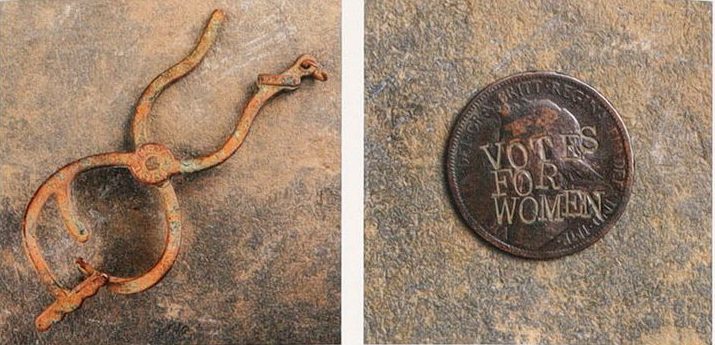
(Left) A late-Victorian-era skirt lifter to keep the hems of women's dresses from getting soiled in the streets; (right) an 1899 halfpenny with "Votes for Women" stamped over Queen Victoria's profile. From Malcolm Russell: Mudlark’d: Hidden Histories from the River Thames. Image source: Thames & Hudson

The (Victorian) mudlarks

But 150 years ago mudlarking was something very different. In the 19th century the Thames was not only a working waterway packed with steamships, sailing vessels and coal barges, but also London's open sewer, where human and animal waste was dumped. What is now Farringdon Street/A201 was previously a canal known as Fleet Ditch, which ran from Hampstead through King's Cross, Clerkenwell and Holborn to the Thames at Blackfriars Bridge. Until it was finally covered over in the 19th century, Fleet Ditch flowed past Smithfield Meat Market, whose offal would be swept into the Fleet and washed into the Thames with every rainstorm, as graphically described in Jonathan Swift's poem "A Description of a City Shower" (1710):

Filth of all hues and odors seem to tell
What street they sailed from, by their sight and smell. . .
Sweepings from butchers' stalls, dung, guts, and blood,
Drowned puppies, stinking sprats, all drenched in mud,
Dead cats, and turnip tops, come tumbling down the flood.

As London's population increased from about 1 million in 1801 to over 6 million by the end of the 19th century, the pollution of the Thames grew ever worse. In June and July 1858 the city was subjected to the Great Stink, during which a choking, putrid stench from the river and its waste-covered foreshore spread over the city. In a Parliamentary debate on 15 July 1858, Benjamin Disraeli, then Chancellor of the Exchequer, noted that the Thames, "that noble river. . .has really become a Stygian pool, reeking with ineffable and intolerable horrors."

The Mud-Lark, from a Daguerreotype by Beard. Illustration from Henry Mayhew, London Labour and the London Poor, v. 2, "The Street-Folk," between pages 136 and 137. Image source: Internet Archive

Mudlarks worked on the reeking, contaminated river scavenging coal, wood, rope, metal, lumps of fat, and anything else saleable from the muck of the foreshore and shallows. In Henry Mayhew's London Labour and the London Poor, vol. 4 ("Those That Will Not Work" [1], 1861), his co-author John Binny reported that mudlarks are "boys and girls, varying in age from eight to fourteen or fifteen; with some persons of more advanced years. For the most part they are ragged, and in a very filthy state. . .As soon as the tide is out they make their appearance, and remain till it comes in" (pp. 366-367). Binny provided a "Narrative of a Mudlark" whom he guessed to be about 13:

About two years ago I left school, and commenced to work as a mudlark on the river, in the neighbourhood of Millwall [on the Isle of Dogs], picking up pieces of coal, and iron, and copper, and bits of canvas on the bed of the river, or of wood floating on the surface. . .When the barge-men heave coals to be carried from their barge to the shore, pieces drop into the water among the mud, which we afterwards pick up. Sometimes we wade in the mud to the ancle, at other times to the knee. Sometimes pieces of coal do not sink, but remain on the surface of the mud; at other times we seek for them with our hands and feet. . .

Some of the mudlarks are orphan boys and have no home. In the summer time they often sleep in the barges or in sheds or stables or cow-houses, with their clothes on. Some of them have not a shirt, others have a tattered shirt which is never washed, as they have no father nor mother, nor friend to care for them. Some of these orphan lads. . .are ragged and dirty, and covered with vermin. (pp. 371-372)

The Mudlark (1950)

The title character of the 1950 film The Mudlark, which is set in the late Victorian era, is just such an orphan—a boy named Wheeler (Andrew Ray) who is about 10 years old. One night while searching the body of a drowned sailor that has washed up on the foreshore he finds a cameo of Queen Victoria. He doesn't recognize the image, but is told by a fence that the queen is "the mother of all England." When he learns that the queen lives at Windsor Castle the motherless boy decides to go there to see her. He manages to sneak past the guards into Windsor, and wanders in the vast halls in a daze until he discovers an empty banquet room.

Wheeler (Andrew Ray) exploring Windsor Castle in The Mudlark (1950). Image source: RareFilmFinder

A formal dinner is being held that night, and when an Irish maid, Kate Noonan (Constance Smith) enters the banquet room to complete the final preparations she discovers Wheeler. She doesn't sound the alarm, but can't smuggle him out of the castle until after the banquet. As the queen and her guests enter, Wheeler hides behind the curtains. Lying in the darkness he falls asleep, and his snoring leads to his discovery. Consternation among the residents of Windsor and a good scrub and delousing for Wheeler follow. John Brown (Finlay Currie), the queen's personal servant and confidant, takes the boy in hand and, once he realizes that he means no harm, gives him a tour of the castle; others surrounding the queen want the boy to be punished, and rumors start to fly that he is part of an Irish plot on the queen's life.

Queen Victoria (Irene Dunne) is still secluded in mourning for her husband Prince Albert, who died nearly 15 years earlier. Prime Minister Benjamin Disraeli (Alec Guinness) has tried to convince her to show herself to her subjects in support of his reform projects, to no avail.

Prime Minister Disraeli (Alec Guinness) and Queen Victoria (Irene Dunne) in The Mudlark. Image source: TMDB.org

But when the queen finally meets the mudlark—he hides away in Windsor Castle a second time—she realizes that the time has come for her to reconsider her isolation at Windsor and re-enter public life.

The Mudlark, written and produced by Nunnally Johnson, is based on the 1949 novel of the same title by San Francisco writer and editor Theodore Bonnet. The novel and film fictionalize and relocate in both time and place the real-life incursion of 14-year-old Edward Jones ("the boy Jones") into Buckingham Palace in December 1838. [2] The Mudlark's visit to Windsor to see the queen is set in 1875, around the time that Disraeli's government was proposing a series of reform bills in Parliament, including:

  • The Factories (Health of Women, &c.) Act, 1874, which raised the minimum age of factory employees to those who would turn 10 by 1876; limited the work of women and children in factories to a maximum of 10 hours, and the longest period of continuous work before an (unpaid) 1-hour meal break to 4.5 hours (meaning that women and children could be on site for a total of 12 hours, 10 of which were paid); established the earliest (6 am) and latest (8 pm) hours that women and children could be required to do factory work; and limited the factory work week to 6 days, with Saturdays a "half day" of 6 hours of manufacturing labor plus a half hour on additional tasks (such as cleaning). The Act did not apply to adult men, agricultural laborers, or miners;
  • The Artizans' and Labourers' Dwellings Improvement Act, 1875, which promoted slum clearance and the development of new housing for workers;
  • The Conspiracy, and Protection of Property Act, 1875, which excluded workers who were nonviolently striking and picketing from being charged with crimes of conspiracy;
  • The Employers and Workmen Act, 1875, which defined servants as employees under contract and enabled workers as well as employers to sue in the civil courts if the terms of those contracts were abrogated (though in practice the costs of bringing suits were generally prohibitive for workers);
  • The Public Health Act, 1875, which promoted the construction of municipal sewage systems and required new housing to include running water and sheltered privies, though earthclosets (latrines) were still permitted;
  • The Sale of Food and Drugs Act, 1875, which forbade the adulteration of food and drugs;
  • The Elementary Education Act, 1876, which required children to be educated to proficiency in reading, writing, and arithmetic, and restricted (but did not ban) the employment of children age 10 or younger.
Benjamin Disraeli

Benjamin Disraeli, Earl of Beaconsfield, albumen cabinet card (detail) by Mayall, circa 1868. Image source: National Portrait Gallery NPG x46496

The Mudlark's writer-producer Johnson and director Jean Negulesco were Hollywood-based, but the bulk of the film's cast and crew were British. The only American actor is Irene Dunne, the star of Roberta (1935), The Awful Truth (1937), and My Favorite Wife (1940), among many other films, who was unrecognizable to me in her prosthetic padding and with her (credible) British accent. Alec Guinness also does not look very much like himself, but does bear a strong resemblance to the historical Disraeli—all the more remarkable given that in 1875 Disraeli would have been over 70, while at the time of filming Guinness was just turning 36. (The makeup was by David Aylott.)

Guinness's excellent performance as Disraeli is capped by a stirring speech in Parliament in defense of his proposed legislation for improving conditions for working-class children. Referring to Wheeler, he asks, "How did this child manage to escape us? How did he manage to reach the age of 10 in the face of all that we did to prevent it?" Astonishingly, this speech, which goes on for nearly 7 minutes of the film's 99-minute runtime, is shot in a single continuous take, and of course it wins the day for reform. In reality the end of child labor, along with the establishment of the 8-hour workday and the five-day workweek, would take many more years of working-class struggle to achieve in Britain, and in our century remain to be achieved for those who harvest our food, sew our clothes, and assemble our electronic devices. Despite its paternalistic picture of social change and its elision of Disraeli's mixed legacy as Prime Minister (including his support of British imperialism), The Mudlark is very much worth seeing for Guinness's performance and for its glimpse of mudlarking's grim past on the Thames.


  1. In addition to mudlarks, Mayhew classifies among "those who will not work" prostitutes, thieves, swindlers, and beggars, including "naval and military beggars," "shipwrecked mariners," "blown-up miners," "bodily afflicted beggars," "starved-out manufacturers" [i.e., factory workers], "unemployed agriculturalists" [i.e., farmworkers], and "hand-loom weavers, &c." who had been permanently replaced by machines. Mayhew had a curious sense of what constitutes an unwillingness to work. ^ Return
  2. Queen Victoria was not in the palace at the time, but at Windsor. Jones, who was spotted, chased, arrested and acquitted, entered Buckingham Palace twice more, in 1840 and 1841, and both times was arrested and sent to prison. Later he was arrested twice for loitering in the vicinity of the Palace, and finally "encouraged" to emigrate to Australia. Not quite the charming urchin of The Mudlark. During her long reign Victoria would survive eight assassination attempts. ^ Return

Sunday, March 19, 2023

“My sin was great, but my punishment was greater”: East Lynne

Mrs Ellen Wood

Mrs. Ellen Wood by Joseph Sydney Willis Hodges, 1875.
Photo credit: Worcester Guildhall, licensed under CC BY-NC-ND. Image source: Art UK

Ellen Wood's East Lynne (1861) is like half a dozen Victorian novels in one. It involves a murder mystery (as in Charles Dickens' Bleak House (1853)), a murder trial (as in Elizabeth Gaskell's Mary Barton (1848)), marital misapprehension (as in Emily Eden's The Semi-Attached Couple (1860)), a woman concealing her past (as in Maria Edgeworth's Helen (1834)), female self-sacrifice (as in Gaskell's Ruth (1853)), and not one but two death-bed scenes (as in Dickens' The Old Curiosity Shop (1841)).

There are two intertwined main narratives in East Lynne. The first is the story of the murder of Afy Hallijohn's father by one of the flirtatious girl's many suitors. ("Afy" is pronounced "Affy"; her full name, fittingly, is Aphrodite.) Suspicion falls on Richard Hare, whose gun was used in the killing and who fled the town of West Lynne the night of the murder and hasn't been seen since. (Or has he?) Richard's father, a local magistrate who is upright to a fault, condemns his own son and vows to send him to the scaffold if he reappears. Believing him innocent, Richard's younger sister Barbara enlists the help of a longtime family friend, conscientious solicitor Archibald Carlyle, to try to clear her brother's name. Complicating matters is that Barbara is deeply in love with Mr. Carlyle, but he doesn't recognize it.

The second narrative concerns Mr. Carlyle's marriage to Lady Isabel Vane (the homophony with "vain," in the senses of foolish and proud, is probably not accidental). Lady Isabel's father died heavily in debt, leaving her "completely destitute." Mr. Carlyle sees her distress, and swayed by her youth, beauty, and "bitter dependence" on unsympathetic relatives, offers her his hand, heart, and comfortable home of East Lynne. Complicating matters is that Lady Isabel loves another man, the handsome but caddish Francis Levison.

. . .her head was aching with perplexity. The stumbling block that she could not get over was Francis Levison. She saw Mr. Carlyle approach from her window, and went down to the drawing-room, not in the least knowing what her answer was to be; a shadowy idea was presenting itself, that she would ask him for longer time, and write her answer.

In the drawing-room was Francis Levison, and her heart beat wildly; which said beating might have convinced her that she ought not to marry another. . .

"Mr. Carlyle. . .seems an out-and-out good fellow, Isabel, and I congratulate you."

"What!" she uttered.

"Don’t start. We are all in the family, and my lady [Lady Isabel's guardian] told; I won’t betray it abroad. She says East Lynne is a place to be coveted; I wish you happiness, Isabel."

"Thank you," she returned in a sarcastic tone, though her throat beat and her lips quivered. "You are premature in your congratulations, Captain Levison."

"Am I? Keep my good wishes, then, till the right man comes. I am beyond the pale myself, and dare not think of entering the happy state," he added, in a pointed tone. "I have indulged dreams of it, like others, but I cannot afford to indulge them seriously; a poor man, with uncertain prospects, can only play the butterfly, perhaps to his life’s end."

He quitted the room as he spoke. It was impossible for Isabel to misunderstand him, but a feeling shot across her mind, for the first time, that he was false and heartless. One of the servants appeared, showing in Mr. Carlyle; nothing false or heartless about him. He closed the door, and approached her, but she did not speak, and her lips were white and trembling. Mr. Carlyle waited.

"Well," he said at length, in a gentle tone, "have you decided to grant my prayer?"

"Yes. But——" She could not go on. What with one agitation and another, she had difficulty in conquering her emotion. "But—I was going to tell you——"

"Presently," he whispered, leading her to a sofa, "we can both afford to wait now. Oh, Isabel, you have made me very happy!"

"I ought to tell you, I must tell you," she began again, in the midst of hysterical tears. "Though I have said 'yes' to your proposal, I do not—yet——It has come upon me by surprise," she stammered. "I like you very much; I esteem and respect you; but I do not love you."

"I should wonder if you did. But you will let me earn your love, Isabel?"

"Oh, yes," she earnestly answered. "I hope so."

He drew her closer to him, bent his face, and took from her lips his first kiss. Isabel was passive; she supposed he had gained the right to do so. "My dearest! It is all I ask." (Ch. XII)

From her tearful confession to her future husband that she does not love him, to her acceptance of his kiss with the thought that "she supposed he had gained the right to do so," this proposal scene is a devastating depiction of Lady Isabel's emotional state as she enters her marriage. But as Mrs. Wood also makes clear, like many women of her time Lady Isabel has few alternatives.

Apart from her lack of romantic feelings for her husband—a condition surely shared by many Victorian wives—the first few years of the marriage involve additional tribulations for Lady Isabel. Although motherhood provides some consolation, the household at East Lynne includes Mr. Carlyle's domineering sister Cornelia, who refuses to yield to her the place of mistress of the house, countermands her orders to the servants, and even interferes in the raising of her children. 

Then Lady Isabel begins to notice that her husband is meeting with the beautiful Barbara Hare in odd places at odd hours. Their semi-clandestine meetings are to discuss developments in her brother's murder case, but of course Lady Isabel leaps to another conclusion. Her jealousy is inflamed by the insinuations of a guest who, at Mr. Carlyle's invitation, happens to be making an extended visit at their home: none other than Francis Levison, for whom seducing vulnerable women is mere sport. Lady Isabel's jealousy of her husband and her still-powerful attraction to the man who is now Sir Francis are a volatile combination.

Mr. Carlyle may be sincere, but he is not very perceptive of the feelings of the women in his life. He does not realize how upset Lady Isabel is becoming at his rendezvous with Barbara. Nor is he aware of Barbara's feelings—until one night as he is walking her home, when she can no longer keep them in check:

Her throat was working, the muscles of her mouth began to twitch, and a convulsive sob, or what sounded like it, broke from her. Mr. Carlyle turned his head hastily.

"Barbara! are you ill? What is it?"

On it came, passion, temper, wrongs, and nervousness, all boiling over together. She shrieked, she sobbed, she was in strong hysterics. . .Barbara struggled with her emotion—struggled manfully—and the sobs and shrieks subsided; not the excitement or the passion. . .

"Are you better, Barbara? What can have caused it?"

"What can have caused it?" she burst forth, giving full swing to the reins, and forgetting everything. "You can ask me that?"

Mr. Carlyle was struck dumb; but by some inexplicable law of sympathy, a dim and very unpleasant consciousness of the truth began to steal over him.

"I don’t understand you, Barbara. If I have offended you in any way, I am truly sorry."

"Truly sorry, no doubt!" was the retort, the sobs and the shrieks alarmingly near. "What do you care for me? If I go under the sod to-morrow," stamping it with her foot, "you have your wife to care for; what am I?"

"Hush!" he interposed, glancing round, more mindful for her than she was for herself.

"Hush, yes! You would like me to hush; what is my misery to you? I would rather be in my grave, Archibald Carlyle, than endure the life I have led since you married her. My pain is greater than I well know how to bear."

"I cannot affect to misunderstand you," he said, feeling more at a nonplus than he had felt for many a day. . ."But my dear Barbara. I never gave you cause to think I—that I—cared for you more than I did."

"Never gave me cause!" she gasped. "When you have been coming to our house constantly, almost like my shadow; when you gave me this"—dashing open her mantle, and holding up the locket to his view; "when you have been more intimate with me than a brother."

"Stay, Barbara. There it is—a brother. I have been nothing else; it never occurred to me to be anything else," he added, in his straightforward truth.

"Ay, as a brother, nothing else!" and her voice rose once more with her excitement; it seemed that she would not long control it. "What cared you for my feelings? What recked you that you gained my love?"

"Barbara, hush!" he implored: "do be calm and reasonable. If I ever gave you cause to think I regarded you with deeper feelings, I can only express to you my deep regret, my repentance, and assure you it was done unconsciously."

She was growing calmer. The passion was fading, leaving her face still and white. She lifted it toward Mr. Carlyle.

". . .If she had not come between us, should you have loved me?"

"Do not pursue this unthankful topic," he besought. . .

"I ask you, should you have loved me?" persisted Barbara, passing her handkerchief over her ashy lips.

"I don’t know. How can I know? Do I not say to you, Barbara, that I only thought of you as a friend, a sister? I cannot tell what might have been."

. . .Arrived at the back gate of the grove, which gave entrance to the kitchen garden. . .Mr. Carlyle took both Barbara’s hands in his.

"Good-night, Barbara. God bless you."

She had had time for reflection, and the excitement gone, she saw her outbreak in all its shame and folly. Mr. Carlyle noticed how subdued and white she looked.

"I think I have been mad," she groaned. "I must have been mad to say what I did. Forget that it was uttered."

"I told you I would."

"You will not betray me to—to—your wife?" she panted.

"Barbara!"

"Thank you. Good-night."

But he still retained her hands. "In a short time, Barbara, I trust you will find one more worthy to receive your love than I have been."

"Never!" she impulsively answered. "I do not love and forget so lightly. In the years to come, in my old age, I shall still be nothing but Barbara Hare." (Ch. XVII)

Mr. Carlyle's emotional obliviousness will ultimately bring tragedy to his marriage.

Ellen Wood, 1814-1887

Ellen Wood (née Price) did not become a novelist until she was in her mid-40s. She was the daughter of a Worcester glovemaker, Thomas Price, and his devout wife Elizabeth. When Ellen entered her teens she was diagnosed with curvature of the spine and confined to bed for four years. This treatment, unsurprisingly, did not correct the curvature; as an adult she could not stand fully upright and was less than five feet tall. In 1836 at the age of 22 she married Henry Wood, a businessman four or five years her senior, and the couple moved to Dauphiné in southeastern France.

The family returned to England in 1856 after Henry's business failed. Ellen had begun anonymously publishing short stories a few years previously, and initially she didn't receive any payment. By the late 1850s, though, she could no longer afford to work for free. She wrote her first novel Danesbury House (1860) in response to a contest sponsored by the Scottish Temperance League, and won the £100 first prize. However, after the novel was published she received no further recompense.

Her next novel, East Lynne (1861), was rejected by the publishers Chapman and Hall due to a poor report by their reader, George Meredith, who may have found that the story of a wife tempted by the prospect of an adulterous affair hit too close to home; just a few years earlier Meredith's wife had left him for another man. Wood's novel was also rejected by Smith, Elder & Co., publishers of Charlotte Brontë and Elizabeth Gaskell.

When East Lynne was offered to Richard and George Bentley, though, they anticipated strong sales; its serial publication in The New Monthly Magazine beginning in January 1860 had significantly boosted that periodical's circulation.

First installment of East Lynne in The New Monthly Magazine, v. 118, 1860, p. 28. Image source: HathiTrust.org

For the right to publish the novel in book form Bentley and Son paid Mrs. Wood £600, about four times the usual fee for a novelist without proven popularity, and ordered a substantial first print run of 2750 copies. (By comparison, publisher Thomas Egerton paid £110 for the copyright of Jane Austen's second novel, Pride and Prejudice (1813), and it had a first print run of 1,000 copies.) Unusually, the Bentleys also agreed to give Mrs. Wood half of the profits realized from sales of the novel. In exchange they asked Mrs. Wood to revise or remove certain "objectionable" scenes, a request she politely but flatly refused. She knew the worth of her work, and despite her image of demure gentility, drove a hard bargain.

Title page of the first edition of East Lynne. Image source: HathiTrust.org

Bentley and Son had, if anything, underestimated East Lynne's sales potential. In the ten years after its initial publication it went through 24 editions, and by 1901 it had sold more than half a million copies. [1]

Over the next 7 years Mrs. Wood would produce another 15 novels, often having two serializations running at once. By 1867 her writing had generated enough income for her to purchase The Argosy magazine and take over as its chief editor. In the first years of her editorship she provided at least half of the content of each issue of the magazine, much of it anonymously, while continuing to publish an average of two books per year under her name.

Title page of The Argosy, Volume VII, 1869. Image source: HathiTrust.org

By the time of her death in 1887, Ellen Wood had published more than 40 books of fiction (several more would be published posthumously) and her writing generated an exceedingly comfortable income of £5–6,000 per year. Denis Goubert writes that "her books enjoyed a greater circulation than those of Trollope, and brought her a great deal more money." [2]

The influence of East Lynne was international. Leo Tolstoy had a copy in the library at his estate Yasnaya Polyana, and as Goubert has shown, likely drew from it in writing Anna Karenina (1878). Mrs. Wood was one of four English novelists that Tolstoy in an 1891 letter said had greatly influenced him; the others were Charles Dickens, George Eliot and Anthony Trollope. [3]

In the late 19th century Mrs. Wood's popularity exceeded that of at least two of the other three English writers on Tolstoy's list. She also received critical recognition: East Lynne appears on the Daily Telegraph's 1899 list of the "100 Best Novels in the World," along with five novels by Dickens, one by Eliot, and one by Trollope. [4]

East Lynne on stage and screen

Shortly after East Lynne was published, multiple dramatic adaptations appeared, and they continued to be staged for decades; although Mrs. Wood received no royalties from the play versions their success likely helped to sustain the sales of the novel. In the early decades of the 20th century, several silent film versions of East Lynne were produced, one starring Theda Bara as Lady Isabel. Note that the poster states that the film is based on "the internationally famous stage success"; Mrs. Wood's name does not appear.

Poster for the silent film version of East Lynne (1916) starring Theda Bara. Image source: Wikimedia Commons

In 1931 a Pre-Code sound film starring Ann Harding as Lady Isabel came out; it was nominated for Outstanding Production (the early version of Best Picture) at the 4th Academy Awards, losing to Cimarron. (The actual best picture of 1931 was Chaplin's City Lights, although it was not even nominated; it wouldn't be the last time the film that should have won was overlooked.)

Poster for the 1931 film version of East Lynne starring Ann Harding. Image source: Amazon.com

The film was sufficiently popular that a Photoplay edition of the novel was issued. But the cover of the Photoplay edition, like the film poster, omits Ellen Wood's name or any mention of the novel. Although Mrs. Wood does receive credit inside the Photoplay edition, it is "fictionized by Arline De Haas" from the screenplay by Bradley King and Tom Barry.

Cover of Photoplay edition of East Lynne (1931). Image source: Archive.org

The history of East Lynne on the big screen may also include the 1969 Indian film Aradhana (Adoration), starring Rajesh Khanna and Sharmila Tagore. Although ostensibly based on the Hollywood film To Each His Own (1946) starring Olivia De Havilland, Aradhana contains scenes of maternal self-sacrifice for which East Lynne seems the more direct inspiration.

Poster for Aradhana (1969). Image source: TMDB

A BBC-TV adaptation of East Lynne from 1982 dates from a period before rising budgets brought a glossier look to BBC productions. Philip Mackie's script takes chunks of dialogue from the novel but omits some key scenes (Lady Isabel never confesses to her husband-to-be that she doesn't love him) and truncates others (Barbara's revelation to Carlyle of her feelings for him ends before she tells him that she will love him forever). Director David Green's pacing is stiff and stagy, as are many of the actors' line readings (not to mention the rustic characters' fake beards). The actor playing Archibald Carlyle, Martin Shaw, has a flat affect throughout; whether this is the fault of his acting or of Green's direction isn't fully clear.

With such major flaws it almost doesn't matter that small details are also off; in the novel Lady Isabel Vane is described as having "dark shining curls," Francis Levison as having "black hair," and Barbara Hare as "very fair, with blue eyes" and "light hair"; in the BBC adaptation Lady Isabel (Lisa Eichhorn) is blonde, Levison (Tim Woodward) has light brown hair, and Barbara Hale (Gemma Craven) has dark brown hair. (One reason this is worth noting is that when Lady Isabel reappears at East Lynne late in the novel, she is unrecognized due to the disfiguring effects of an accident, the tinted glasses she wears, and because her hair has turned gray—a greater contrast with dark hair than blonde hair.) This is a rare BBC adaptation to be avoided.

Ellen Wood today

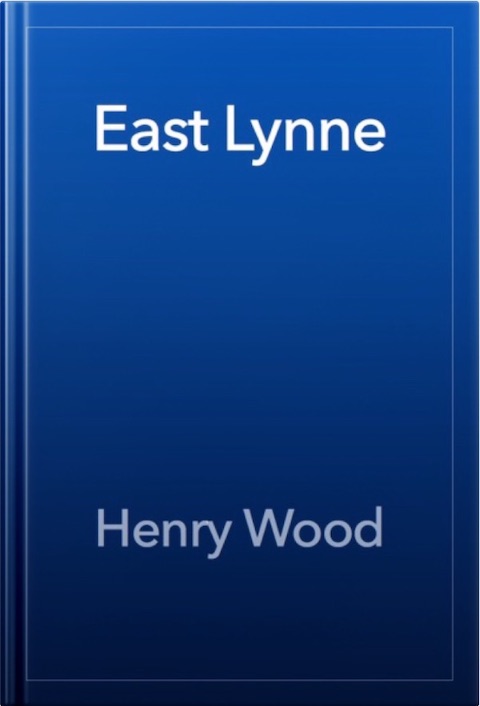
Tolstoy's influencers Dickens, Eliot, and Trollope continue to be widely read and taught, are the focus of a sizeable scholarly literature, and each has been the subject of more than one biography. As the omission of Mrs. Wood's name from the publicity materials of the films may signal, as the 20th century progressed Mrs. Wood's readership and literary reputation went into steep decline, particularly after the 1930s. In the 21st century she has fallen into such obscurity that e-book versions of her novels, including East Lynne, are sometimes attributed to "Henry Wood," dropping the honorific "Mrs." and so suggesting that it was Ellen's husband who wrote her books.

Cover of East Lynne by "Henry Wood" downloaded from Apple Books.

Perhaps, though, there are signs of a revival of interest in Mrs. Wood. A scholarly edition of East Lynne was issued by Broadview Press in 2000, and the first book-length biography of Mrs. Wood, by Mariaconcetta Costantini, was published in 2020.

Victorian critic Alexander Japp wrote that Mrs. Wood "combined in a remarkable degree these two powers or qualities—realistic portraitures of men and women, with invention, construction, and surprises. She successfully used sensational elements for moral ends." [5] As Japp points out, most of Mrs. Wood's characters (Francis Levison perhaps excepted) are "realistic portraitures" rather than cardboard heroes or villains. Mr. Carlyle is a respectable solicitor, and yet into his home and into close contact with his family he invites a wanted man, and later welcomes a notorious rake who is dodging his creditors. Barbara Hare, a candidate for the novel's heroine, expresses jealousy and resentment (as seen above). And Lady Isabel makes several poor choices, but her excessive suffering makes her the focus of the reader's sympathies.

Of course, the plot of East Lynne features some conspicuous implausibilities, and our moral judgments no longer closely align with those of Mrs. Wood's time. However, the narrator's comments that appear throughout the novel function, in my view, not to reinforce our moral judgments against Lady Isabel, but to call them into question. As Lady Isabel tells her husband, "My sin was great, but my punishment was greater." East Lynne deserves a contemporary readership for its compelling story (including a jaw-dropping plot twist two-thirds of the way through) and its multilayered characters. They, like ourselves, act out of a mixture of motives, and discover that actions taken in the heat of an impulsive moment can bring lasting regret.


  1. Jennifer Phegley, "Domesticating the sensation novelist: Ellen Price Wood as author and editor of the Argosy Magazine," Victorian Periodicals Review, Summer 2005, Vol. 38, No. 2, Interdisciplinary Work and Periodical Connections: An Issue in Honor of Sally H. Mitchell, pp. 180-198.
  2. Denis Goubert, "Did Tolstoy read East Lynne?" The Slavonic and East European Review, January 1980, Vol. 58, No. 1, pp. 22-39.
  3. The list of influential novels that Tolstoy shared in his letter was published in the New York Times, 2 April 1978: https://www.nytimes.com/1978/04/02/archives/selection-tolstoy-was-impressed.html. According to Denis Goubert (see note 3), the 1939 edition of Tolstoy's Works states that his library held eight novels by Mrs. Wood, including East Lynne. A manuscript catalogue dating from the half-decade or so after his death lists only six.
  4. The Dickens novels included on the list of the "100 Best Novels" are Martin Chuzzlewit, Nicholas Nickleby, The Old Curiosity Shop, Dombey and Son, and Oliver Twist; not included are David Copperfield, Bleak House, Great Expectations or A Christmas Carol. The Eliot novel is Scenes of Clerical Life; not included are Silas Marner, The Mill on the Floss, Daniel Deronda, or Middlemarch. The Trollope novel is Orley Farm, not included are any of the Chronicles of Barsetshire, the Palliser novels, or The Way We Live Now.
  5. Quoted in Phegley, p. 194.

Sunday, March 5, 2023

The Look of Love

Mark Morris Dance Group, The Look of Love. Image source: The Look of Love

In the summer of 1993 a good friend invited me to go see the opening night of soul legend Jerry Butler's five-night stand at the Kimball's East nightclub in Emeryville, a small city on San Francisco Bay wedged between Berkeley and Oakland. Butler, of course, had hits with "For Your Precious Love" (with the Impressions), "He Will Break Your Heart" (with Curtis Mayfield), "Never Give You Up," "Only the Strong Survive," and many other songs, and co-wrote Otis Redding's "I've Been Loving You Too Long (To Stop Now)." But the mid-90s were three decades past Butler's 1960s peak, and at the start of his 75-minute set his voice was a gravelly echo of the mellow baritone familiar from his classic records. It was great to see him in such an intimate club, but it seemed like the voice might no longer be fully under his command.

But it only took a song or two for his voice to warm up, and soon the years had fallen away. Midway through the set he sang a song that wasn't familiar to me, but the power and emotion of his performance brought us all to our feet. Here is Butler's original recording from 1962:

https://www.youtube.com/watch?v=Qvuk9KddXb8

I later learned that "Make It Easy On Yourself" was written by Burt Bacharach and Hal David. This was Bacharach and David? I had always thought of them as the Kings of Easy Listening, writing songs that seemed wilfully disconnected from the musical and social currents of their time.

In the late 1950s and early 1960s as rock 'n' roll, doo wop, R&B and Motown were surging onto the pop charts, Bacharach was churning out bland Brill Building pop for Frankie Avalon, Perry Como, Bobby Vinton, and Andy Williams. A few years later, around the time of the release of The Beatles' Sgt. Pepper's Lonely Hearts Club Band and the blistering sets by Otis Redding, Janis Joplin, and Jimi Hendrix at the Monterey Pop Festival, Bacharach and David were writing the score of the painfully unfunny James Bond spoof Casino Royale for Herb Alpert and the Tijuana Brass. [1]

In 1969, the year of Woodstock and Altamont, B.J. Thomas had a hit with "Raindrops Keep Fallin' on My Head," one of my least favorite Bacharach/David songs (and one that makes no sense in its original context in Butch Cassidy and the Sundance Kid). The following summer, The Carpenters' version of "Close To You" spent more weeks at number one (four) than The Beatles' final single, "The Long and Winding Road" (two) or Edwin Starr's "War" (three). [2]

After hearing Butler's stunning performance of "Make It Easy On Yourself," though, I clearly needed to reassess Bacharach and David. And I soon discovered that I'd dismissed their music far too quickly. Songs like "Anyone Who Had A Heart," "I Just Don't Know What To Do With Myself," "Always Something There to Remind Me," and "One Less Bell To Answer" are miniature pop symphonies, with complex melodies that incorporate wide vocal ranges, unexpected key changes, shifting time signatures, and unusual syncopation. They are memorable but intricate; try singing along with any of them and you'll encounter surprises.

Of course, Bacharach and David's greatest exponent was Dionne Warwick:

https://youtu.be/GswJOWEkLJM?t=2

Mark Morris's The Look of Love (seen at Zellerbach Hall, Berkeley, 19 February 2023), choreographed to Bacharach/David songs, is a follow-up to 2017's Sgt. Pepper homage Pepperland. Once again, instantly familiar music from the 1960s is defamiliarized by the jazzy, frequently off-kilter arrangements of MMDG Music Ensemble's director and pianist Ethan Iverson; once again, the dancers wear brightly colorful 1960s-Pop-inspired costumes (this time by Isaac Mizrahi channeling Pepperland's Elizabeth Kurtzman channeling Carnaby Street's Mary Quant).

https://www.youtube.com/watch?v=DhH5sjrj-QU

Seeing the Mark Morris Dance Group is always pleasurable, but the elements of this piece didn't quite cohere. Morris's choreographic invention did not seem to be at its peak in this work; some of the elements and gestures seemed either borrowed from earlier pieces, or too directly illustrative of the lyrics (although it would be difficult to resist having the dancers all point in the same direction during "Do You Know The Way To San Jose?" or walk past each other in "Walk On By"). "Thin" is the way my partner described it, not a word we usually associate with Morris.

One danger in using such well-known music is that comparisons with the original versions are inevitable, and in this case did not favor the MMDG Music Ensemble. Iverson's stripped-down arrangements for piano, trumpet, bass and drums meant that the orchestral lushness of many of the songs was missing, and from our seats at the back of the mezzanine trumpeter Jonathan Finlayson was consistently too loud in the mix. Lead vocalist Marcy Harriell's bright soprano was at times noticeably flat (this was the third performance in a three-performance run, and a matinee after an evening performance, so she may have been a little tired; also, she was competing with our memories of Dionne Warwick and Dusty Springfield). Iverson's spiky arrangement of "Raindrops," like his deconstruction of "When I'm Sixty-Four" from Pepperland, helped us hear overfamiliar music in a fresh way, and "Do You Know The Way To San Jose" and "I Say A Little Prayer" are pretty irresistible in any form. But after the show we wondered whether we would have gone to a club to hear this music performed by the band alone, and the answer was no.

But at least The Look of Love sent me back to Bacharach's music and to the exploration of the riches of YouTube—such as this performance of "I Say A Little Prayer" by the incomparable Aretha Franklin:

https://www.youtube.com/watch?v=7Ifw8JhDBvs [3]


  1. For some context, here are signature songs by Otis Redding, Janis Joplin, and Jimi Hendrix at the Monterey Pop Festival. 
  2. "Close to You" was originally recorded in 1963 by Richard Chamberlin. A warning: once Chamberlain's version is heard, it can't be un-heard.
  3. I can't resist linking to another live version of this song, which is notable both for another remarkable performance by Aretha, and also because the cameramen and director are clearly enamoured of her gorgeous backup singers.