Sunday, August 18, 2024

The problem is me, part 4: U2

U2, International House Assembly Hall, University of Chicago, Saturday 11 April 1981

U2 performing on 11 (?) April 1981. Photos: Paul Sandberg. Image source: NewCity

In April 1981 U2 was a new band from Ireland whose first album Boy, released in the US just a month earlier, had begun to get play on college and even some commercial FM radio stations. Their sound was somewhat reminiscent of John Lydon's post-Sex Pistols band Public Image Ltd., especially PiL's First Issue album. Unlike Lydon, though, who sneered and ranted his way through songs, U2's singer Bono had a soaring tenor voice—almost too good for a rock band. (Displays of conventional vocal talent made me suspicious of a rock band's sincerity. Funny that I never have that problem with opera.)

During U2's first US tour they were appearing at the Park West in Chicago, but it was announced that earlier the same day they would do a show at the University of Chicago's International House. It seemed worth taking a chance: tickets for the I-House show only cost $1, and a free beer was included. There's a contradiction in the dates: the Park West show was evidently on Sunday 12 April (here' the setlist for the Park West concert) but various sources state that the University of Chicago show was on Saturday 11 April. I didn't keep a journal at the time, so I can't supply my own confirmatory evidence for either date. I will say that I remember feeling that I had to put in some study hours that night, which accords more closely with a Sunday than a Saturday performance. On the other hand, this was the University of Chicago, where studying on a Saturday night was not an unknown occurrence, particularly if there was a Monday morning exam.

I recall that it was an early-evening show that started around 6 pm: more evidence that it may have happened the same day as their Park West show. While it was still light outside a dear friend and I found ourselves with several hundred other people standing in the I-House Assembly Hall waiting to see what this group would be like. This video clip from Swedish television accords with my memory of what I heard and saw, including Bono's energetic onstage presence and white shirt.

https://youtu.be/98lkI64TmZQ?t=4

You'll notice in the photos above no white shirt is in evidence, a circumstance I can't explain—my memory is extremely vivid. Either that memory is false, or Paul Sandberg's photos are from their Park West performance.

The band played through practically their entire first album (here's the setlist for the I-House show) and then for an encore, almost out of material, repeated some of the songs they had already played. A recording of the I-House show has been posted to YouTube, and the song order matches the setlist linked above. The sound quality is not pristine by any means—perhaps it was recorded by someone in the audience on a Walkman?—but it's fun to hear the energy of the band and the enthusiasm of the crowd:

https://youtu.be/tXniHoUU47o

After the concert my friend and I agreed that we'd enjoyed the band's music, but neither of us were moved to make the commitment of buying their album ($6.98 was serious money for us in those days). We had no clue that within a few years U2 would become, for many, the defining band of the decade.

Perhaps U2 made a greater impression on me than I was willing to acknowledge at the time. The following year I joined a band, and our setlist included "I Will Follow." Hubris, certainly, but fortunately our vocalist and lead guitarist, both very talented musicians, were up to the challenge. I can't say that my moves on bass or my haircut were as cool as Adam Clayton's, though.

Coda: For the story of how U2 came to play the I-House as told by the man who brought them there, see this post by the Major Activities Board's Bart Lazar. He states that people were trying to climb through the windows to get into the show. I don't want to dispute his memory, but as I recall, although the crowd was sizeable, there was no trouble getting tickets—I think we walked up and bought ours at the door—and $1 was within the reach even of an impoverished undergrad like me. Perhaps the show ultimately sold out, but if so it was long after we got there.

Last time: Ramones

Sunday, August 11, 2024

Mozart Summer: The Magic Flute and Don Giovanni

This has been Mozart Summer in San Francisco, with film-inspired productions of The Magic Flute (Die Zauberflöte) by San Francisco Opera and Don Giovanni by the Merola Opera Program.

The Magic Flute

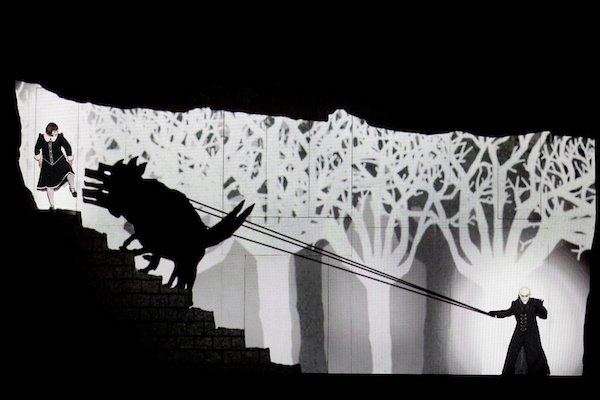
Pamina (Christina Gansch) is terrorized by Monostatos (Zhengyi Bai) in Mozart's <i>The Magic Flute</i> at SF Opera

Pamina (Christina Gansch, left) is terrorized by Monostatos (Zhengyi Bai, right) in Mozart's The Magic Flute at SF Opera. Photo credit: Cory Weaver. Image source: SF Opera

Performers: Amitai Pati (Tamino), Lauri Vasar (Papageno), Anna Siminska (The Queen of Night), Zhengyi Bai (Monostatos), Christina Gansch (Pamina), Kwangchul Youn (Sarastro), Arianna Rodriguez (Papagena), with the SF Opera Orchestra conducted by Eun Sun Kim.
Production: Barrie Kosky and Suzanne Andrade; animation design: Paul Barritt; stage and costume design: Esther Bialas; company: San Francisco Opera; venue: War Memorial Opera House. Seen June 30.

In an earlier post I outlined the problems with Emanuel Schikaneder's libretto for Mozart's The Magic Flute: I find it racist, sexist, misogynistic, hypocritical, and dislike its use of spoken rather than sung dialogue. Barrie Kosky and Suzanne Andrade's clever production solves some of these problems by turning the opera into a Weimar-era expressionist film. That takes care of the problematic stretches of dialogue, which in a very clever and effective idea are replaced by intertitles. The bird-catcher Papageno (Lauri Vasar) is dressed like Buster Keaton, the captive princess Pamina (Christina Gansch) wears a Louise Brooks bob, and the villainous Monostatos (Zhengyi Bai) is made up and costumed to look like Max Schreck's Nosferatu.

Max Shreck as the vampiric title character in F.W. Murnau's Nosferatu, eine Symphonie des Grauens (Nosferatu: A Symphony of Horror (1922))

Max Schreck as the vampiric title character in F.W. Murnau's Nosferatu, eine Symphonie des Grauens (Nosferatu, A Symphony of Horror (1922)).

That last alteration significantly reduces the racism; in the original libretto, the impulsive, lustful and treacherous Monostatos is characterized as "ein Mohr"—a Moor.

All the singers wear the heavy whiteface makeup worn by actors in the silent era. Projected animations referencing Lotte Reiniger's "silhouette-film" The Adventures of Prince Achmed (1926)—as well as Disney's Dumbo (1941) and Peter Pan (1953)—create the spaces in which the characters enact the story. [1]

The Queen of Night (Anna Siminska) is turned into a giant black spider:

The Queen of Night (So Young Park) and Prince Tamino (Bogdan Volkov) in LA Opera’s 2019 production of the Kosky/Andrade/Barritt/Bialas Magic Flute

The Queen of Night (So Young Park) and Prince Tamino (Bogdan Volkov) in LA Opera’s 2019 production of the Kosky/Andrade/Barritt/Bialas Magic Flute. Photo credit: Cory Weaver. Image source: San Francisco Classical Voice

After her Three Ladies (Olivia Smith, Ashley Dixon and Maire Therese Carmack) rescue Prince Tamino (Amitai Pati) from a giant serpent, the Queen of Night demands that he free her daughter Pamina, who is being held captive by the evil mage Sarastro (Kwangchul Youn). But Tamino will discover—no surprise, perhaps, considering the source of the information—that all is not what it seems. The Queen of Night's appearance as a menacing maternal arachnid seemed to refer to Louise Bourgeois's huge sculpture Maman (Mother, 1999):

Louise Bourgeois's spider sculpture Maman in Bürkliplatz, Zürich, Switzerland

Louise Bourgeois's Maman in Bürkliplatz, Zürich, Switzerland. Photo credit: Roland zh. Image source: Wikimedia Commons

As the images and descriptions above may suggest, the staging is visually astonishing and brilliantly allusive, as you can also see in the trailer below:

https://youtu.be/hTQQTx61vCo

However, the production concept creates two issues which work against its effectiveness. The first is the mismatch between the visual allusions and the opera's characters. Papageno is not a stone-faced stoic like Keaton—on the contrary, he always wears his heart on his sleeve. (The Harold Lloyd of Safety Last! (1923) or Chaplin's Little Tramp might have been a better parallels.)

Esther Bialas' costume design for Papageno as Buster Keaton

Esther Bialas' costume design for Papageno. Image source: SF Opera

And Pamina is neither a femme fatale like Lulu in Pandora's Box (1929) nor a "lost girl" (that is, prostitute) like Thymian Henning in Diary of a Lost Girl (1929), Louise Brooks' two most iconic roles.

Pamina (Zuzana Marková) in LA Opera’s 2019 production of <i>The Magic Flute

Pamina (Zuzana Marková) in LA Opera’s 2019 production of The Magic Flute. Photo credit: Cory Weaver. Image source: San Francisco Classical Voice

The second issue is that the animations and film references function as distancing effects: the characters, their relationships and dilemmas get a bit lost in the constant flow of clever images and staging. Also, some of the character transformations are themselves problematic: the Queen of Night's characterization as a venomous spider makes her monstrous. That choice reinforces, rather than calls into question, the libretto's misogyny, and rather than complicating our understanding of the opposition between the Queen of Night and Sarastro, renders it more starkly, well, black & white.

https://youtu.be/RlAImMuZSWo

The voices were all very good, although Gansch's delivery of Pamina's sorrowful "Ach, ich fühl's" perhaps lacked ideal warmth of tone. But for this viewer that was generally true of the production: amid the spectacle, emotion largely went missing. I would definitely see this staging again to try to take in more of the amazing imagery. But when I want to be moved by Mozart's music, Otto Klemperer's 60-year-old recording remains unsurpassed.

Don Giovanni

The servant Leporello (Donghoon Kang) clings to his master Don Giovanni (Hyungjin Son) in the Merola Opera Program's production of Don Giovanni. Photo credit: Kristen Loken; image source: SF Classical Voice

Performers: Hyungjin Son (Don Giovanni), Donghoon Kang (Leporello), Lydia Grindatto (Donna Anna), Viviana Aurelia Goodwin (Donna Elvira), Moriah Berry (Zerlina), Justice Yates (Masetto), Benjamin R. Sokol (Commendatore), and Michael John Butler (Don Ottavio) with the San Francisco Opera Center Orchestra conducted by Stefano Sarzani.
Production: Patricia Racette; scenic design: Andrew Boyce; lighting design: Davida Tkach; projection design: Ian Winters; costume design: Annie Smart; company: Merola Opera Program; venue: Caroline H. Hume Concert Hall, SF Conservatory of Music. Seen August 3.

From Weimar 1927 to Rome 1950: the inspiration for director Patricia Racette's production of Don Giovanni was the neorealist film movement in postwar Italy. During the overture we see a cameraman setting up on location and singers arriving pre-performance and trying on costumes. Projections (by Ian Winters) on the single set provided the backdrops for every scene, and sometimes looked "scratchy" like old celluloid.

But this conceit wasn't developed much further, and it didn't need to be. Racette is a highly regarded soprano with a long career at many American and European opera companies and a mantelpiece-full of awards. Based on this production, her stage experience really shows in her direction (she herself sang Donna Elvira at the Opera Theatre of St. Louis in 1998).

Her focus was less on the concept and more on helping the performers create fully fleshed-out characterizations. Interactions among the characters were also carefully thought through. As a result, this seemed more like a true ensemble work than merely a showcase for Hyungjin Son's excellently-sung Don Giovanni. The Rome 1950 concept wasn't entirely incidental, though: it did allow the women characters to wear some fabulous 1950s frocks, an opportunity not wasted by costume designer Annie Smart.

The aftermath: Masetto (Justice Yates) and Zerlina (Moriah Berry), Leporello (Donghoon Kang) and Donna Elvira (Viviana Aurelia Goodwin), and Donna Anna (Lydia Grindatto) and Don Ottavio (Michael John Butler) survey the wreckage and formulate plans after Don Giovanni's hellish demise. Photo credit: Kristen Loken; image source: SF Classical Voice

In addition to the Don Juan stories, Mozart's librettist Lorenzo Da Ponte is rumored to have based the character and exploits of Don Giovanni on his friend Giacomo Casanova. Let's hope not: over the course of the opera Don Giovanni, supposedly a great seducer, sexually assaults two women. [2]

The first is Donna Anna (the superb Lydia Grindatto, a singer clearly ready for major stages), daughter of the Commendatore (an impressively sonorous Benjamin R. Sokol) and the fiancée of Don Ottavio (sung lyrically and with more than usual ardency by Michael Jean Butler). Don Giovanni enters the Commendatore's house in disguise and surprises Donna Anna in her bedroom; in Racette's version there is no question that his rape attempt is strongly resisted. When Donna Anna raises the alarm, her father pursues and challenges the fleeing attacker. In the ensuing clash, the Commendatore is killed (Racette's direction brought out the brutality of this moment) and the unrecognized Don Giovanni flees. Donna Anna then demands a pledge from Don Ottavio to find her father's killer and avenge his death.

Don Ottavio (Michael Jean Butler) attempts to comfort Donna Anna (Lydia Grindatto) for the death of her father the Commendatore (Benjamin R. Sokol). Photo credit: Kristen Loken; image source: SF Classical Voice

The escaping Don Giovanni and his servant Leporello (well sung by a wonderfully hangdog Donghoon Kang) encounter Don Giovanni's former lover Donna Elvira (portrayed with beautifully mixed emotions by Viviana Aurelia Goodwin). Donna Elvira vows to try to thwart Don Giovanni's attempts to seduce other women, and joins forces with Donna Anna and Don Ottavio.

Don Giovanni and Leporello happen across the country wedding of Masetto (a firm-voiced Justice Yates) and Zerlina (sung beautifully and with an appropriate hint of vulnerability by Moriah Berry). He invites the whole party back to his palazzo and, with Leporello's aid, separates wife and husband. At he first seems to be making some headway with Zerlina, who is tempted by his wealth, status, and suavity. But swiftly losing patience with his lack of continued progress, he pounces. Her screams disrupt the party, which Donna Anna, Donna Elvira, and Don Ottavio are attending in masquerade. As Don Giovanni accuses Leporello of being the culprit, Donna Anna recognizes his voice as that of her attacker. Don Giovanni will escape all human retribution, though. . .

The score was crisply played by the authentically-sized SF Opera Center Orchestra under the assured baton of Stefano Sarzani. In short, this was a superior performance of this opera vocally, musically, and in its thoughtful and detailed staging by Racette. Many a major opera company would love to be able to produce a Don Giovanni so well-performed and -directed.

For another review, please see Lisa Hirsch, "Don Giovanni Gets a Powerful Production From Merola Opera Program," SF Classical Voice, 5 August 2024, which was the source of the images in this part of the post.


  1. Regarding the elements of this Magic Flute production that aren't consistent with the silent film era, such as Dumbo and Tinkerbell, in an interview included in the program Paul Barritt says that "we take our visual inspiration from many eras. . .the actual year isn't important as long as everything comes together visually."
  2. We learn that Don Giovanni has also coerced a third, Donna Elvira, with false promises of marriage. The multiplication of these "seduction" techniques by the 2,065 women he has slept with (according to Leporello's "Madamina, il catalogo è questo") is left as an exercise for the reader.

Sunday, July 14, 2024

The problem is me, part 3: Ramones

Cover of the Ramones' first album. Photo credit: Roberta Bayley. Image source: Discogs.com

As described in the first post in this series, The problem is me: The Sex Pistols, Steve Jones, and Lonely Boy, hearing The Sex Pistols on my college radio station in 1978 was a life-altering experience. One of the many changes it inspired was that I began to seek out the music of other punk bands. The New York publications I started to explore, including the Village Voice and the New York Rocker, extolled a group of four leather-jacketed guys from Queens who called themselves the Ramones.

It was an era when rock album covers often displayed fantasy art featuring spaceships, surrealist landscapes, knights or wizards. In stark contrast, the Ramones' first album offered a grainy black and white photo of the band standing against a grafittied brick wall. Each Ramone wore the bands' uniform of black leather jacket, well-worn blue jeans, and sneakers. And on the back cover Joey (born Jeffrey Hyman, vocals), Johnny (born John Cummings, guitar), Dee Dee (born Douglas Colvin, bass), and Tommy (born Thomas Erdelyi, drums) each took the last name Ramone, as though they were a band of brothers. By punk standards their hair was shockingly long (for the origins of the spiky punk haircut, see Betrayal takes one: Richard Hell).

The songs on that first album were incredibly simple and short, usually constructed around three chords and rarely lasting more than two minutes. They were also incredibly catchy, with melodies hearkening back to the early 60s. On that first album "I Wanna Be Your Boyfriend" and "Listen To My Heart" sounded like lost classics, and they covered "Let's Dance" by Chris Montez. They'd go on to cover "California Sun" (The Rivieras) on Leave Home, "Do You Wanna Dance?" (Bobby Freeman) and "Surfin' Bird" (The Trashmen) on Rocket to Russia, "Needles and Pins" (The Searchers) on Road to Ruin, "Baby I Love You" (The Ronettes) on the Phil-Spector-produced End of the Century, and many others.

They quickly became one of my favorite groups, but I was suspicious of my own enjoyment. While they were one of the first CBGB bands and some of their songs portrayed gritty New York street life (hustling in "53rd & Third," hitching a ride to an urban beach in "Rockaway Beach," scoring heroin in "Chinese Rock"), other songs evoked the worlds of comic books and horror movies. Were the Ramones an elaborate joke, or did they mean it, man? (That the answer to that question could be "both"—that they were completely sincere, and at the same time had a sense of humor about their obsessions—was hard for me to grasp.)

Ramones, Ritchie Coliseum, University of Maryland College Park, Tuesday 14 July 1981

Mark Sullivan, "The cretins bop," The Diamondback, 16 July 1981, p. 6. Photo credit: Debbie Gertler.
Image source: University of Maryland Libraries

I had seen the Ramones for the first time in May 1980 at Ida Noyes Gym at the University of Chicago. I had stayed out overnight in line to buy tickets, needlessly afraid that they'd sell out, but when I awoke cold and sore on the flagstones there were perhaps only twenty people in line with me. Sensible people waited until the box office opened that day, walked up and bought their tickets; the show didn't sell out. (An amazingly loyal friend stuck it out with me all night. When I opened my eyes and realized that it had been pointless, I felt worse for him than for myself.) Perhaps it was my lack of sleep, the bright gym lighting on the Ramones' pasty skin—the gym definitely lacked a rock 'n' roll ambience—or the relatively sparse and largely uninvolved crowd, but after the concert that night I left feeling underwhelmed, even chagrined. If the Ramones were a joke, it was on me.

But despite that first experience, while home the next summer in Baltimore I decided to drive 45 minutes to the University of Maryland on a Tuesday night (a work night!) to see them again. It was a summer in Baltimore; to paraphrase Bruce Springsteen, what else was I going to do? When I walked into the venue, my heart sank: it was another gym, this time the arena where the Terrapin volleyball teams played. It was cavernous, seating perhaps 1500 people on bleachers, with standing room for another 750 or so on the floor. Only about two or three hundred people had shown up to the Ramones gig at the University of Chicago, and although the University of Maryland was substantially larger, it was summer. I feared that there would be a relative handful of us rattling around in this huge space. A less congenial place to see a band like the Ramones was hard to imagine.

But to my amazement, the arena kept filling; ultimately it was packed. And when the Ramones took the stage they seem to have been inspired by the size and enthusiasm of the crowd. They played one of the fiercest, tightest, most intense sets I've ever witnessed. No sooner would one song end in ringing feedback from Johnny's guitar than Dee Dee would count off "onetwothreefo" and they'd launch into another song. I was right in front of the stage in the mosh pit, and it was in a constant frenzy. I later read that the band blazed through 34 songs in an hour, which is completely believable. For a taste of how fast and tight they could be, here is a clip of "Cretin Hop" from their 1977 New Year's Eve show at the Rainbow Theatre in London:

https://www.youtube.com/watch?v=tkucRqyySdA

At the end of the concert I staggered out into the humid Maryland night completely soaked in sweat, bruised, battered, and happily exhausted. This still ranks among the best concert experiences I've ever had. Some bands didn't need to experiment much; they just needed to perfect what they were.

Coda: Although they played hundreds of concerts a year to tens of thousands of fans, the Ramones never achieved the radio play they wanted or the recognition they deserved. Unfortunately, none of the members of the original band is still alive: Joey died in 2001 (of lymphoma), Dee Dee in 2002 (heroin overdose), Johnny in 2004 (cancer), and Tommy in 2014 (cancer).

After the death of Joey Ramone in April 2001 it emerged that in his final moments of consciousness in the hospital he had asked to hear U2's "In A Little While." During U2's summer tour that year Bono would introduce the song by paying tribute to Joey and the Ramones. At a concert in Boston in June he introduced the song by saying "This is a song that Joey Ramone loved. . .it was the last song that Joey Ramone heard in his life here. And that's an amazing thing for someone who grew up as a fan of Joey Ramone."

https://www.youtube.com/watch?v=FbJXwG-1Oy4 (song ends at 4:20)

At a concert in Berlin in July he asked a woman in a Ramones t-shirt to come on stage, and then said, "The Ramones are the reason why we started this band, and we owe so very much to the Ramones." U2 then performed the song with the utterly dazzled woman clinging to Bono throughout. The moment was captured by an audience member on video. 

But U2 hadn't always played arenas.

Next time: U2 at the International House Assembly Hall, University of Chicago, 11 (or 12?) April 1981.

Last time: The Psychedelic Furs at the Marble Bar

Sunday, June 30, 2024

The problem is me, continued: The Psychedelic Furs at the Marble Bar

Psychedelic Furs, Marble Bar, Baltimore, Sunday 5 July 1981

A George Herriman-inspired flyer for the Marble Bar announcing the upcoming Psychedelic Furs show. [1]
Poster by George R. Wilcox/Musigrafix. Image source: Accelerated Decrepitude

After the end of the academic year in Chicago I would return to the family home in Baltimore to work for the summer. There were three advantages to being at home: I didn't have to pay for meals, I had the use of a car, and the drinking age in Baltimore was only 18, which meant I could see shows at venues where alcohol was served. The chief disadvantage, of course, was that I was living at home.

Fortunately for my sanity Baltimore had become home to the City Paper, an alternative weekly similar to Chicago's Reader and New York's Village Voice. As part of my exploration of punk rock (see The problem is me) I began to notice ads for interesting-sounding shows at a place called the Marble Bar. It was located on West Franklin Street in the basement of the Congress Hotel, a former luxury hotel that was now an SRO in a run-down neighborhood just north of downtown. The Marble Bar had live local bands almost every night and once or twice a month hosted a group on tour.

To enter the Marble Bar you had to walk down narrow, dimly-lit stairs into a vast basement room. On the far side was a bar of solid marble. I've seen multiple online claims that the bar was 72 feet long; whatever its dimensions, it was huge.

The Marble Bar's marble bar. Image source: Baltimore Business Journal

The owners, Roger and LesLee Anderson, tended bar except when they'd take the stage with the house band (otherwise known as The Alcoholics) to do vintage rock 'n' roll covers. As I recall, a can of Budweiser cost $1. I would generally buy one when I arrived and then nurse it for the rest of the night. In my defense, I was an impoverished student and was supposed to be saving money for my return to college in the fall. And hey, it probably made for a safer drive home after closing.

LesLee and Roger Anderson at the Marble Bar. Photo courtesy LesLee Anderson. Image source: Baltimore Magazine

I don't remember the first night I went there in the summer of 1979 or 1980, but I soon went there regularly on Friday or Saturday nights. (Yes, I was one of the derided "weekend punks.") I would also go on a worknight (ah, youth) if a band I'd heard of was appearing there.

For a Baltimore basement dive the Marble Bar hosted some surprising shows, including Black Flag with the Minutemen (circa What Makes A Man Start Fires?), the Bush Tetras (circa Rituals), The Cramps (circa Smell of Female), the Dead Boys (circa Night of the Living Dead Boys), the Dead Kennedys (circa In God We Trust, Inc.), Iggy Pop (circa New Values), Sonic Youth (circa Confusion is Sex), The Teardrop Explodes (circa Kilimanjaro), Johnny Thunders and Jerry Nolan, the Undertones (circa Positive Touch), and X (circa Wild Gift—a great show, and unfortunately one of only two of those listed that I was able to see, the other being the Bush Tetras). Baltimore's location between New York City and Washington DC meant that it was a logical place for bands to stop over on their East Coast tours, and musicians probably spread the word about Roger and LesLee's stalwart support of the local scene.

Poison Ivy of The Cramps at the Marble Bar, 2 March 1983. Image source: Jim M (Flickr)

The bar wasn't air-conditioned and the only ventilation was its open door, so on nights when it was packed it could get pretty muggy and airless. It was, of course, also the era when people smoked in bars, and so before the night had advanced very far there was always a thick pall of (mostly) cigarette smoke hanging in the air. When you arrived home after a night at the Marble Bar your hair and clothes smelled like an ashtray.

The most crowded I ever saw the place was when the Psychedelic Furs played there. Like so many English punk and new wave bands they were formed after a Sex Pistols concert, but their sound also hearkened back to the early 70s glam rock era. [2] Like Roxy Music, the Furs included a saxophonist (Duncan Kilburn) in their lineup; like Lou Reed and David Bowie, vocalist Richard Butler sounded world-weary and his lyrics were often elliptical. But although their sound drew on many influences, Butler's gravelly, whiskey-and-cigarettes vocals and John Ashton's flanged guitar also made it distinctive.

The Marble Bar had a sign near the door announcing that the maximum occupancy was 449 people, but I'm guessing there were many more jammed into the club that night. We were so tightly wedged together in front of the stage that you couldn't move; had there been a fire none of us would have made it out alive. I have no idea how the Furs made their way through the densely packed crowd massed between the dressing rooms and the low platform that served as the stage, but somehow the band suddenly materialized a few feet in front of me. In addition to Richard Butler, Ashton and Kilburn, the band included Roger Morris on second guitar, Butler's brother Tim on bass, and Vince Ely on drums. When they launched into the first song, "Into You Like A Train," we all started jumping up and down in unison, because that was the only way you could move. And if the people jammed up against you were jumping up and down, you did too. I understood instantly why English punks had invented the pogo.

The Furs had just released their second album, Talk Talk Talk, and played most of its songs, including "Mr. Jones," "All of This and Nothing," and "Pretty in Pink," plus many favorites from their first album (here is the setlist). Although they would go on later to have some hit synth-pop and dance singles, and "Pretty in Pink" would even become the title song of a John Hughes movie [3], for me the band was at its peak this July night in a sweaty Baltimore basement.

Astonishingly, the Marble Bar show was recorded and has been posted. I'm amazed that 43 years later I can, at least aurally, relive that night, sound system issues and all (you can hear the high end drop out towards the end of "Pretty in Pink" at about 27:24 in the video, and it stays out for the rest of the show). At the end of the show (around 55:12 in the video) Roger Anderson says "this is one of the best shows we've ever had here," while apologizing for the sound and proactively refusing the refunds that no one was asking for—we just wanted an encore. A very Marble Bar moment. I don't recall being disappointed by the sound, but I was very close to the stage—so close that I remember watching the ever-lengthening ash on Richard Butler's cigarette, waiting for it to fall. The song "Fall" from their first album was not, alas, on their set list; probably it was planned for an encore that didn't happen due to the sound system issues. Whatever the problems with the sound system, it was a great concert and a peak Marble Bar experience.

https://youtu.be/KjQn895U4n0

Coda: On 26 April 1984 Roger Anderson had a fatal heart attack in the Marble Bar. [4] LesLee tried to keep the club going for another year or so, but in May 1985 she gave up the lease. Apart from some sporadic shows over the next few years the Marble Bar has been empty ever since, and the neighborhood is even more desolate now than it was then.

I'm clearly far from the only person with fond memories of the Marble Bar. Tom Warner's blog Accelerated Decrepitude offers some excellent posts about the place and the people who made it special:

Baltimore Magazine published a good retrospective on the 35th anniversary of the Marble Bar's third "closing forever" party in 1987:

The Psychedelic Furs show at the Marble Bar was not the only memorable event of that summer. Just nine days later I went to see another exhilarating show by a favorite band in a very different venue: a volleyball gym.

Next time: Ramones

Last time: The problem is me: The Sex Pistols, Steve Jones, and Lonely Boy


  1. The flyer suggests that the show took place in June; however, a June calendar for the club doesn't list a Furs show, and multiple sources (including Setlist.fm and YouTube) confirm the 5 July date. Note the $5 ticket price (in advance).
  2. Alex Ogg, "All Of This And Nothing: The Psychedelic Furs On Talk Talk Talk." The Quietus, 2010, https://thequietus.com/articles/05128-the-psychedelic-furs-interview-talk-talk-talk/
  3. In Alex Ogg's interview linked above, Richard Butler says "The idea of the song was, 'Pretty In Pink' as a metaphor for being naked. The song, to me, was actually about a girl who sleeps around a lot and thinks that she’s wanted and in demand and clever and beautiful, but people are talking about her behind her back. That was the idea of the song. And John Hughes, bless his late heart, took it completely literally and completely overrode the metaphor altogether!"
  4. In the image of the article on Baltimore Or Less, the first character of every line in the first column is cut off, and so I think the transcription misstates the date of Roger Anderson's death. According to the retrospective article in Baltimore Magazine linked above, he died on 26 April 1984, not 6 April. [Since this was written, almosthipguy (Tom Warner) has corrected the date—many thanks!]

Sunday, June 23, 2024

Poor Things

Poor Things film poster

Poster for Poor Things. Image source: CelebMafia.com

Poor Things (2023), starring Emma Stone, Willem Dafoe, Ramy Youssef, and Mark Ruffalo; screenplay by Tony McNamara, based on the novel by Alasdair Gray; directed by Yorgos Lanthimos.

Poor Things, Yorgos Lanthimos' film version of the novel by Scottish writer Alasdair Gray, is a bit like a postmodern Bride of Frankenstein. In the opening moments of the film a young woman in Victorian dress commits suicide by leaping from London's Tower Bridge into the Thames. [1] We learn later that her corpse, still warm when pulled from the river, is revivified after receiving a brain transplant from her own unborn baby. We then follow the adventures and misadventures of Bella (Emma Stone), who has a child's rapidly developing consciousness housed in an adult woman's body.

Emma Stone as Bella Baxter in Poor Things

Bella Baxter (Emma Stone) in Poor Things. Costume design by Holly Waddington.

Godwin Baxter, the doctor who reanimates Bella, is portrayed in the film by Willem Dafoe. In a brilliant touch, his face is criss-crossed with scars, a visual correlative of the novel's hint that his famous surgeon father Sir Colin "had manufactured God by the Frankenstein method" (p. 274). Baxter is himself the product of an experiment [2]:

Willem Dafoe as Godwin Baxter in Poor Things

Godwin Baxter (Willem Dafoe) in Poor Things. Prosthetic design by Nadia Stacey.

In the novel, Baxter says of Bella that she

'has all the resilience of infancy with all the stature and strength of fine womanhood  Her menstrual cycle was in full flood from the day she opened her eyes, so she has never been taught to feel her body is disgusting or to dread what she desires. Not having learned cowardice when small and oppressed she only uses speech to say what she thinks and feels, not to disguise these, so she is incapable of every badness done through hypocrisy and lying—nearly every sort of badness. All she lacks is experience. . .' (Poor Things, p. 69)

Virtually every man she meets wants to exploit the beautiful but naïve Bella for his own sexual gratification. But Bella has her own agency, not to say wilfulness. Eager for the experience she lacks, she abandons her earnest fiancé, Baxter's assistant McCandless (Ramy Yousef; for no clear reason, McCandless is renamed Max in the film from the novel's Archibald) and runs off with hedonistic lawyer Duncan Wedderburn (Mark Ruffalo). In the novel, Bella reports in her letters to Godwin and Max that she frequently "weds" Wedderburn; in the film, instead of employing this cleverly apposite pun, she calls sex "furious jumping."

A child's brain in a woman's body is the misogynistic Wedderburn's erotic ideal. (And not only his, of course: the position of women in Victorian society is largely one of enforced childlike dependence.) Wedderburn tricks Bella into boarding a ship bound for the Mediterranean in the delusional hope that he can control her better onboard. But despite his best efforts he cannot prevent Bella from learning about the world through reading, conversation with cynical fellow passenger Harry Astley (Jerrod Carmichael), and direct experience. And with experience comes, as it does for all of us, the bitter knowledge of deceit, injustice, and cruelty: the immense suffering that humans, and the social and economic systems we've created, cause other humans.

Jerrod Carmichael as Harry Astley in Poor Things

Harry Astley (Jerrod Carmichael) in Poor Things.

When the ship makes port in Alexandria, Bella disembarks and is thrown into an intellectual and emotional crisis by the extreme poverty and misery she sees. This crisis awakens her moral conscience and her outrage. When Wedderburn finally gets lucky in the ship's casino, the unworldly Bella hands his winnings to two of the ship's crewmembers to distribute among the poor. (Of course, they only distribute the money between themselves.)

Bankrupt and thrown off the ship in Marseilles, Wedderburn and Bella make their way to Paris. There Bella encounters the madam Madame Swiney (Kathryn Hunter; in the novel her character is named Madame Cronquebil). Bella discovers that in Swiney's brothel she can earn money working only 20 (unpleasant) minutes every hour, and can spend the rest of her time as she chooses. In the brothel she is befriended by fellow prostitute Toinette (Suzy Bemba), who introduces her to both the principles of socialism and the joys of sapphism.

When Bella returns to London, unwelcome revelations await her. From Baxter she learns the horrifying truth of her origin. And then her wedding to McCandless is interrupted by her former husband Alfie Blessington (Christopher Abbott; the character is named Aubrey in the novel), a general in Britain's imperial army. With all the power of money and the law behind him (and aided by Bella's desire to learn about her past), he takes her back to the life that as Victoria Blessington she so desperately wanted to escape. She soon discovers why.

I've mentioned a few of the differences between the novel and the film above; there are many more, large and small. A very large one is the ending, which in Tony McNamara's screenplay is entirely rewritten. Gray's book is also set in a recognizable version of the historical 19th century; the film's elaborate production design by Shona Heath and James Price places the characters in an alternate world that gives us an ironic distance from the action. In a steampunk Lisbon, aerial trams whoosh by on cables; Alexandria looks like an Arabian Nights fantasy; and Madame Swiney's Paris brothel could have been designed by an erotomaniacal Antoni Gaudí.

Madame Swiney (Kathryn Hunter) watches from the doorway of her brothel as Bella approaches in Poor Things.

But the most significant difference is that the movie's focus is mainly on Bella's personal development rather than, as in the book, her awakening to the necessity of political action to bring about social change. In Lanthimos' movie Bella decides to become a doctor because, as she tells McCandless, Baxter's surgery is the place where she is happiest. In the book, it is because she discovers from Baxter that the city in which she lives is filled with "stinking, overcrowded rooms where you will find as much huddled misery as you saw in the sunlight of Alexandria" (p. 196). Bella studies medicine in order to combat the miseries of poverty by treating the sick, giving women the knowledge and means to control their own fertility, and fighting for basic measures of sanitation and public health. As she learns, "prevention of disease was more important than cure" (p. 198).

The novel has a multilayered metafictional structure that would be very difficult to realize on film; perhaps the production design is Lanthimos' attempt at recreating Gray's distancing effects in a visual medium. Purporting on the title page to be edited by Alasdair Gray, the novel opens with an introduction by him describing the discovery of the volume among boxes of discarded law office files, and closes with his "Notes Critical and Historical." In between lies the text of a memoir of which only one copy was ever printed. Written by Archibald McCandless, M.D., and intended for the eyes of his wife Victoria, it tells the story of Victoria's transformation into Bella. The memoir is followed by a letter from Victoria McCandless to her grandchildren disputing and complicating her husband's version of her life. She points out,

He has made a sufficiently strange story stranger still by stirring into it episodes and phrases to be found in Hogg's Suicide's Grave with additional ghouleries from Mary Shelley and Edgar Allan Poe. What morbid Victorian fantasy has he NOT filched from? I find traces of The Coming Race, Dr. Jekyll and Mr. Hyde, Dracula, Trilby, Rider Haggard's She, The Case-Book of Sherlock Holmes and, alas, Alice Through the Looking-Glass. . .He has even plagiarized work by two dear friends: G.B. Shaw's Pygmalion and the scientific romances of Herbert George Wells. (pp. 272-273)

Mild spoiler alert: The movie has a happy ending of sorts, with Bella finding fulfillment by creating a polyamorous intentional community around her. Although in The Communist Manifesto (1848) Marx and Engels wrote of a revolutionary society "in which the free development of each is the condition for the free development of all," Alasdair Gray's ingrained pessimism as a Scotsman, socialist, and student of history doesn't permit him to end on a note of merely personal contentment.

One of H.G. Wells' "scientific romances" is The War in the Air (1907), written just a few years after the Wright Brothers' first flight. Set just a decade or two after its publication date, the novel depicts aircraft as decisive weapons in a world war launched by Germany. As major cities are bombed into rubble, a global financial collapse and a virulent plague lead to the complete destruction of industrialized society. At the conclusion of the letter to her posterity, Victoria McCandless writes,

H.G.'s book is a warning, of course, not a prediction. He and I and many others expect a better future because we are actively creating it. . .H.G. Wells' warnings should be heeded. But the International Socialist Movement is as strong in Germany as in Britain. The labour and trade-union leaders in both countries have agreed that if their governments declare war they will immediately call a general strike. I almost hope our military and capitalistic leaders DO declare war! If the working classes immediately halt it by peaceful means then the moral and practical control of the great industrial nations will have passed from the owners to the makers of what we need, and the world YOU live in, dear child of the future, will be a saner and happier place. (pp. 275-276)

The letter is dated "1st August, 1914."

Cover of Alasdair Gray's novel Poor Things

  1. Alasdair Gray's novel is set in 1880s Glasgow, not London.
  2. In the novel, Godwin is described as being "a whole head taller than most" with a "big face," "ogreish body" and "thick limbs" (p. 13); visible scars are notably absent from this description and from Gray's illustrations.