Saturday, April 3, 2021

In memoriam: Mills College, 1852-2023

El Campanil, The Oval, and Mills Hall on the Mills College campus. Image source: Mills College.

In late March I learned of the decision by the Board of Trustees of Mills College to "no longer enroll new first-year undergraduate students" and to confer its final degrees in 2023. [1]

This is devastating news. The primary mission of Mills College since its founding in 1852 has been the education of women. Although some may believe that we have reached such a perfected state of gender equality that there is no longer a role for women's colleges, from personal experience I can assert the contrary. In the 1980s I taught science at Mills, and saw first-hand the benefits of women-only classrooms and labs. Many of my students had been discouraged from pursuing courses of study in science, technology, engineering, or mathematics (STEM). Such discouragement was common; even someone as talented as Jennifer Doudna, the 2020 co-recipient of the Nobel Prize in Chemistry, was told by her high school guidance counselor around the time I started teaching at Mills that "girls don't do science." [2]

Despite the many strides that have been made since then, we have not yet achieved an educational system in which young women are treated as fully the equals of young men in STEM fields. One-third of undergraduate women who declare STEM majors switch to non-STEM majors, as opposed to only a quarter of men. STEM attrition has been linked "to such attitudinal factors as motivation, confidence, and beliefs about one's capacity to learn STEM subjects," as well as to "several course-related factors. . .including negative experiences encountered in gatekeeper or introductory math and science courses." [3]

In the science courses I taught at Mills I saw students grow in confidence and capability over the course of each semester. I sought to supply support and encouragement, and to provide my students with the tools to analyze and understand the problems we worked on together, and to apply those skills to solve new problems on their own. Mills has a highly diverse student body: more than half of Mills undergraduates identify as people of color, and half identify as LGBTQ. Many in my classes were first-generation college students, and some were single mothers returning to earn a degree after spending time in the workforce. I tried to create a culture of learning in my classes that was welcoming and supportive of everyone.

At institutions at which I had been a teaching assistant before coming to Mills, introductory science courses were graded by policy on a strict curve that allowed only 15% of the students to receive an A. Grading on a curve pits student against student in a struggle for an artificially limited number of good grades. At my first grading conference as a TA I watched the lead instructor draw a line through a cluster of scores; those above the line got As, and those below the line (whose total scores over the course of the semester differed from some in the A group by as little as one point) got Bs. Then another line was drawn to separate the 20% of the students who would receive Bs from the majority who would receive Cs, Ds, or Fs. We could argue for individual students just below the lines who had some extraordinary circumstance that we were aware of (lengthy illness, family emergency, etc.), but not against the patent injustice of the system.

At Mills I had the freedom to grade my courses on an absolute scale announced at the beginning of the semester, and the flexibility at the end of the semester to adjust that scale (always in favor of the students) so that those who had demonstrated similar levels of understanding would receive similar grades. I also dropped each student's lowest score so that they weren't penalized for needing to deal with a crisis at work or care for a sick child. Letting the students know at the start that they were not competing against one another for grades, but instead that the object of the course was for everyone to succeed in understanding the material, fostered cooperation and peer-to-peer learning.

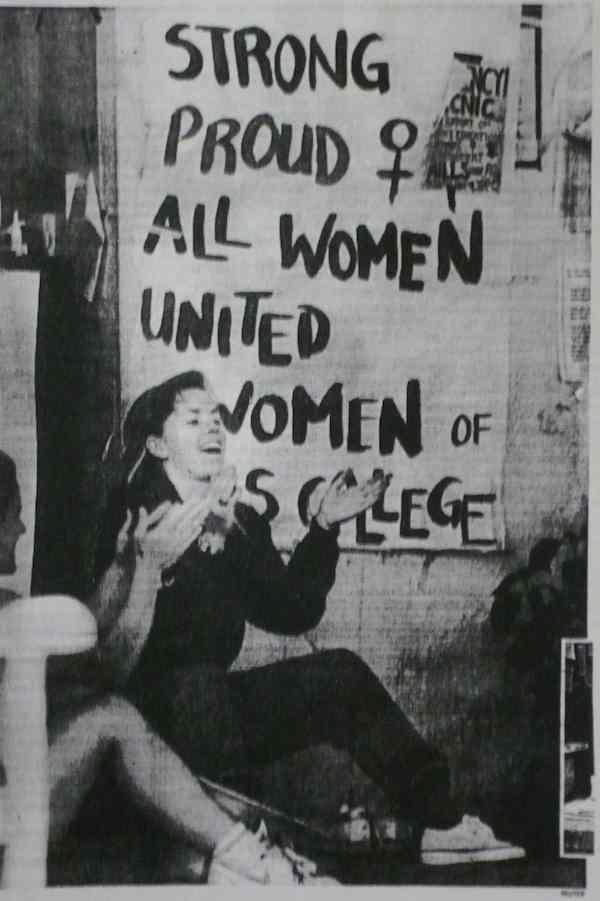
Over the decades the Mills College administration has shown itself to be drastically out of step with its own community. In the mid- to late-1980s the Board of Trustees resisted calls by faculty and students to divest from companies doing business in apartheid South Africa. You might think that an institution located in East Oakland would be especially sensitive to the injustices of racism, but it took six years before the Board finally made the right decision. [4] In 1990 the Board, acting without input from students and faculty, voted to end the identity of Mills as a women's college and admit men as undergraduates; after a two-week student strike garnering strong alumnae and faculty support, the Board rescinded its decision. [5] And in 2017 the Board declared a financial emergency (while apparently paying fees of $2.5 million annually for portfolio management providing below-market returns) and, again without consulting the Mills community, approved a plan eliminating academic programs and terminating tenured faculty. After an outpouring of support for the affected faculty and programs the Board scaled back but did not eliminate the planned cuts. [6]

Mills students during the 1990 strike. Image source: No Bad Language

Mills students, faculty and alumnae are now mobilizing on Facebook (Save Mills), Twitter (@save_mills), and Instagram (#savemills) to keep Mills a women's college. Plans have been announced by the Board and administration to create a Mills Institute to foster women's leadership. But every class at Mills College fosters women's leadership, and there's no reason that a Mills Institute can't coexist with the college. The Board of Trustees should listen to the Mills community once more and reverse the short-sighted decision to close the college. Institutions dedicated to the education and empowerment of women are needed now more than ever.

Update 20 June 2021: The president of Northeastern University has announced that he is currently in negotiations for Mills College to become a part of Northeastern. This is sweetbitter news: sweet because undergraduate programs would continue on the Mills campus, but bitter because Mills would lose its historic focus on women's education. You can read the announcement on the News@Northeastern blog.


  1. Elizabeth L. Hillman, "Mills Announces New Path for the College," March 17, 2021. https://www.mills.edu/announcement/index.php
  2. Jennifer Doudna, quoted in Tor Haugen, "Life, gene editing, and rock ’n’ roll: 5 things we learned from Jennifer Doudna’s talk," Berkeley Library Update, November 15, 2017. https://update.lib.berkeley.edu/2017/11/15/doudna/
  3. Xianglei Chen and Matthew Soldner, "STEM Attrition: College Students’ Paths Into and Out of STEM Fields: Statistical Analysis Report." National Center for Education Statistics, 2013. https://nces.ed.gov/pubs2014/2014001rev.pdf
  4. Olivia Ensign, "Mills College students win divestment from South African apartheid government, 1984-1988," Global Nonviolent Action Database, 2009. https://nvdatabase.swarthmore.edu/content/mills-college-students-win-divestment-south-african-apartheid-government-1984-1988
  5. Mary Lou Santovec, "Mills College Celebrates 20 Years After Student Strike." Women in Higher Education, 2014. https://doi.org/10.1002/whe.10049
  6. Jeanita Lyman, "Mills proposes faculty, department cuts amid community outcry," The Campanil, June 15, 2017. http://www.thecampanil.com/mills-proposes-faculty-department-cuts-amid-community-outcry/

Friday, March 26, 2021

Les Liaisons Dangereuses 1960

Valmont (Gérard Philipe) and Juliette (Jeanne Moreau) in Les Liaisons Dangereuses 1960.
Image source: Paris Cinéma Région

Les Liaisons Dangereuses 1960 (released September 1959), screenplay adapted from the novel by Pierre Choderlos de Laclos by Roger Vailland, Roger Vadim and Claude Brulé; directed by Vadim.

"We must not think that in saying yes to sex one says no to power." (Michel Foucault) [1]

Confirmation of Foucault's insight, should any be needed, can be found in writer/director Roger Vadim's Barbarella (1968), an attempt at a science fiction sex comedy starring his pre-consciousness-raised wife Jane Fonda clad in see-through plastic. Not even successful as camp, Barbarella's reflection of the new sexual mores in society and in cinema in the late 1960s was instantly dated, a textbook example of the voyeuristic male gaze. (And indeed the March 1968 issue of Playboy featured the pictorial "The Girls of Barbarella"; Fonda, by the way, was 30 years old.) It is to the sophomoric Barbarella's everlasting shame that it was released in the same year as Stanley Kubrick and Arthur C. Clarke's 2001: A Space Odyssey. [2]

But a decade earlier Vadim wrote and directed a movie that could be mistaken as a product of the French New Wave. Les Liaisons Dangereuses 1960 is an updating of Pierre Choderlos de Laclos' 1782 novel of aristocratic libertinage to the milieu of the Parisian haute-bourgeoisie in the late 1950s. Vadim seems to have explicitly modelled Liaisons on Louis Malle's Ascenseur pour l'échafaud (Elevator to the Gallows, 1958). Like Malle's film, Liaisons is shot in black and white, stars Jeanne Moreau, and is set to a superb jazz soundtrack (by Thelonious Monk and Art Blakey & the Jazz Messengers in Liaisons, by Miles Davis in Ascenseur).

Valmont (Gérard Philipe in his next-to-last film) and Juliette (Moreau) are a married couple who have reached an understanding. Their mutual sexual spark has died, although apparently it's more extinguished in Juliette than in Valmont, and they each take other lovers. He is open about it, which makes him a target of endless gossip, and Juliette is discreet. She is so discreet, in fact, that many of the couple's friends consider her a model wife, enabling her to use her reputation for virtue as a shield to keep unwanted admirers such as Prevan (Boris Vian) at a distance (at least, until they are useful to her). But although Valmont and Juliette have agreed to sleep with other people, they've also agreed to be completely honest with each other; they have vowed "not to accept the lies that degrade other couples." [3]

Juliette and Cécile (Jeanne Valérie) in Les Liaisons Dangereuses 1960.
Image source: Notre Cinéma

Juliette sets Valmont the task of seducing the virginal teenaged Cécile (Jeanne Valérie). Cécile's parents have been looking to get her married; to get them off her back she has betrothed herself to the wealthy Jerry Court (Nicholas Vogel), who is twice her age. Unbeknownst both to Cécile's parents and herself, Court is one of Juliette's current lovers. Meanwhile, Cécile is in love with another man, college student Danceny (Jean-Louis Trintignant, who was actually closer to Vogel's age than Valérie's). Juliette tells Valmont that she wants him to help her revenge herself on her self-satisfied lover Court: "He thinks he is marrying virtue, but he must marry vice." Her revenge, it turns out, will engulf not only Court, Cécile and Danceny, but ultimately Valmont, and herself.

That Juliette's name is shared with the Marquis de Sade's anti-heroine is no accident. Both characters view sex as the surest, and often for women the sole, means to power. As Angela Carter has written, "[De Sade's Juliette] is a woman who acts according to the precepts and also the practice of a man's world and so she does not suffer. Instead, she causes suffering." [4]

One of the many who suffer at the hands of Liaisons' Juliette is the devout Madame de Tourvel (Annette Vadim, the director's wife; paging Dr. Freud). Madame de Tourvel has also succumbed to Valmont's seductive stratagems, and the adulterous couple are, for a short time, blissfully happy.

Valmont and Madame de Tourvel (Annette Vadim) in Les Liaisons Dangereuses 1960.
Image source: Paris Cinéma Région

But Juliette accuses Valmont of violating their pact, and gives him an ultimatum. He looks on silently as she sends Madame de Tourvel a telegram in his name:

My Angel, one becomes bored of anything, it's a law of nature. Stop. I took you with pleasure and I leave you without regret. Stop. Good-bye. Stop. That's the way of the world. Stop. It's not my fault. Stop. Valmont.

Madame de Tourvel receives the telegram just after she has told her husband that she is leaving him for Valmont; her abrupt abandonment drives her into madness.

The updating of the novel works surprisingly well. To the novel's letters the film adds phone calls, tape recordings, and Juliette's telegram; most of the translations required by the temporal leap forward by nearly two centuries maintain the spirit of the original. Some "modern" touches don't work so well, however. There's a scene where a jazz band (Art Blakey's Jazz Messengers) sends women into an orgiastic frenzy of dancing, like something out of Joseph March's The Wild Party (1928). And Vadim gives a smarmy introduction to the film in which he Explains It All To Us; one of its more memorable lines concerns "young women freed from sex-related social constraints and that burst open, buoyantly, like ripe fruits."

Vadim's introduction suggests that Juliette is escaping the sexual double standard, but in fact she is conforming to it. And we never learn the source of Juliette's desire for vengeance against Valmont, and, indeed, all men (her destruction of the happiness of Cécile and Madame de Tourvel is ultimately aimed at the men in their lives). In Laclos' novel Merteuil tells Valmont that she is "born to revenge my sex and command yours," and goes on to say that "I must conquer or perish." [5] Merteuil's anger at the enforced subordination of women is largely absent from Vadim's film. Instead, we're left to surmise that an earlier betrayal by Valmont is what motivates Juliette's coldness and malice. Merteuil's rebellion against the proscriptions imposed on women by men, portrayed so vividly in Laclos' novel, is replaced by an intramarital power struggle. 

Moreau as Juliette. Image source: Notre Cinéma

Les Liaisons Dangereuses 1960 succeeds on its own terms: it's sleek and chic and has excellent leads in Gérard Philipe and Jeanne Moreau, who are flattered by the gorgeous black-and-white photography of Marcel Grignon. [6] But it could have been much more. That would have required, though, some self-critical reflection on the part of Vadim, whose later career demonstrates that he forever remained a prisoner of the idea that women's sexual freedom should primarily benefit men.


  1. Michel Foucault, The History of Sexuality vol. 1: An Introduction, a translation by Robert Hurley of Histoire de la sexualité: la volonté de savoir (The History of Sexuality: The Will to Knowledge), Pantheon, 1978, p. 157.
  2. Vadim made a specialty of films showcasing the bodies of young actresses who were by pure coincidence his lovers, for example in Et Dieu. . .créa la femme (And God Created Woman, 1956) with his then-wife Brigitte Bardot. Liaisons features a nude scene with Vadim's new wife Annette Strøyberg, who was 9 years his junior and looks remarkably similar to Bardot (blonde hair, wide-set eyes, pouty lips). He would go on to write and direct Le Vice et la Vertu (Vice and Virtue, 1963), a retelling of the Marquis de Sade's Justine featuring his teenaged lover Catherine Deneuve.
  3. Quotes from the screenplay are taken from Roger Vadim's Les Liaisons Dangereuses, screenplay by Roger Vailland, Roger Vadim and Claude Brulé, translated by Bernard Shir-Cliff. Ballantine Books, 1962.
  4. Angela Carter, The Sadeian Woman and the Ideology of Pornography, Pantheon, 1978, p. 79. 
  5. Pierre Choderlos de Laclos, Les Liaisons Dangereuses, 1782, translated anonymously as  Dangerous Connections, 1812, J. Ebers. Letter LXXXI: https://archive.org/details/dangerousconnec00laclgoog/page/n459/mode/1up
  6. Grignon often worked as the cinematographer on films directed by André Hunebelle, including Les 3 Mousquetaires (1953), Le capitan (1960), Les mystères de Paris (1962), Fantômas (1964), and Fantômas contre Scotland Yard (1967).

Monday, March 1, 2021

Mozart and Salieri: The Magician's Cave

Antonio Salieri (detail). Image source: Terra.com.br

There is an indelible popular image of the composer Antonio Salieri, thanks to Peter Shaffer's 1979 play Amadeus and F. Murray Abraham's Oscar-winning performance in the 1984 Miloš Forman film version. In the play and film Salieri, "the patron saint of mediocrity," envies Mozart, undermines him at every turn, and finally, to rid himself of his more talented rival, poisons him.

Salieri's culpability for Mozart's death was taken by Shaffer from Alexander Pushkin's dramatic dialogue Mozart and Salieri, one of the four Little Tragedies (1830):

Salieri:
I am an envier. I envy; sorely,
Profoundly now I envy. — O Heaven!
Where, where is justice? When the sacred gift,
Immortal genius, comes not in reward
For fervent devotion, complete self-denial,
For toil and effort and prayers,
But casts its glow upon a madman's head,
An idle loafer's brow. . .O Mozart, Mozart!

This image of Salieri is contradicted, however, by the historical evidence. For one thing, Salieri was vastly more successful than Mozart. In 1774, at the age of only 24, Salieri was appointed Kammerkomponist ("chamber composer"—in essence, the director of non-church and non-ceremonial music) and director of the Italian opera at the Viennese court of the Habsburg Emperor Joseph II. Salieri was also the protégé of Gluck, the most renowned opera composer of the previous generation. Between 1783 and 1792 Salieri's operas received a total of 167 performances in Vienna; Mozart's operas received 63 performances—respectable, certainly, but only sufficient to make him the seventh-most-performed opera composer in the imperial capital. Beyond Vienna, Salieri's operas were performed in Milan (where Joseph's brother Ferdinand was Grand Duke), Venice, Rome, and Paris (where Joseph's sister Marie Antoinette was Queen). Mozart had far more cause to be envious of Salieri than the other way around. [1]

Michael Kelly by Adèle Romany. Image source: Nancy Storace (1765-1817)

Michael Kelly, the Irish tenor who sang in Vienna between 1784 and 1787 and by his own account appeared in Paisiello's Barbiere di Siviglia (Barber of Seville) and the first performances of Martin y Soler's Una Cosa Rara (A Rare Thing) and Mozart's Le nozze di Figaro (The Marriage of Figaro), knew Salieri well. He wrote of him in his Reminiscences (1826),

Salieri. . .was a composer of eminence. . .He was a little man, with an expressive countenance, and his eyes were full of genius.

. . .Salieri, indeed, would make a joke of any thing, for he was a very pleasant man, and much esteemed at Vienna; and I considered myself in high luck to be noticed by him. [2]

This does not mean, of course, that there was no rivalry between Mozart and Salieri. Since they were both producing operas for the court theater and vying for the Emperor's and the audience's favor, it could hardly have been otherwise. And not all of Salieri's decisions as director of the opera would have been pleasing to Mozart, which may have colored his perspective. Kelly reports that

. . .three pieces were nearly ready for representation at the same time, and each composer claimed the right of producing his opera for the first. The contest raised much discord, and parties were formed. The characters of the three men were all very different. Mozart was as touchy as gunpowder, and swore that he would put the score of his opera [Le nozze di Figaro] into the fire if it was not produced first; his claim was backed by a strong party. Righini, on the contrary, was working like a mole in the dark to get precedence [for Il Demogorgone, ovvero il filosofo confuso].

The third candidate was Maestro di Capella to the court [Salieri is described as Maestro di Capella on the title page of the score of La Grotta di Trofonio below, although he was not officially appointed Hofkapellmeister until 1788], a clever, shrewd man, possessed of what Bacon called, crooked wisdom; and his claims were backed by three of the principal performers, who formed a cabal not easily put down. [3]

Was there a conspiracy against Mozart led by Salieri? Mozart thought so at times. One of his father's letters to Mozart's sister Nannerl says that "very powerful cabals have ranged themselves against your brother. Salieri and all his supporters will move heaven and earth to try to down his opera. . .many people are plotting against him." [4] The most probable source of Leopold's information was his son. Complicating this picture, of course, are what we know of Mozart's own "touchy as gunpowder" nature (was he seeing dark conspiracies to undermine him where none existed?), the fact that Salieri did not actually have an opera ready in the spring of 1786 (La Grotta di Trofonio (The Cave of Trophonius) had been performed the previous fall, and had been very successful), and Mozart's miraculous ability to thwart the nefarious plans of the "powerful cabal": in the end, it was his Figaro that was the first opera produced when the season resumed.

But if they were sometimes at odds with one another, Mozart and Salieri also worked together. In 1785 they collaborated, perhaps with a third composer, on a short cantata celebrating the return to health of Nancy Storace, a leading soprano in the opera troupe (the score of the cantata was identified in 2015). Among many other roles, Storace created Ofelia in Salieri's La Grotta and Susanna in Mozart's Figaro.

Nancy Storace (detail) by Pietro Bettelini, 1788. Image source: Wikimedia Commons

And in early 1786 Mozart and Salieri each composed a one-act comic opera—Mozart's Der Schauspieldirektor (The Impresario) in German, and Salieri's Prima la musica, poi le parole (First the music, then the words) in Italian—to be performed at a banquet held by the emperor. So while at times they were professional rivals, they were also colleagues who could poke fun at backstage machinations. Whatever the truth or falsity of Mozart's suspicions, it seems that relations between them remained generally cordial until the end of Mozart's life.  [5]

Mozart would borrow elements of Salieri's parody of a prima donna's aria ("Lá tu vedrai chi sono") from Prima la musica when later writing Fiordiligi's partly-parodic "Come scoglio" in Cosi fan tutte (1790). As I wrote in my post on a recording of excerpts from Der Schauspieldirektor and Prima la musica, selected as one of my Favorite recordings of 2018, "Nothing was lost on Mozart."

That feeling was reinforced on hearing the superb recording of Salieri's La Grotta di Trofonio with Les Talens Lyriques conducted by Christophe Rousset (Ambroisie, 2005). In the opera two sisters, the more serious Ofelia (Raffaella Milanesi in Rousset's recording) and the more lighthearted Dori (Marie Arnet) have reached the age of marriage and have chosen lovers who reflect their temperaments. Ofelia loves the contemplative Artemidoro (Nikolai Schukoff), while Dori loves the fun-loving Plistene (Mario Cassi).

Title page of the score of La Grotta di Trofonio: Ofelia and Dori meet Trofonio outside his cave in a scene from Act II. Vienna: Artaria, 1786, engraving by Mansfeld. Image source: Oxford Music Online

While wandering in the forest Artemidoro encounters the magician Trofonio (Carlo Lepore) and enters his cave in search of knowledge. Soon, seeking his friend, Plistene also enters the cave. When the two friends emerge their personalities have been switched, to the dismay of the sisters. The women's father Aristone (Olivier Lallouette) suggests that the simplest solution is for them to exchange lovers. The sisters reject this idea and decide to visit the magician's cave themselves, where their personalities are also switched—only, in the meantime the men have re-entered the cave and been switched back. Now the couples are mismatched again, this time to the dismay of the men. Finally Aristone pleads with Trofonio to resolve the situation. He invites the sisters back into the cave where they return to their original personalities, and the opera ends with a double wedding.

When he wrote the libretto for Cosi fan tutte, Lorenzo Da Ponte clearly drew inspiration from Giovanni Casti's libretto for La Grotta. Da Ponte's libretto also features two sisters and two swains of differing temperaments, an older man advising/manipulating the two couples and pressuring them to switch partners, and at the end a restoration of the original couples and a double wedding.

Mozart also borrowed musical ideas from La Grotta. Salieri's overture begins with sustained chords in the low strings evoking the underworld, an unusual opening that is also heard in Mozart's Don Giovanni (1787), as is the recurrence of the same music later in the opera at the appearance of the supernatural. (This is somewhat unusual; in this era the music of the overture was still often independent of that of the opera it introduced.) La Grotta's opening trio involving Aristone and his daughters prefigures the sound-world of Cosi and the trios featuring Don Alfonso, Fiordiligi and Dorabella (like Dori in La Grotta, the livelier/shallower sister).

In Act I of La Grotta, Artemidoro (a tenor) sings a beautiful aria about finding peace and tranquillity in solitude, "Di questo bosco ombroso" (In this shady wood):

https://www.youtube.com/watch?v=fA0IRhZyC88

In Act I of Cosi, Ferrando (a tenor) sings a beautiful aria about nourishing his heart on the hope of love, "Un' aura amorosa" (A breath of love). Though in a different key, the aria's phrases follow a similar melodic arc:

https://www.youtube.com/watch?v=77M1fg_fXrw

Perhaps it is not surprising that these arias sound similar: they were written for the same singer, Vincenzo Calvesi, who appeared in the first performances of both operas.

This is not to say that La Grotta develops the full emotional resonance of Cosi, of which I've written that "the depth of feeling expressed by Mozart's music complicates the cynical farce of Da Ponte's plot." In Cosi the lovers' understanding of each other and themselves is transformed by the emotional trials they undergo; in La Grotta the characters may switch personalities but when it's all over they haven't much changed. As is also the case with Handel, when Mozart borrowed ideas from other composers he generally improved them. Nonetheless, La Grotta is a sparkling comic opera whose brilliant score is done full justice in Christophe Rousset's excellent recording, which is available for download.

And if the evidence of Mozart's borrowings is not fatal to the idea of Salieri as a talentless hack (after all, you don't borrow ideas you think are bad), there are the other composers who sought out Salieri as a teacher in the decades after Mozart's death, such as Beethoven, Schubert, and Meyerbeer. And the most successful opera composer of the generation following Salieri's, Gioachino Rossini, paid his own tribute to Salieri. The opening vocal phrase of Rosina's aria "Una voce poco fa" from Rossini's Il barbiere di Siviglia (1816) follows that of "Ne lo stato conjugale," a duet for Dori and Plistene from Salieri's La Grotta, virtually note-for-note. (According to Christophe Rousset, Rossini knew La Grotta very well, as it continued to be performed for three decades after its premiere.)

In Pushkin's Mozart and Salieri, Mozart gives a speech that perhaps provides a more historically accurate reflection of his relationship to Salieri:

Mozart:
Here is a toast
To you, my friend, and to the candid union
That ties together Mozart and Salieri,
Two sons of harmony.

Update 23 March 2021: When writing this post I had thought that my recognition of connections between Salieri and Casti's La Grotta and Mozart and Da Ponte's Cosi was reasonably original. It turns out that several scholars had this insight more than two decades before me.

In The Culture of Opera Buffa in Mozart's Vienna Mary Hunter describes Cosi as being "in conversation" with other opere buffe in the repertory of Vienna's Burgtheater, including Pasquale Anfossi and Giovanni Bertati's Il curioso indiscreto (Unwise curiosity, 1777, performed in Vienna in 1783), Paisiello and Bertati's I filosofi immaginari (The imaginary philosophers, 1779, performed in Vienna in 1783), and Martin y Soler and Da Ponte's L'arbore di Diana (The tree of Diana, premiered in Vienna in 1787). Hunter devotes 16 pages to a discussion of the parallels between La Grotta and Cosi, including the Dori/Dorabella and Ofelia/Fiordiligi echoes, textual and musical parallels between the first act trio in La Grotta between Aristone and the sisters' suitors with the opening trio in Cosi between Don Alfonso and the sisters' suitors, similarities between the two operas' first-act finales, and affinities between the two "filosofi," Trofonio and Don Alfonso (although she dismisses the correspondences I noted between the suitors Artemidoro and Ferrando as "broadly typological" of tenor lovers). "In every example of significant resemblance between the two operas," she writes, "Cosi either improves upon or mocks Trofonio." [6]

Bruce Alan Brown and John A. Rice also discovered another connection between Salieri and Cosi: Da Ponte evidently wrote the libretto for Salieri, not Mozart. Salieri went so far as to begin setting the text to music: he wrote out the vocal part for the opening trio involving Don Alfonso, Ferrando and Guglielmo, "La mia Dorabella," and fully scored the second trio for the men that follows, "È la fede delle femmine." (In "La mia Dorabella" the suitors expound on the beauty and faithfulness of their sweethearts; in "È la fede delle femmine," Don Alfonso tells them that "the faithfulness of women is like the Arabian phoenix; everyone says it exists, but no one has ever found it.") However, after composing these two numbers Salieri stopped for reasons that are unknown, and Da Ponte took the libretto to Mozart. Brown and Rice quote Victor Novello's paraphrase of Constanze Mozart's feeling that "Salieri first tried to set this opera but failed, and the great success of Mozart in accomplishing what he could make nothing of is supposed to have excited his envy and hatred, and have been the first origin of his enmity and malice toward Mozart. . ." [7]

But Salieri must have known that Da Ponte would be offering the libretto to Mozart if he gave it up, and Cosi did not have "great success": although it was apparently well-received, it was performed only five times in January and February 1790 before the death of Joseph II closed the theaters, and then only five more times between June and August of that year. Hunter writes that the circumstances surrounding Salieri's giving way to Mozart in the setting of Cosi "does not tell us much about the relationship between the two composers. The relations between Trofonio and Cosi, however, do seem to tell a story of unrelieved competitiveness on Mozart's and Da Ponte's parts; whether this was meant more or less amicably or in bitterness, and how it was received, will probably never be known." However, we do know that a little more than a year after Cosi's final performance Mozart invited Salieri to see his new opera The Magic Flute, and that Salieri praised it highly (see note 5).


  1. The list of composers with more opera performances in Vienna than Mozart during his lifetime, in descending order: Paisiello (251), Salieri (167), Martin y Soler (140), Cimarosa (127), Guglielmi (112), and Sarti (97). Tallies taken from John Platoff, "Mozart and his Rivals: Opera in Vienna," Current Musicology, Vol. 51, No. 1, 1993, p. 105-111.
  2. Michael Kelly, Reminiscences, Oxford University Press, 1975, pp. 99, 101. 
  3. Kelly, Reminiscences, p. 130. The "discord" must have taken place in the spring of 1786, but Kelly mis-remembers that Salieri was advocating for La Grotta; it had already been performed in the fall of 1785.
  4. Leopold Mozart to his daughter, [25th?] April 1786. Letters of Mozart and his Family, vol. III, translated and edited by Emily Anderson, Macmillan, 1938, p. 1336.
  5. In October 1791 Mozart took Salieri and his mistress, the soprano Caterina Cavalieri (who had sung Konstanze in Die Entführung aus dem Serail and Donna Elvira in Don Giovanni), to see Die Zauberflöte (The Magic Flute). Mozart wrote his wife Constanze, "Salieri listened and watched most attentively and from the ouverture to the last chorus there was not a single number that did not call forth from him a bravo! or bello! It seemed as if they could not thank me enough for my kindness." Quotation from Letters of Mozart and his Family, vol. III, translated and edited by Emily Anderson, Macmillan, 1938, pp. 1442-43.
  6. Mary Hunter, The Culture of Opera Buffa in Mozart's Vienna, Princeton University Press, 1999, Ch. 8, pp. 247-272.
  7. Bruce Alan Brown and John A. Rice, "Salieri's 'Così fan tutte'," Cambridge Opera Journal, Vol. 8, No. 1 (March 1996), pp. 17-43.

Saturday, February 20, 2021

Suggested reading: Technocracy unbound

Image source: The Guardian

1. Graded on where you live

You may not have followed the story about A-level results in Britain last summer; after all, for non-Brits another country's college entrance exams may seem pretty remote from their own daily crises. But it's worth taking a closer look because it starkly illustrates how, under the guise of "objectivity," algorithms can perpetuate injustice.

The General Certificate of Education Advanced Level test in the UK is somewhat equivalent to the SAT or ACT in the US: it's used to determine what university or other post-secondary education a student qualifies for, if any. Falling short means that you don't qualify. Obviously for students the stakes are huge.

As has been well documented, "standardized" tests are anything but: scores on such tests in the US correlate more strongly with factors such as race, family income and parental education level than they do with success in college and beyond (non-normalized high school grades correlate more strongly with college success than SAT scores). Increasingly colleges and universities in the US are de-emphasizing or even (as in the case of the University of California system) eliminating the SAT or ACT as requirements for admission, since their role in perpetuating systemic educational inequities is so clear. [1]

In the UK last spring the A-levels had to be cancelled due to the COVID-19 pandemic and the closing of schools. Universities were faced with making admission decisions based only on the A-level grades as assessed by teachers. Britain's Department for Education directed that, to prevent grade inflation, the assessed grades should be adjusted by the Office of Qualifications and Examinations Regulation (Ofqual). Ofqual developed an algorithm to adjust the assessed A-level grades based on the A-level grades earned by students at the same schools over the previous three years, how those grades related to national averages, and whatever adjustments were needed to fit scores to a pre-determined national distribution. [2]

The results were disastrous, and disastrously unfair: nearly 40% of teacher's assessments of their students were downgraded. High-performing students from disadvantaged schools were more likely to see their assessed grade reduced, while students attending schools with historically above-average results were more likely to see their grades raised. As Kenan Malik writes,

Algorithms are, as the writer and broadcaster Timandra Harkness puts it, "prejudice engines". The data with which they are fed is inevitably tainted by the prejudices and biases of the human world. Unchecked, that feeds into the results they produce. And where algorithms make predictions, those prejudices and biases are projected into the future.

The reason the exam algorithms penalised pupils from disadvantaged schools is that this is the algorithm built into real life. The education system has long served to thwart the ambitions of working-class pupils and to ease the path of the more privileged ones. The results debacle is but a sharper expression of what usually happens year after year. [3]

In one school, over the previous three years 8 out of 64 students (12.5%) earned the highest grade (A*), and none received a U ("unclassified," or fail). If those patterns held for the 27 students from that school taking A-levels in 2020 you would expect 3 students to earn an A* and none to receive a U. However, the algorithm predicted that only 5.7% (or 1.5 students) from that school would earn an A*, and 2.3% (or 0.62 students) would receive a U. Obviously you can't assign a grade to a fraction of a student, so the number who received algorithmically-assigned A* grades was reduced to 1, and the number who received a failing grade was increased to 1. This process was applied at every school: if the algorithm predicted a non-zero probability of a U, the student with the lowest teacher-assessed grade had to be assigned a U, even if their assessed grade was much higher. [4]

As you might guess, the downgraded results inspired outrage. Following days of vociferous protests by students, parents, teachers, and school administrators, the education secretary Gavin Williamson made a complete U-turn: the algorithm's assignments would be discarded and the teachers' assessments would be the A-level grades of record. But by then it was too late: universities had awarded places in their incoming classes based on the algorithm. Although the change back to teacher assessments meant more students qualified for university entrance, there were no places left for them.

Jessica Johnson. Image source: The Guardian

"I've fallen into my story": One of the affected students was Jessica Johnson, who had won an Orwell Foundation Youth Prize in 2019 for a story about school results being assigned by a biased algorithm based on social class. Then in 2020 her own teacher-assessed English A-level grade of A was reduced to a B by Ofqual's algorithm. She had been admitted to her first-choice school, the University of St Andrews, but the offer was withdrawn when her grade was lowered. "I've fallen into my story. It's crazy," Johnson said.

Her real-life story, at least, ended well: after the A-level grades were reverted to teacher assessments, her withdrawn place in the incoming class at the University of St Andrews was reinstated. Not everyone was so lucky, though. An unfair algorithm had changed the lives of thousands of students.

"We got told you can go wherever you want in life if you work hard enough," Johnson said before the U-turn, "but we've seen this year that no matter how hard you worked, you got given a grade based on where you live." [5]

Eyal Weizman, founding director of Forensic Architecture. Image source: Goldsmiths

2. Human rights as a security threat

Last February Eyal Weizman was scheduled to give a talk at the opening of an exhibit at the Museum of Art and Design in Miami devoted to the work of Forensic Architecture, the London-based nonprofit organization of which he is founding director. But Weizman never made it onto the plane. Two days before his flight his visa was revoked with no reason given and without the possibility of appeal. When he went to the US Embassy to reapply, he was told that "the 'algorithm' had identified a security threat."

Forensic Architecture uses the tools of computer image and audio analysis and 3D modelling to investigate suspected human rights violations. The MOAD exhibit featured Forensic Architecture's work on a CIA drone strike in Pakistan, a Chicago police killing, the Israeli bombing of Rafah, and ICE's Homestead detention center in Florida.

Weizman, a Fellow of the prestigious British Academy, was requested by the US Embassy to provide 15 years of his travel history and the names of anyone he'd been in contact with who might have triggered the algorithm. He writes,

we are being electronically monitored for a set of connections—the network of associations, people, places, calls and transactions—that make up our lives. Such network analysis poses many problems, some of which are well known. Working in human rights means being in contact with vulnerable communities, activists and experts, and being entrusted with sensitive information. These networks are the lifeline of any investigative work. I am alarmed that relations among our colleagues, stakeholders and staff are being targeted by the US government as security threats. 

Weizman refused to comply, but the information is likely known to government agencies anyway. As has long been the case, those who monitor governments are themselves placed under intensified governmental surveillance.

Since the MOAD exhibit opened, Forensic Architecture has continued its investigations: they have produced reports on the massive Beirut port explosion, police brutality at Black Lives Matter protests, and the exposure of personally identifiable data collected by COVID-19 contact-tracing software. As Weizman writes, "Our work seeks to demonstrate that we can invert the forensic gaze and turn it against the actors—police, military, secret service, border agencies—that aim to monopolise information." [6]

Image source: The Guardian

3. Eliminating cars, increasing traffic

Speaking of technocratic solutions gone awry: London has done much that is promoted by "green city" advocates. It has virtually eliminated private cars in the central city at peak times, offers a ubiquitous public transportation network and has built "cycle superhighways." And yet, as Gwyn Topham notes in The Guardian, until the pandemic hit London traffic had reached the point of gridlock. The reasons are many:

  • Uber and Lyft: Although ride-sharing promised to take private cars off the road, in fact it increased them: the number of licensed private-hire vehicles in London went up more than 75% to nearly 90,000 between 2013 and 2017. And ride-shares seem to cannibalize public transportation and taxis rather than reducing individual car use. Not to mention that at any given moment, about a third of ride-share vehicles on the road are empty of passengers. The Union of Concerned Scientists has found that due to "deadheading" (travelling without a passenger) and the use of ride-sharing instead of lower- or non-emission alternatives such as public transit or walking, "ride-hailing trips produce 47 percent more carbon emissions than a similar trip taken in your own private car. . .[and] are 69 percent more polluting on average than the transportation options they displace." [7]
  • Delivery vans: Supposedly a more efficient way for us to receive stuff, our delivery system is an overlapping network of companies, routes and drivers. A single household might receive three or four separate deliveries over the course of a day; an office building might receive dozens. Amazon Prime and other next-day shipments are an especial problem, because instead of being efficiently consolidated deliveries are made one item at a time.
  • Bicycle lanes: Dedicated bicycle lanes are safer for cyclists (though not for the pedestrians who have to dodge them), but they reduce the road space available to buses, slowing them down. And buses are far more efficient at moving people around the city than bikes. Not to mention that buses, unlike bikes, are broadly accessible to disabled riders and can transport people in all sorts of weather. However, when buses are slowed by traffic they lose ridership. One London bus route measured in 2016 had an average speed of 4 mph, which is only slightly faster than most people walk.
  • Decentralized decisionmaking: Local government is better and more responsive than remote central government, no? But some issues are best resolved at a higher level than the local. London is a patchwork of 32 boroughs plus The City, leading to contradictory policies and congestion-creating inefficiencies. The head of a London bus company states, "Regent Street [which runs for little more than a mile between Regent's Park and Pall Mall] had 36 different operators doing recycling. Each person was doing the right thing, but add them all up together. . ." [8]

This is not to say that all these things are only bad. But lack of coordination among different entities with different priorities leads to a situation of cross-purposes and stand-still, which is realized quite literally on urban streets.

Image source: Huffington Post

4. Management by algorithm: Uber and Lyft's business model

In November 2020 California voters, swayed by a relentless $200 million dollar ad campaign paid for by Uber, Lyft, Doordash, and Instacart, overwhelmingly passed Proposition 22. Prop 22, authored by the same companies, exempted their "independent contractor" drivers from California Assembly Bill 5 (passed in 2019), which had reclassified them as employees with rights such as unemployment insurance, health insurance, minimum wage, and collective bargaining. Uber and Lyft had never complied with the provisions of AB 5.

The majority of voters might have been less susceptible to Uber and Lyft's manipulative ads had they understood more about their business model and practices. As researcher Aaron Benanav has written in The Guardian,

One might assume that misclassifying drivers as independent contractors enables rideshare companies such as Uber to make exorbitant profits. The reality is far weirder. In fact, Uber and Lyft are not making any profits at all. On the contrary, the companies have been haemorrhaging cash for years, undercharging users for rides in a bid to aggressively expand their market shares worldwide. Squeezing drivers' salaries is not their main strategy for becoming profitable. Doing so merely slows the speed at which they burn through money.

The truth is that Uber and Lyft exist largely as the embodiments of Wall Street-funded bets on automation, which have failed to come to fruition. These companies are trying to survive legal challenges to their illegal hiring practices, while waiting for driverless-car technologies to improve. The advent of the autonomous car would allow Uber and Lyft to fire their drivers. Having already acquired a position of dominance with the rideshare market, these companies would then reap major monopoly profits. There is simply no world in which paying drivers a living wage would become part of Uber and Lyft's long-term business plans. [9]

As has become clear to drivers since Prop 22 went into effect. While it supposedly guaranteed that drivers would earn at least 120 percent of minimum wage and receive health care stipends, the proposition is full of loopholes that enable the companies to evade these promises. A study by Ken Jacobs and Michael Reich of the UC Berkeley Labor Center found that under Prop 22's provisions:

  • waiting or travel time between passengers is not counted as work time,
  • mileage and insurance costs while drivers are between passengers are unreimbursed, and while they are engaged with passengers are under-reimbursed,
  • the majority of drivers don't qualify for the health care stipends,
  • as independent contractors, drivers must pay both the employer and employee share of payroll taxes and do not receive paid rest breaks, paid meal breaks, paid sick leave, unemployment insurance, or worker's compensation insurance.

The authors calculate that the true guaranteed wage paid by Uber and Lyft under Prop 22 after subtracting for unpaid time and un- or under-paid costs is actually $5.64 per hour. California minimum wage is currently $13 per hour, 130% greater. [10]

A scare tactic used in the ad campaign was that Uber and Lyft rides would become more expensive if Prop 22 didn't pass in order to pay for employee benefits mandated under AB5. Prop 22 passed, and Uber and Lyft have raised their passenger charges anyway. Meanwhile, drivers report that their pay has fallen. [11]


  1. Richard V. Reeves and Dimitrios Halikias, "Race gaps in SAT scores highlight inequality and hinder upward mobility," Brookings Institution, 2017: https://www.brookings.edu/research/race-gaps-in-sat-scores-highlight-inequality-and-hinder-upward-mobility/. Unfortunately, as Reeves and Halikias point out, simply making college admissions more equitable does not close racial gaps in degrees awarded. Long-term inequities in K-12 education and college preparation must also be addressed.
  2. Angelique Richardson, "Elbowed off the pavement," LRB Blog, 20 August 2020: https://www.lrb.co.uk/blog/2020/august/elbowed-off-the-pavement
  3. Kenan Malik, "The cruel exams algorithm has laid bare the unfairness at the heart of our schools," The Guardian, 23 August 2020: https://www.theguardian.com/commentisfree/2020/aug/23/the-cruel-exams-algorithm-has-laid-bare-the-unfairness-at-the-heart-of-our-schools
  4. Alex Hern, "Do the maths: Why England's A-level grading system is unfair," The Guardian, 14 August 2020: https://www.theguardian.com/education/2020/aug/14/do-the-maths-why-englands-a-level-grading-system-is-unfair 
  5. Jessica Murray, "Student who wrote story about biased algorithm has results downgraded," The Guardian, 18 August 2020: https://www.theguardian.com/education/2020/aug/18/ashton-a-level-student-predicted-results-fiasco-in-prize-winning-story-jessica-johnson-ashton
  6. Eyal Weizman, "The algorithm is watching you," LRB Blog, 19 February 2020: https://www.lrb.co.uk/blog/2020/february/the-algorithm-is-watching-you
  7. Jiayu Liang, "Ride-hailing: Convenience at what cost?" Catalyst, Spring 2020, pp. 9-11,21: https://www.ucsusa.org/sites/default/files/2020-05/catalyst-spring-2020.pdf
  8. Gwyn Topham, "How London got rid of private cars—and grew more congested than ever," The Guardian, 11 February 2020: https://www.theguardian.com/politics/2020/feb/11/how-london-got-rid-of-private-cars-and-grew-more-congested-than-ever
  9. Aaron Benanav, "Why Uber's business model is doomed," The Guardian, 24 August 2020: https://www.theguardian.com/commentisfree/2020/aug/24/gig-economy-uber-lyft-insecurity-crisis
  10. Ken Jacobs and Michael Reich, "The Uber/Lyft Ballot Initiative Guarantees only $5.64 an Hour," UC Berkeley Labor Center Blog, 31 October 2019: https://laborcenter.berkeley.edu/the-uber-lyft-ballot-initiative-guarantees-only-5-64-an-hour-2/
  11. Michael Sainato, "'I can't keep doing this': Gig workers say their pay has fallen after Prop 22," The Guardian, 18 February 2021: https://www.theguardian.com/us-news/2021/feb/18/uber-lyft-doordash-prop-22-drivers-california

Wednesday, February 10, 2021

Return of the repressed: The Fall of the House of Usher

Images: Boston Lyric Opera

". . .the uncanny is nothing else than a hidden, familiar thing that has undergone repression and then emerged from it. . ." —Sigmund Freud, "The 'Uncanny'" [1]

The word for "uncanny" in German is unheimlich. Heimlich means "belonging to the home, familiar, intimate, comfortable," so the uncanny is the opposite: disturbing and (apparently) strange, "eerie, weird, arousing gruesome fear." [2] In this formulation one of the most terrifying of phenomena is the house, which should be a place of refuge and comfort, that is instead a source of the unheimlich. "Many people experience the feeling [of the uncanny] in the highest degree in relation to death and dead bodies, to the return of the dead, and to spirits and ghosts. . .some languages in use today can only render the German expression 'an unheimlich house' by 'a haunted house.'" [3]

A house haunted by the spectres of degeneration, derangement and death is the first image in Edgar Allan Poe's story "The Fall of the House of Usher":

During the whole of a dull, dark, and soundless day in the autumn of the year, when the clouds hung oppressively low in the heavens, I had been passing alone, on horseback, through a singularly dreary tract of country; and at length found myself, as the shades of the evening drew on, within view of the melancholy House of Usher. I know not how it was—but, with the first glimpse of the building, a sense of insufferable gloom pervaded my spirit. I say insufferable; for the feeling was unrelieved by any of that half-pleasureable, because poetic, sentiment, with which the mind usually receives even the sternest natural images of the desolate or terrible. I looked upon the scene before me—upon the mere house, and the simple landscape features of the domain—upon the bleak walls—upon the vacant eye-like windows—upon a few rank sedges—and upon a few white trunks of decayed trees—with an utter depression of soul which I can compare to no earthly sensation more properly than to the after-dream of the reveller upon opium—the bitter lapse into everyday life—the hideous dropping off of the veil. There was an iciness, a sinking, a sickening of the heart—an unredeemed dreariness of thought which no goading of the imagination could torture into aught of the sublime. [4]

The nameless narrator has been summoned to the house by a letter from a boyhood friend whom he has not seen for many years, Roderick Usher, who is seeking company to alleviate an "acute bodily illness" and "a mental disorder which oppressed him." Roderick lives with his twin sister, Madeline, who is suffering from "a settled apathy, a gradual wasting away of the person, and frequent although transient affections of a partially cataleptical character" ("affections" in the 19th century having the dual meaning of "a mental state," "disposition," or "inclination," and also "a bodily state, especially a malady or disease." [5])

Catalepsy, neurasthenia, and all-pervading melancholy would not seem to be promising material on which to base an opera. While Poe's story effectively develops an atmosphere of mounting dread ending in a moment of terror, there is no dramatic conflict and almost no direct speech. Nonetheless by my count eight composers have attempted to write operas based on it, including, most famously, Philip Glass. [6]

Boston Lyric Opera has responded to the current moment by producing a film version of Glass's opera using puppets and stop-motion animation. [7] The filmed opera is intercut with and paralleled by a hand-drawn animated story about Luna, a young Guatemalan girl who together with her mother flees the violence of her homeland and tries to make it to the United States.

These parallel sequences are accompanied by television footage described in a framing introduction by a host (actress Sheila Vand in a non-singing role) as "a window into our collective consciousness, programming what we fear, what we long for, and that which we dare not speak of." The footage includes images of Cold War nuclear drills, Stanley Milgram's obedience experiments, electroshock treatments, and police attacks on civil rights marchers. This footage and Luna's story bring home, as it were, our continuing history of racism, exclusion, environmental destruction, fear, exploitation and injustice: the Return of the American Repressed, the sinister twin of the American Dream.

"To many people the idea of being buried alive while appearing to be dead is the most uncanny thing of all."—Sigmund Freud, "The 'Uncanny'"

Part of the horror of "The Fall of the House of Usher" is that both Roderick and Madeline are already buried alive in their tomb-like mansion (it is even made of gray stone, like a headstone). Those of you who have not read Poe's story may want to skip the rest of this paragraph to avoid spoilers: when Madeline (whose wordless vocalise is sung by soprano Chelsea Basler) dies and is sealed in her coffin in the family crypt, the narrator notes that "a faint blush [remained] upon the bosom and the face." Over the following days the narrator finds Roderick, with an "unceasingly agitated mind. . .gazing upon vacancy for long hours, in an attitude of the profoundest attention, as if listening to some imaginary sound." But is it imaginary? Glass's opera seems to imply that it's all in his head; Poe's story is much more unsettling. In the film while Roderick (sung by tenor Jesse Darden), in a moment of dawning horror, tells his visitor (named "William" in the opera, sung by baritone Daniel Belcher), "We have put her living in the tomb," we see images of immigrant children, separated from their parents and fenced in behind barbed wire—put living in the tomb of an ICE concentration camp.

The film is brilliantly conceived and executed by director James Darrah, production designer Yuki Izumihara, director of photography Pablo Santiago, and screenwriter Raúl Santos. The use of puppets (costumes and dolls designed by Camille Assaf) and the multiple through-lines improve Glass's opera and its rather clunky Arthur Yorinks libretto by giving it far-reaching resonances. Luna's moving contemporary story (designed by Yee Eun Nam and animated by Will Kim, Rodrigo Muñoz, and Jian Lee) and Poe's gothic 19th-century one come together in the film's astonishing final images, which poetically evoke destruction and freedom, terror and awe.

https://www.youtube.com/watch?v=IgC-aS_u8m0

The Fall of the House of Usher is available to view through June 30 for US$10 for a seven-day rental from Boston Lyric Opera.


  1. Sigmund Freud, "The Uncanny." Translated by Alix Strachey. First published in Imago, Band V, 1919. https://web.mit.edu/allanmc/www/freud1.pdf
  2. Daniel Sanders, Wörterbuch der deutschen Sprache (1860), 1:729. Quoted in Anthony Vidler, "The Architecture of the Uncanny: The Unhomely Houses of the Romantic Sublime." Assemblage, No. 3, 1987, pp. 6-29. https://www.jstor.org/stable/3171062
  3. Freud, "The Uncanny."
  4. This and subsequent quotes from Edgar Allan Poe, "The Fall of the House of Usher," taken from Project Gutenberg: http://gutenberg.org/cache/epub/932/pg932.txt
  5. Definitions from Shorter Oxford English Dictionary, 6th ed., Oxford University Press, 2007.
  6. For the record, in addition to Glass they are Claude Debussy (La Chute de la maison Usher, unfinished), Alan Claflin (1920), Clarence Loomis (1941), Larry Sitsky (1965), Russell Currie (1984), Hendrik Hofmeyr (1988), and Gordon Getty (Usher House, 2013). Information from Oxford Music Online.
  7. Puppets, dolls, and twins are also uncanny, of course, and all feature in the film.