Showing posts with label books - translation. Show all posts

Saturday, October 7, 2023

Haruki Murakami, part 4: The Wind-Up Bird Chronicle

Haruki Murakami. Photo credit: Kevin Trageser / Redux. Image source: The New Yorker

In this post series I am discussing three Haruki Murakami-related works:

  • David Karashima's Who We're Reading When We're Reading Murakami (Soft Skull, 2020), an examination of the English-language publication of Murakami's books from his first novella through his international breakthrough The Wind-Up Bird Chronicle (1995/1997).
  • Jay Rubin's Haruki Murakami and the Music of Words (Harvill, 2002/Vintage 2005), a survey of Murakami's life and work up through the publication of Umibe no Kafuka (Kafka on the Shore, 2002/2005).
  • Ryūsuke Hamaguchi's Drive My Car (2021), the Academy-Award-winning film based on two Murakami short stories published in the collection Men Without Women (2014).

Cover design: Chip Kidd. Image source: Chip Kidd

The Wind-Up Bird Chronicle was written during Murakami's time as a visiting lecturer at Princeton University in the early 1990s. Perhaps distance invited reflection: it is the Murakami work that engages most directly with the legacy of Japan's imperial wars in Asia.

At the opening of the novel, the situation is familiar to readers of the short story "The Wind-Up Bird and Tuesday's Women": the aimless (but this time not nameless) 30-year-old narrator Toru Okada is sent by his wife Kumiko in search of their missing cat, who disappeared more than a week ago. It will come as no surprise to the reader that the cat has a larger significance:

"I want you to understand one thing," said Kumiko. "That cat is very important to me. Or should I say to us. We found it the week after we got married. Together. You remember?" (p. 47)

That the symbol of their union has gone missing is a strong clue to the reader, if not to Toru, that his marriage of six years is in trouble. Additional clues include the new earrings his wife is wearing, along with the unfamiliar perfume she's dabbed behind her ears. And the strongest clue: after returning increasingly late from work for the past few weeks, one night Kumiko does not return home at all.

Now Toru is searching for both his cat and his wife. His wife had told him to be sure to search for the cat at a vacant house at the dead end of the alley that runs behind their home. (The metaphors are multiplying.) At that house he encounters a neighbor, the boldly curious and precociously provocative 16-year-old May Kasahara. The Wind-Up Bird Chronicle continues the pattern in Murakami's fiction of the semi-autobiographical narrator seemingly being irresistible to women of all ages, including an anonymous phone-sex caller, an about-to-be-married colleague who worked at the same law firm, and the psychic Creta Kano. May voices a question the reader may also be entertaining: "Just how many women do you have hanging around you?" (p. 215).

In the yard of the vacant house May shows Toru a dry well (another metaphor, of course; wells and subterranean spaces recur throughout Murakami's fiction). After his wife disappears Toru descends to the bottom of the well to think things through. Sitting at the bottom of the well he falls asleep, and May pulls up the rope ladder, stranding him in darkness. Memories of his marriage, encounters with an alternate reality, connections with the Japanese occupation of Manchuria, and a dawning realization that his wife's brother is not only unlikeable but actively malign, will follow.

The Wind-Up Bird Chronicle includes elements familiar from previous Murakami works: it features a lone protagonist on a quest who crosses the barrier into an alternate reality and does battle with agents of evil in that world and this one. But the Manchuria sections show Murakami depicting the futility, waste, and horror of war with a descriptive power and moral complexity that he had rarely deployed before. The Manchuria sections portray a universe where all available choices are abhorrent, and yet choices still must be made.

The text was significantly shortened in its published U.S. version (just as Hard-Boiled Wonderland had been). Knopf had contracted for a 125,000 word novel. When translator Jay Rubin turned in a manuscript that was 290,000 words long (the book was published in three volumes in Japan), he was asked to cut. Rubin estimates that ultimately he removed about 25,000 words, requiring the rearrangement of some of the material.

Murakami's former editor at Kodansha, Elmer Luke, told David Karashima that "the prose—of the translation, that is—had no tightness, it was flabby, and the novel went on and on and on far too long. . .It should have been cut more" (p. 239). Even with Rubin's cuts the hardback is over 600 pages long. But Murakami's editor at Knopf, Gary Fisketjon, saw the novel as "a giant step forward. . .in terms of scale and scope and ambition" (Karashima, p. 232). [1]

The novel's length and structural complexity—it includes flashbacks/memories, events that happen in a dreamlike alternate reality, lengthy stories (which have their own flashbacks) told by several characters to the protagonist, as well as interpolated transcriptions of letters, a newspaper article and a computer chat session—did not daunt reviewers. With the exception of Michiko Kakutani of the New York Times, the book received strong to glowing reviews, and garnered a readership for Murakami among other influential writers such as David Mitchell, Junot Diaz and Pico Iyer. The Japanese-American writer and critic Roland Kelts said of the novel,

"For anyone who'd read Murakami before, the book felt like the author had marshalled his talents and concentrated them into one dazzling performance. For readers new to Murakami, he was a portal to another universe, another way of looking at and experiencing both the isolation of urban anomie in Tokyo and the repressed, unprocessed memories of the war in Asia." (Quoted in Karashima, p. 234)

Sales of the hardback doubled in comparison to his earlier books, to 14,000. Even more importantly, his paperback backlist titles also surged. Fisketjon noted to Karashima that "each and every one of his books in Vintage paperback sold more copies year after year. . .This demonstrated that if a reader enjoyed his or her first Murakami, he or she would then read another and another, and introduce friends to his work, and then they would do the same. I can't overestimate how important this is, and how rare" (p. 233). Murakami's international success, so long sought by his translators and editors, was now established.

In writing this survey of Murakami's English-language translations from the first English Library titles through The Wind-Up Bird Chronicle, I've drawn heavily on two works:

Cover of Who We're Reading When We're Reading Murakami by David Karashima

Image source: Soft Skull Press

David Karashima's Who We're Reading When We're Reading Murakami recounts the story of Murakami's first appearances in English translation. It features interviews with many of the main figures involved, with a particular focus on his first translator, Alfred Birnbaum, and the editor with whom Birnbaum worked closely, Elmer Luke. Karashima approaches his task journalistically. While this allows the actors in this story to speak for themselves, it also means that Karashima passes virtually no judgments of his own on the relative quality of the translations he covers or on Murakami's original work.

Image source: The Fictional Julie Koh

For judgments (almost always highly positive, verging on the uncritical) about Murakami's work, and comments (sometimes misguided) on the relative quality of translations, readers can turn to Jay Rubin's Haruki Murakami and the Music of Words. Rubin offers a translator's perspective on the many issues involved in "carrying over" Murakami's work from Japanese to English. He also provides interpretive summaries of the books through Kafka on the Shore (2002/2005), and a valuable bibliography (now, of course, in need of updating).

Murakami in English, three decades on

My own re-encounter with Murakami's earlier fiction has left me with mixed feelings. When I first discovered him in my 20s through Alfred Birnbaum's translations, I was drawn to what I've described elsewhere as his "self-sufficient but emotionally incomplete protagonists, indifferent to or alienated from worldly measures of success, who find themselves unexpectedly thrust into the role of detective when they come into contact with a dreamlike alternate reality." I found his conversational prose style very readable (thanks to Birnbaum) and the alternate worlds he created brilliantly imaginative at times. He became one of my favorite contemporary writers, and I eagerly anticipated each new release.

Three decades later, I still perceive all those strengths; at the same time, I now find that the symbolism can be heavy-handed, the moral lessons banal, and the available roles for women often limited. The novels can also be contradictory; as an example, while they critique consumerism, they also celebrate it: brand names, especially of high-end stereo equipment and imported whiskey, are often specified. And my responses have also been complicated by the disappointments of some of his later novels, particularly the 900-page behemoth 1Q84 (2008-10/2011) and his next novel, Colorless Tsukuru Tazaki and His Years of Pilgrimage (2013/2014). 

Colorless Tsukuru is, and may remain, the last Murakami novel I've read. I confess that despite the allusion in its title to Mozart and Da Ponte's Don Giovanni, I haven't been tempted to read Killing Commendatore (2018), and I also doubt that I will pick up the forthcoming The City and Its Uncertain Walls. "Lately I've begun to wonder," I wrote in my post on Colorless Tsukuru, "whether I wasn't really a fan of his early translator, Alfred Birnbaum." It's a question which may not be resolvable.

Murakami on film

Murakami has long attracted filmmakers. The first film adaptation of his fiction, Kaze no uta o kike (Hear the Wind Sing), came out as early as 1982. Seven additional feature films, eight short films and a TV series episode based on various short stories and novels have followed. As a coda to this series, in my next post I will look a recent feature film adapted from Murakami's short stories.

Next time: Film adaptation: Ryūsuke Hamaguchi's Drive My Car (2021)

Other posts in this series:

  • The English Library novels: Hear the Wind Sing (1979/1987), Pinball, 1973 (1980/1985), and Norwegian Wood (1987/1989)
  • The first U.S. publications: A Wild Sheep Chase (1982/1989) and Hard-Boiled Wonderland and the End of the World (1985/1991)
  • The transition: The Elephant Vanishes (1980-91/1993) and Dance Dance Dance (1988/1994)
  • Comics adaptation: Jean-Christophe Deveney and PMGL's Haruki Murakami: Manga Stories (2021/2023)

  1. Also published within a year or so of Murakami's novel: David Foster Wallace's Infinite Jest (Little, Brown, 1996), Don DeLillo's Underworld (Scribner, 1997), and Thomas Pynchon's Mason & Dixon (Holt, 1997), all of which were even longer than The Wind-Up Bird Chronicle. Big books (by men, at least) were in fashion.

Sunday, October 1, 2023

Haruki Murakami, part 3: The transition - short stories and a sequel

Haruki Murakami. Photo credit: Kevin Trageser / Redux. Image source: The New Yorker

In this post series I am discussing three Haruki Murakami-related works:

  • David Karashima's Who We're Reading When We're Reading Murakami (Soft Skull, 2020), an examination of the English-language publication of Murakami's books from his first novella through his international breakthrough The Wind-Up Bird Chronicle (1995/1997).
  • Jay Rubin's Haruki Murakami and the Music of Words (Harvill, 2002/Vintage 2005), a survey of Murakami's life and work up through the publication of Umibe no Kafuka (Kafka on the Shore, 2002/2005).
  • Ryūsuke Hamaguchi's Drive My Car (2021), the Academy-Award-winning film based on two Murakami short stories published in the collection Men Without Women (2014).

For a discussion of the three Murakami novels that were published in the Kodansha English Library series for Japanese readers learning English, please see Haruki Murakami, part 1: The English Library novels. For a discussion of the first two Murakami novels published in the U.S., please see Haruki Murakami, part 2: The hard-boiled wonderland.

Cover design: Chip Kidd. Image source: BoekMeter

After the U.S. publication of A Wild Sheep Chase in 1989, Haruki Murakami had begun to have short stories published in The New Yorker: Birnbaum's translation of "TV People" in the issue of 10 September 1990, and "The Wind-Up Bird and Tuesday's Women," later to become the first chapter of The Wind-Up Bird Chronicle (1995/1997), on 26 November 1990. Over the next two years three more stories would follow, two translated by Jay Rubin ("The Elephant Vanishes," 18 November 1991, and "Sleep," 30 March 1992) and one by Philip Gabriel ("Barn Burning," 2 November 1992).

The New Yorker stories interested the U.S. publisher Alfred Knopf, and Murakami, disappointed in his sales with Kodansha, soon came to an agreement with the American publisher. As Murakami's next book for the U.S. market, Knopf decided to issue a collection of seventeen short stories, The Elephant Vanishes (1993), which included the five New Yorker stories ("Barn Burning" in a retranslation by Birnbaum), five that appeared elsewhere (Granta, The [Mobil] Magazine, Playboy, The Threepenny Review, and Zyzzyva), and seven that had never before been published in English. In the order of their appearance in English, here are summaries of a half-dozen stories from The Elephant Vanishes:

  • "The Kangaroo Communiqué" (first English publication: Zyzzyva, Spring 1988, translated by J. Philip Gabriel; retranslated by Birnbaum for The Elephant Vanishes):

A rambling communication about kangaroos quickly veers into disturbingly personal territory. It turns out to be a transcript of a cassette tape recorded by a department store worker in response to a customer's letter of complaint. Between expressing his feelings about kangaroos, rejecting the complaint, and confessing his desire to sleep with the customer (whom he has never met), the narrator says, "Somehow I've talked too much about myself. But if you think about it, it can't be helped. 'Cause I don't know anything about you." This was the introduction to Murakami's deadpan humor for American readers, preceding the publication of A Wild Sheep Chase by more than a year.

  • "TV People" (first English publication: The New Yorker, 10 September 1990, translated by Birnbaum)

On an aimless Sunday evening, the miniature TV People appear at the narrator's apartment and set up a television set in his living room. Once the TV is in place, the narrator can't focus on anything other than the screen, even though it displays no picture. His wife does not notice the rearrangement of the room, the TV, or the TV People. The next day at work the narrator sees the TV People again, but his co-workers don't respond to his comments about them. When he returns to his apartment at the end of the day, his wife is gone. The TV is still there, and the TV People seem to have multiplied. "Shame about your wife," they say to him. The narrator looks around: has he begun to shrink?

  • "The Elephant Vanishes" (first English publication: The New Yorker, 18 November 1991)

As the title suggests, a parable about memory. One day it's discovered that a suburban town's captive elephant and his keeper have disappeared. There are searches of the nearby area, news conferences by the mayor, calls for an investigation by the political opposition, and general consternation among the citizens of the town. As time passes, though, news stories stop appearing, and "people seem to have forgotten that their town once owned an elephant." But the narrator saw something strange the night of the disappearance. . .

  • "The Second Bakery Attack" (first English publication: Playboy, January 1992, translated by Jay Rubin)

A young married couple wake up hungry in the middle of the night, but their refrigerator is empty. The husband-narrator (Boku, "I") recalls the time roughly a decade ago when he and a college friend (the Rat?) decided to completely reject the capitalist system. Although they refused to work out of principle, they still needed to eat and had no money. The logical thing to do was to rob a bakery. But the baker they chose was a Wagner fanatic, and offered them all the bread they could eat if they would listen to the overtures to Tannhäuser and The Flying Dutchman—perhaps 25 minutes of music. They put their knives away, dutifully sat and listened, and took their bread home.

That experience was a turning point: afterwards Boku went back to classes, graduated, went to work in a law firm and got married. On the surface, he is living a complacent bourgeois existence. But his wife senses that beneath the placid surface of their marriage linger repressed urges, manifested by their sudden hunger, that may erupt at any time. Her solution: "Attack another bakery. Right now." And, to her husband's astonishment, she brings out a shotgun and two ski masks. "Why my wife owned a shotgun, I had no idea. Or ski masks. Neither of us had ever skied. But she didn't explain and I didn't ask. Married life is weird, I felt."

"'Thirty Big Macs. For takeout.' The manager looked into the muzzle of the shotgun and resigned himself to fate." Illustration for "The Second Bakery Attack" by Kinuko Y. Craft, Playboy, January 1992, pp. 130-131. Image courtesy of the University of California's Northern Regional Library Facility.

  • "Sleep" (first English publication: The New Yorker, 30 March 1992, translated by Rubin)

Of Murakami's short stories, this is perhaps the eeriest and most unsettling (and that's saying a good deal). A first-person female narrator (uncommon in Murakami's fiction) discovers that she is unable to sleep. This is not ordinary restlessness or insomnia: at the beginning of the story she states that she has gone without sleep for 17 days straight.

Her sleeplessness seems to have released something within her. Although she continues to efficiently manage the routine tasks demanded of her by her household, children, and husband, she indulges in guilty pleasures she last experienced in high school: reading Anna Karenina and gorging herself on chocolate (something frowned on by her dentist husband). "Where had the old me gone, the one who used to read a book as though possessed by it?" she asks herself. "What had those days—and that almost abnormally intense passion—meant to me?"

But as her sleeplessness continues, the memories from her past seem to fade: "All the memories I have from the time before I stopped sleeping seem to be moving away with accelerating speed. It feels so strange, as if the me who used to go to sleep every night is not the real me, and the memories from back then are not really mine. This is how people change."

She has begun to take long nighttime drives as a self-soothing activity. That night she parks down by the waterfront, and is staring at the water when men approach out of the darkness. As the story ends, they are rocking the car, trying to turn it over as she remains trapped inside. . .

  • "Barn Burning" (first English publication: The New Yorker, 2 November 1992, translated by Gabriel; retranslated for The Elephant Vanishes by Birnbaum)

The narrator becomes enmeshed in the lives of a beautiful young woman and her well-to-do boyfriend. One day the boyfriend confesses to the narrator that every few months he sets fire to a barn. He makes sure that no people or animals are hurt, but feels that run-down barns are just waiting to be torched. His revelation changes the narrator's perspective. After their conversation, he looks at every barn and weighs its potential for burning, but can never successfully identify the boyfriend's next target. And the urge to burn barns becomes contagious: "Sometimes, I could swear he was trying to get me to burn a barn. . .I'll grant you, there were times that, well, as long as I was waiting around for him to do the deed, I half considered striking the match myself" (p. 146). In 2018 this story was made into an Academy-Award-nominated film, Burning, by Korean writer-director Chang-dong Lee.

Of the seventeen stories, nine translations were by Birnbaum and eight were by Rubin. At the time of publication Birnbaum was living in Mexico, had just begun a degree program in Burmese Studies at the University of London, and would soon move to Myanmar with his wife. He was unable to commit to translating Murakami's next novel; in an email to Karashima, Birnbaum called this period in his life "a troubled, lost, disruptive passage" (Karashima, p. 203). After Birnbaum withdrew, Rubin became the obvious choice to translate the next book Murakami would publish with Knopf, The Wind-Up Bird Chronicle (1997).

From the point of view of sales, publishing a short-story collection was a curious choice, as in the U.S. they generally sell less well than novels. And indeed, Murakami's sales didn't increase: The Elephant Vanishes sold only about as well as Hard-Boiled Wonderland. Murakami was again disappointed: "Whenever I published a book in Japan I was selling at least 100,000 copies, so I thought 10,000 copies was low" (Karashima, p. 181. Karashima reports that the hardback actually sold 5,500 copies). But perhaps by publishing a short story collection Knopf intended to signal that Murakami was a Serious Writer. If so, that strategy may have paid off later on.

In the meantime, an odd situation was unfolding: Murakami's old publisher and translator had one last project in the pipeline.

Cover design: Maki Sasaki. Image source: Raptis Rare Books

Murakami's sixth novel Dance Dance Dance, originally published as Dansu Dansu Dansu in 1988, is a sequel to A Wild Sheep Chase. [1] The narrator (Boku) returns to the Dolphin Hotel in Sapporo five years after the events of the earlier novel. But the old hotel is gone; in its place is a sleek new 26-story high-rise, "l'Hôtel Dauphin," a product of the Bubble Economy. Boku discovers that all the land in the district slated for redevelopment had been purchased by a single company well in advance of the public disclosure of the plan.

That's advanced capitalism for you: The player making the maximum capital investment gets the maximum critical information in order to reap the maximum desired profit with maximum capital efficiency—and nobody bats an eye. . .Fairness has got nothing to do with it.

. . .Everything is rigged, tied into that massive capital web, and beyond this web there's another web. Nobody's going anywhere. You throw a rock and it'll come right back at you. (pp. 54-55)

The high-tech hotel seems to have obliterated all traces of the old Dolphin. One night, though, the hotel elevator stops at a cold, pitch-black floor that seems to be a slice of an alternate reality in which the old hotel may still exist. On that floor Boku encounters the Sheep Man. It will turn out that he's not the only one to have done so: Yumiyoshi, a receptionist at the hotel, and Yuki, a 13-year-old girl with psychic powers who is a guest there, are also taken by the elevator to this strange floor.

Both women will become involved in Boku's search for the Girl with the Perfect Ears who left him at the old Dolphin Hotel without a goodbye five years previously. That search will lead Boku to Yuki's father, who is a bestselling writer and TV personality named Hiraku Makimura (an anagram of Haruki Murakami, and perhaps Murakami's vision of a possible alternate life he might have been tempted to lead). It will also reconnect him with Riyoichi Gotanda, a former high school classmate who is now a well-known actor. Through Gotanda, Boku will uncover a series of killings whose victims are Tokyo call girls, and through Yuki he will learn the fate of the Girl with the Perfect Ears. (In A Wild Sheep Chase she was nameless; here we learn that she called herself Kiki, which means "listening" in Japanese.)

The title of the novel comes from something the Sheep Man tells Boku:

"Yougottadance. Aslongasthemusicplays. Yougottadance. Don'teventhinkwhy. . .Dance. Danceyourbest, likeyourlifedependedonit. Yougottadance." (pp. 86-87)

The Sheep Man also tells him that the place of their encounter, a room on the alternate 16th floor of the hotel, is somehow Boku's:

"Youreallyarepartofhere, really. Alwayshavebeen, alwayswillbe. Itallstartshere, itallendshere. Thisisyourplace. It'stheknot. It'stiedtoeverything. . .Thingsyoulost. Thingsyou'regonnalose. Everything. Here'swhereitalltiestogether." (p. 83)

The choice to translate the Sheep Man's speech without spaces between words was Birnbaum's, and was continued from A Wild Sheep Chase. Written Japanese does not generally have spaces between words, and so in the original Japanese editions the Sheep Man speaks like all the other characters. However, Birnbaum told Karashima,

"I couldn't imagine a crazy guy in a sheep costume talking normal[ly]. I saw him as a genuinely original quirky character, hence a chance to inject a bit of zany cartoonish humor (Murakami included a funny drawing of him, after all [see part 2]). I wanted something close to baaaaa yet still intelligible." (Karashima, p. 186)

Dance Dance Dance did not break any new stylistic ground for Murakami, and of course it revisited characters and situations from A Wild Sheep Chase, which had been published five years before. It also continued Murakami's tendency to have his authorial stand-in Boku make pronouncements that thud on the mind's ear, at least in English. As an example, Boku tells Yuki, "As time goes on, you'll understand. What lasts, lasts; what doesn't, doesn't. Time solves most things. And what time can't solve, you have to solve yourself" (p. 312).

Perhaps as a result, Dance Dance Dance did not win Murakami a large number of new readers. That would change three years later with the publication of his international breathrough.

Next time: International breakthrough: The Wind-Up Bird Chronicle

Other posts in this series:


  1. Curiously, although it is the sequel to the third volume in the so-called "Trilogy of the Rat" (Hear the Wind Sing, Pinball, 1973, and A Wild Sheep Chase), Dance Dance Dance is not considered to belong to the series, perhaps because the Rat does not appear.

Monday, September 25, 2023

Haruki Murakami, part 2: The hard-boiled wonderland

Haruki Murakami

Haruki Murakami. Photo credit: Kevin Trageser / Redux. Image source: The New Yorker

In this post series I am discussing three Haruki Murakami-related works:

  • David Karashima's Who We're Reading When We're Reading Murakami (Soft Skull, 2020), an examination of the English-language publication of Murakami's books from his first novella through his international breakthrough The Wind-Up Bird Chronicle (1995/1997).
  • Jay Rubin's Haruki Murakami and the Music of Words (Harvill, 2002/Vintage 2005), a survey of Murakami's life and work up through the publication of Umibe no Kafuka (Kafka on the Shore, 2002/2005).
  • Ryūsuke Hamaguchi's Drive My Car (2021), the Academy-Award-winning film based on two Murakami short stories published in the collection Men Without Women (2014).

For a discussion of the Murakami novels that were published in the Kodansha English Library series for Japanese readers learning English, please see Haruki Murakami, part 1: The English Library novels.

Cover of A Wild Sheep Chase

Cover design: Shigeo Okamoto. Image source: Raptis Rare Books

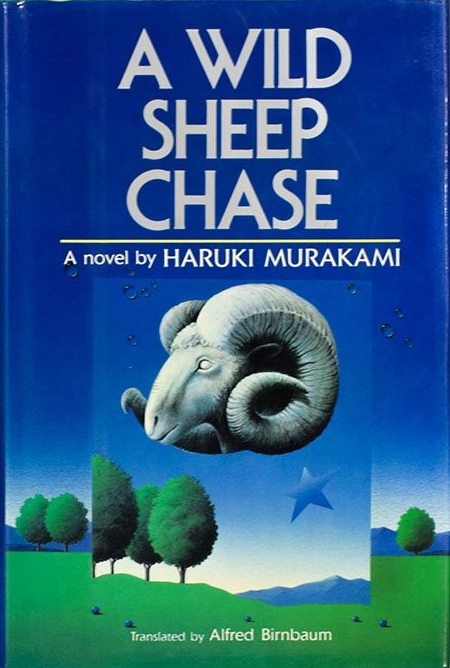
After translating Pinball, 1973 (1980/1985), Hear the Wind Sing (1979/1987), and Norwegian Wood (1987/1989) for the Kodansha English Library, Alfred Birnbaum was finally able to work on the novel that had originally inspired him to translate Murakami. The title A Wild Sheep Chase is not a literal translation of Murakami's original Japanese title Hitsuji o meguru bōken (which means something like "An Adventure Involving Sheep"), but instead is Birnbaum's inspiration, recalling the English expression "a wild goose chase."

This is an approach that characterizes Birnbaum's translations in general: he is more concerned with rendering Murakami's writing in a vivid way that will engage American and UK readers than with strict fidelity to the Japanese original. And with this book he was working with a new editor, Elmer Luke, who had been hired (along with several others) at Kodansha with the goal of increasing U.S. sales. A Wild Sheep Chase, Murakami's third novel, had originally been intended for the English Library series. But with Luke's backing, Kodansha decided to publish it in hardback in the U.S., where it came out in 1989.

A Wild Sheep Chase features many tropes that recur in Murakami's later books: the interaction between an alternate world and everyday reality; a laconic, whiskey-drinking protagonist who becomes enmeshed in a mystery and reluctantly takes on the role of detective; and traces of the lingering but unacknowledged traumas of World War II. I had read fiction by Ryūnosuke Akutagawa, Kōbō Abe, and Junichirō Tanizaki, but Murakami's narrative voice (at least, as rendered into English by Birnbaum) seemed more like a contemporary cross between Kurt Vonnegut and Raymond Chandler.

The plot of A Wild Sheep Chase defies easy summary; Rubin's synopsis takes a dozen pages. But here's my attempt in a few paragraphs: Five years after the action of Pinball, 1973, the protagonist Boku ("I") is 29 (Murakami's age in 1978), is divorced after four years of marriage, is running a small advertising agency, and is currently living with a girlfriend who has perfect ears. Boku's college friend, the Rat, has disappeared but has kept in touch periodically by mail. The last communication Boku received from the Rat contained a photograph of sheep and a request that he make the photo public in some way. Boku uses the photo in an ad, and shortly afterward is visited by a sinister man dressed in black. He is acting for his shadowy Boss, who has a keen interest in a particular sheep with a star-shaped mark on its back that appears in the photo.

Boku and his girlfriend set off to find the Rat, a journey that takes them to the northern island of Hokkaidō. There at the girlfriend's suggestion they check into the Dolphin Hotel, where they meet the "Sheep Professor." The old man reveals that in the mid-1930s he was briefly possessed by the malevolent spirit of the sheep with the star-shaped mark; it soon moved on to other hosts. Boku finds his way to the Rat's cottage, where he encounters the "Sheep Man," who wears a self-fashioned sheepskin suit.

The Sheep Man

Illustration of the Sheep Man by Haruki Murakami, from Hitsuji o meguru bōken. Image source: Niponica: Discovering Japan

Boku decides to wait in the cottage for the Rat; the first night, while he's sleeping, his girlfriend disappears (shades of the twins in Pinball, 1973). Ultimately Boku learns what became of the Rat and the significance of the sheep with the star-shaped mark. (And, indeed, of all the sheep in Japan: they were imported as a domestic source of the wool needed to make winter uniforms for the Japanese Army's invasion of northern China; they are a legacy of Japan's violent imperialist past.)

One reason A Wild Sheep Chase seems so immediate to English-language readers is due to Birnbaum and Luke's choice to eliminate dates in the novel. It has a prelude set on a specific day in 1970: 25 November, the day that the right-wing writer Yukio Mishima committed seppuku after failing to rouse the Japanese Self-Defense Forces to revolt and restore the Emperor to power, a news story unfolding live on the soundless TV set in the bar where an indifferent Boku is having a beer. The major events of the narrative occur eight years later (the novel itself was originally published in 1982). But in Birnbaum's translation references to specific dates are omitted or obscured. As a result the novel seems to take place in the present day of the reader, rather than in a particular moment in the past.

In Haruki Murakami and the Music of Words, Murakami translator Jay Rubin suggests that in his view Birnbaum is too free in his translation of A Wild Sheep Chase. He gives as an example Birnbaum's rendering of the title of Chapter 24, "Iwashi no tanjo" (The birth of Sardine) as "One for the Kipper." (The reference is to a cat, who over the course of the chapter acquires the name Kipper, or Sardine.)

Rubin writes, "Set in 1978, the novel should not have contained—and does not in the original—this reference to the famous movie line 'Make it one for the Gipper,' which flourished during the Reagan years after 1980" (p. 189). The actual line from Knute Rockne, All American (1940) is "win just one for the Gipper." Reagan used the catchphrase (without the qualifying "just") in his 1965 autobiography, Where's the Rest of Me?, adopted "Gipper" as his nickname, and used it throughout his political career: a Time magazine article from 29 March 1976 refers to Reagan as "Gipper" three times, including in the headline. Rubin's claim that "one for the Gipper" is a phrase that could not have been known to a narrator in the late 1970s is unfounded.

And there's another connection that might have been known to Birnbaum. The day of the Army-Notre Dame football game in which coach Knute Rockne gave the "win one for the Gipper" halftime speech was 10 November 1928. Newspapers carrying previews of the game also had front-page headlines reporting Hirohito's enthronement ceremonies as the Emperor of Japan.

Newspaper headlines from 10 November 1925

Front page of the Taunton (Mass.) Daily Gazette, 10 November 1928. Image source: Timothy Hughes Rare & Early Newspapers

It was under Hirohito's rule, of course, that Japan's wars of imperial conquest in Asia and the Pacific were waged. Since the star-backed sheep represents the violent, nationalistic elements that remain present but hidden in Japanese society, Birnbaum's reference to the Gipper, and thus through historical association to Hirohito's accession, seems perfectly apposite and historically resonant.

A Wild Sheep Chase received many good reviews (my initial interest in the novel must have been sparked by one) and sold a respectable 8500 copies, but it was just the beginning. Birnbaum and Luke began searching for a follow-up. Although in 1988 Murakami had written a sequel to A Wild Sheep Chase, Dansu dansu dansu (Dance Dance Dance), and Norwegian Wood had been a bestseller in both its original Japanese and its English Library editions, neither was the next novel selected. Luke thought that Norwegian Wood's coming-of-age story was "too Japanese" to be the next Murakami book English-language readers encountered. And Dansu Dansu Dansu probably would not expand his readership beyond those who had already liked A Wild Sheep Chase.

Instead Birnbaum and Luke decided on Murakami's fourth novel, Sekai no owari to Hādo-boirudo Wandārando (The End of the World and Hard-Boiled Wonderland, 1985), which was longer and, with its parallel-worlds plot, even more complex than A Wild Sheep Chase.

Cover of Hard-Boiled Wonderland

Cover design: Shigeo Okamoto. Image source: Huc & Gabet

Again the title was freely translated, this time reversing the order of the two worlds in the original (neither Birnbaum nor Luke wanted the book to be known as End of the World, which they thought was clichéd). Murakami had distinguished the two worlds of the novel in part through the first-person pronouns employed: in the Hard-Boiled Wonderland chapters, which take place in a near-future Tokyo, the narrator uses the more formal watashi; in the End of the World sections, which occur in a dreamlike (or nightmarish) walled Town, the more familiar boku. English, of course, has only one first-person pronoun, "I." Birnbaum chose to render the Hard-Boiled Wonderland chapters in the past tense, and the alternating End of the World chapters in the present tense. (As it will turn out, there is no sense of the past in the End of the World.)

In the biggest change from the Japanese original, Luke estimates that he and Birnbaum cut about a hundred pages of material, much of which relates to the 17-year-old Girl in Pink and her relentless (and graphically explicit) sexual pursuit of the 35-year-old narrator. Luke finds the Girl in Pink material "preposterous almost," and Birnbaum defends their cuts of "an embarrassing amount of unfocused extraneous material" (Karashima pp. 116, 120). Even so, the translation came in at 400 pages, a third longer than A Wild Sheep Chase.

If A Wild Sheep Chase adopted aspects of hardboiled crime novels, Hard-Boiled Wonderland additionally incorporates elements of cyberpunk and fantasy fiction. Watashi, the sardonic first-person narrator in the Hard-Boiled Wonderland, is a Calcutec: a human computer who encrypts and stores data in his brain. There is another group of human computers called the Semiotecs, who are rogue Calcutecs using their skills to steal data and sell it for profit or use it for their own ends. Semiotecs work for an organization called the Factory, which opposes the corporate System that controls Tokyo and creates and directs Calcutecs. There are hints that the Factory and the System are both parts of the same vast organization, and (like the global adversaries in Orwell's 1984) both Factory and System benefit from their perpetual war.

Watashi takes a job at a bizarre office building with a huge elevator and corridors that go on seemingly without end; this is where he meets the Girl in Pink, who is the receptionist. From his office Watashi descends a ladder to a subterranean river, the realm of the dangerous INKlings. The office is really a cover for the laboratory of the elderly Professor (grandfather of the Girl in Pink), who has set up his laboratory deep underground. Although the INKlings are hostile to humans, they are also a form of security. Their presence serves to deter anyone from stealing the Professor's research: he has found a way to record images from the subconscious.

The Professor asks the Calcutec to process his data by "shuffling," a highly restricted procedure that involves passing the data through the Calcutec's subconscious. It turns out that that the Professor used to be Chief of Research for the System. He is the one who enabled Calcutecs to shuffle data by recording their subconscious images, editing them into a semi-coherent story, and implanting them back in their brains. Watashi is the only surviving Calcutec who has undergone this procedure; his implanted story is called "The End of the World."

In a parallel narrative, we encounter the first-person narrator Boku. He has recently arrived in a walled Town, from which no one is allowed to leave. On Boku's arrival, the Town's Gatekeeper has severed his Shadow, where all his memories are stored. Shadows are left to die, along with the unicorns that absorb the final traces of the Townspeople's dreams and live outside the Town, exposed to the harsh winter. As his own individuality slowly fades, Boku plots to reunite with his Shadow and escape the Town.

As elements from one narrative gradually bleed into the other, we come to realize that the Town is Watashi's subconscious "End of the World." The data shuffling that the Professor has had the Calcutec perform will sever the connection between Watashi's conscious mind and the real world of the Hard-Boiled Wonderland. In little more than a day Watashi will be forever sealed inside his own mind, unless the Professor reverses the process. But Factory thugs, aided by INKlings, have broken into and destroyed the Professor's laboratory. . .

Published in the U.S. in 1991, Hard-Boiled Wonderland was not quite as widely or as well reviewed as A Wild Sheep Chase, and sold only about 5,000 copies in hardback. (One of those is on my shelf.) Murakami had lost some of his novelty value, in part because it had been two years since the publication of A Wild Sheep Chase, and in part because it was becoming clear that he was not alone.

In the wake of the success of A Wild Sheep Chase, Birnbaum had edited and translated a collection of recent Japanese short stories and novel excerpts with the arresting title Monkey Brain Sushi: New Tastes in Japanese Fiction. In his review of Hard-Boiled Wonderland, science-fiction writer Bruce Sterling wrote that Monkey Brain Sushi "demonstrates that there are plenty more where Murakami came from. Slangy, vivid, caustic and political, media-soaked and set on fast-forward, this 'New Fiction' crowd is fiercely intent on showing the world that Kawabata, Tanizaki and Mishima are history" (Karashima p. 123). As indeed they were; the most lately deceased of the three had died twenty years before Sterling's review was published. And of course part of the "slangy, vivid" character of the writing reflected Birnbaum's style as a translator.

Murakami was disappointed that his U.S. sales hadn't grown with Kodansha. He decided to switch agents and publishers, a change that would ultimately also mean a change in translators, and in his literary fortunes.

Next time: The transition: The Elephant Vanishes and Dance Dance Dance.

Other posts in this series:

Wednesday, September 20, 2023

Haruki Murakami, part 1: The English Library novels

Haruki Murakami. Photo credit: Kevin Trageser / Redux. Image source: The New Yorker

Haruki Murakami was the bestselling author of six novels in Japan before any of his books were published outside of that country. But less than a decade after the U.S. publication of his third novel Hitsuji o meguru bōken as A Wild Sheep Chase in 1989, Murakami had become an international phenomenon. Today he is by far the best-known contemporary Japanese writer; his books are instant bestsellers but also receive serious critical attention. He has been a member of the visiting faculty of Princeton and Harvard, has given a lecture series at UC Berkeley, and has received an honorary degree from Yale. There is even a library dedicated to Murakami at his alma mater Waseda University.

Waseda International House of Literature (The Haruki Murakami Library). Image source: Niponica: Discovering Japan

In this post series I'll be discussing three Murakami-related works:

  • David Karashima's Who We're Reading When We're Reading Murakami (Soft Skull, 2020), an examination of the English-language publication of Murakami's books from his first novella through his international breakthrough The Wind-Up Bird Chronicle (1995/1997).
  • Jay Rubin's Haruki Murakami and the Music of Words (Harvill, 2002/Vintage 2005), a survey of Murakami's life and work up through the publication of Umibe no Kafuka (Kafka on the Shore, 2002/2005).
  • Ryūsuke Hamaguchi's Drive My Car (2021), the Academy-Award-winning film based on two Murakami short stories published in the collection Men Without Women (2014).

David Karashima's Who We're Reading When We're Reading Murakami begins with the reason English-language readers know Murakami today: translator Alfred Birnbaum. Birnbaum had first encountered Murakami's writing in the early 1980s while working as a translator for Japanese art and design books published by Kodansha International. After a friend urged him to read a short story collection by Murakami, Birnbaum translated several of the stories on spec. During a meeting with a Kodansha editor in the spring of 1984 Birnbaum brought out his translation of the story "Nyū Yōku tankō no higeki" ("New York Mining Disaster"), and expressed interest in translating Murakami's most recent novel Hitsuji o meguru bōken, which had won the Kodansha-associated Noma New Writer's Prize in 1982 and had become a bestseller.

Instead he was given Murakami's first two short novels, Kaze no uta o kike (Listen to the Wind's Song), published in 1979, and 1973-nen no pinbōru (1973 Pinball), published in 1980. Murakami called these his "kitchen table novels," because he wrote them at his kitchen table in his off hours from running the bar he owned with his wife. [1]

Birnbaum translated the second book first, and at the suggestion of editor Jules Young titled it Pinball, 1973. In 1985 Birnbaum's translation was published in the paperback Kodansha English Library, a series published only in Japan and intended for Japanese readers who were learning English. (Each volume contained an English-Japanese glossary at the back.)

Cover illustration: Maki Sasaki. Image source: Book Dragon

Pinball, 1973 alternates between the stories of the nameless narrator (Jay Rubin calls him "Boku," after one of the Japanese words for "I") and a college friend nicknamed the Rat, who is trying to become a writer. Both men are in their mid-20s and somewhat adrift. 

The Rat spends most of his time at J's Bar in Kobe. He's trying to work up the courage to leave a woman he's become involved with, because their relationship is apparently a barrier to his writing ambitions. (A reader may imagine that spending hours drinking in a bar every day instead of writing might be a greater barrier to getting anything done.) One day the Rat simply decides never to call the woman again, and leaves town for destinations unknown. [2]

Boku is living in Tokyo with cute twins whom he can only identify by their numbered sweatshirts (208 and 209). He embarks on a quest to find an unusual pinball machine that he used to play at a Tokyo arcade that closed down three years previously. Once Boku's quest reaches its end with a surreal encounter in an eerie pinball machine warehouse, the twins leave. Either obstacles and distractions, or muses, guides and healers for his male protagonists: early on Murakami set out the limited roles available to many of his women characters.

He also introduced some of the elements that would become recurring tropes in his fiction. On the first page we read that people tell the narrator stories "as if they were tossing rocks down a dry well"; the image of a well will recur in the later novels A Wild Sheep Chase and Norwegian Wood, and the protagonist will spend much of The Wind-Up Bird Chronicle at the bottom of a dry well. Also featured is the narrator's obsession with ears: in this novel, every evening after his bath the twins would "sit one on each side of me and simultaneously clean both my ears. The two of them were positively great at cleaning ears." If this sounds vaguely sexual, that suspicion will be borne out in his later books.

Pinball, 1973 also displayed Murakami's tendency to present banalities or truisms as insights:

". . . .if a person would just make an effort, there's something to be learned from everything. From even the most ordinary, commonplace things, there's always something you can learn." (p. 96)

The past and the present, we might say, "go like this." The future is a "maybe." Yet when we look back on the darkness that obscures the path that brought us this far, we only come up with another indefinite "maybe." The only thing we perceive with any clarity is the present moment, and even that just passes by. (p. 177)

Pinball, 1973 went on to multiple printings: my copy purchased in the early 1990s is the eighth. On the strength of its success Birnbaum published two more Murakami translations in the English Library: Kaze no uta o kike as Hear the Wind Sing in 1987, and the multimillion-selling blockbuster Noruwei no mori (1987), Murakami's fifth novel, as Norwegian Wood in 1989.

Cover illustration: Maki Sasaki. Image source: Abebooks.co.uk

The second novel of Murakami's to be translated into English was the first work of fiction he wrote. The novel is about the unnamed narrator's struggles to write the very book we are reading. The narrator (again, following Rubin, we'll call him Boku) looks back from 1979 on his friendship a decade previously with his college buddy the Rat. Although the Rat has ambitions to be a writer, he spends most of his time drinking beer with Boku in J's Bar. Both of them attend university in Tokyo, and are home in Kobe for the summer. The novel is set in August 1970, three years before the action of Pinball, 1973, and just months after the militant Japanese student protest movement was violently suppressed by the police. Boku has a broken tooth sustained in a police confrontation, but both he and the Rat have become disillusioned with political action, or, really, any kind of action at all.

In Haruki Murakami and the Music of Words, Rubin offers a revised translation of the first chapter of Hear the Wing Sing. [3] Comparing Birnbaum's and Rubin's translations points up some characteristic differences in their approaches. In the following passage I've placed Rubin's revisions in parentheses following Birnbaum's version:

". . .when it came to getting something into writing, I was always overcome with despair. The range of my ability was just too limited. Even if I could write, say, about elephants (an elephant), I probably couldn't have written a thing about elephant trainers (the elephant's keeper). So it went (That kind of thing).

For eight years I was caught in (went on wrestling with) that dilemma—and eight years is a long time. . .Now I think I'm ready to talk (Now I'm ready to tell). . .Still, it's awfully hard to tell things honestly. The more honest I try to be, the more the right words recede into the distance (sink into the darkness).

I don't mean to rationalize (I'm not making excuses), but at least this writing is my present best (the best I can do for now). There's nothing more to say. And yet I find myself thinking that if everything goes well, sometime way ahead, years, maybe decades, (even decades) from now, I might discover at last that these efforts have been my salvation (discover myself saved). Then lo, at that point, the elephants will return to the plains and I will set forth a vision in words more beautiful (And then, at that time, the elephant will return to the plain, and I shall begin to tell the tale of the world in words more beautiful than these). (Hear the Wing Sing, pp. 5-6|Rubin, pp. 41-42) [4]

I don't read Japanese, so I can't judge these translations by their fidelity to the original. But I do have some thoughts about tone.

Rubin's narrator is earnest and describes his situation with more than a touch of post-adolescent melodrama: the right words "sink into the darkness," in the future he "may discover myself saved," and then he will "tell the tale of the world." Birnbaum's narrator is more self-mocking: in "So it went" there's the echo of Kurt Vonnegut's fatalistic "So it goes" from Slaughterhouse-Five, words "recede into the distance" instead of "sink into the darkness," and "Then lo, at that point," deflates the pomposity of his talk of salvation through a self-ridiculing awareness of how Biblical he's begun to sound.

Rubin's narrator grandiosely says he will "tell the tale of the world"; Birnbaum's will "set forth a vision"—undercutting himself with more of that ironic pseudo-Biblical diction, and making no claims to universality. Finally, Rubin's narrator is "wrestling" with his dilemma, while Birnbaum's is "caught" in his, a word that seems better to capture the narrator's detachment and passivity. Birnbaum's translation is sometimes clunky—"sometime way ahead, years, maybe decades, from now" has a lot of commas over the course of a very few words. And there would seem to be a significant difference (which I can't resolve) between an elephant trainer and an elephant keeper (Ted Goosens' later translation also uses "trainer"). But to my mind's ear Rubin's translation is no less clunky—"discover myself saved" as an example—and his choices makes the narrator sound as though he's lacking the ironic self-awareness of Birnbaum's.

Image source: Raptis Rare Books

As Birnbaum finished his translation of Hear the Wind Sing, Murakami published his fifth novel, Noruwei no mori (Norwegian Wood) in September 1987. [5] It became a massive bestseller, selling millions of copies over the next 15 months. Birnbaum's editor Jules Young requested that he translate it immediately for the English Library. 

Birnbaum was unenthusiastic. He found that the novel was "missing the humor and surreal aspects I liked" and was "a bit sentimental," and he had already started translating A Wild Sheep Chase. But he did not have the luxury of turning down a job, and so he agreed to do both. I think Birnbaum's hesitations were justified. If Norwegian Wood had been the first Murakami novel I read, I doubt that I would have been interested in reading any of his other fiction.

This time Murakami's narrator has a name—Tōru Watanabe—and is once again looking back at his college-age self from Murakami's age at the time of writing (38). The novel takes place against the distant background of the Japanese student movement of the late 1960s. In the foreground are the love troubles of the young Tōru, who has come from his home town of Kobe to attend university in Tokyo (again, like Murakami himself).

Tōru is torn between two women. The first is Naoko, the former girlfriend of Tōru's best friend in high school, Kizuki. Death seems to surround her: both Naoko's sister and Kizuki committed suicide, and she herself has dark thoughts that have resulted in her leaving college to go to a sanatorium-like retreat in the mountains. The second woman in Tōru's life is the lively, outgoing, un- (or less-) complicated Midori, who makes overtures to Tōru even though she already has a boyfriend. Yes, it's a woman who represents the death drive versus a woman who represents the life force.

Complicating matters is Naoko's roommate at the sanatorium, a 39-year-old woman named Reiko, who pours out her life story to the sympathetic Tōru. That story involves her experiences as a musician, wife and mother, until her lesbian seduction (recounted at multi-page length and in explicit detail) by a beautiful but malevolent 13-year-old (!) student.  Reiko's marriage and career are destroyed, and she has a breakdown that brings her to the sanatorium. [6]

Rubin calls Reiko's tale "a compelling, heartbreaking story" that has the reader "hanging on every word" (p. 4). Another perspective might be that her story indulges in tiresome clichés about predatory lesbians, and provides prurient details for the titillation of both Tōru and the reader.

Reiko's friendship with Tōru ultimately leads her to leave the illusory safety of the sanatorium to go stay with Tōru in Tokyo. The (literal) seductions of lesbianism are, of course, vanquished by a night of passionate (unprotected, intergenerational and semi-incestuous) sex with the straight hero. [7]

It's been a while since I've read Norwegian Wood, but I don't think I'm exaggerating its schematic and stereotypical qualities. But despite (or perhaps because of) those qualities it made Murakami the most successful novelist in Japan. In 2010 it was adapted as a film by writer-director Anh Hung Tran.

Given Murakami's subsequent international fame, it's curious that Hear the Wind Sing, Pinball, 1973, and Norwegian Wood were available in English in Japan a least a decade before they were published in any English-speaking country. (Norwegian Wood was published in the U.S. in a new translation by Rubin in 1999, and the first two novels were published in new translations by Ted Goosens in 2015.) But perhaps this was a wise choice on the part of Kodansha. I bought all three English Library titles as imports at the Kinokuniya Bookstore in San Francisco's Japantown after reading the U.S. edition of A Wild Sheep Chase shortly after it came out. I recall being disappointed in each of them. The two short novels seemed slight, and Norwegian Wood seemed conventional in the worst senses, in comparison to the first Murakami novel published in the U.S.: A Wild Sheep Chase. [8]

Next time: Murakami's first U.S. publications: A Wild Sheep Chase and Hard-Boiled Wonderland and the End of the World.

Other posts in this series:


  1. This is often described as a "jazz bar," but it didn't feature live bands; Murakami played jazz records as background music.
  2. In A Wild Sheep Chase, the third novel in the so-called "Rat Trilogy" and which takes place half a decade later, Boku will go in search of the Rat.
  3. In the foreword to the U.S. publication of the first two novellas (in a new translation by Ted Goosens), Murakami reports that his breakthrough into writing was to compose the opening passages of Hear the Wind Sing in English after the manner of the American writers he was currently reading, such as Raymond Chandler and Raymond Carver. He then "translated" the passages back into Japanese. In the early 1980s Murakami had begun to translate American fiction into Japanese, and the boku-hero of Pinball, 1973 has set up an English translation agency with the Rat.
  4. It's interesting that this passage describes the narrator's inability to write about an elephant keeper. The disappearance of an elephant and his keeper will be the central event in Murakami's later short story "The Elephant Vanishes," and elephants will turn up in several of Murakami's other stories and novels. Again, an apparently casual or random reference turns out to be a recurring motif.
  5. "Noruwei no mori"—literally, "A Forest in Norway"—is, according to Rubin, "the standard Japanese mistranslation of The Beatles' song 'Norwegian Wood'," which features repeatedly in the novel. (p. 149)
  6. I don't recall the disturbing detail of the student's age in Birnbaum's translation, but it is definitely present in Rubin's later retranslation. Bisexual or lesbian characters also recur in Murakami's fiction.
  7. The apparently irresistible sexual magnetism of Murakami's protagonists, who are frequently provided with semi-autobiographical characteristics, is another frequent feature of his fiction.  In 1Q84 (2009/2011), a beautiful bisexual assassin has a deep sexual attraction to middle-aged men with receding hairlines; in 2009 Murakami turned 60.
  8. I was so disappointed in Norwegian Wood that I sold my two-volume red and green English Library copy to a used bookstore. I probably got $5 for both volumes. These days copies of the two-volume English Library edition, even in later printings, are selling for hundreds of dollars; signed first printings go for thousands.

Wednesday, July 22, 2020

The dead man who is an author: The Posthumous Memoirs of Bras Cubas


Joaquim Maria Machado de Assis, around the time of the publication of Memorias Pósthumas de Braz Cubas.
Photo: Marc Ferrez. Image source: PublishNews

Is it possible to make judgments about the quality of a translation if you don't read the language of the original? The answer may seem obvious—of course not!—but as I've tried to show previously with works such as Pushkin's Eugene Onegin, Flaubert's Madame Bovary, and Machado de Assis' Memorial de Ayres, I think it's not so simple. In each case, using my own judgment of readability and some investigation and comparison to try to determine fidelity to the meaning of the original, I was able to point out flaws and felicities in the attempts of various translators to render these works into English.

What has inspired me once more to wade into waters that wiser ones would avoid is the near-simultaneous publication of two new translations of Machado's Memorias Pósthumas de Braz Cubas (The Posthumous Memoirs of Brás Cubas). Posthumous Memoirs, first published in Brazil as a serial in 1880 and then issued as a book in 1881 (with at least three more editions issued in Machado's lifetime) is unquestionably a masterpiece. To read my first thoughts on encountering this great work, please see my previous post on the novel.

Posthumous Memoirs employs many techniques that we now think of as postmodern, although they are as old as novels themselves, and some are as old as storytelling: metafictional strategies, self-referentiality, irony, typographical playfulness. Here is the entirety of Chapter CXXXIX, "How I did not become a minister of state":
. . . . . . . . . . . . . . . . . . . . .
. . . . . . . . . . . . . . . . . . . . .
. . . . . . . . . . . . . . . . . . . . .
. . . . . . . . . . . . . . . . . . . . .
. . . . . . . . . . . . . . . . . . . . .
The next chapter begins, "There are things that are best said by silence; such is the substance of the previous chapter."

The novel's status as a classic may be justification enough for new translations: how many different English versions of Eugene Onegin or Madame Bovary are there? But given the vast corpus of literature that has not yet been translated into English, it's curious when new translations are published of works for which multiple English versions already exist. I've been able to identify five English translations of Machado's novel: by William L. Grossman (São Paulo Editôra, 1951 and Noonday, 1952), E. Percy Ellis (Instituto Nacional do Livro, 1955), Gregory Rabassa (Oxford, 1997), Flora Thomson-DeVeaux (Penguin, 2020), and Margaret Jull Costa and Robin Patterson (Liveright, 2020). Of these Ellis's Posthumous Reminiscences of Braz Cubas is not discussed in this post because it was unavailable to me.


The first translation into English was William L. Grossman's Posthumous Memoirs of Braz Cubas, published in Brazil in 1951. Curiously, when the translation was republished the next year in the U.S. by Noonday Press it was retitled Epitaph of a Small Winner. This title has no source in the original: "epitaph" in Portuguese is epitáfio, not memorias, which means "memoirs" or "memories"; where "small winner" comes from or what exactly it means is anyone's guess. It's certainly not Brás Cubas' estimation of himself, and the equivalent phrase appears nowhere in Machado's text. Perhaps the title was forced on Grossman by an editor; let's hope it wasn't his own choice.

The narrator of Posthumous Memoirs is skeptical and self-deprecating, and unsparingly points out his own blindnesses, follies, hypocrises, and failures. As the (correct) title implies, he's also dead. In the first chapter, "The death of the author," Machado writes, "eu não sou propriamente um autor defunto, mas um defunto autor." (My translation: "I'm not exactly an author who is a dead man, but a dead man who is an author.")

Grossman's translation grossly over-explains: "I am a deceased writer not in the sense of one who has written and is now deceased, but in the sense of one who has died and is now writing." Machado's eleven words have become Grossman's thirty-one. Rabassa is better: "I am not exactly a writer who is dead but a dead man who is a writer," although by using "dead" before the conjunction and "a dead man" after, he doesn't preserve Machado's reverse parallelism ("autor defunto" / "defunto autor"). Neither do the other translators: Thomson-DeVeaux has "I am not exactly an author recently deceased, but a deceased man recently an author" ("recently," of course, is not in Machado's original). And Jull Costa and Patterson obscure the parallelism still further: "I am not so much a writer who has died, but a dead man who has decided to write" (and "decided to" is another addition to Machado).

In Posthumous Memoirs Machado's prose is generally (so far as I can judge) lean, spare, and elegant in its simplicity. The narrative voice is that of a man who, now that he's dead, can finally speak plainly. Elaboration is not only needless, it misrepresents the narrator's directness.

But overall Grossman's text is not markedly less faithful than other translations, and sometimes it's more so. Here is his rendering of the opening sentences of Chapter XI, "O menino é pai do homem," or "The child is father of the man" [1]:
I grew; and in this the family did not help; I grew naturally, as the magnolias and cats grow. Perhaps cats are less mischievous, and surely magnolias are less restless, than I was as a boy.
The first thing that struck me are the two semicolons in the first sentence, a highly unusual construction. The semicolons are not Grossman's invention, however, but Machado's, whose first sentence reads:
Cresci; e nisso é que a família não interveio; cresci naturalmente, como crescem as magnólias e os gatos.
Here is how the three other translators render this passage:
I grew. My family had no part in that. I grew naturally, the way that magnolias and cats do. Cats may be less sly and magnolias are certainly less restless than I was in my childhood. (Rabassa)

I grew up; this the family had no part in; I grew naturally, the way magnolias or cats do. Cats may be less shrewd, and magnolias are certainly less restless than I was as a child. (Thomson-DeVeaux)
I grew, and in this my family played no part at all; I grew quite naturally, just as magnolia trees and cats do. Although cats might be less cunning, and magnolia trees certainly less restive than I was as a child. (Jull Costa and Patterson)
Only Grossman and Thomson-DeVeaux have followed Machado's actual sentence structure and included both semicolons. And although it may seem like a trivial point, I think the semicolons reveal something about each translator's approach. In that first sentence Machado wants to give the same weight to the pauses between each of the thoughts expressed. Rabassa accomplishes this, but substitutes a full stop for Machado's pauses, which changes the rhythm. The rhythm is also altered by Jull Costa and Patterson's use of a comma and a semicolon, which give the pauses differing emphases.

Posthumous Memoirs translated by Gregory Rabassa

Image source: Oxford University Press

Word choice and order, of course, also differ among these translations. I would translate the second phrase "e nisso é que a família não interveio" as "and in this the family did not interfere." (Another good choice would be "intervene," which is the exact English cognate of "interveio.") Grossman has "in this the family did not help," which is somewhat similar, but doesn't seem quite right—it's not chiefly help, but correction that his parents and other adult relatives don't offer this "little devil." The other three translations both miss the idea of not-so-benign neglect (we can "play no part" in events that don't concern us or that take place at a distance) and sound clunky in varying ways to the mind's ear: "had no part in that" and "had no part in" both end weakly, while "played no part at all" adds an emphasis ("at all") not present in Machado.

The narrator grows "naturally" or "quite naturally," as do "magnolias" ("trees," added by Jull Costa and Patterson, seems unnecessary, and the word "trees" (árvores) is not in the original) and (not "or," as Thomson-DeVeaux has it) cats. Grossman is the only translator to include a form of the word "grow" three times, as Machado does; the other three omit the third repetition, and again end the sentence weakly, on the unnecessary "do." I might translate this phrase, "I grew naturally, in the same way as magnolias and cats."

But the cats: are they less "mischievous," "sly," "shrewd," or "cunning" than the narrator? Machado wrote,
Talvez os gatos são menos matreiros, e, com certeza, as magnólias são menos inquietas do que eu era na minha infância.
"Matreiros" suggests sneaky, devious, or wily more than "mischievous" (Grossman) or "shrewd" (Thomson-DeVeaux): "sly" (Rabassa) or better yet "cunning" (Jull Costa and Patterson) seem closer to the meaning of the original.

And the magnolias: are they less "restive" (Jull Costa and Patterson) or "restless" (the others)? "Inquietas" is usually translated as "restless," but I like "restive," with its additional sense of recalcitrant, refractory, unruly, impatient of control or authority. I think I would have translated this sentence, "Perhaps cats are less guileful, and, certainly, magnolias are less restive than I was in my childhood." None of the published translators try to match Machado's rhythm by including all three commas; Grossman comes closest, with two, while Rabassa omits them (as he does frequently throughout his translation).

I've advocated for trying to follow Machado's diction and sentence structure as closely as possible. Sometimes, though, in order to best convey the meaning of the original it's necessary not to follow it too literally. In Chapter LXXVIII we learn that the husband of Bras Cubas' mistress Virgília has been offered "uma presidência de província" ("a provincial presidency"). Instead of "presidency" Jull Costa and Patterson offer "governorship" or "governor," which seem like better English equivalents.

Posthumous Memoirs, translated by Margaret Jull Costa and Robin Patterson

Image source: Liveright Publishing

But not all of Jull Costa and Patterson's attempts to substitute English equivalents work as well. In Chapter XI we see the narrator as a six-year-old child riding on the back of Prudêncio, "um moleque de casa"—literally, a "house-boy," but more precisely, a house slave. Prudêncio is on his hands and knees with a rope or cord between his teeth as a bridle; the child is holding the "reins" and has a switch in his hand:
eu. . .fustigava-o, dava mil voltas a um e outro lado, e ele obedecia, — algumas vezes gemendo,— mas obedecia sem dizer palavra, ou, quando muito, um — «ai, nhonhô!» — ao que eu retorquia: — «Cala a boca, besta!»
My translation: "I. . .flogged him, forced him to turn a thousand times to one side and the other, and he obeyed, — sometimes groaning, — but he obeyed without saying a word, or, at most, an — "Ow, nho-nhô!" — to which I retorted: — "Shut your mouth, beast!"

In his translator's introduction William Grossman describes "Nhonhô" and "Yayá" as "common nicknames for the male and female children, respectively, of well-to-do families." More specifically, they are forms of address used by children's social inferiors, especially slaves; "nhonhô" is a truncated and doubled form of "senhor" ("master," "sir," or "mister"). Rabassa translates it probably as well as it can be rendered into English as "little master," while Grossman leaves it untranslated (perhaps the best choice, with an explanatory note).

Jull Costa and Patterson, though, render it as "Massa." Later in the chapter a group of slavewomen refer to the narrator's uncle as "sinhô João." "Sinhô" is another form of "senhor," but strangely, given their choice to try to translate "nhonhô," Jull Costa and Patterson leave "sinhô" untranslated. Grossman translates "sinhô João" as "Mist' João," while Rabassa translates it as "Master João." Thomson-DeVeaux renders it as "Massa João."

As a translation of either "nhonhô" or "sinhô," "Massa" is a jarring choice, reminiscent for this reader of Stephen Foster, blackface minstrelry, and other supposedly comic attempts to render the speech of black American slaves and slave descendants. Yes, black writers such as Zora Neale Hurston and Claude McKay used "Massa" too. But to the modern ear it can't help but evoke an offensive tradition; Grossman and Rabassa, in my view, found much better solutions in both cases.

Machado's grandparents on his father's side were freed slaves; he grew up poor, and was under no illusions about the horrors of slavery and poverty. In Chapter LXVIII, the narrator happens across a crowd watching one black man whipping another (the translation is Grossman's, lightly edited):
The victim did not try to flee; he merely groaned, "No, have mercy, sir; sir, have mercy!” But the other responded to each supplication with a new lash of the whip. 
"Take that, you devil!" he was saying. "Here’s some more mercy for you, drunkard.''
"Sir!" groaned the victim.

"Shut your mouth, beast!"
I stopped, I looked. . .Good heavens! The man wielding the whip was none other than my house slave Prudêncio, whom my father had freed some years earlier. I approached him; he stopped immediately and kissed my hand. I asked him whether the other black man was his slave. 
"Yes, Nho-nhô, he is.". . .
On the outside the episode I had witnessed was grim; but only on the outside. When I opened it up with the knife of rational analysis, I found a curious and profound kernel. It was Prudêncio's way of ridding himself of the blows he had received—passing them on to someone else. I, as a child, had sat on his back, had put a rein in his mouth, and had beaten him mercilessly; he had groaned and suffered. Now, however, that he was free and could move his arms and legs when and as he pleased, now that he could work, relax, sleep, as he willed, unrestrained, now he rose and changed places: he bought a slave and paid to him, in full and with interest, all that he had received from me. See how clever the rascal was!
The brutality and humiliation visited on one generation are passed on to the next. In a world in which one's fate is a chance of birth, so is one's ability to be virtuous. Brás Cubas's insouciance about the violence he has delivered and has seen perpetuated is more devastating than any omniscient authorial comment could be.

But perhaps Brás Cubas comes to recognize, in death if not in life, the cruelty of inflicting injustice and suffering. The final sentence of the novel is "Não tive filhos, não transmiti a nenhuma creatura o legado da nossa miséria": "I did not beget children, and so did not bequeath to any creature the legacy of our misery."

As I've tried to show in this post, each of the translations has strengths and weaknesses. Despite its title, Grossman's translation is not bad, but it softens some of the family and social dynamics. Rabassa's translation best replicates Machado's spareness (his is the shortest version by far), but he substitutes a staccato rhythm for Machado's succession of meaningful pauses. Jull Costa and Patterson try to subtly flesh out Machado's lean prose, at the risk of making his bemused, detached narrative voice seem more effusive and emphatic.


Image source: Penguin Books

Thomson-DeVeaux's translation deserves special mention for three reasons: first, she includes an extensive introduction and notes, highlighting in particular the way that the legacies of slavery haunt the narrative. The scene quoted above in which Prudêncio beats his own slave takes place in the neighborhood of Valongo; Thomson's notes inform us that Valongo was the site of Rio de Janeiro's slave market, at one time the largest in the Americas. As Machado's original readers would have recognized, Prudêncio's beating of his slave is an echo of the brutality inflicted in the same place over centuries on literally millions of men, women and children.

The second feature that makes Thomson-DeVeaux's translation stand out is that hers is the only one that begins each of Machado's chapters on a new page, as in the original. Machado's chapters are quite short, sometimes consisting only of a single paragraph—or, as in Chapter CXXXIX, an ellipsis. The other translations separate the chapters only by a few blank lines, so that a new chapter can start in the middle or at the bottom of a page. The bottom of the page is where Chapter CXXXIX begins in Rabassa's translation, which undercuts the humor: there is room for only three lines of ellipsis, and you have to turn the page to realize that the ellipsis is the entirety of the chapter.

Finally, as noted in the beginning of this post, the novel was originally serialized and then went through several editions. The other translators use one of the later editions as the basis of their version; Thomson-DeVeaux is the only one to include material from the earlier editions of the novel.

But in whatever version you choose to read Machado's brilliant work you'll be amazed that a novel written 140 years ago can seem this modern. As I wrote in my earlier post linked above, the narrator offers "unflattering honesty about himself and his motives: greed, fear, lust, envy, indolence, boredom, a desire to avoid difficulty and embrace immediate pleasure. Motives which, on reflection, are uncomfortably familiar." While the simultaneous publication of two new translations may seem like a surfeit of riches, if you have not yet acquainted yourself with this astonishing novel you now have two new reasons to do so.


  1. A small point: Grossman and Rabassa title this chapter "The child is father to the man" (emphasis added here and following). But in "My Heart Leaps Up" (1802), Wordsworth wrote "The child is father of the man." It was Gerard Manley Hopkins who slightly misquoted Wordsworth by writing "'The child is father to the man,'" which appeared as Fragment 68 in the posthumous Poems of Gerard Manley Hopkins now first published (1918). Machado and Brás Cubas could only have known Wordsworth's poem, as the Hopkins was published a decade after Machado's death. Full marks to Thomson-DeVeaux and Jull Costa and Patterson for referencing Wordsworth by using "of," rather than referencing Hopkins by using "to."