Showing posts with label music - jazz. Show all posts

Sunday, May 31, 2026

Ella Fitzgerald: Like Someone in Love

Cover of the Ella Fitzgerald album Like Someone in Love

Cover of Ella Fitzgerald's Like Someone in Love, Verve Records, 1957. Photo credit: Phil Stern. Image source: Goatless

Technology can revolutionize not only artistic form, but content. The advent of the 12-inch 33 1/3 RPM long-playing record in the late 1940s and early 1950s is a case in point. The LP could hold up to 25 minutes of music on a side, in comparison to the 12 minutes of the 10-inch 45 RPM or the four minutes of the 78 RPM records that were then the standard formats. With its greater duration, the LP made possible whole albums of sustained moods or overarching themes.

A key early example is Frank Sinatra's In the Wee Small Hours (1955), an album of meditations on lost love that was precipitated by his failing marriage to Ava Gardner. Filled with melancholy ballads in arrangements by the brilliant Nelson Riddle, the album's mood is reflected in the cover art featuring a pensive Sinatra smoking a cigarette late at night under a lamppost on a deserted urban street.

Cover of In the Wee Small Hours by Frank Sinatra

Cover of Frank Sinatra's In the Wee Small Hours, Capitol Records, 1955. Image source: Amazon.ca

Sinatra wasn't the only one exploring the possibilities of the longer format. The year after the release of In the Wee Small Hours, jazz producer Norman Granz began showcasing Ella Fitzgerald on his new Verve label in a thematic project enabled by the LP: the Song Book series. Each entry in the series was devoted to the work of a single songwriter or songwriting team of the Great American Songbook. Ultimately the series consisted of eight releases comprising 15 hours of music on 19 LPs: double albums for Cole Porter (1956), Rodgers & Hart (1956), Irving Berlin (1958), and Harold Arlen (1961); a four-LP boxed set for Duke Ellington in both big band and small ensemble modes (1957); a five-LP set for George & Ira Gershwin (1959); and single albums for Jerome Kern (1963) and Johnny Mercer (1964).

Cover of Ella Fitzgerald Sings the Cole Porter Song Book

Cover of Ella Fitzgerald Sings the Cole Porter Song Book, Verve Records, 1956. Image source: "Celebrating Ella Fitzgerald's Life Through the Objects That Defined Her Career" by Lily Rothman and Liz Ronk, Time, 25 April 2017.

The first albums in the Song Book series were immediate successes. But in the middle of recording the series—in fact, in the same month she recorded The Duke Ellington Song Book—Ella went back into the studio with an orchestra playing arrangements and conducted by Frank DeVol. On 15 October 1957 they recorded eleven tracks (!), four with Stan Getz on tenor sax; returning almost two weeks later on 28 October, they recorded another eight tracks with Ted Nash on alto sax. Fifteen of the nineteen tracks recorded in these sessions were released as the album Like Someone in Love in early December of the same year. Thirty-four years later the album would be released on CD, with the addition of the remaining four tracks from the 28 October session. And thirty-five years after that, I would come across the CD at my local public library sale and discover anew the brilliance of Ella Fitzgerald at her peak.

Like Someone in Love is Ella's In the Wee Small Hours, an album of torch songs that creates a hushed mood. The songs express anticipation and yearning; the joys of dawning love and the sorrow of inevitable loss. Ella's inimitable voice had gained warmth but lost little of its purity as she entered her 40s. Cushioned by DeVol's lush string arrangements and accompanied on four of the tracks by Stan Getz's understated soloing, Ella's singing is seductive, caressing, and sometimes mournful.

Another notable aspect of the album is its song choice. Where each album in the Song Book series focuses on one songwriter, the expanded CD version of Like Someone in Love features songs by seventeen different lyricists and eighteen different composers (Johnny Mercer and Johnny Burke are the two lyricists each represented by two songs, and Jimmy Van Heusen the only composer represented by two songs). I had never before knowingly heard the work of many of the songwriters, as with the first track, "There's a Lull in My Life," with lyrics by Mack Gordon and music by Harry Revel:

https://youtu.be/b3Q3FD2Tdko

Some of the songwriters who would later feature in the Song Book series are also represented here: Mercer, of course, supplying lyrics for Lionel Hampton and Sonny Burke's "Midnight Sun" (re-recorded for the Johnny Mercer Song Book arranged and conducted by Nelson Riddle) and Van Heusen's "I Thought About You"; George & Ira Gershwin's "How Long Has This Been Going On" (re-recorded for the Gershwin Song Book, also arranged and conducted by Riddle); and Irving Berlin's "I Never Had A Chance" (which was not re-recorded for the Irving Berlin Song Book):

https://youtu.be/PBu7cKEjdoE

For me, among the delightful new discoveries on the album is "Then I'll Be Tired Of You," with music by Arthur Schwartz (composer of "I Guess I'll Have to Change My Plan" and "Dancing In The Dark") and words by Yip Harburg (lyricist of "April In Paris" and "Somewhere Over The Rainbow"):

https://youtu.be/BdaXz-Du7XU

I'll never be tired of hearing Ella Fitzgerald. Like Someone in Love is 70 minutes of Ella captured in the era of her peak vocal artistry: pure pleasure.

Sunday, October 26, 2025

Kind of Blue: The Making of a Jazz Masterpiece

Cover of the Miles Davis album Kind of Blue

Cover of Kind of Blue (Columbia CS 8163). Photo credit: Jay Maisel. Image source: HMV.com

The Miles Davis sextet's Kind of Blue regularly tops listener's and critic's polls of the greatest jazz albums of all time. It was certainly an ear-opening experience for me when I encountered it for the first time in the record collection of my then-girlfriend and current life partner four decades ago. It became a gateway to further exploration of jazz, especially from the mid-1940s through the mid-1960s. The players on the album were a remarkable and never-to-be-repeated group. Each was a bandleader in his own right: apart from Davis himself on trumpet, they included John Coltrane on tenor sax, Julian "Cannonball" Adderley on alto sax, Bill Evans and Wynton Kelly on piano, Paul Chambers on bass, and Jimmy Cobb on drums. [1]

Ashley Kahn's Kind of Blue: The Making of the Miles Davis Masterpiece (second edition with a new afterword by the author, Da Capo, 2007; originally published in 2000) is a deep dive into the recording sessions, held on March 2 and April 22, 1959. The book is essentially 200 pages of detailed liner notes; if you love this album it's a fascinating read, even if Kahn occasionally lapses into empty critics' shorthand (calling Kind of Blue "the height of hip" (p. 16) in his introduction, for example).

Cover of the Ashley Kahn book Kind of Blue

Cover of Ashley Kahn's Kind of Blue: The Making of the Miles Davis Masterpiece (Da Capo, 2007). Cover photo: Chuck Stewart. Image source: Bookshop.org

The year 1959 was a remarkable moment in the evolution of jazz. Among the albums released that year were the Dave Brubeck Quartet's Time Out, Ornette Coleman's The Shape of Jazz to Come, João Gilberto's Chega de Saudade, Abbey Lincoln's Abbey Is Blue, Charles Mingus's Mingus Ah Um, Thelonious Monk's 5 by Monk by 5, Oliver Nelson's debut Meet Oliver Nelson, and Nina Simone's debut Little Girl Blue. It was also the year John Coltrane recorded Giant Steps, which was released in early 1960; six of its seven tracks were recorded on May 4 & 5, 1959, just two weeks after the second and final Kind of Blue session.

Kind of Blue crystallizes both the artistic ferment of the era and the mastery of the players in the Davis sextet. Its special atmosphere is apparent from the first moments of the opening track, "So What":

https://www.youtube.com/watch?v=ylXk1LBvIqU

Bill Evans played piano on "So What," "Blue in Green," "All Blues," and "Flamenco Sketches." Wynton Kelly replaced Evans on piano for the second track on Side 1, "Freddie Freeloader." The track titles were all added by Davis after the sessions; when they were recorded they were simply assigned project and song numbers by the engineers.

Kind of Blue achieved greatness despite a host of errors, small and large, that marred the original issue of the album. Most consequentially, the first side was mastered at the wrong speed, and so the music sounded a little faster than it was played in the studio and about a quarter-step sharp (something a generation of musicians discovered when they tried to play along). My partner noticed this immediately when I put on the 1997 CD reissue—amazingly, the first issue of this album on which the playback speed was corrected. "It's slower than on the album," she said, perceptively. The running time of the corrected version of "So What" is 9:22, versus the original album's 8:57. [2]

There's also the moment in "Freddie Freeloader" (the second track on Side 1, but the first song to be recorded), where, on Coltrane's emphatic entrance for his solo, you can hear engineer Fred Plaut frantically turning down the volume level on his mic. As Kahn writes, "As precise a balance as Plaut may have achieved by arranging the band in the studio, he was unprepared for the startling power of Coltrane's tenor" (p. 106).

From left: John Coltrane, Cannonball Adderley, Miles Davis, and Bill Evans during the Kind of Blue recording sessions. Photo credit: Don Hunstein. Image source: Simon Schreyer

In some versions of the album, the order of the tracks on Side 2 was switched on the back cover, with "Flamenco Sketches" erroneously listed as coming first (in some pressings this is true of the listing on the Side 2 record label as well). Additionally, Adderley's name was misspelled on the cover (the second "e" was dropped); the drummer, who was known professionally as Jimmy Cobb, was credited as James Cobb; Wynton Kelly, who went by his full name professionally, was listed as Wyn Kelly; and the producer Irving Townsend was uncredited. As with the mastering speed of Side 1, the crediting errors were corrected for the first time on the 1997 CD reissue, 38 years after the album was first released.

Image of the back cover of Kind of Blue from 1959

Back cover of a 1959 issue of Kind of Blue, with the reversed Side 2 track listing and misspelled/misnamed credits. Image source: Discogs.com [3]

There are three key legends about Kind of Blue that, although false, continue to cling to it. The truth about how the album was created is miraculous enough to need no embellishment. It has been claimed that the music on Kind of Blue is:

  • Unrehearsed: Bill Evans' original liner notes say that "Miles conceived these settings only hours before the recording dates," and the implication is that none of the musicians had seen any of the music before. However, Kahn reports that drummer Jimmy Cobb remembers of "So What" that "we had played it once or twice on gigs" before the recording sessions, and Miles stated in an interview at the time with jazz critic Ralph Gleason that "All Blues," the opening track on Side 2, had been played live and developed over several months (p. 96). Evans had left the band in November 1958 and had only rejoined them for the recording sessions several months later; he may not have known about music the band had been playing since his departure.

    And in 1991 Miles said of "All Blues" that "it's just 'Milestones' in 3/4" (p. 143); it's a similar chord progression, although the chords in "Milestones" are played staccato, at twice the speed, and with a different time signature (4/4). The title track of Davis' 1958 album Milestones was his first modal composition, a way of basing chord changes on specific scales, or modes, rather than melodies; it's a framework that structures all the tracks on Kind of Blue. Bassist Paul Chambers and saxophonists Cannonball Adderley and John Coltrane had played on Milestones.

    And finally, motifs on two of the tracks seem similar to music that Evans had recorded several months earlier, in one case with Chambers (see below). So both the general musical approach and perhaps elements of specific pieces were familiar to at least some of the musicians when they walked into the studio.
  • First takes: A statement frequently made about the album is that it consists entirely of first takes. However, this isn't quite true even if the statement is modified as "first complete takes": the version of the closing track "Flamenco Sketches" that was selected for the album is the second complete take, and the sixth take overall. (The first take was issued for the first time as a bonus track on the 1997 CD reissue.) "So What" had multiple false starts before the first complete run-through on the fourth take; "Freddie Freeloader"'s first complete take was also Take Four; "Blue in Green"'s first complete take was Take Five; and "All Blues" is the second take after a false start. It's still remarkable that the five tracks on the album were selected from only six complete takes, but it was also how Davis often preferred to record. Keyboardist Herbie Hancock, who was in his band from 1963 to 1968 and continued to record with him for several years afterward, said "Everything was a first take unless we screwed up the melody, so what you hear on the record is the first full take. The five-and-a-half years I was with him that's the way Miles worked" (p. 105).
  • Solely composed by Davis: The album cover states "All compositions by Miles Davis." However, Evans later said that he wrote the opening chords of "Blue in Green" (the closing track of Side 1) in late 1958 based on a suggestion from Davis.


    And indeed the chords can be heard in modified form in Evans' accompaniment to Chet Baker's instrumental version of "Alone Together" (Dietz/Schwartz), recorded in December 1958 and released on the album Chet in early 1959. [4]

    An even closer match with an Evans composition, to my ears, are the opening chords for "Flamenco Sketches," which sound very much as though they are derived from Evans' "Peace Piece" from the album Everybody Digs Bill Evans, also recorded in December 1958. Although Kahn reports that Evans expressed some bitterness about the lack of composing co-credit, he never challenged Davis's copyright to "Blue in Green" or "Flamenco Sketches." Davis repeatedly credited Evans for his contributions to the sound of the album, and in 1986 said in an interview with his biographer Quincy Troupe, "'Blue in Green'—we wrote that together" (quoted in Kahn, p. 98). Nonetheless, the composing credits remain Davis's alone.

Of course, jazz is by its very nature improvisational and collaborative, and Kind of Blue is the sum of all of the contributions of the brilliant musicians who played on it. This is not to take anything from Davis' role as leader: he assembled the band, chose the numbers, sketched the chord progressions, and gave each musician instructions about how and when they should play. But within his conception he left them free to choose what they played; Kahn reports Cannonball Adderley as saying "He never told anyone what to play but would say 'Man, you don't need to do that.' Miles really told everyone what NOT to do" (p. 106). The album these men produced together remains one of the greatest achievements in jazz.


  1. Kelly, Chambers and Cobb would continue to play live and in the studio as a part of Davis's group until 1963. Coltrane would leave in early 1960 after the release of Giant Steps, and Adderley departed in the fall of 1959 to form his own quintet. The group as it appears on Kind of Blue never recorded together again.
  2. You can hear the difference by listening to the original album version of "So What" and comparing it to the version above.
  3. The variant versions of the early pressings and their matrix numbers are listed on Discogs.com.
  4. Apart from Evans and Baker, the musicians on "Alone Together" are Herbie Mann (alto flute), Pepper Adams (baritone saxophone), Paul Chambers (bass), and Connie Kay (drums).

Sunday, August 15, 2021

Doris Day: An appreciation

Doris Day around the time of Tea for Two (1950). Image source: Billboard

I had long thought Doris Day only worthy of disdain. She was the perpetual virgin, the whitebread archetype of marriage and suburban conformity whose signature song was the bland "Que sera, sera," belted out in Hitchcock's 1950s remake of The Man Who Knew Too Much.

But in the past few years I've come to realize that my contempt was misplaced—I had been seriously underestimating her. Day was a triple threat: she could act, dance (she clearly had ballet and jazz-tap training), and sing everything from torch songs to Broadway show-stoppers. In fact, it was the film version of a Broadway show (Pajama Game) that was my Doris Day conversion experience. 

Her virginal image also belied her real-life experience. By age 17 she was a big-band singer, and at age 18 married trombonist Al Jorden. He beat her during a pregnancy to try to induce a miscarriage, and they divorced before Day turned 20. At 25 as she was filming her first movie Romance on the High Seas she was two years into her second marriage, to saxophonist George Weidler, but the union was in serious trouble (they divorced a year later). As her co-star in that film, Oscar Levant, once quipped, "I knew Doris Day before she was a virgin."

Two years after her second divorce she married for a third time, to producer Martin Melcher, only to discover at the end of her film career that he'd bankrupted her. And she yet went on in her mid-50s to marry once more (the triumph of hope over experience, surely; that marriage also ended in divorce).

Below I survey some of Day's better-known films, but a word of warning: if you're allergic to glossy Hollywood musicals and/or outdated social mores, these movies are best avoided. Nonetheless, even when the movies themselves are less than great her work in them is very much worthy of note.

Romance on the High Seas (1948). Screenplay by Julius and Philip Epstein with additional dialogue by I.A. Diamond; directed by Michael Curtiz.

Doris Day as Georgia Garrett/"Elvira Kent" with the Page Cavanaugh Trio in Romance on the High Seas.

The dialogue is sparkling, as you might guess of a film written by the Epstein brothers (who wrote the Curtiz-directed Casablanca) and Diamond (Billy Wilder's co-writer on Some Like It Hot and The Apartment). In her first film role Day plays Georgia Garrett, a sassy saloon singer who dreams of foreign travel. She's so smitten with the idea that she goes to travel agencies and pretends to be shopping for cruises to exotic locales so that she can collect the brochures as fuel for her fantasies.

One day at a travel agency she encounters Elvira Kent (Janis Paige), who wants to take a long-postponed trip with her husband Michael (Don DeFore) to revive the flagging romance in their marriage and divert his attention from his stunning secretary (Leslie Brooks). When Michael comes up with yet another excuse that prevents his going and suggests that Elvira take the romantic South American cruise on her own, she becomes suspicious. She decides to use Georgia as a decoy on the cruise, offering her a dream trip on the condition that she travel under Elvira's name and send Michael an occasional telegram; Elvira will secretly stay in New York to spy on her husband to see if he's having an affair. Meanwhile, Michael is mistrustful of Elvira's pretended eagerness to travel by herself and hires a detective, Peter Virgil (Jack Carson), to take the cruise and watch his wife to see if she's having an affair.

When during the cruise Peter starts to fall for "Elvira" (actually Georgia, of course), the comic complications multiply. (Some detective: he didn't even ask to see a photo of the woman he's supposed to be shadowing? Whose hair is dark rather than blond? Never mind.) As leading men Carson and DeFore are uninspiring, but that leaves the focus instead on the fourth-billed Day and a colorful supporting cast prominently featuring the sardonic Oscar Levant, as always brilliantly playing himself.

If you're familiar with classic Hollywood you'll likely also recognize Franklin Pangborn (of the Preston Sturges comedies), Eric Blore (of the Fred Astaire and Ginger Rogers movies), and S.Z. Sakall (Karl in Casablanca). Add appearances by performers such as Avon Long, Sir Lancelot and the Samba Kings, plus a half-dozen songs for Day by Jule Styne and Sammy Cahn, and there's no time for your higher brain centers to engage before the Feydeauesque false identities, mutual suspicions and erotic confusions are resolved and the couples are happily united.

This is the film that introduced "It's Magic," which instantly became a standard:

https://www.youtube.com/watch?v=AQLNF0d9PKY

For reasons that are readily apparent audiences loved Day, and the movie was box office magic. Her film career was launched.

Calamity Jane (1953). Screenplay by James O'Hanlon; directed by David Butler.

Doris Day in and as Calamity Jane—a still that long deterred me from watching it.

The racial and sexual politics of this movie are indeed a calamity. The brownface "Injuns" exist only to mindlessly attack the Deadwood stagecoach and be mowed down by the shotgun-toting heroine. Meanwhile, Calamity shacks up (literally, in a shack) with frontier music-hall actress Katie Brown (the leggy Allyn Ann McLerie), and learns from her the regressive lesson that to catch the romantic eye of her bosom buddy Wild Bill Hickok (Howard Keel at his most Howard-Keelish) she has to pack away her butch buckskins and femme up—or down, depending on how you look at it.

Don't say you weren't warned. But if you are able to ignore all that (and not everyone can, or should—it's a lot to ignore) Calamity Jane gives Day a chance to shed (or at least complicate) her glamour and show off her athleticism. As the tomboyish "Calam" she does many of her own stunts, including riding horses, making a running leap onto a bar, and being lowered by her arms from a second-tier theater box onto the stage a dozen feet below. 

Calamity Jane also gives Day a chance to perform what became another of her signature songs, Sammy Fain and Paul Webster's "My Secret Love":

https://www.youtube.com/watch?v=H8P_p7dB2dw

It's fun to watch Day play such a brash, indelicate character for most of the movie, but the wince-worthy racist and sexist stereotypes prevent me from ultimately recommending this one.

Love Me or Leave Me (1955). Screenplay by Daniel Fuchs and Isobel Lennart; directed by Charles Vidor.

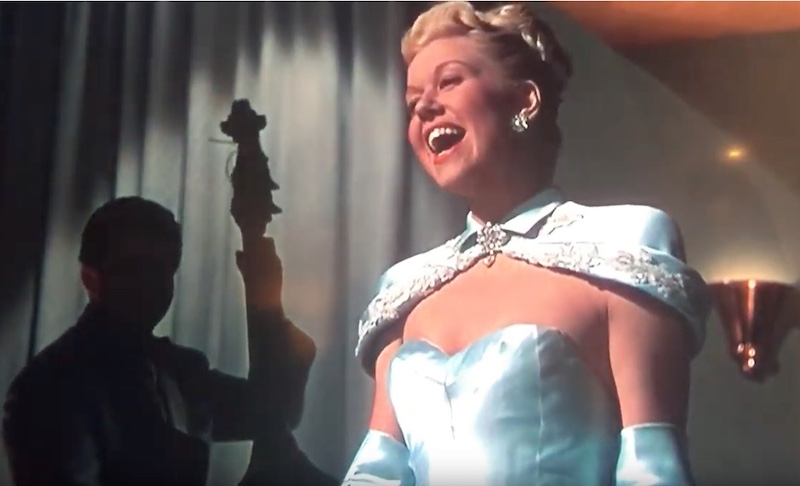
Doris Day wearing a Helen Rose creation as chanteuse Ruth Etting in Love Me or Leave Me.

The story of a nightclub singer's rise to stardom and marriage to a controlling, violent man may have attracted Day because of the parallels to her own life. Singing hopeful Ruth Etting (Day) is spotted in a 10-cents-a-dance joint by Chicago gangster Martin Snyder (James Cagney), whose racket is shaking down nightclub owners under the cover of providing laundry services. Snyder aggressively takes charge of Ruth's career, strong-arming Ruth's way into a job singing a warm-up jingle for a male headliner, and then engineering the headliner's no-show so that Ruth can go on in his place. He peremptorily turns down a booking for Ruth in New York that he doesn't consider prestigious enough, and instead has her go on the radio, where her show becomes a hit. The Ziegfeld Follies are soon calling, and Ruth becomes the toast of Broadway for a time—but finds keeping Snyder at arm's length more and more difficult. 

Snyder's frustration and jealousy are further inflamed by Ruth's musical director Johnny Alderman (Cameron Mitchell), who has made no secret of his attraction to her:

https://youtu.be/5yoHIxAXIlQ?t=10

Ruth gradually comes to return Johnny's feelings, but her career is tied to Snyder. Snyder ultimately coerces Ruth into marriage, resulting in misery for all three.

Just for contrast's sake, here is Ruth Etting herself performing "It All Depends on You"; the uptempo approach typical of its time makes it a little harder to believe her when she sings "I can be sad" or "I can be lonely":

https://youtu.be/nxAC3lONBMA?t=40

As with most Hollywood biopics, the film is a sanitized and glamourized version of real events, and liberties both large (Prohibition and bootlegging are never mentioned) and small (Alderman's actual name was Harry, not Johnny) are taken. Much of the glamour is provided by the gorgeous gowns designed for Day by Helen Rose (of Designing Woman fame), in which she looks smashing. Day surprises by playing Ruth as a woman whose sweet appearance conceals a will of steel, who knows what she wants and goes after it, even at the cost of her own happiness.

Cagney gives a fiercely driven performance as Snyder, the intensity of whose passion for Ruth is never enough to evoke responsive feelings in her. Cagney even manages at times to make Snyder sympathetic in his inability to help himself despite his recognition of the hopelessness of his situation. That hopelessness is emphasized by the nearly quarter-century age difference between Cagney and Day, and amplified by his looking and playing older, and she younger, than their real ages. (The actual Moe Snyder was only three years older than Etting.) 

In addition to the strong script and performances, Day sings a dozen standards, including the title track, "Ten Cents A Dance," "Mean to Me," "I'll Never Stop Loving You," "You Made Me Love You," and a lush version of "Never Look Back."

If I were trying to convince a Doris Day skeptic of her range in both acting and singing, Love Me or Leave Me might be the movie I'd choose.

Pajama Game (1957). Screenplay by George Abbott and Richard Bissell; directed by Abbott and Stanley Donen.

John Raitt (Bonnie's dad) as Sid Sorokin and Doris Day as Babe Williams in Pajama Game.

A hugely successful Broadway show (winner of the Tony Award for Best Musical in 1955), Pajama Game was transferred to the screen with its creative team and cast largely intact—with one key exception. On Broadway the role of Babe Williams was played by Janis Paige, who, when she'd portrayed Elvira Kent in Romance on the High Seas, was billed two spots above Day. As evidence of the different trajectories of their film careers in the succeeding decade, the now far more famous Day was brought in to replace Paige for the movie version. (They would work together again in the 1960 movie Please Don't Eat the Daisies, which this post will pass over in silence.)

Babe Williams (Day) is the head of the union grievance committee at the Sleep-Tite Pajama Company; Sid Sorokin (John Raitt) is the new factory manager. The workers are asking for a 7 and 1/2 cent hourly pay increase, but Sid must enforce the hard line of factory owner Myron Hasler (Ralph Dunn). It's inevitable that despite misunderstandings (and being members of historically opposed classes) Babe and Sid will come to a labor-management accord on both the personal and professional levels. Along the way: choreography by a young Bob Fosse and energetic songs by Richard Adler and Jerry Ross (also writers of the songs for Damn Yankees), including "Steam Heat," "I'm Not At All In Love," and "There Once Was A Man" (actually written by Frank Loesser, according to Raitt).

But in addition to those brassy numbers the show also includes the gorgeously wistful ballad "Hey There":

https://www.youtube.com/watch?v=1FpLgiuv9mU

In retrospect Pajama Game's story of a strike at a garment factory was already outdated. It belonged more to the era of union militancy before WWII than to the 1950s, when unions traded guarantees of labor peace for modest wage and benefit gains. But speaking of being instantly outdated. . .

Pillow Talk (1959)

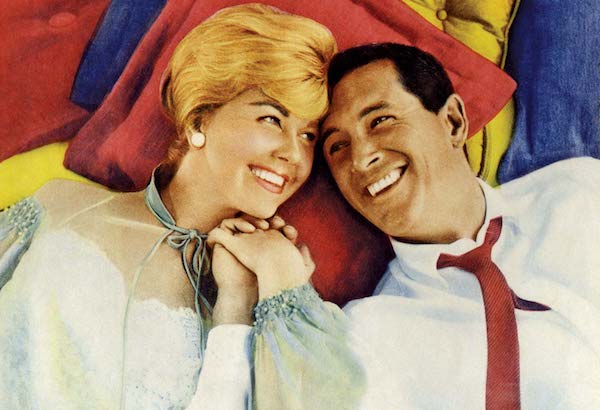
Doris Day as career woman Jan Morrow and Rock Hudson as footloose bachelor Brad Allen in Pillow Talk.

In 1748 Samuel Richardson wrote in the preface to Clarissa Harlowe, or the History of a Young Lady, that he'd written the novel "to warn the inconsiderate and thoughtless of the one sex, against the base arts and designs of specious contrivers of the other. . .[and to caution them against] that dangerous but too-commonly-received notion, that a reformed rake makes the best husband." Evidently Day's character in Pillow Talk, Jan Morrow, never got around to reading Richardson.

Jan is a single woman with a successful career as an interior decorator. Unfortunately for the no-nonsense Jan, she shares a party line with Broadway composer Brad Allen, a playboy who spends most of his daylight hours on the phone sweet-talking his stable of girlfriends. To Jan's great irritation, he not only hogs the line when she needs to make business calls, he also plays for each of his girlfriends the same love song, "Inspiration," which he claims was "written just for you."

One night out at a club Brad overhears a woman complaining about the guy who shares her party line. He recognizes her voice: it's Jan, of course. Brad is instantly attracted, but realizes that if he introduces himself she'll reject him without a second thought. So he puts on a fake (and terrible) Southern accent and pretends to be "Rex Stetson," a millionaire Texas rancher. While Rex is wooing Jan with dinners and late-night phone calls, Brad pretends to have overheard a phone conversation between them on the party line and disparages Rex in order to spur Jan's praise of him. Jan is utterly smitten with Rex, and as they are heading to a weekend in a country cabin together we hear her (surprisingly explicit) thoughts:

https://youtu.be/6AmBP45SKts

But of course she'll ultimately discover that she's been deceived, and will seek her revenge.

I confess that I found Pillow Talk more entertaining than I had expected, despite its paucity of songs for Day (in addition to "Possess Me" there's only the title song and the cringeworthy novelty number "Roly Poly"). But just a few years after its release the movie's social mores would seem like ancient history (and the sources of much of its humor would seem unfunny). Pillow Talk tries to wring comedy out of the predatory Brad's bachelor pad, which features pushbuttons that automatically convert the sofa into a bed and remotely lock the door to prevent a reluctant date's escape. There is also a lot of coded innuendo about "Rex"'s effeminacy (although shouldn't that make us wonder whether Brad's rampant womanizing is just overcompensation?). And finally, even in 1959 it was probably quite a stretch to imagine that two adults who were seeing one another romantically would spend a chaste weekend together in a cozy country cabin, although it must be said that a similar situation occurs in Patricia Highsmith's novel The Cry of the Owl, published three years later.

The gay subtexts of Pillow Talk are made starkly apparent in Mark Rappaport's video essay Rock Hudson's Home Movies (1992), included as an extra on the Criterion Collection DVD of All That Heaven Allows (1955), director Douglas Sirk's melodrama masterpiece starring Hudson and Jane Wyman. It was seeing Rappaport's film that made us curious about Pillow Talk, and ultimately inspired the at-home Doris Day film festival which led to this post; a post on Douglas Sirk may follow soon.

Friday, March 26, 2021

Les Liaisons Dangereuses 1960

Valmont (Gérard Philipe) and Juliette (Jeanne Moreau) in Les Liaisons Dangereuses 1960.
Image source: Paris Cinéma Région

Les Liaisons Dangereuses 1960 (released September 1959), screenplay adapted from the novel by Pierre Choderlos de Laclos by Roger Vailland, Roger Vadim and Claude Brulé; directed by Vadim.

"We must not think that in saying yes to sex one says no to power." (Michel Foucault) [1]

Confirmation of Foucault's insight, should any be needed, can be found in writer/director Roger Vadim's Barbarella (1968), an attempt at a science fiction sex comedy starring his pre-consciousness-raised wife Jane Fonda clad in see-through plastic. Not even successful as camp, Barbarella's reflection of the new sexual mores in society and in cinema in the late 1960s was instantly dated, a textbook example of the voyeuristic male gaze. (And indeed the March 1968 issue of Playboy featured the pictorial "The Girls of Barbarella"; Fonda, by the way, was 30 years old.) It is to the sophomoric Barbarella's everlasting shame that it was released in the same year as Stanley Kubrick and Arthur C. Clarke's 2001: A Space Odyssey. [2]

But a decade earlier Vadim wrote and directed a movie that could be mistaken as a product of the French New Wave. Les Liaisons Dangereuses 1960 is an updating of Pierre Choderlos de Laclos' 1782 novel of aristocratic libertinage to the milieu of the Parisian haute-bourgeoisie in the late 1950s. Vadim seems to have explicitly modelled Liaisons on Louis Malle's Ascenseur pour l'échafaud (Elevator to the Gallows, 1958). Like Malle's film, Liaisons is shot in black and white, stars Jeanne Moreau, and is set to a superb jazz soundtrack (by Thelonious Monk and Art Blakey & the Jazz Messengers in Liaisons, by Miles Davis in Ascenseur).

Valmont (Gérard Philipe in his next-to-last film) and Juliette (Moreau) are a married couple who have reached an understanding. Their mutual sexual spark has died, although apparently it's more extinguished in Juliette than in Valmont, and they each take other lovers. He is open about it, which makes him a target of endless gossip, and Juliette is discreet. She is so discreet, in fact, that many of the couple's friends consider her a model wife, enabling her to use her reputation for virtue as a shield to keep unwanted admirers such as Prevan (Boris Vian) at a distance (at least, until they are useful to her). But although Valmont and Juliette have agreed to sleep with other people, they've also agreed to be completely honest with each other; they have vowed "not to accept the lies that degrade other couples." [3]

Juliette and Cécile (Jeanne Valérie) in Les Liaisons Dangereuses 1960.
Image source: Notre Cinéma

Juliette sets Valmont the task of seducing the virginal teenaged Cécile (Jeanne Valérie). Cécile's parents have been looking to get her married; to get them off her back she has betrothed herself to the wealthy Jerry Court (Nicholas Vogel), who is twice her age. Unbeknownst both to Cécile's parents and herself, Court is one of Juliette's current lovers. Meanwhile, Cécile is in love with another man, college student Danceny (Jean-Louis Trintignant, who was actually closer to Vogel's age than Valérie's). Juliette tells Valmont that she wants him to help her revenge herself on her self-satisfied lover Court: "He thinks he is marrying virtue, but he must marry vice." Her revenge, it turns out, will engulf not only Court, Cécile and Danceny, but ultimately Valmont, and herself.

That Juliette's name is shared with the Marquis de Sade's anti-heroine is no accident. Both characters view sex as the surest, and often for women the sole, means to power. As Angela Carter has written, "[De Sade's Juliette] is a woman who acts according to the precepts and also the practice of a man's world and so she does not suffer. Instead, she causes suffering." [4]

One of the many who suffer at the hands of Liaisons' Juliette is the devout Madame de Tourvel (Annette Vadim, the director's wife; paging Dr. Freud). Madame de Tourvel has also succumbed to Valmont's seductive stratagems, and the adulterous couple are, for a short time, blissfully happy.

Valmont and Madame de Tourvel (Annette Vadim) in Les Liaisons Dangereuses 1960.
Image source: Paris Cinéma Région

But Juliette accuses Valmont of violating their pact, and gives him an ultimatum. He looks on silently as she sends Madame de Tourvel a telegram in his name:

My Angel, one becomes bored of anything, it's a law of nature. Stop. I took you with pleasure and I leave you without regret. Stop. Good-bye. Stop. That's the way of the world. Stop. It's not my fault. Stop. Valmont.

Madame de Tourvel receives the telegram just after she has told her husband that she is leaving him for Valmont; her abrupt abandonment drives her into madness.

The updating of the novel works surprisingly well. To the novel's letters the film adds phone calls, tape recordings, and Juliette's telegram; most of the translations required by the temporal leap forward by nearly two centuries maintain the spirit of the original. Some "modern" touches don't work so well, however. There's a scene where a jazz band (Art Blakey's Jazz Messengers) sends women into an orgiastic frenzy of dancing, like something out of Joseph March's The Wild Party (1928). And Vadim gives a smarmy introduction to the film in which he Explains It All To Us; one of its more memorable lines concerns "young women freed from sex-related social constraints and that burst open, buoyantly, like ripe fruits."

Vadim's introduction suggests that Juliette is escaping the sexual double standard, but in fact she is conforming to it. And we never learn the source of Juliette's desire for vengeance against Valmont, and, indeed, all men (her destruction of the happiness of Cécile and Madame de Tourvel is ultimately aimed at the men in their lives). In Laclos' novel Merteuil tells Valmont that she is "born to revenge my sex and command yours," and goes on to say that "I must conquer or perish." [5] Merteuil's anger at the enforced subordination of women is largely absent from Vadim's film. Instead, we're left to surmise that an earlier betrayal by Valmont is what motivates Juliette's coldness and malice. Merteuil's rebellion against the proscriptions imposed on women by men, portrayed so vividly in Laclos' novel, is replaced by an intramarital power struggle. 

Moreau as Juliette. Image source: Notre Cinéma

Les Liaisons Dangereuses 1960 succeeds on its own terms: it's sleek and chic and has excellent leads in Gérard Philipe and Jeanne Moreau, who are flattered by the gorgeous black-and-white photography of Marcel Grignon. [6] But it could have been much more. That would have required, though, some self-critical reflection on the part of Vadim, whose later career demonstrates that he forever remained a prisoner of the idea that women's sexual freedom should primarily benefit men.


  1. Michel Foucault, The History of Sexuality vol. 1: An Introduction, a translation by Robert Hurley of Histoire de la sexualité: la volonté de savoir (The History of Sexuality: The Will to Knowledge), Pantheon, 1978, p. 157.
  2. Vadim made a specialty of films showcasing the bodies of young actresses who were by pure coincidence his lovers, for example in Et Dieu. . .créa la femme (And God Created Woman, 1956) with his then-wife Brigitte Bardot. Liaisons features a nude scene with Vadim's new wife Annette Strøyberg, who was 9 years his junior and looks remarkably similar to Bardot (blonde hair, wide-set eyes, pouty lips). He would go on to write and direct Le Vice et la Vertu (Vice and Virtue, 1963), a retelling of the Marquis de Sade's Justine featuring his teenaged lover Catherine Deneuve.
  3. Quotes from the screenplay are taken from Roger Vadim's Les Liaisons Dangereuses, screenplay by Roger Vailland, Roger Vadim and Claude Brulé, translated by Bernard Shir-Cliff. Ballantine Books, 1962.
  4. Angela Carter, The Sadeian Woman and the Ideology of Pornography, Pantheon, 1978, p. 79. 
  5. Pierre Choderlos de Laclos, Les Liaisons Dangereuses, 1782, translated anonymously as  Dangerous Connections, 1812, J. Ebers. Letter LXXXI: https://archive.org/details/dangerousconnec00laclgoog/page/n459/mode/1up
  6. Grignon often worked as the cinematographer on films directed by André Hunebelle, including Les 3 Mousquetaires (1953), Le capitan (1960), Les mystères de Paris (1962), Fantômas (1964), and Fantômas contre Scotland Yard (1967).

Thursday, November 3, 2016

In memoriam: Kay Starr


Image of Kay Starr: Memphis Music Hall of Fame

Kay Starr died Thursday in Los Angeles at the age of 94. She was a singer who ignored genre boundaries, singing big band jazz, country (her 1952 hit "Wheel of Fortune" could have been sung by Patsy Cline), and even proto-rock 'n' roll.

In memoriam: From the Rita Hayworth film Down to Earth (1947) the song "Kiss of the Muse," in which the amazing Starr voices Terpsichore (portrayed by the sassy Adele Jergens). They don't, and couldn't, make them like this any more:


Saturday, January 23, 2010

Fred & Ginger Part 4: Shall We Dance and Carefree

7. Shall We Dance (1937): What makes a musical great? If it requires only great music, then Shall We Dance would certainly qualify. Five of the Gershwin songs it introduced have become standards: "Beginner's Luck," "They All Laughed," "Let's Call The Whole Thing Off," "They Can't Take That Away From Me," and the title song. And if great music isn't enough, Shall We Dance combines highlights from several of the earlier Fred & Ginger films. The main plot is similar to The Gay Divorcée (1934). In that film, Ginger pretends to have an affair so she can get a divorce, and over the course of an evening of dancing with Fred really falls in love with him. In this one, everyone thinks that Fred and Ginger are already married; when Ginger wants to marry someone else, she realizes she can only do so by publicly divorcing Fred first—but to do that, they'll have to really get married. The pretend relationship turning into a real one has rich comic possibilities that are better exploited here than in the earlier film—there's an amusing recurring bit with Eric Blore as an unctuous hotel manager locking and unlocking the door between Fred and Ginger's adjoining suites as his understanding of their marital status changes.

There are borrowings from other films in the series, too. Like Follow The Fleet (1936), it has an extended shipboard tap solo for Astaire: here, he dances to "Slap That Bass" in a huge, gleaming Art Deco engine-room set. Unusually for the time, he's accompanied by an all-black band, and the first verse of the song is taken by the bandleader Dudley Dickerson (though in her Fred Astaire and Ginger Rogers Book (1972) Arlene Croce writes that Dickerson's voice was actually that of the similarly uncredited Mantan Moreland). Also as in Follow The Fleet there's a gag dance: Astaire dances to a record of "Beginner's Luck" that keeps skipping (in the earlier film it was Ginger who kept getting stuck while the music played on). And Fred and Ginger's roller-skating duet in the rink in Central Park echoes their dance in the gazebo in Hyde Park from Top Hat (1935).

But if Shall We Dance has such excellent songs and seems at times like a greatest hits collection from earlier Fred & Ginger films, why isn't it more enjoyable? Partly it's because the songs aren't always integrated into the action or narrative—sometimes they just happen. Two examples: "Beginner's Luck" (the vocal version) is sung by Astaire to Rogers on shipboard as they're sailing to America. Astaire is Petrov, the principal dancer in a Ballet-Russe-style troupe headed by Edward Everett Horton. (Petrov, of course, is really an American, Peter P. Peters, who loves jazz.) Petrov agrees to tour with the ballet to New York so that he can take the same ship as a cabaret dancer he's become smitten with, Linda Keene (Ginger). He contrives to meet her every evening when she takes her dog for exercise. He finally manages to get her alone, leans on the railing next to her, and sings "Beginner's Luck." But the mismatch between song and situation—since she clearly doesn't yet reciprocate his feelings, why does he feel so lucky?—is rescued only by the charm of Fred and Ginger. And it ends too soon; as Croce reports George Gershwin writing to a friend, "They literally throw one or two songs away," and here that complaint seems justified.

In their famous Central Park rollerskating number, "Let's Call the Whole Thing Off," Ginger sings to Fred, "You say laughter and I say lawhfter, you say after and I say awhfter..." But it's Fred who has been (inconsistently) putting on an exaggerated accent as Petrov, while the idea that Ginger would say "lawhfter" or "banawhnah" comes from nowhere. And so the joke of having each complain in the same terms about the other doesn't work, in contrast to the similar but much more carefully constructed "A Fine Romance" scene in Swing Time (1937). Fortunately we're immediately distracted from this lyrical non sequitur when Fred and Ginger then launch into their famous dance on roller skates:


One song that does make sense in the context of the story is "They All Laughed." At a nightclub Linda Keene is coaxed into singing, and the song she chooses is about the evident mismatch between her and her goofy fiancé (William Brisbane in the thankless rival-to-Fred role). But as she tries to head back to her table, Fred gets up and coaxes her into dancing—he does some balletic leaps, she answers with a quick burst of tap, he responds in kind, and then they're off. Fred's intervention changes the song: suddenly it's about both the apparent mismatch between ballet and jazz dance styles and between Petrov and Linda themselves, resolving into a beautiful Fred and Ginger duet. Here's a severely truncated version:


Shall We Dance also contains one of their loveliest ballads, sung by Fred to Ginger on a fog-shrouded ferry as they return to New York for their divorce: "They Can't Take That Away From Me". This gorgeous song, though, cries out for a dance duet, which doesn't happen. The movie's finale to the title song is a surreal number with a chorus of women all holding Ginger masks. If Fred can't dance with Ginger herself, he'll dance with an army of women who look like her. But then one of the women behind the masks reveals herself to look uncannily like Ginger...


Ultimately, though, Shall We Dance falls short. I'd make the case that the best Hollywood musical is Singin' In The Rain (1952), even though its Arthur Freed-Nacio Brown songs—while perfectly appropriate to its late-20s setting—don't measure up to the now-classic Gershwin songs in Shall We Dance. What Singin' In The Rain has that Shall We Dance lacks is a compelling story and songs that are integrated with and suited to the action. Despite the Gershwin tunes and some brilliantly staged numbers to showcase them, Shall We Dance proves that when it comes to musicals, a great score isn't quite enough.

8. Carefree (1938). One problem for the Astaire-Rogers films is that they're suspenseless. "The minute the names of Astaire and Rogers go up on the marquee," Croce quotes their producer Pandro Berman as saying, "the audience knows they belong together." So the main problem the screenwriters faced throughout the series was figuring out ways to keep them apart until the happy ending.

In Carefree, that problem was "solved" by having Fred (as the psychiatrist Tony Flagg) hypnotize Ginger (as Amanda Cooper) and plant a post-hypnotic suggestion that she hates him and is really in love with her stolid fiancé Ralph Bellamy (as Stephen Arden). Tony's been brought in on Amanda's case because she's reluctant to marry Stephen (and that's a mystery?). After her consultation with Tony (and eating heaps of rich food that he's prescribed) she dreams that she's in love—but with Tony, not Stephen—in the number "I Used To Be Colorblind." The design of the set and the lyrics of the song seem to indicate that this sequence was intended to be in color, a suspicion that Arlene Croce confirms. The number does offer two striking innovations: the use of slow motion, which beautifully emphasizes the grace of the dance (Ginger seems to be literally floating around Fred), and an extended kiss between Fred and Ginger at the conclusion—perhaps their first kiss in the entire film series (even in "The Continental" from The Gay Divorcée, which urges the participants to "Kiss while you're dancing," Fred and Ginger's lips never meet):


"Colorblind" leads to another unusual number. Throughout the series the typical pattern has been Fred trying to convince Ginger to dance with him; in the novelty number "The Yam" it's Amanda who wants a reluctant Tony to dance with her:


Amanda's obvious infatuation with Tony is what leads to the implanting of the post-hypnotic suggestion that she really hates him. Of course, the rest of the movie involves Amanda acting on that suggestion and Tony desperately trying to remove it. He almost succeeds when he gets her alone at Stephen's country club (to the strains of "Change Partners"), but Stephen interrupts them before it can happen. Tony has one last chance to reach Amanda—on her wedding day...

If this sounds like the plot of a screwball comedy, there's a good reason. The late 30s were the heyday of screwball comedy; the fifteen months since the release of the previous Astaire-Rogers picture, Shall We Dance, had seen the release of The Awful Truth (1937), Holiday (1938) and Bringing Up Baby (1938). And Ginger Rogers, an excellent comedienne, almost carries it off. Alas, the script lets both her and Astaire down. When Tony hypnotizes Amanda, he tells her that men like him "should be shot down like dogs"—a jarringly brutal formulation that she tries to enact when she winds up at a country-club skeet shoot while still under the influence. The violence doesn't end there. To remove the suggestion, Tony has to render Amanda unconscious again, leading to the disturbing final image of—spoiler alert!—Amanda walking down the aisle sporting a black eye. Even if it's Stephen who has inadvertently given it to her, it's an image that simply isn't funny.

—End of spoiler—

Carefree was the last of the Astaire-Rogers comedies; it was followed six months later by the tragic biopic The Story of Vernon and Irene Castle (1939), a movie that has its own charm, but which doesn't really fit with their earlier comedies together. And they then didn't dance together again onscreen for another decade. By then, after a string of Gingerless flops and special appearances in other people's movies, Astaire had retired. But in 1948 he agreed to come out of retirement to take the place of the injured Gene Kelly opposite Judy Garland in Easter Parade (1948). The film was one of the year's biggest hits, and a second Astaire-Garland movie was planned. Only this time it was Garland who was taken off the film after she repeatedly missed rehearsals, to be replaced by...Ginger Rogers.

Interestingly, even though it hadn't originally been conceived as an Astaire-Rogers film, The Barkleys of Broadway (1949) is an homage to their earlier films together and a parody of their rumored offscreen clashes. (Those clashes have been exaggerated; there's nothing to suggest that their professional conflicts—mainly over their mutual ambitions to do films outside the partnership—were ever personal ones.) Together with Easter Parade, The Barkleys of Broadway launched the second phase of Astaire's film career: he went on to star in some of the most beloved musicals of the 1950s, including Royal Wedding (1951), The Band Wagon (1953), Funny Face (1957) and Silk Stockings (1957). Rogers had won an Academy Award as Best Actress for Kitty Foyle (1940); in 1950 Astaire was given a special Academy Award "for his unique artistry and his contributions to the technique of musical pictures" (the presenter was Ginger Rogers). But despite their successes apart, they will be forever remembered for their unique partnership, which can be invoked solely with their first names: Fred & Ginger.

Other posts in this series:

Wednesday, December 30, 2009

Fred & Ginger Part 3: Follow The Fleet and Swing Time

5. Follow The Fleet (1936) is based on Hubert Osborne's play Shore Leave (1922), which was turned into a stage and film musical composed by Vincent Youmans (who later wrote the music for Flying Down To Rio (1933)). The sailors-on-shore-leave plot has been used many times since, including in the Comden-Green-Robbins-Bernstein musical On The Town (stage version 1944, film version 1949).

Follow The Fleet also bears a strong resemblance to the third Astaire-Rogers film, Roberta (1935). Just as in Roberta, Fred's buddy is Randolph Scott; here the two play Navy sailors "Bake" Baker (Fred) and "Bilge" Smith (Scott). Just as in Roberta, Scott is the main romantic lead, while Fred and Ginger are the secondary couple; and just as in Roberta, the story is centered on uniting the main couple in order to save an inheritance (in Roberta, a fashion boutique; in Follow The Fleet, a ship.)

The tone of the movie is set by the first scene on shipboard just before the boys go on shore leave in San Francisco, with Fred singing Irving Berlin's hilarious patter song "We Saw The Sea":

We joined the Navy to see the girls,
But what did we see? We saw the sea.
Instead of a girl or two in a taxi
We were compelled to look at the Black Sea
Seeing the Black Sea isn't what it's cracked up to be.
At the ten-cents-a-dance Paradise Club they separately encounter Bake's old dance partner Sherry Martin (Ginger) and her bespectacled schoolteacher sister Connie (the singer Harriet Hilliard, later of "Ozzie and Harriet" fame). Sherry performs at the club, and we see her sing a great version of "Let Yourself Go" with a backup trio that includes Betty Grable. While Sherry and Bake are getting reacquainted, Connie is getting a makeover from Lucille Ball (in a bit part) and other dancers at the club. When she emerges without her glasses and dressed in one of Sherry's silver-lame gowns, the aptly named Bilge (a love-'em-and-leave-'em type who'd earlier spurned her) suddenly takes notice. Unfortunately, the combination of Scott's callous character and his leaden screen presence make it hard for me to care whether he gets the girl—in fact, Bilge would clearly be bad news for the smart and sincere Connie.

The whole club sequence flows from one incident and number to the next. After her transformation sparks Bilge's interest, Connie sings "Get Thee Behind Me, Satan," a song that would have made more sense in the movie for which it was originally written, Top Hat (1935). In that movie, Ginger's character is trying to resist her attraction to a man she thinks is married; in this one, Connie has done everything she can to captivate Bilge, so it's not clear why she's suddenly singing "I want to resist...I mustn't be kissed." In any case, her resistance evaporates as the song ends, and she leaves the club with Bilge to take him home—and cook him a meal, of course...

Meanwhile, Bake and Sherry return from backstage and inadvertently get involved in a dance contest. Their dance to "Let Yourself Go" is one of their most exhilarating numbers together:


One of the remarkable things about Roberta, one of the models for Follow The Fleet, is that Fred & Ginger's romance is almost an afterthought to the story of Irene Dunne and Randolph Scott. This offhand treatment of the Fred-Ginger romance was corrected in Follow The Fleet, where Bake and Sherry have a number of obstacles to overcome. Bake gets Sherry fired from the Paradise Club and then inadvertently sabotages her audition for a new producer by pouring bicarbonate of soda into her glass of water, thinking he's undoing her rival. Sherry—having performed a terrific tap solo (her only solo dance in the series)—then finds herself hiccuping through a reprise of "Let Yourself Go." In retaliation, Sherry provokes a fight that gets Bake confined to his ship.

All is made right, though, on the night of the big benefit show that Bake and Sherry stage to help Connie salvage her ship. That show involves the improbably elaborate but gorgeous "Let's Face the Music and Dance" production number:


In her Fred Astaire & Ginger Rogers Book Arlene Croce compares Follow The Fleet unfavorably to Roberta; she calls the earlier film "ineffable" and this one "a bore" (p. 96). In my estimation, Roberta has the fatal flaws of forcing us to imagine Randolph Scott as the head of a Parisian fashion house, and forcing us to watch Scott and Dunne (rather than Fred and Ginger) work through all of the romantic complications. Follow the Fleet makes Scott a sailor (a better fit for his he-man persona) and provides a plot for Fred and Ginger, two vast improvements over the earlier film. I find Follow The Fleet, aided by its great Irving Berlin score, to be one of the most exuberant and satisfying of the Astaire-Rogers musicals.

6. Swing Time (1936) has a reputation in some quarters as the neglected masterpiece of the Astaire-Rogers films. Arlene Croce writes "There never was...a greater dance musical" (p. 103).

Hmmm. This is another movie where my opinion diverges from Croce's. For me, Swing Time is something of a letdown after the delights of Top Hat and Follow The Fleet, mainly because the plot is so contrived. Fred is the professional dancer and gambler "Lucky" Garnett, whose pals (including Victor Moore's slow-talking sleight-of-hand specialist "Pop") conspire to keep him from his wedding to Betty Furness' Margaret. They convince him that he has to have his formal pants cuffed; pantsless, Lucky misses the wedding. When he finally gets there he does make a deal with Margaret's father, though—if he can earn $25,000 at gambling, the wedding is still on. (What concerned father would refuse that offer?) Penniless Lucky, still dressed in his wedding outfit of top hat and tails, then hops a freight train to the big city to make his fortune and win the girl, and Pop scrambles on after him.

No sooner do they make it to New York than they (literally) bump into Penny Carrol (Ginger), an instructor at an Arthur Murray-style dance studio. This setup leads to what's admittedly the cutest of their meet-cute scenes, where Fred pretends to be unable to dance in order to take lessons with Penny. She tries to give him the brush-off and is about to be fired for discouraging customers by the prissy owner Eric Blore when Fred gets the idea to show him what he's learned in his first lesson (to Jerome Kern's wonderful "Pick Yourself Up"):


Lucky and Penny decide to form a dance partnership. Much business then ensues involving rival nightclubs and the winning and losing of the contract of Ricardo Romero (Georges Metaxa) and his band, who are apparently the only dance band in New York. To complicate matters, Romero is in love with Penny—like Eric Rhodes' Alfredo Bedini in Top Hat, he's an utterly non-credible rival to Fred. At least this plot line does provide an excuse for Lucky and Penny's audition number, "Waltz in Swing Time." Swing Time is generally praised for how well the songs are integrated with the script, but beautiful as this dance is, it's basically an item number. Unlike "Smoke Gets In Your Eyes" or "Cheek to Cheek" or "Let's Face The Music and Dance," "Waltz in Swing Time" doesn't tell a story about the characters (though when the dance is so enjoyable, who's complaining?).

There's actually another item number in Swing Time: "Bojangles of Harlem," a solo with chorus that Astaire dances in blackface. Croce calls this "the homage...of one great artist to another" (p. 107), and it is surely intended as Astaire's tribute to the great tap dancer Bill "Bojangles" Robinson. And as a dance, it's astonishing—Astaire wears taps on his palms as well as his shoes, and sets up complex counter-rhythms between the music, his feet and his hands. And in the middle section of the number Astaire dances in and out of synchronization with three "shadows" (created by trick photography, not by dancers behind the scrim). But it's hard to get past the blackface thing. While I realize that blackface is a complex cultural phenomenon—even black performers donned blackface—its association with racist stereotypes overwhelms its more nuanced meanings. I have to confess that this sequence, brilliant as it is, is hard for me to watch.

Back to our story, where Lucky vacillates between trying not to earn the $25,000 so he can stay in New York and woo Penny, and acting cool to Penny every time Pop reminds him of his engagement. This push-me pull-you relationship is comically encapsulated in "A Fine Romance," where first Lucky, then Penny (after she learns of his engagement) take turns rebuffing the other (and singing the verse). Penny decides that she's going to marry Romero after all, giving Fred and Ginger the opportunity to dance a beautifully poignant farewell duet together to Kern's "Never Gonna Dance"/"The Way You Look Tonight."

The denouement, though, has to be one of the least convincing in the series. Romero falls for the same, lame "your trousers should have cuffs" gag that prevented Lucky's wedding to Margaret at the beginning of the film. And then Penny, learning of Lucky's now permanently broken engagement, decides amid gales of forced laughter that "There isn't going to be any wedding"—to Romero, at least. To me this scene reeks of the writers' desperation to wrap up the movie, and confirms the truism that watching other people laugh is rarely funny. Fred and Ginger do get a coda, though, where they sing "A Fine Romance" and "The Way You Look Tonight" simultaneously in harmony, as snow falls on New York. A lovely ending to a film that for me—whenever Fred and Ginger aren't dancing, at least—doesn't quite live up to its reputation.

Other posts in this series:

Wednesday, December 23, 2009

Fred & Ginger Part 2: Roberta and Top Hat

As we've proceeded with our re-viewing of the eight 1930s Astaire-Rogers comedies, it's gradually become clear that there are (at least) two templates for their movies. The first, the one we all remember, is outlined in the introduction to Fred & Ginger Part 1. The second template is based on the two-couple conventions of comic opera: there's a leading couple around whom the romantic complications center, and a secondary couple who provide most of the comedy. The surprise in the second type of film is that, even when they're top-billed, Fred and Ginger play the comic secondary couple. As in...

3. Roberta (1935): You'd think that it would have been obvious to everyone how well the Astaire-Rogers star pairing worked in The Gay Divorcée (1934), but for Roberta they were returned to supporting roles. The film was planned before The Gay Divorcée was released, so perhaps that explains the filmmakers' caution in falling back on the Flying Down to Rio formula.

The movie was based on a Jerome Kern stage musical of the same title. As was the usual practice, several numbers from the stage show were cut, and new songs—"Lovely To Look At" and "I Won't Dance," also by Kern—were substituted.

The lovely Irene Dunne gets top billing as Stephanie, the main designer at a glamorous Parisian boutique. When Roberta's owner dies and leaves the shop to her American nephew John Kent (Randolph Scott), he and Stephanie clash at first before they realize they can't live (or run a business) without each other. Stephanie and Kent are the serious romantic couple, and so Dunne doesn't get to give full play to the wonderfully wry comic persona she later displayed in movies like The Awful Truth (1937) and My Favorite Wife (1940). She does sing the Kern classics "Lovely to Look At" and "Smoke Gets In Your Eyes" in a high operatic soprano that, because it doesn't have a hint of jazz in it, sounds like it should be in a different film. The stolid Scott is typecast as an American lunk who gets in over his head in both business and love.

Fred is Huckleberry Haines, leader of the Wabash Indianians dance band. Ginger is Lizzie Gatz, Huck's hometown sweetheart who went to Paris to make her fortune and now performs as the cafe singer "Countess Scharwenka." With Dunne and Scott going through the all the romantic plot twists and misunderstandings, all Fred and Ginger are given to do is banter, sing and dance together, which they do superbly. In "I'll Be Hard To Handle," Ginger sings the song in her "Countess Scharwenka" accent, and then she and Fred launch into a tap routine that reprises the relationship of their characters while it showcases the actors' easy comic rapport (at about 1:35 you can hear them laugh together for a moment over something invisible to us mere mortals):

Delightful as this is, it's their second dance together that's the iconic number from Roberta: the fluid "Lovely To Look At/Smoke Gets In Your Eyes" duet, with the lithe Ginger in a clingy black satin gown and Fred in the white tie and tails that he'd make his trademark in the title number of their next film, Top Hat (1935):

In The Fred Astaire & Ginger Rogers Book Arlene Croce calls this movie "their most ebullient film" (p. 46), and speculates that it's because during the filming of Roberta the super-hit success of The Gay Divorcée was becoming apparent. Whatever the reason, the high spirits evident in this film carry over into at least their next three collaborations, starting with...

4. Top Hat (1935): This was the first of their films to be written specifically for Astaire and Rogers, but it essentially follows the model of The Gay Divorcée—initial antagonism and mistaken identity inevitably being overcome by love. Rogers plays Dale Tremont, friend of Madge Hardwick (Helen Broderick), wife of the theater producer Horace Hardwick (Edward Everett Horton), who is putting on a London show featuring the American song-and-dance man Jerry Travers (Astaire). Got all that?

Dale comes to believe that Jerry is Horace, and so she is outraged by his romantic pursuit of her around London and all the way to Venice (or perhaps I should say "Venice," since no attempt is made to made the Venice locations look like anything other than the huge Art Deco film set that they are). And Dale is very puzzled by Madge's eager matchmaking between her and the man she thinks is Madge's husband. Of course, ultimately the confusion is cleared up, but not before Fred and Ginger sing and dance through some terrific Irving Berlin numbers written for the movie.

Fred's solos to "No Strings (I'm Fancy Free)" (in which he first wakes up his downstairs neighbor Ginger with a tap routine, and then puts her to sleep with a soft shoe reprise), and "Top Hat, White Tie and Tails" (in which he "shoots" a male chorus line with his walking stick), are justly famous. But—no surprise here—I find his duets with Ginger to be the highlights of the film. First is "Isn't This A Lovely Day," where Fred and Ginger conduct a charming courtship dance in a deserted gazebo in the middle of a sudden downpour:

(This scene should look familiar to Bollywood fans, as it's the original to which director/writer Karan Johar is paying homage in Kuch Kuch Hota Hai (1998).)

Fred and Ginger's second dance together is "Cheek to Cheek," which begins with Fred singing "Heaven, I'm in heaven..." Easy to believe when he's dancing with Ginger. This is the number with the famous ostrich-feather dress; according to Croce, it was designed by Rogers herself. It floats around her beautifully, especially when Astaire twirls her, dips her, or lifts her into the air—a suggestion of heaven, indeed, in what is probably their best-known (and perhaps loveliest) duet:

I find the plot of Top Hat to be a bit too thin—is it really conceivable that Dale wouldn't realize her mistake almost immediately, or that she would so readily agree to marry the fop Bedini (Eric Rhodes, of course)?—but I realize that the plot is beside the point. Top Hat is delirious tongue-in-cheek fun, and it was a smash. It's still probably the movie people are most likely to be thinking of when they think of an Astaire-Rogers movie. Amazingly, though—in my humble opinion, at least—they still hadn't reached their peak.

Other posts in this series: