Sunday, February 28, 2016

Christmas noir: Remember the Night


Four years before they appeared as the fatally attracted couple in Billy Wilder's film noir classic Double Indemnity, Fred MacMurray and Barbara Stanwyck co-starred in Remember the Night (1940, directed by Mitchell Leisen, screenplay by Preston Sturges). Up until now I've always thought that the bleakest holiday movie was Frank Capra's It's a Wonderful Life (1946), but Remember the Night manages to be even darker. The DVD cover calls it "a heartwarming holiday classic"; heartwrenching is more like it.

The movie begins a few days before Christmas. Amid the New York holiday throngs, "Lee Leander" (Stanwyck) is arrested for shoplifting an expensive bracelet. [1] It's clear that she does so deliberately and with premeditation—it's not a misunderstanding or a moment of forgetfulness. Despite being caught red-handed, she pleads not guilty and is put on trial. Rising young assistant district attorney John Sargent (MacMurray) is picked to prosecute the case because of his track record of convicting women: he uses his "niceness" to sway juries whose sympathies might otherwise lie with the accused.

We learn during the trial that Lee has a history of thievery, committed under a series of aliases; this is far from her first offense. But with a dramatic closing argument her lawyer is about to get her acquitted when Sargent, seizing on a technical error by the defense, presses for a continuation until after the holidays. Lee, on the verge of freedom, is remanded to spend Christmas and New Year's Eve in jail. Sargent feels a twinge of conscience, and in an impulsive moment of generosity asks bondsman Fat Mike (Tom Kennedy) to bail her out.

Fat Mike brings Lee to Sargent's apartment. He thinks that Sargent has bailed her out in exchange for sex, and she thinks the same thing:
Sargent: "What are you doing here?"
Lee: "I don't know yet, but I've got a rough idea." [2]


After Sargent explains that he isn't expecting any favors, the conversation takes a turn:
Lee: "You mean, I don't have to stay here if I don't want to?"
Sargent (trying to get her to leave): "You most certainly do not."
Lee (after a moment's thought): "Then I'll stay—but I won't be forced."
Sargent: "Hey, now, wait a minute!..."
Lee: "You know, there's nothing so dangerous as a square shooter. If all men were like you there wouldn't be any nice girls left."
It's remarkable that in an era which was governed by the puritanical Production Code, the heroine of Remember the Night—a serial thief who has clearly faced sexual coercion in the past—can frankly express her willingness to sleep with the hero. Stanwyck, of course, often played hardbitten but sympathetic women with complicated histories; it's difficult to imagine any other actress in this role.

One reason Lee is willing to stay is that she has no other place to go: the hotel where she's been staying has locked her out for non-payment (perhaps this was the motive for shoplifting the bracelet). Sargent, though, just wants to get rid of her. He's about to drive back to Indiana to see his mother for Christmas, and Lee is a complication he doesn't need. But then he finds out that Lee grew up just 50 miles away from his home town:
Sargent: "How long since you've been home?"
Lee: "Never."
Sargent: "Why?"
Lee: "I ran away."
Sargent: "Well, I don't know what the circumstances were, of course..."
Lee: "Not so hot."
Sargent tries to give her some reassurance: "Time takes care of those things." (The very next thing we learn is that Lee's father is dead; perhaps time has taken care of some of those things.)

Sargent has a brainstorm: he offers to take Lee back to see her mother for Christmas, and pick her up on his way back. As the sentimental "My Indiana Home" plays in the background (with an uncredited Martha Mears on vocals), Lee—overcome by Sargent's kindness, and feeling a surge of misplaced nostalgia—lets her emotions sway her judgment. As we know from other films noir, that's never a good idea.


After downing a couple of scotches (it's 1940, after all), they hit the road. Our first sign that things aren't going to go smoothly on this trip is that in the middle of the night they encounter a detour, take a wrong turn and wind up stranded in a cow pasture. The next morning a shotgun-toting farmer arrests them for trespassing, destruction of property (his fence), and petty larceny (a thermos of fresh milk), hinting that Sargent has brought Lee across state lines for immoral purposes. They're dragged before the local justice of the peace, where it's clear that the farmer and the justice make a nice supplemental income from wayward travellers. After giving obviously false names, they're facing jail time when Lee tosses a lit match into an overflowing wastepaper basket; in the ensuing chaos they escape. Both literally and metaphorically, Sargent has left the straight and narrow:
Lee: "It must feel kind of funny for you to be a fugitive from justice."
Sargent: "Very funny"...
Lee: "It's better than going to jail, isn't it? I told you my mind worked differently!"
Sargent: "Do you realize that house is probably in flames a mile high?"
Lee: "I hope it is."
Sargent: "Well so do I—but what's that got to do with the morals of the case?"
Lee: "What have morals got to do with it? You've treated me like your sister."
By the time they roll into Lee's home town, night has fallen again, and she's feeling very apprehensive about seeing her mother for the first time in ten years. The dark, gloomy family home does not make her feel less nervous:


And for good reason. What follows is one of the most harrowing mother-daughter confrontations in American film. Ten years has not dimmed the anger of Lee's mother (Georgia Caine) or softened her animosity towards her daughter. By the end of their brief but bitter conversation the tough, cynical Lee is in tears. "I've forgotten how much that woman hates me...and how much I hate her," she says, a line still retains the power to shock.

Sargent realizes that it would be cruel to leave the desolated Lee on her own, and on the spur of the moment he decides that he's going to bring her home with him. Sargent's family is everything that Lee's isn't: warm, welcoming, and nonjudgmental, even after he's revealed to his widowed mother exactly who Lee is, and what awaits them when the holidays are over. Mrs. Sargent (Beulah Bondi) refuses to believe that Lee is a hardened criminal:
Mrs. Sargent: "Do you remember when you took my egg money I was going to buy a new dress with? And then how hard you worked to pay it back when you did understand?"
Sargent: "You made me understand."
Mrs. Sargent: "No, dear. It was love that made you understand."
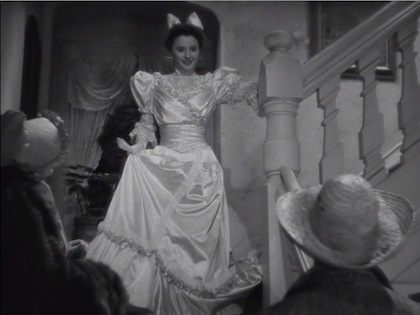
Love was missing from Lee's home, but she finds it in Sargent's. His mother and his Aunt Emma (Elizabeth Patterson) give her acceptance and trust, and she discovers in herself some unexpected yearnings for domesticity. She is falling in love with Sargent and his world, but he's steadfastly oblivious to his own developing feelings. At least, that is, until the night of the "old-fashioned" barn dance on New Year's Eve, when Lee appears in Aunt Emma's old wedding dress:


Up until now, Lee has generally worn black; in a white bridal gown, she appears transformed, and Sargent suddenly realizes how dazzling she is. If their journey together has caused Sargent to bend the laws he is sworn to uphold, it has shown Lee what it might mean to have a loving home and family. As Sturges later wrote of Remember the Night, "love reformed her and corrupted him." [3]

But Sargent is not the only one who is newly aware of his feelings; his mother also perceives them, and is troubled. That night after the dance she visits Lee as she's getting ready for bed. The conversation that follows is devastating, as Mrs. Sargent gently pleads with Lee not to allow her love for her son to destroy everything that he has worked for, and everything he might become. For the second time in the journey, Lee faces the blasting of her hopes, and is left in tears.

On the way back to New York Sargent and Lee drive through Canada. (When asked at the border crossing for his reason for entering Canada, Sargent replies, "I'm a fugitive from justice." The border guard laughs.) At Niagara Falls, Lee tries to convince Sargent that neither of them loves the other. But, if he didn't before, Sargent now knows his true feelings. He spins a fantasy of their marriage and honeymoon:
Sargent: "You know where we're going on our honeymoon? Niagara Falls."
Lee: "Aren't we there now, darling?"


The spectacular falls (even if they are a studio effect) and their association with weddings and honeymoons sweep away the lovers' hesitations for one night. But when they return to New York, reality sets in. As Lee says to Sargent, "People aren't responsible for what they say in Niagara Falls. This is New York, this is today, and this is different." A resumption of her trial awaits.

Sargent now faces a critical choice. If Lee is acquitted, he can marry her, but the marriage would put an end to his career in the D.A.'s office and to his potential future in politics. If he wins a conviction, Lee will be sentenced to jail, and they'll be separated, possibly for years. Of course, Lee also has a critical choice to make, and it turns out that her choice will be decisive...

With its excellent cast, sharp dialogue, and understated direction, Remember the Night has all the ingredients of a Hollywood classic. So why isn't it better known? While its subject matter is pretty dark—a manipulable, corrupt, and unjust legal system; poverty; parental violence and abuse; social stigma—that's also true of other films that are far more famous: Double Indemnity, for one.

Perhaps one issue is Remember the Night's ambiguous ending; we're unsure of the couple's future, although it's clear that the odds are against them. But perhaps another reason this film hasn't quite achieved the same classic status as some of Sturges' other movies is the depiction of Sargent's manservant Rufus. Rufus is dimwitted, cringingly servile, and speaks in broad dialect. Near the beginning of the movie, Sargent's superior calls his apartment, and Rufus answers the phone:
Sargent: "If that's the office tell 'em I've already left."
Rufus: "Yassuh...yassuh....well, if dis is de office he's already lef'."
District Attorney: "Oh, my, no, this isn't his office! You just tell him a young woman wants to make an appointment with him."
Rufus: "It ain't de office...a young woman want to make an appointment wid you." [4]
Etc. The actor who portrayed Rufus was Fred "Snowflake" Toones, listed in the credits only as "Snowflake" (as my partner said after the credits, "I wouldn't want my name associated with that role either"). Toones, a dark-skinned black man—thus the "hilarity" of his stage name—was frequently cast in stereotypical servant, janitor, waiter, or shoeshine boy roles. (It must be noted, though, that his appearance as a cowering club car porter in Sturges' The Palm Beach Story (1942) hasn't seemed to affect the reception of that film.) Toones may have laughed, or seethed, all the way to the bank, but he can't be blamed for the racist caricature he was repeatedly called on to play. His scenes are hard to watch, though, and they mar what's otherwise a bleak masterpiece of Christmas noir.


  1. Stanwyck's character is rarely addressed by name in the movie, and it's clear that Lee Leander is not her birth name. In the trial scene her lawyer calls her "Anna-Rose Malone, sometimes known as Lee Leander," and her mother's name will turn out to be Malone. However, Preston Sturges' script (reprinted in Three More Screenplays by Preston Sturges (University of California Press, 1998) and the film's credits refer to her as Lee Leander, and as we'll see, there are significant reasons beyond her need for criminal aliases for her to have taken on a new identity. The one time that Sargent introduces her, midway through the film, it's highly significant that he calls her by her chosen rather than her birth name.
  2. This and all following quotes except the last one are transcribed dialogue from the film, which differs from the script published in Three More Screenplays by Preston Sturges, University of California Press, 1998. In my view, in every case where there is a difference between the scene as it appears in the film and the published script, the scene as shot is superior.
  3. Preston Sturges by Preston Sturges, Simon & Schuster, 1990, p. 288
  4. Three More Screenplays, pp. 337-338. I've quoted from Sturges' published screenplay so that I can't be accused of exaggerating the representation of Rufus' speech.

Sunday, February 14, 2016

The other Barber of Seville

The composer Giovanni Paisiello at the clavichord,
by Marie Louise Élisabeth Vigée Le Brun, 1791 (detail)

Two hundred years after its first performance, Rossini's Barber of Seville (in Italian, Il barbiere di Siviglia) remains one of the best-known and most-produced operas in the repertory. According to Operabase, in the past five years alone it has received more than 2300 performances in over 500 productions internationally. San Francisco Opera has presented it in four of the past dozen seasons, including two of the last three. Music from the opera crops up in movies (Breaking Away), cartoons (the Bugs Bunny Rabbit of Seville), and commercials.

But the first performance of Rossini's Barber on February 20, 1816 was almost its last. It was a notorious fiasco. The mishaps on stage at the Teatro Argentina in Rome—a singer tripped and gave himself a bloody nose, and a wandering cat upstaged the diva (twice!)—were nothing compared to what went on in the audience. From the first moments of the opera, whistling, catcalls and shouted abuse rained down on Rossini (who was directing from the keyboard) and drowned out much of the music.

What was upsetting to some members of that first-night audience was that another version of Barber already existed. Composed by Giovanni Paisiello in 1782 to a libretto by Giuseppe Petrosellini, the earlier Barber—an adaptation of the first play in Pierre Beaumarchais' Figaro trilogy—was an international hit and audience favorite. First written for the court theater of Russian empress Catherine the Great, it was quickly produced in other European cities such as Naples, Venice, Amsterdam, London, Lisbon and Madrid.

In Vienna in 1783, Paisiello's Barber was seen by a young composer searching for an operatic subject. Inspired by Barber's comic possibilities (and its popularity—it was performed during every opera season in Vienna for five years after its debut), the composer recruited a librettist to write a sequel based on the second play in the Beaumarchais trilogy, The Marriage of Figaro. That composer—Mozart, of course—included several musical allusions to his inspiration, quoting Paisiello's descending three-note motif ("Fiii-ga-ro") in the Figaro overture, and including an amorous serenade (Cherubino's "Voi che sapete") that has striking similarities to Barber's "Saper bramate," seen below:


Count Almaviva is serenading Rosina, the beautiful young ward of the miserly Dr. Bartolo, who keeps her a virtual prisoner in his home. To make matters even worse, Bartolo is planning to marry Rosina against her will. Almaviva, struck by Rosina's beauty, enlists the aid of the canny barber of the opera's title, Figaro, to disguise himself, gain entry to Bartolo's home, and rescue her.

Rosina is attracted to this handsome stranger and desperate to escape the lecherous clutches of Dr. Bartolo. At the close of the first part of the opera she sings "Giusto ciel," a plea to heaven to witness the truth of her affections for the man she thinks is a poor student, and to grant her peace:


The soprano performing Rosina in this recent production from the Teatro Verdi di Sassari is Gabriella Costa.

You may notice a resemblance between "Giusto ciel" and "Porgi amor," an aria for the Countess Almaviva (who is, of course, also Rosina) in The Marriage of Figaro. Again that resemblance is a deliberate evocation of Paisello's opera [1]. Such references, which Mozart and his librettist Lorenzo Da Ponte could assume would be recognized by their audience, created emotional continuity between the characters in Barber and those same characters in Figaro, the events of which take place a few years after those in Barber.

As these excerpts demonstrate, Paisiello's treatment of Barber is less farcical than Rossini's later version. But the high musical quality and humanistic warmth of Paisiello's opera ultimately could not compete against the sheer tunefulness and manic comic energy of Rossini's version. Despite that first-night demonstration against Rossini's opera, it went on to be a success, and within a few years Paisiello's opera was no longer performed. Despite occasional revivals in Europe and two or three (out of print) recordings, Paisiello's opera today remains, unjustly, a rarely-heard obscurity.

Enter West Edge Opera, a tiny Bay Area company with imagination and daring far beyond those of many much larger and richer organizations. Artistic director Mark Streshinsky and musical director Jonathan Khuner once again made virtues of necessity in their semi-staged concert version of Paisiello's Barber (seen February 9). The stripped-down musical forces (violin, cello, oboe and keyboards) and intimate non-traditional venue (the downtown Berkeley roots-music club Freight & Salvage) heightened the work's immediacy. Khuner's witty supertitles and the committed performances of an excellent cast (special mention must be made of Sara Duchovnay's Rosina and Nicholas Nackley's Figaro) made for an evening of sheer delight.

In the opera's finale ensemble, Khuner cleverly interpolated a few bars each of Bartolo's "La Vendetta" from The Marriage of Figaro and Figaro's "Largo al factotum" from Rossini's Barber. The seamlessness with which these musical quotations could be inserted showed just how much the later (and now vastly more famous) composers owed to Paisiello. It was another demonstration of how thoughtfully the WEO artistic team approaches its productions.

WEO's Opera Medium Rare season continues on March 20 (Mills College) and March 22 (Freight & Salvage) with the other La bohème, composed by Ruggero Leoncavallo almost simultaneously with Puccini's version. It will be followed by the company's Summer Festival 2016, featuring Janáček’s The Cunning Little Vixen, Thomas Adés’ Powder Her Face, and Handel’s wickedly cynical Agrippina.


  1. In Mozart's Operas (University of California, 1990) Daniel Hearst has outlined many of the musical and thematic connections between Paisello's Barber and Mozart's Marriage of Figaro, including those between "Giusto ciel" and "Porgi amor."

Sunday, January 31, 2016

Six months with Jane Austen: Sense and Sensibility, inheritance, and money

"Passion subdued by Reason." The Lady's Magazine, March 1795.

This is the first in a series of monthly posts focussing on the social contexts of the six novels Jane Austen prepared for publication. These posts will accompany my own re-reading of the novels, and my hope is that they may inspire your own reading or re-reading. This time: Sense and Sensibility (1811).

Inheritance

Questions of inheritance are central to all of Austen's novels, but are particularly fundamental to Sense and Sensibility. The book opens, in fact, with a description of a will: that of Henry Dashwood's rich uncle.
The old gentleman died: his will was read, and like almost every other will, gave as much disappointment as pleasure. He was neither so unjust, nor so ungrateful, as to leave his estate from his nephew;—but he left it to him on such terms as destroyed half the value of the bequest. Mr. Dashwood had wished for it more for the sake of his wife and daughters than for himself or his son;—but to his son, and his son's son, a child of four years old, it was secured, in such a way, as to leave to himself no power of providing for those who were most dear to him…. [1]
The uncle's estate, Norland Park, is bequeathed to John Dashwood, Henry's well-to-do son by his first wife, as a trustee for his own son.

Why does the uncle bypass Henry in his will? In Austen's England land was economic, social, and political power, and estate owners wanted to ensure that family land, and thus power, would remain intact. Under the principle of primogeniture, the eldest son inherited the vast bulk of the land, houses, and associated income from an estate (although other members of the family could be granted inheritances of cash and securities, personal property, or annual incomes). [2]

In the absence of an eldest son—the rich uncle in Sense and Sensibility is childless—an estate could be bequeathed to a relative (usually male) in a collateral line. After the death of its owner, the estate would be held in trust for the future heir, who would inherit either when he came of age, when he got married, or on the death of an intermediate possessor. That intermediate possessor was prevented from selling any part of the estate or bequeathing it elsewhere. (This is the situation in Pride and Prejudice and Persuasion, where the Bennet and Elliot family estates have been entailed on male cousins.)

A wife did not automatically inherit her husband's property. It was common for her at the time of her marriage to receive a jointure (typically, a life interest in the rental income from a portion of the estate designated to support her after her husband's death). She could only inherit an estate as a freehold if her husband made that provision in his will. There are two wealthy widows in Sense and Sensibility, Mrs. Ferrars and Mrs Smith, both of whom control the disposition of their estates.

Daughters could inherit, and in the absence of a will, entail or settlement they would be considered heiresses if there were no son. But daughters, unlike sons, inherited in common. In Emma, Austen's fourth novel, the heroine Emma Woodhouse and her elder sister Isabella are the co-heiresses of their father's estate, Hartfield. But it was rare for estates to be divided among siblings in this way, because if the practice continued the subsequent generations in each branch of the family would receive smaller and smaller portions of the original estate as it became divided among more and more descendants.

Clearly, the uncle in Sense and Sensibility does not want Norland to be divided among Henry Dashwood's three daughters. Both Henry and his son John apparently receive life tenancies; the true heir is John's son. We're told that "the whole was tied up for the benefit of this child, who, in occasional visits with his father and mother at Norland, had so far gained on the affections of his uncle...as to outweigh all the value of all the attention which, for years, he had received from his niece and her daughters." [3]

As a tenant for life Henry is unable, "by any charge on the estate, or by any sale of its valuable woods," to ensure that his wife and daughters receive an income from the estate after his death. [4] Those with only life interests were forbidden from setting up a jointure ("a charge on the estate") or from selling any part of an estate (including its "valuable woods"). The uncle's estate must be held intact.

So when Henry himself dies—an untimely event which occurs within a year and in the very next paragraph—John, as trustee for his son, receives all the land of the estate and its associated income. (Later in the novel we learn that John plans to cut down a grove of old walnut trees on the estate in order to build a greenhouse. If he were only a life tenant, he would seem to be barred from cutting down trees. However, exceptions were made if trees were to be cut down for either firewood or in the course of "improvements" to the estate, and John portrays the building of a greenhouse and the planting of a flower garden as improvements. We can guess, though, that the greedy John is likely to profit handsomely; walnut was and is a wood highly prized by cabinetmakers.)

Unable to pass on the Norland estate to his wife, Henry could only bequeath his personal property ("china, plate, and linen" [5]) and his personal fortune of £7000. Combined with the daughters' bequests from their uncle of £1000 each, that means that Mrs. Dashwood and her daughters have a total capital of about £10,000. This sum would translate into an annual income of about £500 (exactly how will be discussed in the section "Money," along with the adequacy of this income for a family of the Dashwood's social standing).

On Henry's death John and his family can and do take immediate possession of Norland. Mrs. Dashwood and her daughters Elinor, Marianne and Margaret suddenly find themselves guests in the home that was once theirs, a situation that proves to be anything but comfortable. The Dashwood women are placed in a position of irksome dependency on John and his mercenary and controlling wife Fanny. Mrs. Dashwood and her daughters ultimately find it impossible to continue to live at Norland, and move to Barton Cottage, on the Devonshire estate of their relative Sir John Middleton.

The move separates Elinor from Edward Ferrars, Fanny's brother. Edward has been visiting his sister and her family, and as a result has come to know Elinor. Fanny's harshly disapproving reaction to the discovery of their growing attachment is what precipitates the move from Norland. That move not only disrupts the nascent relationship of Edward and Elinor, it also takes Marianne into the neighborhood of the young, handsome, but rakish gentleman Willoughby, and the older, more upright and more reticent Colonel Brandon. Both men—Willoughby openly, and Brandon silently—fall in love with the vivacious Marianne. The story begins.

Money
"I wish as well as every body else to be perfectly happy; but, like every body else it must be in my own way. Greatness will not make me so."
"Strange that it would!" cried Marianne. "What have wealth or grandeur to do with happiness?"
"Grandeur has but little," said Elinor, "but wealth has much to do with it."
"Elinor, for shame!" said Marianne, "money can only give happiness where there is nothing else to give it.  Beyond a competence, it can afford no real satisfaction, as far as mere self is concerned."
"Perhaps," said Elinor, smiling, "we may come to the same point. Your competence and my wealth are very much alike, I dare say; and without them, as the world goes now, we shall both agree that every kind of external comfort must be wanting. Your ideas are only more noble than mine. Come, what is your competence?"
"About eighteen hundred or two thousand a year; not more than that."
Elinor laughed. "Two thousand a year! One is my wealth! I guessed how it would end." [6]
Money changes everything, as a philosopher once said. And in Sense and Sensibility, the financial standing of every character is known, weighed and discussed openly by the other characters. To make sense of this information, it's helpful to understand something about how, in Austen's day, capital was converted into income, and what differing levels of income might mean. [7]

Austen's novels take place among the landed gentry and the class that historian Alan Everitt has called the "pseudo-gentry": those who were roughly of the same social class as the gentry, such as clergymen, but who did not themselves own estates. These classes typically invested large capital sums in government bonds, the "consols" (for "Consolidated Annuities"), which paid a fixed rate of interest that depended on when they were purchased. The nominal rate of interest on consols was 3%; however, Austen was writing at a time of war, and consols tended to be discounted, sometimes substantially. The cheaper it is to purchase a bond of a particular value, of course, the greater the return. The average return on consols for the first decade of the 1800s was 4.8%. There were also instruments called "Navy 5 percents," which were generally not discounted. [8]

So as an approximate rule of thumb the interest income derived from invested capital would be around 5% of the total. The Dashwood women's combined capital of £10,000 would thus result in an annual income of about £500. How adequate an income was this for a family of four women of the Dashwood's social class? For a partial answer, we can turn to the odious Fanny Dashwood: "...what on earth can four women want for more than that?—They will live so cheap! Their housekeeping will be nothing at all. They will have no carriage, no horses, and hardly any servants; they will keep no company, and can have no expenses of any kind! Only conceive how comfortable they will be!" [9]

Out of this income, the women would have to pay rent on the furnished Barton Cottage (offered "on very easy terms," but not rent-free [10]), purchase food, clothing, and other daily necessities, pay postage, offer presents and alms, and pay the wages of three servants ("two maids and a man" [11], costing together perhaps £50 per year, plus room and board). As Fanny points out, they would not be able to afford to keep horses or a carriage, making them dependent on others (or on paying their way) for travel of more than two or three miles. While the Dashwood women are hardly impoverished, they are certainly facing severely reduced circumstances and increased social isolation.

What about the incomes of the other characters in Sense and Sensibility, and in particular, the beaux of Elinor and Marianne?
Willoughby: "...though Willoughby was independent, there was no reason to believe him rich.  His estate [in Somersetshire] had been rated by Sir John at about six or seven hundred a year; but he lived at an expense to which that income could hardly be equal, and he had himself often complained of his poverty." [12] In his relative "poverty," of course, Willoughby keeps a carriage and carriage-horses, as well as hunting horses and hounds.

Colonel Brandon possesses an estate, Delaford, that helps to generate an income of "two thousand a year without debt or drawback." [13] Brandon keeps horses and a carriage, and can make occasional visits to London. He also has the power of bestowing the Delaford living—that is, a life position as the rector of Delaford parish, which has an accompanying income of about £200 a year.

It was not uncommon at this time to sell livings when they became vacant. John Dashwood is amazed that Colonel Brandon simply gives the living to Edward Ferrars as a gift. As John says, "...for the next presentation to a living of that value—supposing the late incumbent to have been old and sickly, and likely to vacate it soon—he might have got I dare say—fourteen hundred pounds...I wonder he should be so improvident in a point of such common, such natural, concern!" [14]

Edward Ferrars "was the eldest son of a man who had died very rich" [15], and in the ordinary course of events would have inherited the entirety of his father's estate. But we learn that "except a trifling sum [which turns out to be £2000], the whole of his fortune depended on the will of his mother." [16] Two thousand pounds would generate an annual income of about £100 a year—four times the annual income of an ordinary laborer, and twice that of a typical clerk, but not much money on which to maintain one's social standing in the gentry or pseudo-gentry.

Even when Edward receives the Delaford living, which will add £200 to his annual income, in Colonel Brandon's view it "can do no more than make Mr. Ferrars comfortable as a bachelor; it cannot enable him to marry." [17] And although Elinor is quite prepared to marry him anyway, "they were neither of them quite enough in love to think that three hundred and fifty pounds a-year would supply them with the comforts of life" (the additional £50 a year, of course, coming from Elinor's £1000 legacy). [18]

Disinheritance

If an inheritance sets this plot in motion, two disinheritances lead to its resolution. Willoughby is the heir presumptive to the rich Mrs. Smith, an elderly cousin, who owns the Allenham Court estate. But when Mrs. Smith learns that Willoughby has seduced and abandoned Colonel Brandon's niece-in-law and ward Eliza, and is unwilling to marry her, he is "formally dismissed from her favour and her house." [19] Willoughby, no longer heir to Allenham, later confesses to Elinor that he had decided "to re-establish my circumstances by marrying a woman of fortune." [20] The woman he chooses, Miss Grey, has a fortune of £50,000, sufficient to add £2500 a year to his income. He breaks with Marianne, making it possible, after the passage of time, for Colonel Brandon to declare his feelings for her.

And when Mrs. Ferrars learns of Edward's secret engagement to the pretty but penniless, "artful, and selfish" Lucy Steele [21], she disinherits him in favor of his younger brother Robert, who is then "considered as the eldest son." [22] Robert is the immediate recipient of sufficient money to supply him with an income of £1,000 a year, and also has the expectation of inheriting the entire Ferrars estate on the death of his mother.

Robert's income is more than three times that of Edward; this is sufficient to convince the conniving Lucy (who "has next to nothing herself" [23]) to shift her allegiance from Edward to Robert. She works to make Robert attached to her, and once she is secure of him, breaks her engagement to Edward. As soon as he learns that he is free, Edward rides to Barton to propose to Elinor.

In the end, Marianne achieves her competence, and Elinor her wealth. With Colonel Brandon's £2000 a year, Marianne achieves what she considers "a very moderate income...A proper establishment of servants, a carriage, perhaps two, and hunters, cannot be supported on less." [24] And when Mrs. Ferrars relents a bit, and provides Edward with £10,000 on his marriage, it boosts his and Elinor's income to £850 a year—a level at which they may be able to afford a carriage, but at the least secure many of the "comforts of life."

And as for Lucy Steele? "The whole of Lucy's behaviour in the affair, and the prosperity which crowned it, therefore, may be held forth as a most encouraging instance of what an earnest, an unceasing attention to self-interest, however its progress may be apparently obstructed, will do in securing every advantage of fortune, with no other sacrifice than that of time and conscience." [25]

Next time: Pride and Prejudice and the marriage market
Last time: Six months with Jane Austen: The plan

Other posts in the "Six months with Jane Austen" series:


  1. Jane Austen, Sense and Sensibility, Volume I Chapter i; Chapter 1. (References to Austen's novels will be given both by volume and chapter and by sequentially numbered chapters, so that they can be found in many editions; of course, quotations can also be found by a Google search.)
  2. This and the subsequent discussion of English inheritance law is indebted to Eileen Spring's Law, Land, and Family: Aristocratic Inheritance in England, 1300 to 1800 (University of North Carolina Press, 1993). I alone, however, am responsible for any misunderstanding or misrepresentation of the texts I cite. 
  3. Austen, Sense and Sensibility, I. i.; 1.
  4. —, Sense and Sensibility, I. i.; 1.
  5. —, Sense and Sensibility, I. ii.; 2.
  6. —, Sense and Sensibility, I. xvii.; 17.
  7. This and the subsequent discussion of the economics of the gentry and pseudo-gentry in Austen's time is indebted to Edward Copeland's Women Writing About Money: Women's Fiction in England, 1790-1820, Cambridge University Press, 1995.
  8. Robert D. Hume, "Money in Jane Austen." The Review of English Studies, New Series (2013), Vol. 64, No. 264, pp. 289-310. doi: 10.1093/res/hgs054
  9. —, Sense and Sensibility, I. ii.; 2.
  10. —, Sense and Sensibility, I. iv.; 4.
  11. —, Sense and Sensibility, I. v.; 5.
  12. —, Sense and Sensibility, I. xiv.; 14.
  13. —, Sense and Sensibility, II. viii.; 30.
  14. —, Sense and Sensibility, III. v.; 41
  15. —, Sense and Sensibility, I. iii.; 3.
  16. —, Sense and Sensibility, I. iii.; 3.
  17. —, Sense and Sensibility, III. iii.; 39.
  18. —, Sense and Sensibility, III. xiii.; 49.
  19. —, Sense and Sensibility, III. viii.; 44.
  20. —, Sense and Sensibility, III. viii.; 44.
  21. —, Sense and Sensibility, II. i.; 23.
  22. —, Sense and Sensibility, III. v.; 41.
  23. —, Sense and Sensibility, III. i.; 37.
  24. —, Sense and Sensibility, I. xvii.; 17.
  25. —, Sense and Sensibility, III. xiv.; 50.

Sunday, January 24, 2016

Whole lives: Carrie Brownstein, Patti Smith, and Elvis Costello

Carrie Brownstein, Hunger Makes Me A Modern Girl (Riverhead Books, 2015)


Carrie Brownstein was and is a guitarist and vocalist in Sleater-Kinney. Her excellent memoir Hunger Makes Me A Modern Girl—the title is taken from a song on the 2005 album The Woods—will draw you in even if, like me, you can't quite be described as a fan of the band (although by the time you finish it you probably will be).

It is about much more than being a fairly famous performer. Brownstein offers moving accounts of what it was like to grow up in the 70s and 80s in a suburban family with deeply hidden emotional fissures; to find music as a refuge, as a solace, as an escape, and as a means of expression; to enter the adult world with deep uncertainty about your future and purpose; to try to find like-minded people as friends, partners, mentors, and co-creators; and to struggle to hold on to what you've achieved while at the same time allowing yourself and your partners room to grow and change.

Of course, there is plenty of vivid detail about grungy practice spaces, the grind of travelling in drafty vans and sleeping on people's floors, and the terror and exhilaration of standing up in front of an audience to play. For those who have romantic notions of what touring in a rock band is like, Brownstein's book will be a sobering reality check.
In 2000, Greil Marcus named us the best rock band in America in Time magazine...Here we were, "America's Best Rock Band," unloading our equipment that had been shipped home from overseas, that we'd just picked up from the airport by ourselves: drums, amps, road cases. We did not even have the help of a friend or crewmember to carry everything out of our van and into Janet's basement, down rotted steps with very low headroom. You had to duck or you'd give yourself a concussion. "Best Band in America" and my back is about to go out again because I'm carrying a sixty-pound amp into a practice space the size of a pantry in which Janet's aged marmalade cat had sprayed multiple times. It smelled like piss and dryer sheets. This was us having "made it!"
Brownstein leaves no doubt, though, that it can all be worth it for a transcendent moment making music. At the end of the book, describing how it felt to step onstage for the opening show of the tour for the first Sleater-Kinney album in a decade, 2015's No Cities to Love, she writes, "I was home."


Patti Smith, M Train (Knopf, 2015)


M Train is Patti Smith's deeply personal memoir covering the period from her move to Detroit in 1980 up to the present. In its format and associative structure it is clearly influenced by W. G. Sebald's unclassifiable works such as Rings of Saturn, but like Smith's great cover versions of songs by other artists, it emerges as something uniquely her own, expressed in her own unmistakable voice.

In the time period covered by the book Smith lost the love of her life, Fred Smith, and her brother Todd; re-emerged as one of the most compelling performers you will ever have the privilege to see; and watched as her beloved New York City was devastated by Hurricane Sandy and struggled to recover. But to focus on the external events it describes is to miss the flavor of this reflective and intimate book.

M Train is the perfect companion volume to Smith's previous memoir, the brilliant Just Kids (Ecco, 2010). That book describes her first move to New York in the late 60s, her chance encounter with Robert Mapplethorpe, and the development of their transformative artistic and personal partnership. In my post "Favorites of 2010: Books," I wrote that "Just Kids is written in an autodidact's style which is direct, genuine, unsentimental, at times incantory, and like her music, utterly compelling." The same can be said of M Train.

Patti Smith performing Bob Dylan's "Changing of the Guard" from Twelve (my favorite rock recording of 2010):


Elvis Costello, Unfaithful Music & Disappearing Ink (Blue River Press, 2015)


In addition to borrowing his sartorial style from Buddy Holly—the horn-rims, the suits and ties—1970s-era Elvis Costello also adopted Holly's concise songwriting style. Back then Costello wrote fierce two- and three-minute songs which didn't need to be longer, and which would have been less effective if they were.

His biting, bitter lyrics were so dense with wordplay that their manifest meaning was sometimes anything but straightforward. The latent meaning, though, was always clear: Costello himself memorably said in an early interview that his songs were all about "revenge and guilt," although "resentment and anger" might be equally true.

The gift for the telling detail seems to have abandoned Costello almost entirely when he sat down to write his memoir, though. This rambling, confusingly arranged book would be twice as good if half its ink had really disappeared. But of course, as his incredible creativity in the period 1977-1982 (in 1980 alone he released 40 songs in the US), various nasty drunken comments, and many ill-advised choices show, Costello famously lacks an internal editor; it's just unfortunate that his publisher couldn't supply him with an external one.

Of course, brevity has its limitations (that could almost be an Elvis Costello lyric), and we can be glad that Costello has occasionally allowed himself a more expansive canvas, as on 1982's Frank Sinatra-Nelson Riddle influenced Imperial Bedroom. But my admiration for Costello did anything but grow after spending 670 pages in his sometimes enjoyable, sometimes annoying, sometimes evasive, and sometimes tedious company. As he writes with self-lacerating wit (on page 372), "The trouble with finishing any autobiographical tome like this is that for every mildly diverting tale or precious memory, you eventually arrive at this thought: I don't much care for the subject." It's a feeling the reader may come to share.

As someone once almost said, you may feel I'm unkind, but I'm being as nice as I can.

A blast from the past: "Lipstick Vogue" from the furious This Year's Model (1978):


Saturday, January 9, 2016

Favorites of 2015: Bollywood song picturizations

In this coda to my "Favorites of 2015" series I'm going to count down my five favorite Bollywood song picturizations from films released in 2015. This is a little bit different from a list of my favorite songs, although of course a good picturization needs to start with a good song. It's also definitely not a list of songs from my favorite films. I've only seen two of the films on this list: one (Tanu Weds Manu Returns) was distinctly lacking and the other (Dilwale) was almost wholly misconceived. But these are the picturizations that best combined inventive or spectacular settings, appealing actors, and, yes, good tunes:

5. "Ghani Bawri," Tanu Weds Manu Returns (starring Kangana Ranaut, R. Madhavan, and Kangana Ranaut, directed by Anand Rai, music by Krsna Solo, lyrics by Raj Shekhar, sung by Jyoti Nooran)

In "Favorites of 2015: Bollywood" I named TWMR as "the sequel most in need of a sequel." But "Ghani Bawri," powered by Jyoti Nooran's vocals and Kangana Ranaut's compelling performance(s), is a song I never tire of watching. To set the scene, Tanu (Ranaut) is crashing the wedding of her ex-husband Manu (Madhavan) and his new bride Kusum (a much younger woman who looks suspiciously similar to Tanu—does this seem like a good idea?):


4. "Gulaabo," Shaandaar (Fabulous, starring Alia Bhatt, Sanah Kapoor, and Shahid Kapoor, directed by Vikas Bahl, music and lyrics by Amit Trivedi, sung by Vishal Dadlani and Anusha Mani)

I have no idea how or whether the carnival/smugglers setting and Alia Bhatt's very cute drag king act fit into the plot of Shaandaar, but of course, it doesn't matter—"Gulaabo" is offbeat and lots of fun:


3. "Prem Ratan Dhan Payo," Prem Ratan Dhan Payo (A treasure called Prem (Love), starring Salman Khan and Sonam Kapoor, directed by Sooraj Barjatya, music by Himesh Reshammiya, lyrics by Irshad Kamil, sung by Palak Muchhal)

On Namaste America's survey of most-requested songs from 2015 this morning (the program which inspired this post), host Obaid Kadwani could barely contain his sneer at this "throwback to the 90's." Sorry, but if "throwback" means beautiful settings and costumes, spectacular dancing (surprisingly well executed by Sonam Kapoor, who is not known for her grace on the dance floor), and the traditionally-flavored music by Reshammiya (with vocalist Palak Muchhal uncannily channeling Shreya Ghoshal), then I say bring on more throwbacks:


2. "Pinga," Bajirao Mastani (starring Priyanka Chopra, Deepika Padukone, and Ranveer Singh, directed by Sanjay Leela Bhansali, music by Bhansali, lyrics by Siddharth–Garima, sung by Shreya Ghoshal and Vaishali Made)

Okay, this song really is a throwback—to the astonishing "Dola Re Dola" from Devdas (2002). But who cares? While neither Chopra nor Padukone may quite be at the level of Madhuri Dixit or Aishwarya Rai in Bhansali's earlier film, they are two of the best dancing actresses in Bollywood, filmed in the sweeping style that Bhansali has made his trademark. A song as gorgeous as this one is all the justification needed for self-borrowing:


1. "Gerua," Dilwale (Brave Heart, starring Kajol and Shah Rukh Khan, directed by Rohit Shetty, music by Pritam Chakraborty, lyrics by Amitabh Bhattacharya, sung by Antara Mitra and Arijit Singh)

The movie is a loud, violent, incoherent mess. DIrector Rohit Shetty and writer Yunus Sajawal should be ashamed for providing a such a weak platform for the reunion of SRK and Kajol (the movie could easily lose every scene in which they don't appear together). But this song offers breathtaking—and scary, because there's little or no bluescreen CGI involved (as you can see in the "making of" video linked below)—natural settings, lush music, and the legendary chemistry between the two stars:


This song also has the best "making of" video ever; too bad the gentle humor and emotional warmth so evident in this short were not used as a model for the rest of the film.